](https://deep-paper.org/en/paper/2506.20553/images/cover.png)
Introduction: The “Expensive Robot” Problem
Imagine you have developed a new planning algorithm for a self-driving car. You are confident it works, but before you can deploy it to a fleet of vehicles, you need to answer a critical question: How safe is it, really?
To statistically guarantee safety, you might need to test the vehicle over millions (or even billions) of miles. Doing this entirely in the real world is feasible for almost no one—it is prohibitively expensive, time-consuming, and potentially dangerous if the system fails.
Naturally, robotics engineers turn to simulators. Simulators are cheap, fast, and safe. You can run thousands of scenarios overnight. But there is a catch: the “Sim-to-Real” gap. No matter how good your simulator is, it is never a perfect replica of reality. If your simulator says the car is safe, but the physics engine doesn’t perfectly model tire friction, your real-world metrics might be completely different.
So, we are stuck between a rock (expensive real-world testing) and a hard place (untrustworthy simulations).
In a recent paper titled “Sim2Val: Leveraging Correlation Across Test Platforms for Variance-Reduced Metric Estimation,” researchers from NVIDIA, Harvard, and Stanford propose a clever statistical bridge between these two worlds. They introduce a framework that allows engineers to use cheap simulation data to “correct” and improve the estimates derived from sparse real-world data. The result? You can achieve high-confidence performance estimates with significantly fewer real-world tests.
The Core Concept: Don’t Replace Real Data, Augment It
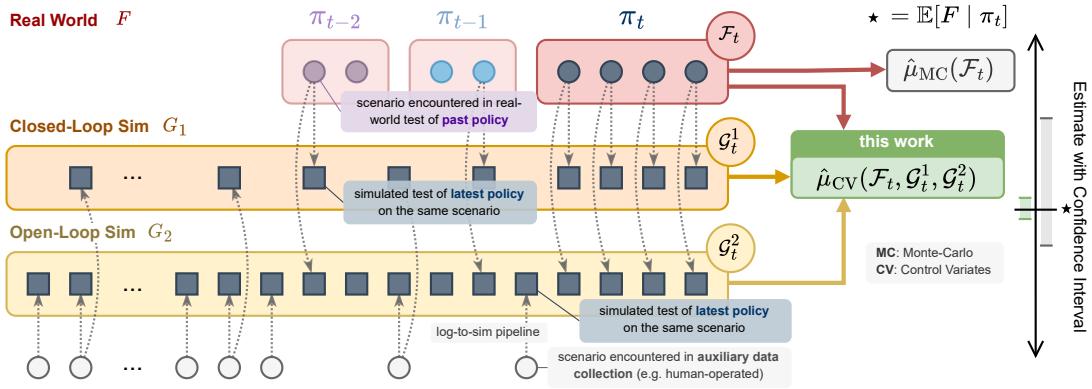
The intuition behind Sim2Val is not to replace real-world testing entirely, nor is it to blindly trust the simulator. Instead, the goal is to leverage the correlation between the simulator and the real world.
Even if a simulator isn’t perfect, it is often directionally correct. If a driving scenario is difficult in the real world, it is likely difficult in the simulator. If a robot trips over a specific terrain in reality, it likely struggles with it in simulation too.
Sim2Val uses a statistical technique called Control Variates. The method uses a small amount of “paired data” (the same scenario run in both reality and simulation) to understand the relationship between the two. It then uses a massive amount of “unpaired data” (simulation only) to reduce the variance of the real-world performance estimate.
The Setup: Paired vs. Unpaired Data
To make this work, the researchers define two types of datasets:
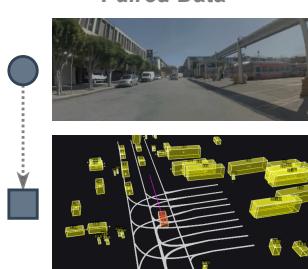
- Paired Data (\(D_{paired}\)): You run a set of \(n\) scenarios in the real world to get the “true” metric \(F\), and you run the exact same scenarios in the simulator to get a surrogate metric \(G\). This is expensive because it requires real-world testing.
- Surrogate Data (\(D_{surrogate}\)): You run a massive set of \(k\) additional scenarios only in the simulator. This is cheap and fast.
The Mathematical Engine: Control Variates
The goal is to estimate the true mean performance \(\mu\) (e.g., the average safety score or velocity error).
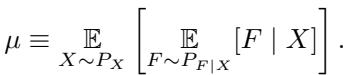
The standard way to estimate this is the Monte Carlo (MC) estimator, which is just a fancy term for taking the average of your real-world samples.

The problem with \(\hat{\mu}_{MC}\) is variance. If you only have a few real-world samples, your calculated average might be far off from the true average. To shrink that error bar (variance), you typically need to increase \(n\) (collect more real data), which costs money.
Enter the Control Variate Estimator
Sim2Val introduces a correction term based on the simulation data. Here is the estimator equation:

Let’s break this down in plain English:
- Term 1: The average of your real-world metrics (the standard MC estimate).
- Term 2: A “correction” based on the difference between the simulation results on the paired data versus the simulation results on the massive unpaired dataset.
Think of it this way: Suppose you are testing a robot. You run 5 tests in the real world and the same 5 in the simulator.
- The simulator average for these 5 tests is Score 80.
- But you also run 1,000 other tests in the simulator, and the global simulator average is Score 70.
This tells you that your 5 specific test cases were easier than average (since 80 > 70). Therefore, your real-world results for those 5 tests are likely “optimistic” as well. The Control Variate equation uses this insight to subtract a portion of that optimism, giving you a more accurate estimate of the true real-world performance.
The “magic number” \(\beta\) determines how much you should trust this correction. The optimal \(\beta\) depends on how strongly the simulation correlates with the real world:

If the correlation is zero, \(\beta\) becomes zero, and you revert to the standard real-world average. If the correlation is high, \(\beta\) adjusts your estimate significantly, drastically reducing variance.
Variance Reduction and Sample Efficiency
The theoretical beauty of this approach is that it is guaranteed to lower variance (or at worst, stay the same). The variance of the Sim2Val estimator is:

Notice the term \((1 - \rho^2)\). \(\rho\) represents the correlation between Sim and Real. As correlation approaches 1 (perfect simulation), the variance approaches 0. This means you need fewer real-world samples to achieve the same confidence interval.

This equation (\(n_{min}\)) calculates exactly how many paired samples you need to match the confidence of a much larger real-world dataset.
When Simulation is “Bad”: The Metric Correlator Function
What if your simulator is not very good? If the raw correlation between Sim and Real is low, the Control Variate method won’t help much.
The authors propose an enhancement called the Metric Correlator Function (MCF). Instead of using the raw simulator output \(G\) directly, they train a neural network (the MCF) to predict the real-world metric \(F\) based on the simulator output \(G\) and scenario features \(X\).
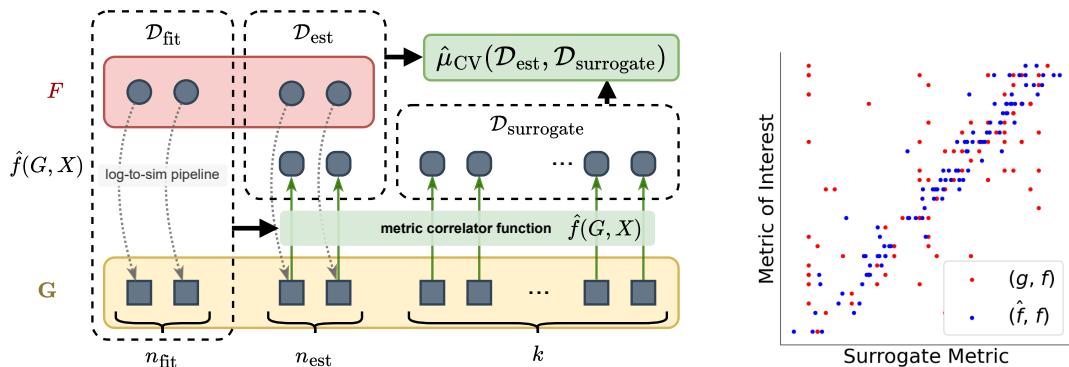
By transforming the raw simulation data through this learned function, we create a new “synthetic” metric that correlates much better with reality.
- Split your paired data into a “fitting” set and an “estimation” set.
- Train the MCF on the fitting set to map Sim \(\rightarrow\) Real.
- Use the MCF’s predictions as the Control Variate for the estimation set.
This technique allows Sim2Val to work effectively even when the simulator has systematic biases or low fidelity, provided the relationship is learnable.
Experimental Results
The researchers validated Sim2Val across three distinct domains: autonomous driving simulation (NuPlan), real-world driving logs, and a quadruped robot.
1. NuPlan: Open-Loop vs. Closed-Loop
In this experiment, “Real World” was represented by expensive Closed-Loop simulation (reactive agents), and “Simulation” was represented by cheap Open-Loop simulation (non-reactive).
The results showed that as the number of cheap unpaired samples (\(k\)) increased, the variance of the estimate dropped significantly.
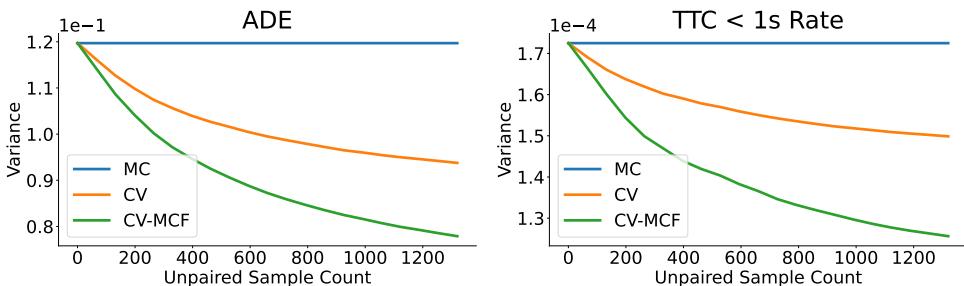
In Figure 4, look at the Green Line (CV-MCF). It drops well below the Blue Line (Standard Monte Carlo). This gap represents money and time saved. The authors found that for some metrics, they could reduce the required sample size by over 50%.
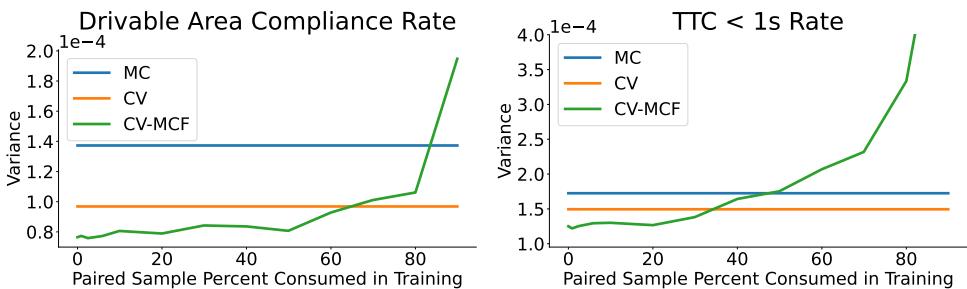
They also analyzed how much data is needed to train the MCF. Figure 5 shows that using some paired data to train the correlator (increasing the x-axis) reduces variance, but you have to balance it against saving data for the final estimation.
2. Real-World Autonomous Driving
Using real logs from an autonomous vehicle, they tested the method on metrics like “distance to nearest vehicle” and “lane centering.”
Because the simulator used here (a neural reconstruction simulator) was high-fidelity, the raw correlation was already high (\(\rho > 0.9\)). Consequently, Sim2Val achieved massive variance reductions—up to 82.9%. This implies that for certain validation tasks, you would need almost 6x fewer real-world driving hours to verify performance.
3. Quadruped Velocity Tracking
Finally, they tested a quadruped robot. The goal was to track a target velocity. Here, the physics simulator was not perfectly aligned with the real hardware, resulting in a very poor raw correlation (\(\rho \approx 0.07\)).
Standard Control Variates failed here because the simulator wasn’t predictive enough. However, by applying the Metric Correlator Function (MCF), they raised the correlation to 0.61. This allowed them to reduce the variance and achieve a tighter confidence bound, proving that the method works even with imperfect simulators.
Budget Allocation: What should you buy?
A practical question for any engineer is: “I have a budget of $10,000. How many real tests vs. sim tests should I run?”
The paper provides an optimization framework for this. The heatmaps below show the optimal mix of paired (\(n\)) and unpaired (\(k\)) samples for different cost ratios and correlations.
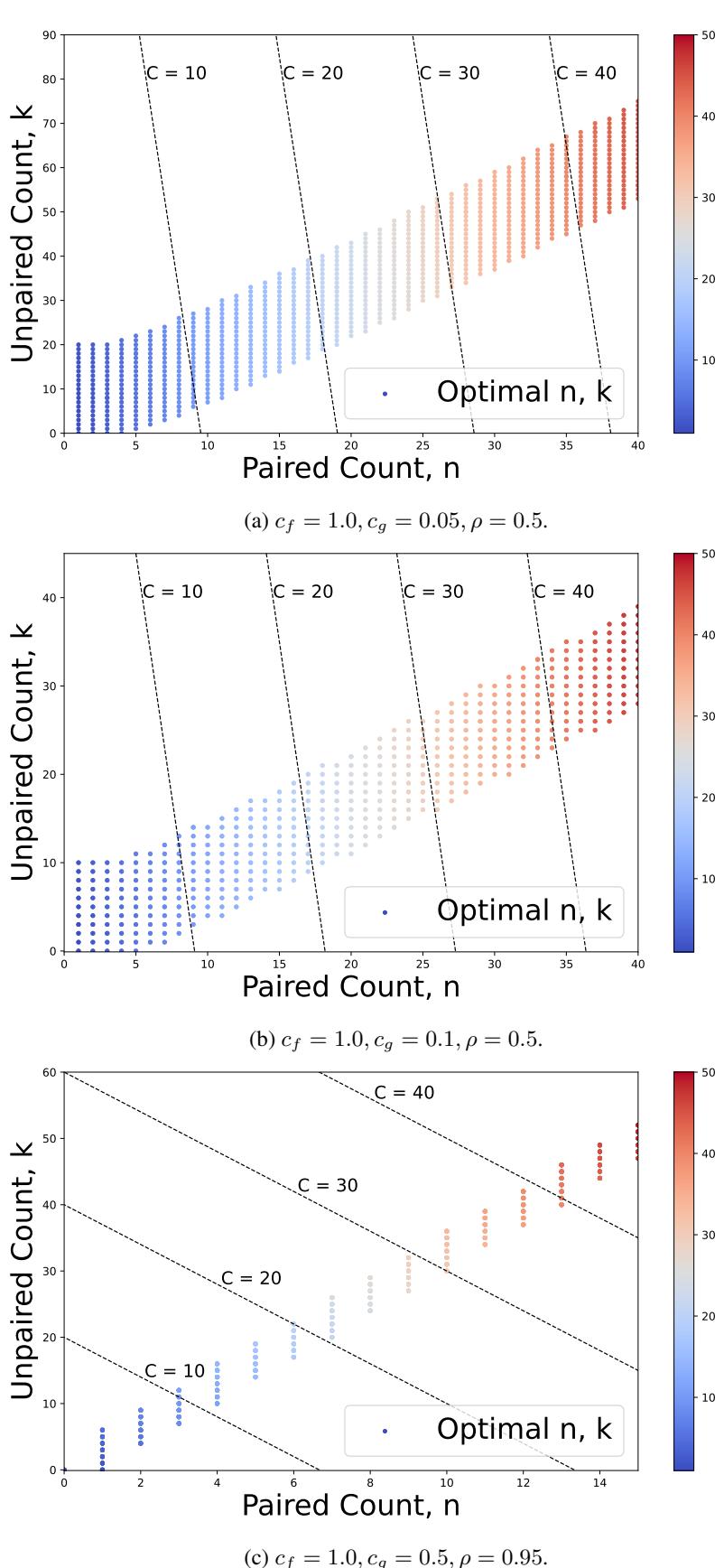
- Left (a): When real-world tests are cheap-ish, you do a mix.
- Right (c): When correlation is very high (\(\rho=0.95\)), you should aggressively prioritize cheap simulation samples (high \(k\), low \(n\)), because the simulator is a trustworthy proxy.
Conclusion
Sim2Val offers a rigorous, statistically grounded way to validate robotic systems. It acknowledges a fundamental truth in robotics: simulations are imperfect, but they contain valuable signal.
By treating simulation outputs as control variates—and enhancing them with learned correlator functions—engineers can mathematically “subtract” the noise and bias from their real-world estimates.
Key Takeaways:
- Don’t discard the simulator: Even if it’s biased, it reduces variance if correlated.
- Paired data is gold: A small set of real-world tests matched with simulations unlocks the value of massive simulation libraries.
- Learn the gap: If the simulator is bad, use machine learning (MCF) to learn the translation from Sim to Real, then use that for validation.
For the future of autonomous vehicles and robotics, techniques like Sim2Val are essential. They move us away from the brute-force approach of “drive 10 billion miles” toward a smarter, more efficient validation paradigm.