](https://deep-paper.org/en/paper/2506.23126/images/cover.png)
Imagine you are trying to sweep a pile of sand onto a dustpan using a brush. As you move the brush, you intuitively predict how the sand particles will flow, cascade, and settle. You don’t need to calculate the trajectory of every single grain consciously; you have a “world model”—an internal physics engine—that helps you plan your actions to achieve the goal.
For robots, developing this kind of intuition is incredibly difficult, especially when dealing with mixed materials. Pushing a rigid box is one thing; manipulating a soft rope that is sweeping granular material (like sand) is entirely different. The robot needs to understand how the rope deforms and how that deformation transfers force to the sand.
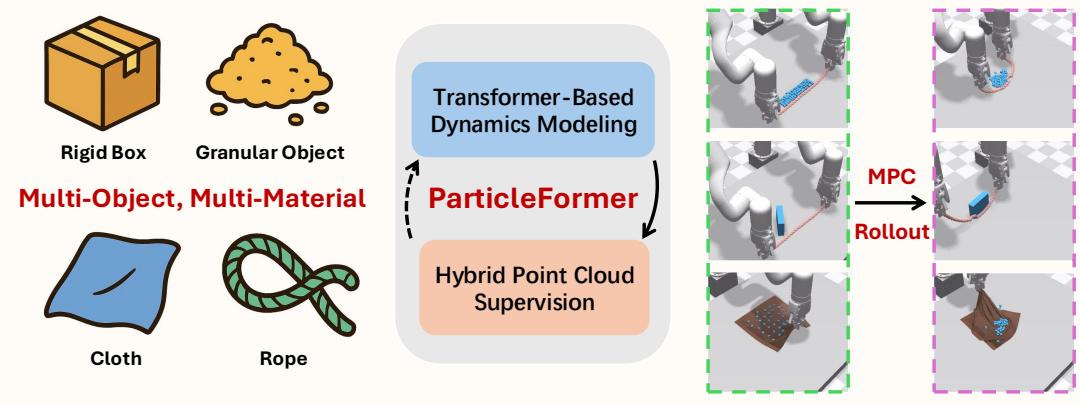
In this post, we are diving deep into ParticleFormer, a new research paper that proposes a Transformer-based world model. This model treats the world as a collection of particles and uses attention mechanisms to predict complex, multi-material interactions directly from visual data.
The Problem: Why is Robot Physics so Hard?
To plan complex tasks, robots use World Models. These are neural networks that take the current state of the world and a proposed action, and then predict what the next state of the world will look like.
\[ x _ { t + 1 } = f ( x _ { t } , u _ { t } , M ) . \]
As shown above, the goal is to learn a function \(f\) that takes the current state \(x_t\), the robot’s action \(u_t\), and material information \(M\), to output the next state \(x_{t+1}\).
Historically, there have been two main approaches to this, but both have significant limitations:
- Graph-Based Neural Dynamics (GBND): These models represent objects as particles connected by a graph. They use Graph Neural Networks (GNNs) to pass messages between neighbors to simulate physics.
- The Flaw: They are brittle. You have to manually tune parameters like “how close must particles be to connect?” (adjacency radius) or “how many neighbors can a particle have?” (TopK). If you get these wrong, the simulation breaks. They also often require expensive 3D reconstruction to train.
- 2D Image Models: These models (like video generation models) predict the next frame of a video pixel-by-pixel.
- The Flaw: They lack 3D understanding. Predicting pixels isn’t the same as understanding geometry. They struggle with the precise spatial reasoning needed to, say, fit a peg in a hole or pour liquid into a cup.
ParticleFormer bridges this gap. It operates in 3D space using point clouds (like GNNs) but replaces the rigid graph structure with the flexible Transformer architecture (like Large Language Models).
The ParticleFormer Architecture
The core insight of ParticleFormer is that we shouldn’t force particles into a fixed graph structure. Instead, we should let a neural network learn which particles interact with which, regardless of distance or material type.
1. From Vision to Particles
The process begins with the robot looking at the scene. Using stereo cameras (which provide depth), the system creates a 3D point cloud of the environment.
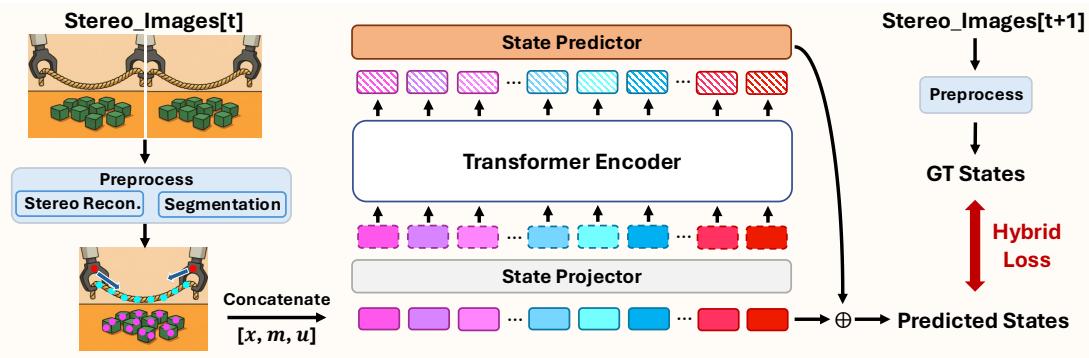
As illustrated in the overview above, the system segments the object of interest (using tools like Segment Anything) and extracts a set of particles.
For every particle \(i\) at time \(t\), the model constructs a feature vector. This isn’t just the XYZ position; it’s a rich embedding that combines:
- Position: Where is the particle?
- Material: Is it rigid, cloth, or granular sand? (Encoded as a one-hot vector).
- Motion: How is the particle moving? (Specifically for the robot’s end-effector).
This information is projected into a latent representation \(z_t(i)\):

2. The Transformer Backbone (Dynamics Transition)
Here is where ParticleFormer diverges from traditional physics models. Instead of a Graph Neural Network, it uses a Transformer Encoder.
In a GNN, a particle can only influence its immediate geometric neighbors. In a Transformer, the Self-Attention mechanism allows every particle to theoretically “attend” to every other particle. The model learns weights that determine how much influence Particle A has on Particle B.
This is crucial for multi-material interactions. For example, if a robot pulls a cloth, the cloth might hit a pile of sand. The interaction isn’t just about immediate proximity; it’s about the propagation of force. The Transformer allows the model to learn these dependencies implicitly without manual hyperparameter tuning.
The dynamics transition is expressed as:
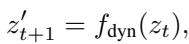
Here, \(z'_{t+1}\) is the predicted latent state of all particles for the next timestep.
3. Predicting Motion, Not Just Position
The model doesn’t try to guess the absolute coordinates of the particles for the next frame directly. Instead, it predicts the displacement (or velocity)—how much each particle will move.

Once the displacement \(\Delta \hat{x}\) is predicted, it is added to the current position to get the final predicted state. This residual learning approach makes it much easier for the network to learn stable physics.

Optimizing Physics: The Hybrid Loss
One of the paper’s key contributions is how it trains this model. In standard point cloud learning, researchers usually use Chamfer Distance (CD). CD measures the average distance between points in two clouds. It’s great for general alignment but has a weakness: it can be dominated by “noisy” outliers or fail to capture the fine structure of the shape.
The authors introduce a Hybrid Supervision strategy. They combine Chamfer Distance with a differentiable approximation of Hausdorff Distance (HD).
- Chamfer Distance: Ensures the bulk of the particles are in the right place (Local accuracy).
- Hausdorff Distance: Penalizes the worst outliers. It ensures the global shape is preserved and that the boundaries of objects (like the edge of a cloth) are accurate.

This combination allows ParticleFormer to handle “passive” dynamics—like sand particles that only move because the cloth underneath them was pulled—much better than previous methods.
Experimental Results
The researchers tested ParticleFormer on a suite of complex tasks involving rigid boxes, soft ropes, deformable cloth, and granular materials (sand). They compared it against GBND (the leading Graph-based model) and DINO-WM (a visual 2D model).
Simulation & Real-World Setup
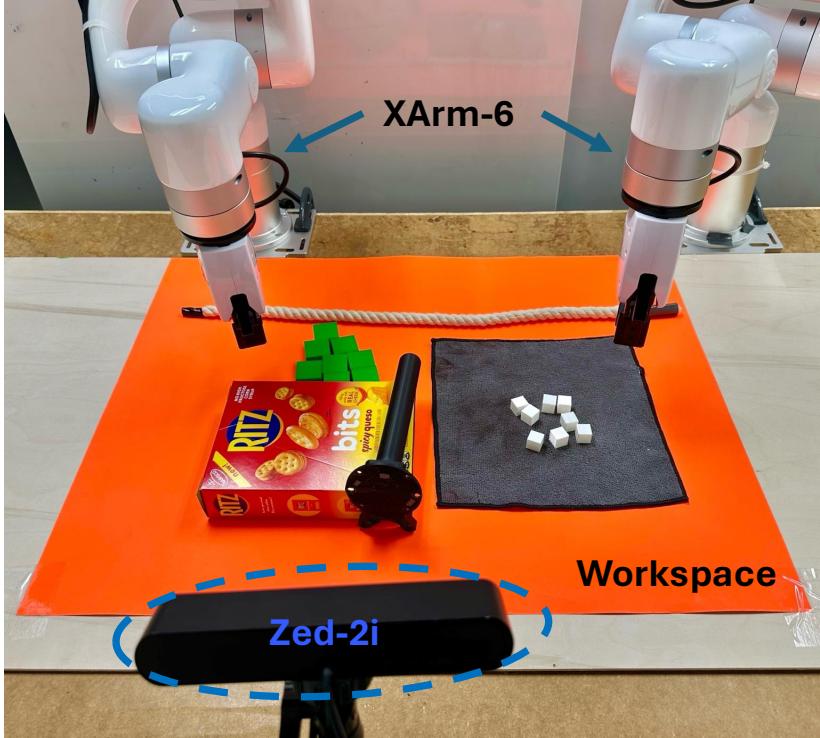
The experiments covered both simulated environments (using Nvidia FleX) and real-world scenarios using xArm-6 robots.

Qualitative Dynamics Prediction
Does the model actually understand physics? The visual results suggest yes.
In the figure below, look at the Rope Sweeping task (bottom row). The goal is to move a rope to sweep granular particles.
- ParticleFormer (Ours): Correctly predicts how the rope curls and how the granules are pushed along.
- GBND: The prediction “breaks”—the rope graph splits, and the physics looks unrealistic.
- Ours w/o Hybrid: Without the special loss function, the model underestimates the movement of the sand (the passive object).
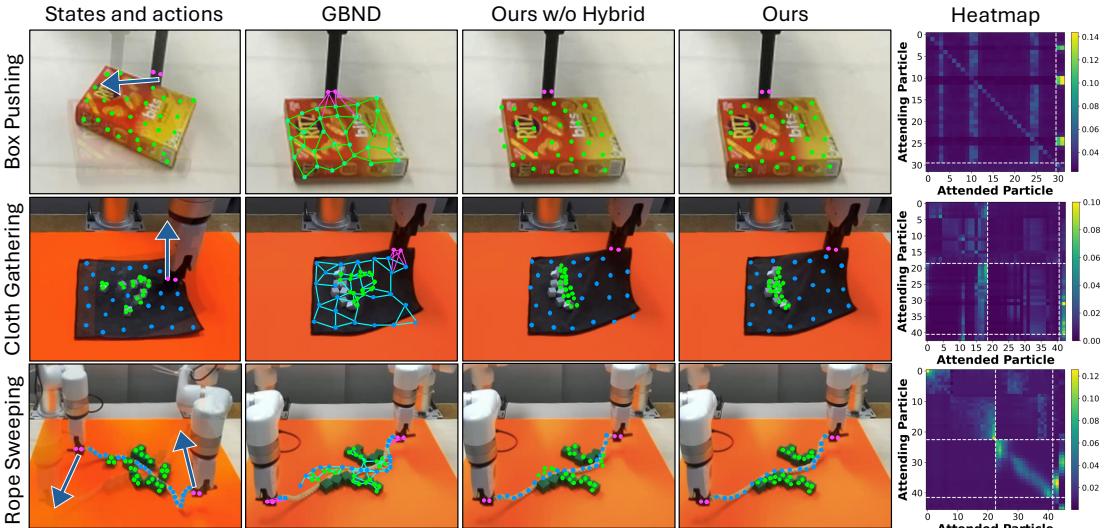
The Attention Heatmaps (far right in the image above) are particularly fascinating. They show what the model is “looking at.” In the Rope Sweeping task, you can see strong attention between the rope particles and the granular particles, proving the model has learned that the rope is the cause of the sand’s motion.
Quantitative Accuracy
The numbers back up the visuals. ParticleFormer achieves the lowest error rates across almost all tasks.
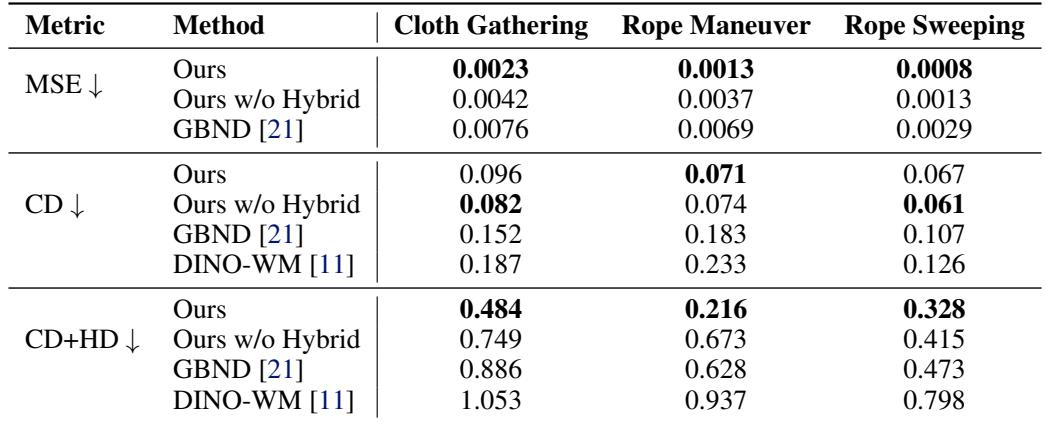
It is worth noting that ParticleFormer performs significantly better on the combined CD+HD metric, validating the choice of the hybrid loss function.
The Problem with Graphs (GBND Analysis)
The authors performed a deep dive into why the baseline GNN models struggled. It comes down to those manual hyperparameters mentioned earlier.
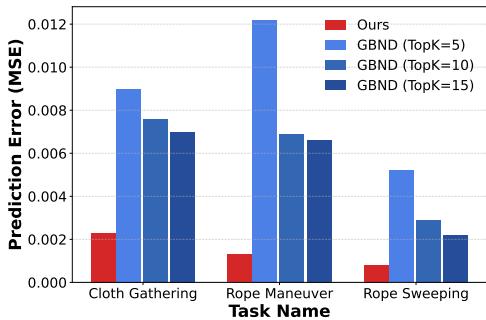
1. Sensitivity to Neighbors (TopK):
In a GNN, you must decide the maximum number of neighbors a particle interacts with (TopK).
- If
TopKis too low, the physics are inaccurate (not enough connections). - If
TopKis too high, the computational cost explodes.
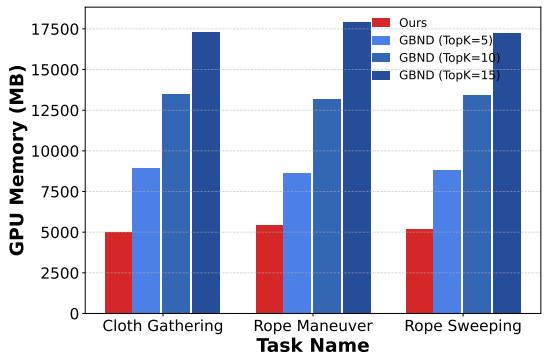
2. Computational Cost:
As you increase TopK to get better accuracy with GBND, the GPU memory usage skyrockets. ParticleFormer (Ours) remains efficient because the Transformer’s attention mechanism is optimized for these kinds of dense interactions without needing an explicit adjacency matrix stored in memory.
3. Sensitivity to Distance (MaxDist):
GNNs also require a distance threshold (MaxDist) to form connections. The chart below shows that GBND’s performance swings wildly depending on this setting. ParticleFormer, which uses soft attention, doesn’t need this threshold at all.

Putting it to Work: Model Predictive Control (MPC)
Predicting the future is cool, but can the robot actually do anything with it?
The researchers used ParticleFormer as the core simulation engine for Model Predictive Path Integral (MPPI) control. Essentially, the robot simulates thousands of random action sequences in its “imagination” (using ParticleFormer), picks the one that gets the objects closest to the target state, and executes it.
The results show that ParticleFormer enables the robot to successfully complete complex tasks like gathering cloth or sweeping ropes, whereas baselines often fail to reach the target configuration.

Looking at the rollout errors on the right side of the figure above, ParticleFormer maintains low error over long time horizons (multiple steps into the future), which is critical for planning long-term tasks.
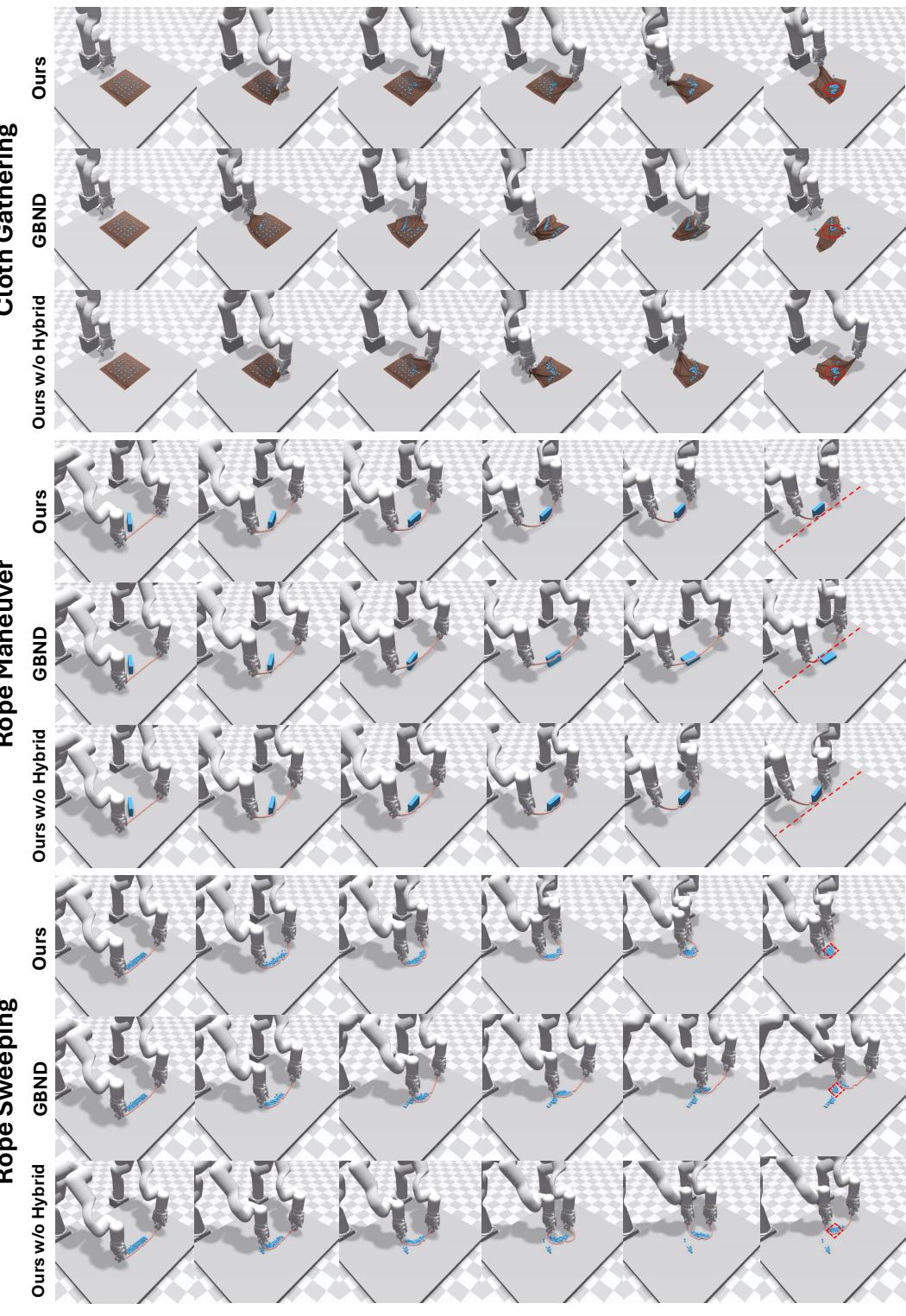
In the simulation results above, notice the Rope Sweeping task (bottom row). The “Ours” column shows the rope cleanly sweeping the floor. The “GBND” column shows the rope getting tangled, and “Ours w/o Hybrid” results in a complete mess. This demonstrates that both the Transformer architecture and the Hybrid Loss are essential for success.
Conclusion and Key Takeaways
ParticleFormer represents a significant step forward in robotic world modeling. By moving away from rigid graph structures and embracing the flexibility of Transformers, the researchers have created a system that can:
- Model Heterogeneous Materials: It seamlessly handles rigid, deformable, and granular materials in the same scene.
- Learn Implicit Structures: It figures out which particles interact with which using attention, rather than relying on manual “neighbor” definitions.
- Scale Efficiently: It avoids the memory bottlenecks associated with high-connectivity GNNs.
- Capture Fine Details: The hybrid loss function ensures that even subtle, passive motions are modeled accurately.
While the current model is trained per-scene and relies on external segmentation tools, it opens the door for general-purpose physics models that could one day allow robots to manipulate the world with the same intuitive ease as humans.