](https://deep-paper.org/en/paper/2507.01830/images/cover.png)
Imagine you are running a massive online store. Every minute, new items are added to your inventory. Your goal is to group these items based on similarity—putting all the “vintage leather jackets” in one cluster and “wireless gaming mice” in another.
In a static world, you would have all the items in front of you, run a clustering algorithm once, and be done. But in the real world, data is dynamic. Items arrive one by one. You cannot afford to re-run a massive clustering operation every time a single new product is listed. You need an algorithm that updates the clusters on the fly, accurately and quickly.
This is the problem of Dynamic Correlation Clustering.
In a recent paper titled “SPARSE-PIVOT: Dynamic correlation clustering for node insertions,” researchers Mina Dalirrooyfard, Konstantin Makarychev, and Slobodan Mitrović propose a groundbreaking algorithm that solves this problem with remarkable efficiency. They achieve a constant-factor approximation with an update time that is polylogarithmic—meaning it scales incredibly well even as the database grows to millions of nodes.
In this deep dive, we will unpack how SPARSE-PIVOT works, the clever “good vs. bad” node theory behind it, and why it outperforms previous state-of-the-art methods.
The Challenge: Correlation Clustering
Before we get to the dynamic part, let’s establish what Correlation Clustering actually is.
Unlike \(k\)-means or other clustering methods where you specify the number of clusters (\(k\)) beforehand, Correlation Clustering is agnostic to the number of clusters. You are given a graph where nodes are items (e.g., products, documents) and edges represent similarity.
- Positive Edge (+): The classifier thinks these two nodes are similar.
- Negative Edge (-): The classifier thinks these two nodes are dissimilar (or there is no edge).
The goal is to partition the nodes into clusters to minimize disagreements:
- Negative Disagreement: Two similar nodes (connected by a + edge) are put in different clusters.
- Positive Disagreement: Two dissimilar nodes (no edge) are put in the same cluster.
This problem is NP-hard, so researchers look for approximation algorithms. One of the most famous static algorithms is PIVOT, which provides a 3-approximation (it costs at most 3 times the optimal solution).
The Dynamic Twist
The challenge addressed in this paper is the Dynamic Node Insertion model.
- Nodes arrive one at a time.
- When a node arrives, we query a database to find its similar neighbors.
- We must immediately update the clustering.
- We cannot change the arrival order (it’s non-adaptive).
Previous attempts, such as the algorithm by Cohen-Addad et al., managed to do this with sublinear update times, but the “constant” in their approximation error was huge (potentially in the hundreds or thousands). SPARSE-PIVOT drastically reduces this error to roughly 20, while maintaining blindingly fast update speeds.
The Foundation: Reference Clustering
To build SPARSE-PIVOT, the authors first imagine an “ideal” but slow version of the PIVOT algorithm adapted for dynamic inputs. They call this Reference Clustering.
In the standard static PIVOT algorithm, you pick a random node, make it a “pivot” (a cluster center), assign all its unclustered neighbors to it, and remove them from the graph. You repeat this until no nodes are left.
In the dynamic version, we assign every node a random rank \(\pi(u)\) between 0 and 1. When a new node \(u\) arrives:
- We check its neighbors.
- If \(u\) has the lowest rank (smallest number) among its neighbors, it becomes a Pivot. It starts a new cluster.
- If \(u\) has a neighbor \(v\) with a lower rank that is already a Pivot, \(u\) joins \(v\)’s cluster.
- If \(u\) falls into neither category, it becomes a singleton (a cluster of one).
The problem with this “Reference” method is speed. To determine if \(u\) is the lowest rank node, you have to check all its neighbors. In a dense graph, checking neighbors takes linear time \(O(n)\), which is too slow for massive databases.
The Solution: SPARSE-PIVOT
The core innovation of SPARSE-PIVOT is to approximate the Reference Clustering without doing all the heavy lifting. The authors introduce a way to find pivots and maintain clusters using sampling rather than exhaustive searching.
1. The Random Rank Trick
Just like the Reference method, every node \(u\) gets a random rank \(\pi(u) \in [0, 1]\).
When node \(u\) arrives, the algorithm makes a quick decision based on how likely \(u\) is to be a pivot.
- Low Rank (High Probability Pivot): If \(\pi(u)\) is very small (specifically \(\pi(u) \leq L/d(u)\), where \(L\) is a logarithmic term and \(d(u)\) is the degree), the algorithm suspects \(u\) might be a pivot. It runs a full check (
EXPLORE) on its neighbors. Because the rank is so low, this happens rarely, keeping the average cost low. - High Rank (Low Probability Pivot): If \(\pi(u)\) is large, \(u\) is almost certainly not a pivot. Instead of checking all neighbors to find the right cluster, the algorithm samples a logarithmic number of neighbors. It looks at their assigned pivots and picks the “best” one (the one with the smallest rank).
2. Handling “Bad” Nodes: The Sparse Pivot
This is where the algorithm gets its name. In Correlation Clustering, a “bad” node is one that is structurally confusing—perhaps it has edges to many different clusters, or very few edges to its own cluster. Including these nodes in a main cluster can skyrocket the cost (number of disagreements).
To solve this, the algorithm maintains a set \(B_v\) for every pivot \(v\). This set contains all nodes that want to belong to pivot \(v\). However, the algorithm doesn’t blindly accept them all.
It calculates a dense subset \(C_v \subseteq B_v\).
- \(C_v\) (the core cluster) acts as the actual cluster.
- The nodes in \(B_v \setminus C_v\) (the rejects) are turned into singletons.
This “pruning” ensures that the core cluster remains high-quality and dense, while “bad” nodes are isolated where they can do less damage to the overall score.
3. Estimating Costs Efficiently
How do we decide which nodes stay in \(C_v\) and which get kicked out? We need to estimate the cost of the cluster. But counting edges is slow. The authors use a statistical estimator.
The algorithm estimates the cost of potential clusters using sampling. The expected value of a sampled sum of edges allows them to approximate the true cost without counting every single edge.
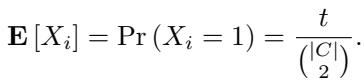
Here, \(X_i\) is a random variable representing whether a sampled pair is a non-edge (a “mistake” inside the cluster). By averaging these samples over \(\tau_C\) trials, they get a reliable estimate \(S'\):
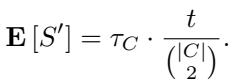
From this, they derive the estimator \(Y\):
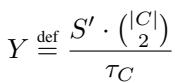
The paper proves that this estimator \(Y\) concentrates tightly around the true cost. If the number of disagreements is high, the estimator detects it with high probability:
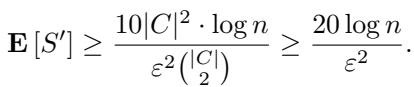

This allows the algorithm to quickly check: “If I include these nodes in the cluster, will the cost explode?” If the answer is yes, those nodes are relegated to singletons.
Theoretical Analysis: Good, Bad, and Poor
The theoretical backbone of the paper relies on classifying nodes based on how well they fit into their clusters. This classification justifies why turning some nodes into singletons is a valid strategy.
The Taxonomy of Nodes
The authors define nodes relative to a reference clustering \(A\):
- Light Nodes: Nodes that don’t have enough edges inside their own cluster (\(d_C(u) \le |C|/3\)). They are loosely connected.
- Heavy Nodes: Nodes that have too many edges pointing outside their cluster (\(d(u) \ge \beta |C|\)). They drag the cluster down.
- Poor Nodes: Nodes that have a much lower degree than their pivot (\(d(u) \le \alpha d(p(u))\)).
- Bad Nodes: Any node that is Light, Heavy, or Poor.
- Good Nodes: Nodes that are well-connected inside and poorly connected outside.
The authors prove a crucial lemma regarding “Bad” nodes. If you take a clustering algorithm \(A\) and create a new algorithm \(A'\) that simply takes all the Heavy and Light nodes and makes them singletons, the cost does not increase significantly.
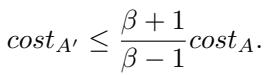
Here, \(\beta\) is a parameter related to the “heaviness” threshold. This equation tells us that “giving up” on confusing nodes (making them singletons) is a safe approximation strategy.
They further extend this to “Poor” nodes (nodes with low degrees compared to their pivot). The expected sum of degrees of these poor nodes is bounded relative to the total cost:

Combining these insights, they show that a strategy \(B\) that makes all “bad” nodes singletons has a cost bounded by the original cost of \(A\):

This theoretical guarantee is what allows SPARSE-PIVOT to achieve the \(20 + \varepsilon\) approximation factor. By identifying and isolating the nodes that would ruin the clustering, the algorithm limits the damage.
Does it Work? Experimental Results
Theoretical bounds are great, but does the algorithm perform on real data? The authors tested SPARSE-PIVOT against:
- DYNAMIC-AGREEMENT (DA): The previous state-of-the-art by Cohen-Addad et al.
- REFERENCE CLUSTERING (RF): The slow, ideal baseline.
- SINGLETONS: A naive baseline where every node is its own cluster.
They used datasets like social networks (Facebook), email networks (Enron), and citation networks (HepTh).
Approximation Quality
The metric used is the “Clustering Objective” (lower is better).
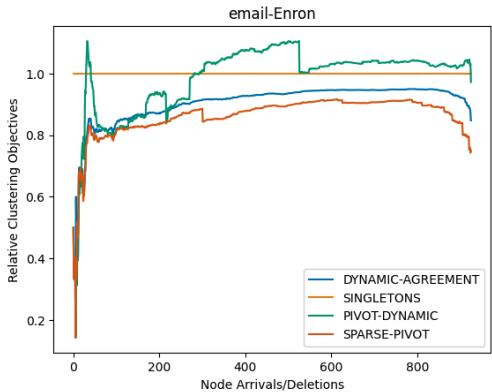
In the chart above (likely representing a synthetic or averaged result), look at the positioning of the lines. The Green line (PIVOT-DYNAMIC/Reference) is often the baseline we want to approach. The Red/Orange line (SPARSE-PIVOT) consistently tracks lower (better) than the Blue line (DYNAMIC-AGREEMENT).
Let’s look at a specific real-world example, the Facebook graph:
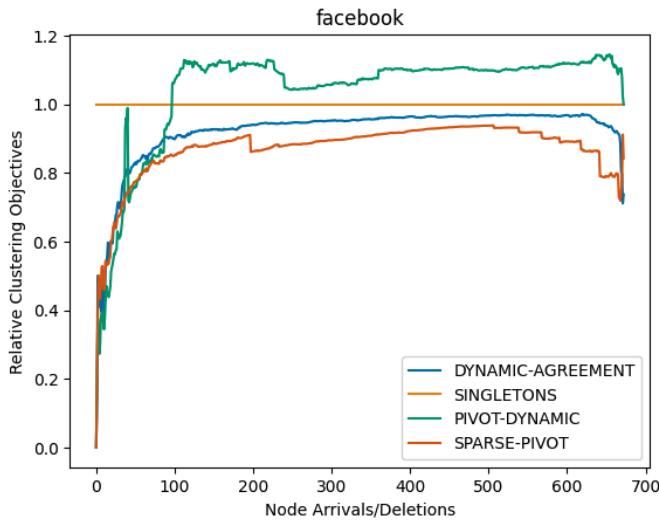
Here, SPARSE-PIVOT (Red) starts competitively and stays significantly lower than SINGLETONS (Orange) and DYNAMIC-AGREEMENT (Blue) as the number of node operations increases. This confirms that the “Sparse” strategy of pruning clusters yields a tighter, more accurate clustering than previous dynamic methods.
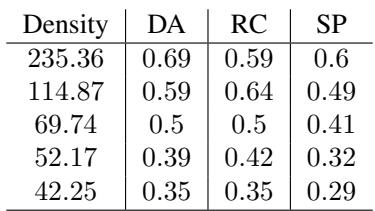
The numerical results tell the same story. In the table below, “SP” (Sparse-Pivot) consistently scores lower (better) than “DA” (Dynamic Agreement).
Runtime Efficiency
Speed is the other half of the equation. A dynamic algorithm is useless if it hangs the database.
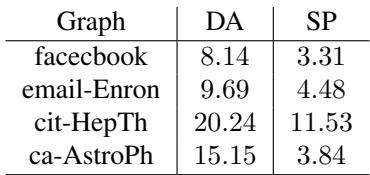
Table 3 compares the running times on SNAP datasets.
- Facebook: DA takes 8.14s, SP takes 3.31s.
- ca-AstroPh: DA takes 15.15s, SP takes 3.84s.
SPARSE-PIVOT is consistently 2x to 4x faster than the previous state-of-the-art. This confirms the power of the sampling approach combined with the cost-estimation technique.
Handling Deletions
While the paper focuses on Insertions, real databases also delete items. The authors handle deletions via Soft Deletions.
- When a node is deleted, it is marked as “soft-deleted” but kept in the structure.
- The algorithm ignores these deletions for a while.
- Once the number of updates reaches a threshold (\(\varepsilon \cdot N\)), the algorithm triggers a Recompute.
Because the update time is so fast (polylogarithmic), periodically rebuilding the clustering is computationally affordable. The authors prove that ignoring deletions for short bursts does not significantly degrade the cost expectation:

This inequality shows that the cost of the clustering with deletions ignored (\(C_{NO-DEL}\)) is very close to the cost if we handled them perfectly (\(C_{DEL}\)).
Conclusion
SPARSE-PIVOT represents a significant leap forward in dynamic graph algorithms. It successfully bridges the gap between the simplicity of static algorithms and the rigorous demands of dynamic environments.
By combining randomized pivot selection, sampling, and a rigorous pruning strategy for “bad” nodes, the authors achieved:
- High Speed: Polylogarithmic update times.
- High Accuracy: A \(20 + \varepsilon\) approximation factor (a massive improvement over previous hundreds/thousands factors).
- Real-world Viability: Superior performance on actual datasets like Facebook and Enron.
For students and researchers in machine learning and data infrastructure, this paper highlights a crucial lesson: sometimes the best way to maintain a complex structure (like a clustering) is not to meticulously fix every error, but to efficiently identify and isolate the “bad” parts that cause the most trouble.
If you are building systems that need to organize streaming data—from news aggregators to e-commerce inventories—SPARSE-PIVOT provides a robust blueprint for keeping your data sorted in real-time.