](https://deep-paper.org/en/paper/2507.01857/images/cover.png)
The dream of general-purpose robotics often centers on the hands. If we can build a robot hand with the same dexterity as a human hand, surely we can teleoperate it to do anything a human can do, right? This logic has driven the field of dexterous teleoperation for years. The standard approach is straightforward: capture the motion of a human hand and map it, joint-for-joint, to a robot hand. This process is known as retargeting.
But there is a flaw in this logic. Robot hands are not biological hands. They have different kinematics, different joint limits, and often, capabilities that exceed human anatomy (such as fingers that can bend further backward or rotate in non-human ways). By forcing a robot to strictly mimic a human, we paradoxically limit the robot’s potential. We shackle the machine to human constraints and struggle with the “morphological mismatch” that causes dropped objects and awkward fumbles.
In this deep dive, we will explore a new research paper titled “TypeTele: Releasing Dexterity in Teleoperation by Dexterous Manipulation Types.” The researchers propose a paradigm shift: instead of low-level motion mimicry, we should focus on high-level manipulation types.

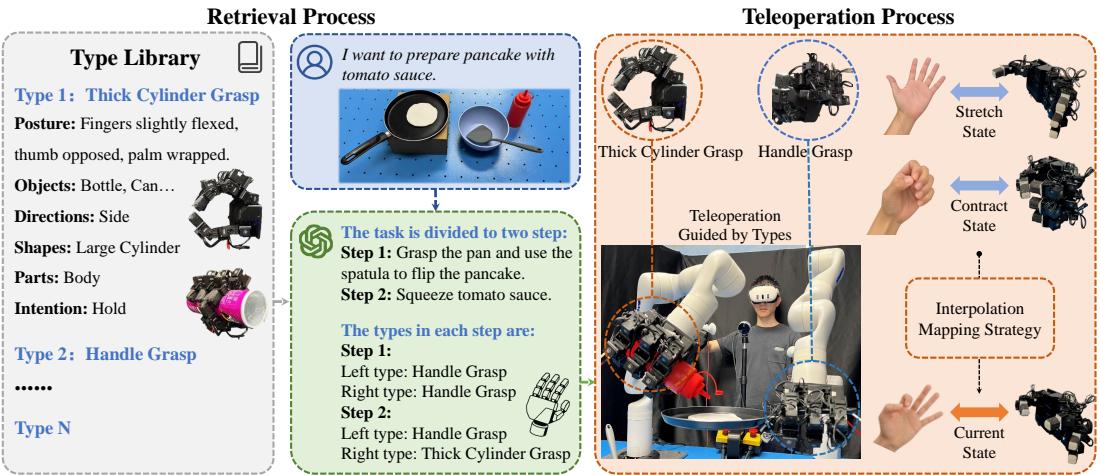
As shown in Figure 1, the core idea is to translate human intent into specific “types” of robotic action, effectively bridging the gap between human cognition and robotic execution.
The Problem with Direct Retargeting
To understand why TypeTele is necessary, we first need to look at why current methods fail. Most existing teleoperation systems utilize retargeting algorithms that try to preserve the spatial consistency between the human operator’s hand and the robot’s hand. If you curl your index finger, the robot curls its index finger.
This sounds intuitive, but it faces two major hurdles:
- Morphological Differences: A robot hand might have longer fingers, different thumb placement, or fewer joints than a human hand. Direct mapping often leads to unstable grasps (the robot thinks it’s holding the object, but the physics say otherwise) or self-collisions (the robot fingers crash into each other).
- Wasted Potential: A fully actuated robot hand can perform poses humans cannot. For example, a robot might be able to spread its fingers wider or pinch with higher force in a configuration that would break a human finger. Retargeting restricts the robot to only what a human hand can physically do.
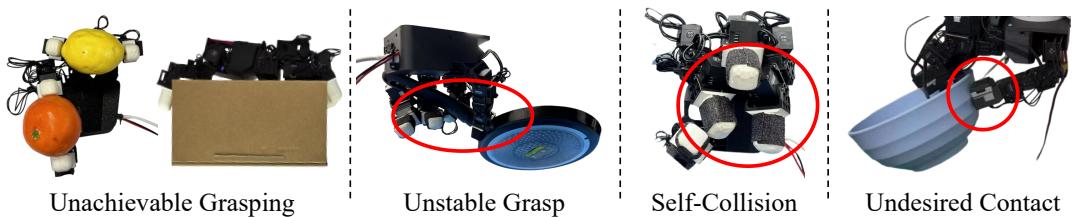
Figure 2 illustrates these failures vividly. Notice the “Unachievable Grasping” example—the robot configuration required to hold those two spheres is physically impossible for a human hand to mimic exactly. Therefore, a retargeting system would never command the robot to do it, resulting in a failure to grasp.
The TypeTele Solution: Type-Guided Teleoperation
The researchers propose TypeTele, a system that moves away from continuous pose imitation. Instead, it introduces the concept of Dexterous Manipulation Types.
Think of a “type” as a pre-configured skill or template. Rather than telling the robot “move joint A 5 degrees and joint B 10 degrees,” the system identifies that the user wants to perform a “Bottle Cap Unscrew” or a “Heavy Object Lift.” The system then maps the human’s hand motion to the progression of that specific type.
The framework operates in two main stages, as illustrated below:
- Retrieval Process: Identifying the correct manipulation type for the task.
- Teleoperation Process: Controlling the action using an interpolation strategy.
1. The Dexterous Manipulation Type Library
The foundation of this system is a carefully constructed library of manipulation types. The authors didn’t just guess these types; they built a hierarchical taxonomy based on existing human grasp research and expanded it to include robot-specific capabilities.
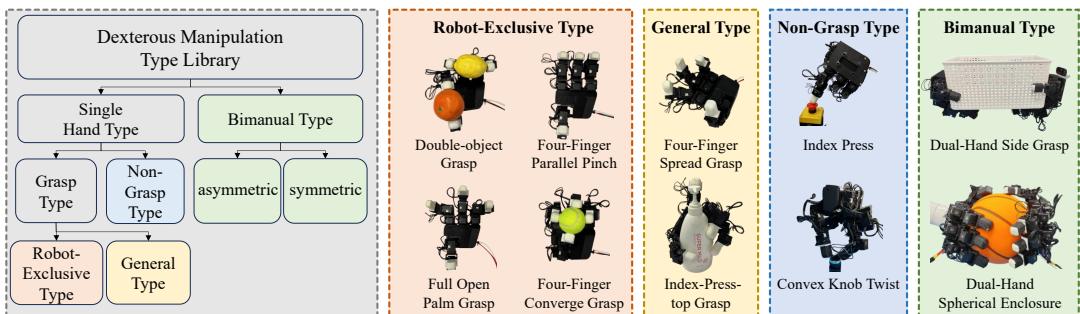
As detailed in Figure 4, the library is divided into:
- Single Hand vs. Bimanual: Does the task require one hand or coordination between two?
- Grasp vs. Non-Grasp: Is the robot holding something, or pushing/pressing it?
- Robot-Exclusive Types: This is a crucial innovation. These are grasps that leverage the robot’s unique structure—postures that are impossible for humans but highly effective for manipulation.

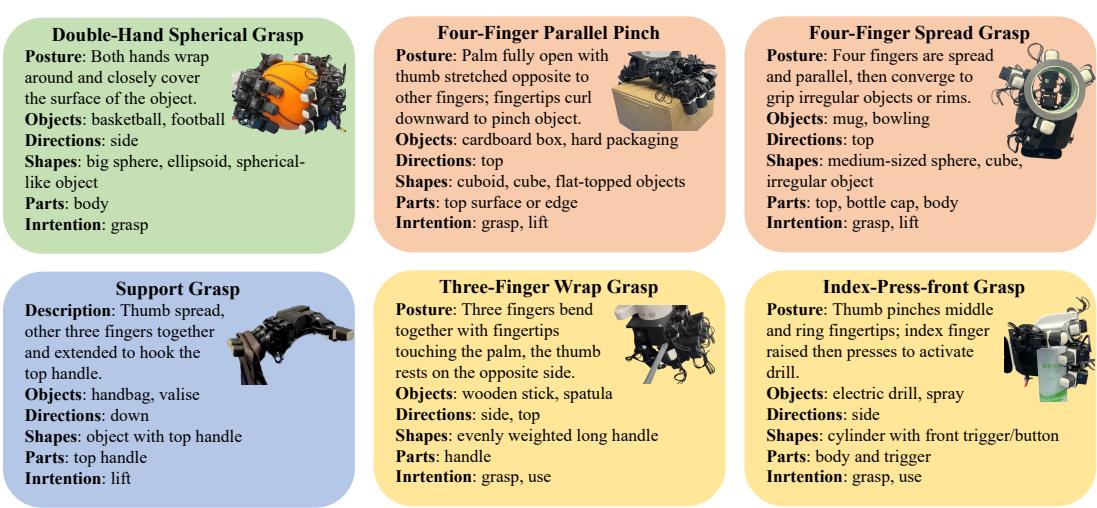
Figure 9 provides a visual catalog of these types. Notice the “Robot-Exclusive” category (orange border). The “Four-Finger Parallel Pinch,” for example, utilizes the robot’s ability to oppose four fingers against the thumb in a flat plane—a geometry difficult for humans but excellent for holding boxes.
To make these types usable by a computer, each one is annotated with rich metadata: what objects it works on, what the posture looks like, and the intended interaction (e.g., lifting vs. twisting).
2. MLLM-Assisted Retrieval
With a library of 30+ types, how does the system know which one to use? The operator shouldn’t have to scroll through a menu in the middle of a task.
TypeTele utilizes a Multi-modality Large Language Model (MLLM), specifically GPT-4o, to act as an intelligent assistant. The process works like this:
- Input: The system feeds the MLLM the current camera view of the workspace and the user’s verbal command (e.g., “I want to pour the water”).
- Reasoning: The MLLM decomposes the task into steps.
- Selection: Based on the object geometry and the action required (pouring), the MLLM selects the most appropriate “Type” from the library for each hand.
This allows the operator to focus on the task, while the AI handles the complex kinematics setup in the background.
3. The Interpolation Mapping Strategy
Once a type is selected (e.g., “Thick Cylinder Grasp”), how does the user control it? This is where TypeTele diverges from traditional retargeting.
Instead of mapping absolute positions, TypeTele maps the progression of the grasp. Every type in the library is defined by two key states:
- Stretch State: The hand fully open or prepared.
- Contract State: The hand fully closed or engaged in the action.
The system tracks the human hand and calculates a “projection ratio”—essentially, how far the human has moved from an open palm to a closed fist. This ratio (\(p_{ratio}\)) is calculated using the vector positions of the fingertips.
The equation for determining this ratio is:

Here, \(\mathbf{p}\) represents the fingertip positions. The formula projects the current human fingertip position onto the vector formed by the stretch and contract states, resulting in a value between 0 (fully open) and 1 (fully closed).
This ratio is then used to drive the robot’s joints via linear interpolation:

In this equation, \(\theta\) represents the joint angles of the robot. The robot moves smoothly between its own pre-defined “stretch” and “contract” joint configurations based on the human’s input.
Why is this brilliant? It completely bypasses the morphological mismatch. The human operator just needs to perform a natural closing motion. The robot, receiving the \(0 \to 1\) signal, executes a perfect, stable grasp that has been pre-optimized for its own hand geometry.
Fine-Tuning with Type Adjustment
Sometimes the pre-defined type isn’t perfect. The system allows for “Type Adjustment,” where the operator can apply offsets to specific fingertips. The system uses Inverse Kinematics (IK) to calculate the new joint angles (\(q'\)) based on the desired transformation (\(T_\Delta\)):

Experimental Setup & Results
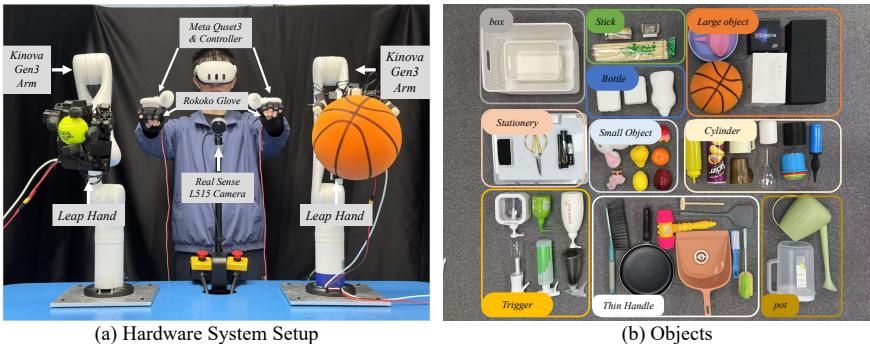
To prove this system works, the researchers set up a rigorous testing environment using two Kinova robot arms equipped with LEAP dexterous hands. The operator wore Rokoko motion capture gloves and a Meta Quest 3 headset.
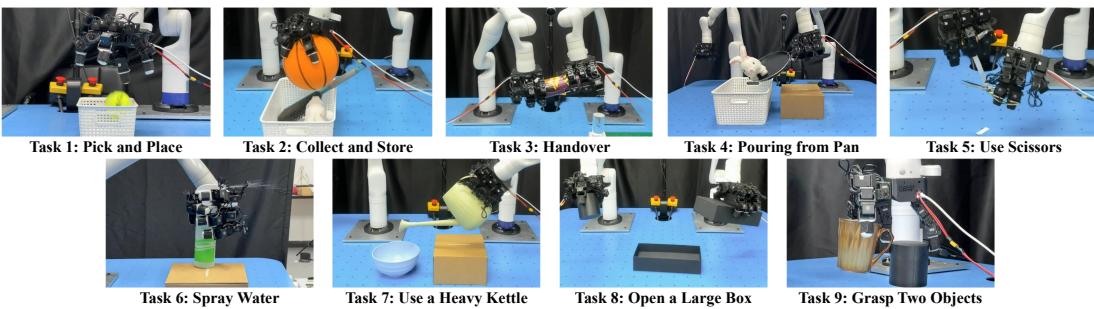
They designed a suite of tasks ranging from simple “Pick and Place” to highly complex actions like “Using Scissors” and “Spray Water.”
Comparison with Baseline
The results were compared against a standard retargeting-based system (the “Baseline”). The differences, as shown in Table 1, are stark.

Key Takeaways from the Results:
- Success Rate: TypeTele achieved a 100% success rate in simple tasks and high success rates (80%+) in complex tasks where the Baseline failed completely (0%).
- Complex Tasks: Look at “Use Scissors,” “Spray Water,” and “Open Large Box.” The Baseline scored 0 on all of these. Retargeting simply couldn’t handle the fine motor control or the specific hand geometry required. TypeTele handled them effectively.
- Efficiency: Even in tasks where the Baseline worked (like “Collect and Store”), TypeTele was significantly faster (\(T_{all}\) dropped from 1231s to 616s).
Generalization and Versatility
One might worry that using “types” makes the system rigid. However, the experiments showed that a single type is surprisingly versatile.

As seen in the top of Figure 7, a single type (like a trigger-press motion) generalizes across different objects, such as spray bottles and lotion pumps. The bottom half of the figure demonstrates “long-horizon” tasks, where the system successfully switched between multiple types to complete a multi-step cooking sequence.
Improving Autonomous Robots
The ultimate goal of teleoperation is often to collect data to train autonomous AI policies. The researchers trained an Imitation Learning policy (using a method called iDP3) on data collected from both systems.
The policy trained on TypeTele data significantly outperformed the one trained on Baseline data. Because the teleoperation was smoother and the grasps were more stable, the “teacher” provided better examples, leading to a smarter “student” (the autonomous robot).
User Experience
Beyond the raw numbers, the researchers conducted a user study. Participants found TypeTele significantly easier to use.
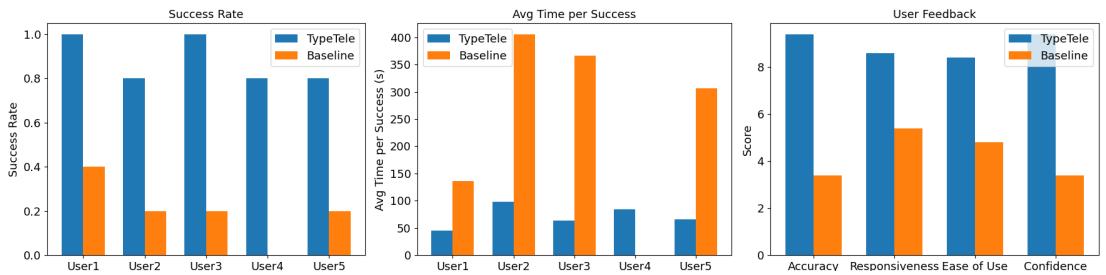
The charts in Figure 11 show that users felt more confident and rated the system higher in accuracy and responsiveness. This is likely because the “interpolation mapping” masks the jitteriness of human hand motion, making the robot feel more stable and predictable.
Conclusion: The Future of Dexterity
TypeTele represents a mature step forward in robotic manipulation. By accepting that robots are different from humans—and leveraging those differences via “Dexterous Manipulation Types”—the researchers unlocked capabilities that direct mimicry could never achieve.
This approach transforms the operator’s role. Instead of being a puppeteer struggling to pull the right strings, the operator becomes a conductor, signaling intent while the robot handles the virtuoso performance of finger placement and force modulation. As robotic hands become more complex, systems like TypeTele will be essential for bridging the gap between human instruction and machine execution.