](https://deep-paper.org/en/paper/2507.12846/images/cover.png)
Imagine you are at the grocery store, and you suddenly wonder, “Do I need to buy milk?” To answer this, you don’t just look at the shelves in front of you. You mentally simulate a walk through your kitchen, recalling the last time you opened the fridge, perhaps remembering that you finished the carton during breakfast yesterday. You combine your current perception (being at the store) with long-term episodic memory (yesterday’s breakfast) to make a decision.
For humans, this integration of past and present is intuitive. For robots, it is an immense challenge.
Most current robotic systems operate with a form of tunnel vision. They are either “active” agents that explore their immediate surroundings to answer a question (but have no memory of last week), or they are “episodic” agents that can recall a specific video log (but cannot move to check new information).
In this post, we will dive into a fascinating paper titled “Enter the Mind Palace”, which proposes a unified framework called Long-term Active Embodied Question Answering (LA-EQA). We will explore how researchers are teaching robots to build a “Mind Palace”—a structured memory system that allows them to reason across days, weeks, and months to answer complex questions like, “Are we missing anything we usually have for breakfast?”
The Problem: Robots with Amnesia
To understand the breakthrough, we first need to define the bottleneck in current robotics. Embodied Question Answering (EQA) is the task where a robot must answer questions about the physical world.
Currently, EQA is split into two isolated camps:
- Active EQA: The robot starts from scratch. It knows nothing about the environment and must explore now to find an answer.
- Episodic EQA: The robot sits still and analyzes a pre-recorded video of a past event to answer a question.
Neither of these captures the reality of a home or office assistant. A real assistant needs to remember that you left your keys on the counter yesterday (Episodic) but also needs to check if they are still there today (Active).

As shown in Figure 1, the authors introduce Long-term Active EQA (LA-EQA). In this setting, the robot must answer questions by reasoning over a long history of past experiences (spanning days or months) and deciding when to actively explore the current environment.
This is difficult because of the sheer volume of data. A robot operating for months generates millions of image frames. Feeding all that video data into a Visual Language Model (VLM) is computationally impossible and practically inefficient. The robot needs a better way to organize its memories.
The Solution: The Robotic Mind Palace
The researchers drew inspiration from the “Method of Loci,” also known as the Mind Palace technique. This is a mnemonic strategy used by memory champions, where information is associated with specific physical locations in a visualized spatial environment.
The authors propose Mind Palace Exploration, a system that converts raw robot logs into a structured, queryable “palace” of scene graphs.
1. Constructing the Palace
Instead of storing hours of video, the system processes robot trajectories into Episodic World Instances. Think of these as snapshots of the world at different times (e.g., “Tuesday Morning,” “Wednesday Afternoon”).
The architecture uses a Hierarchical Scene Graph:
- Nodes: These represent physical places (like “Kitchen,” “Living Room”) and specific viewpoints within those rooms.
- Edges: These connect the rooms spatially.
- Content: Each node contains semantic information—lists of objects detected and captions describing the scene.
This structure transforms a massive stream of pixels into a searchable database of “places and things” across time.
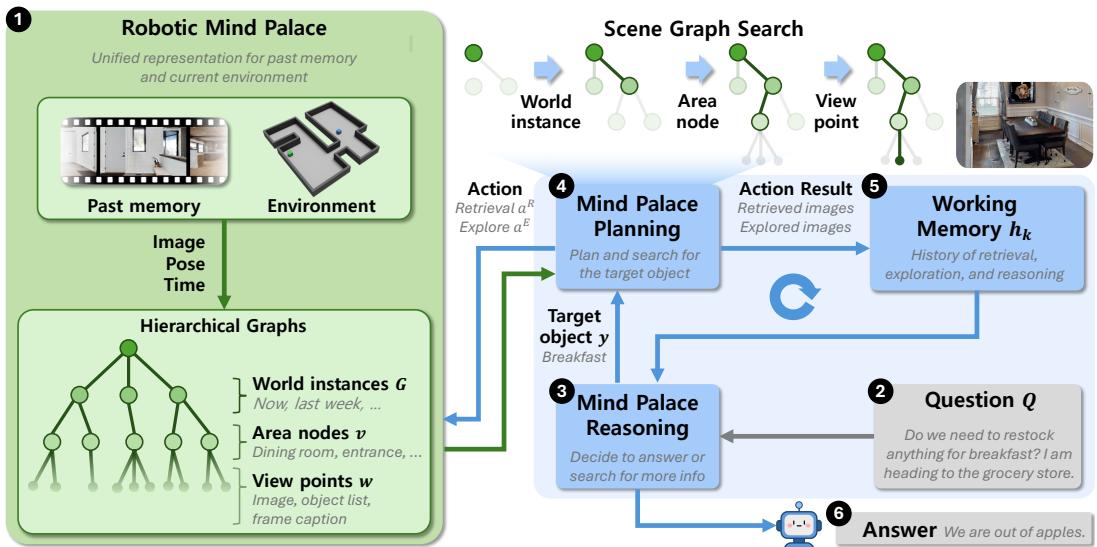
Figure 2 illustrates the complete pipeline. The “Robotic Mind Palace” (1) unifies past memory and the current environment. When a question arrives (2), the system enters a loop of Reasoning (3) and Planning (4), updating its Working Memory (5) until it generates an Answer (6).
2. Reasoning and Planning
How does the robot use this palace? It doesn’t just randomly search. It uses a Large Language Model (LLM) to act as a high-level brain.
When a question is asked (e.g., “Where is my backpack?”), the system performs reasoning to identify the target object. Then, it plans a search strategy. The crucial innovation here is that the robot can “teleport” through its memories.
- Past Retrieval: The robot can “visit” the Living Room in its memory of “Tuesday Morning” instantly.
- Present Exploration: If the memory is outdated or insufficient, the robot plans a physical path to move its body to the Living Room now.
The planning happens hierarchically:
- Select World Instances: Which memories are relevant? (e.g., “Check yesterday and today.”)
- Select Areas: Which rooms are most likely to contain the backpack? (e.g., “Living Room” > “Kitchen.”)
- Select Viewpoints: Which specific angle should I look from?
3. Value of Information (The Stopping Criteria)
One of the smartest parts of this system is knowing when not to look. Exploring the physical world is expensive (battery, time), and even retrieving memories takes compute.
The authors implemented an early stopping mechanism based on Value of Information (VoI). Before retrieving another past memory or moving to a new room, the robot calculates the expected utility of that action.
\[ V O I ( O ^ { \prime } \mid o ) = J ^ { ( } o ) - \sum _ { o ^ { \prime } } P ( o ^ { \prime } \mid o ) J ^ { * } ( o , o ^ { \prime } ) . \]This equation effectively asks: Will seeing this new piece of information actually change my plan? If the robot is already 99% sure the keys are in the kitchen based on yesterday’s memory, retrieving data from three weeks ago has zero Value of Information. It skips the retrieval and goes straight to the kitchen.
A New Benchmark for Long-Term Reasoning
Because no dataset existed for this specific problem (combining long-term memory with active exploration), the authors created one. The LA-EQA Benchmark spans both high-fidelity simulations and real-world environments.
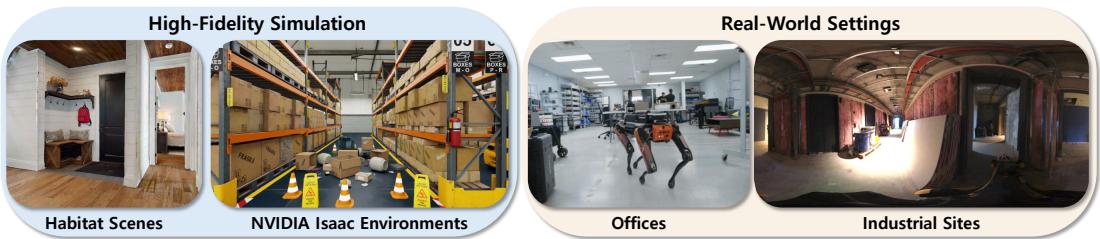
As seen in Figure 3, the benchmark is diverse. It includes:
- Simulations: Household scenes (Habitat) and massive industrial warehouses (NVIDIA Isaac). These allow for “ground truth” testing where we know exactly where every object is.
- Real World: Data collected from a robot dog (Spot) in an office building and a construction site over 6 months.
The questions in the benchmark are designed to test different temporal reasoning skills:
- Past: “Where did I leave my umbrella yesterday?”
- Present: “What color is the TV stand?”
- Past-Present: “Is the package that arrived Tuesday still at the door?”
- Multi-Past: “What do we usually eat for breakfast?” (Requires aggregating trends over many days).
Experimental Results: Does it Work?
The authors compared Mind Palace Exploration against several state-of-the-art baselines, including powerful Multi-Frame VLMs (which try to look at many images at once) and episodic memory systems like ReMEmbR.
The results were decisive.
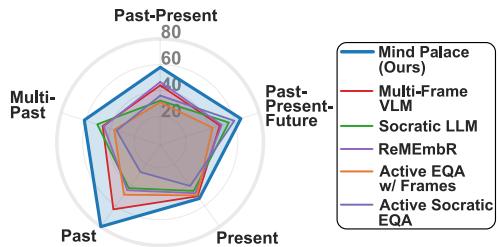
Figure 4 visualizes the performance across different question types. The blue line (Mind Palace) encompasses all others, indicating superior performance in every category. It is particularly dominant in “Past” and “Multi-Past” questions, where understanding the timeline is critical.
Let’s look at the concrete numbers:
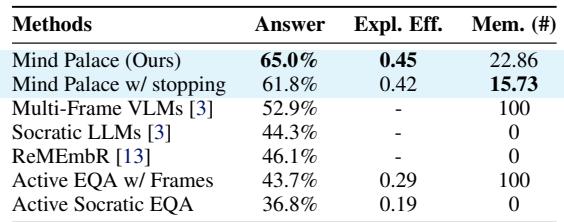
Table 1 reveals the extent of the improvement. The Mind Palace method achieves 65.0% answer correctness, significantly higher than the Multi-Frame VLMs at 52.9%.
Even more impressive is the efficiency. Look at the “Mem. (#)” column. The Multi-Frame VLM had to retrieve 100 images to try and answer the questions. The Mind Palace method needed only about 23 images on average. By structuring memory into a scene graph, the robot only retrieves the relevant snapshots rather than ingesting a firehose of visual data.
Scalability
One major concern with long-term memory is “bloat.” As the robot operates for months, does it get slower or confused?
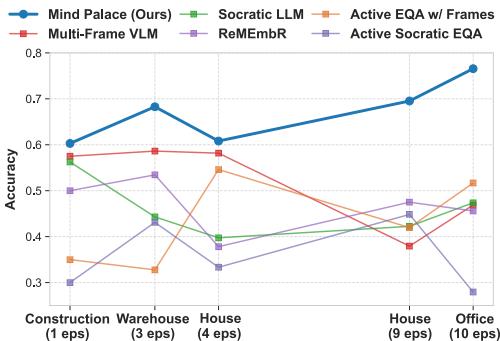
Figure 5 suggests the opposite. The Mind Palace approach (Blue line) maintains high accuracy even as the number of episodes (and the complexity of the environment) increases. In complex environments like the “Warehouse,” the gap between Mind Palace and the baselines actually widens.
Real-World Deployment
This isn’t just a simulation result. The team deployed this on a Boston Dynamics Spot robot in a 1,000 \(m^2\) office space.
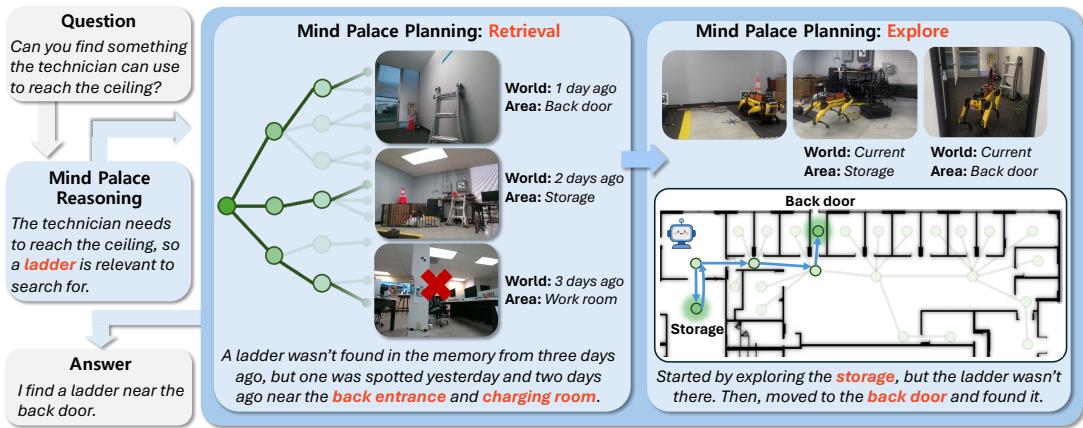
Figure 6 walks through a real-world example.
- User Question: “Is there anything to reach the ceiling?”
- Reasoning: The robot identifies it needs a “ladder.”
- Memory Retrieval: It checks memories from 1, 2, and 3 days ago. It realizes it saw a ladder “Yesterday” near the back entrance.
- Active Exploration: It navigates to the back door to confirm.
- Answer: “I find a ladder near the back door.”
Without memory, the robot would have had to blindly search every room in the office. With memory, it went straight to the most likely location.
How Do We Measure Success?
To scientifically evaluate these robots, the paper uses rigorous metrics. Aside from standard accuracy, they use SPL (Success weighted by Path Length) to measure efficiency.
\[ \mathcal { X } = \left\{ \frac { \displaystyle \frac { \sigma - 1 } { 4 } \times 1 0 0 \% , } { \displaystyle \frac { \sigma - 1 } { 4 } \times \frac { l } { \operatorname* { m a x } ( l , p ) } \times 1 0 0 \% , \quad \mathrm { o t h e r w i s e } . } \right. \]This formula penalizes robots that wander aimlessly. If a robot finds the answer but takes a path 10x longer than necessary, its score drops. The Mind Palace agent achieved much higher exploration efficiency (0.45) compared to active baselines (0.29), proving that memory helps the robot move smarter, not just answer better.
Limitations and Failure Cases
Despite the success, the system is not perfect. The “Mind Palace” relies heavily on the capabilities of the underlying Visual Language Model (VLM) to interpret images. If the VLM makes a mistake, the whole reasoning chain can break.

Figure 13 highlights two such failures:
- Detection Failure: The robot sees construction tools but fails to specifically identify a “leveling tool” requested by the user, leading to a vague answer.
- Counting Failure: When asked to count blue barrels, the robot sees them but fails to track the count accurately across multiple viewpoints, outputting “5” instead of “7.”
These errors are due to the visual perception models, not the Mind Palace structure itself. As VLMs (like GPT-4o or Gemini) improve, these errors should naturally decrease.
Conclusion
The “Mind Palace” paper represents a significant step toward lifelong learning robots. By moving away from unstructured video logs and toward structured, semantic scene graphs, the authors have shown that robots can effectively manage memories spanning months of operation.
This approach solves the “context window” problem—robots don’t need to remember everything at once; they just need to know where in their mental palace to look. As this technology matures, we can expect household robots that don’t just follow commands, but actually know our homes and habits, becoming proactive and intelligent assistants.