](https://deep-paper.org/en/paper/2507.13088/images/cover.png)
In the world of robotics and autonomous systems, there is a constant tug-of-war between foresight and reaction speed. Imagine driving a race car at high speed. To drive optimally, you need to look far ahead (foresight), anticipating curves that are hundreds of meters away. However, you also need to make decisions instantly (reaction speed). If you spend too much time calculating the perfect line for the next ten curves, you’ll crash into the first wall before you’ve even turned the wheel.
This is the fundamental challenge of Model Predictive Control (MPC). It is one of the most popular control strategies for complex systems like autonomous vehicles, walking robots, and biomedical devices. However, MPC is computationally expensive.
In a recent paper, researchers proposed a novel solution called ZipMPC. Their framework allows a robot to run a “cheap,” fast, short-sighted controller that behaves as if it has the deep foresight of a computationally expensive one. It achieves this by “zipping” (compressing) long-term context into a learned cost function.
In this post, we will break down how ZipMPC works, the technology behind it, and how it enables autonomous race cars to achieve near-optimal lap times with a fraction of the computational effort.
The MPC Dilemma: The Horizon Trade-off
To understand ZipMPC, we first need to understand the mechanics of Model Predictive Control.
At its core, MPC is an optimization problem solved repeatedly in real-time. At every time step (e.g., every 30 milliseconds), the controller looks at the current state of the robot and solves an optimization problem to find the best sequence of control inputs (like steering and throttle) for a specific period into the future. This period is called the prediction horizon (\(N\)).
Mathematically, the MPC solves the following problem:

Here, the controller tries to minimize a cost function \(\ell\) (which penalizes things like deviation from the track center or excessive fuel use) while adhering to the system dynamics \(f\) (physics) and constraints (don’t hit the wall).
The Information Gap
Here lies the problem.
- Long Horizon (\(N_L\)): If \(N\) is large, the controller sees far into the future. It knows a sharp turn is coming and prepares early. This yields high performance but is computationally heavy.
- Short Horizon (\(N_S\)): If \(N\) is small, the optimization is fast and suitable for real-time chips. However, the controller is “myopic.” It might speed up on a straightaway only to realize too late that a hairpin turn is approaching, leading to sub-optimal performance or constraint violations.
Traditional attempts to fix this involve “learning the cost-to-go” (approximating the remaining cost beyond the horizon) or cloning the policy completely using a neural network (Explicit MPC). However, Explicit MPC often fails to satisfy hard safety constraints because neural networks don’t inherently respect physics.
ZipMPC: The Best of Both Worlds
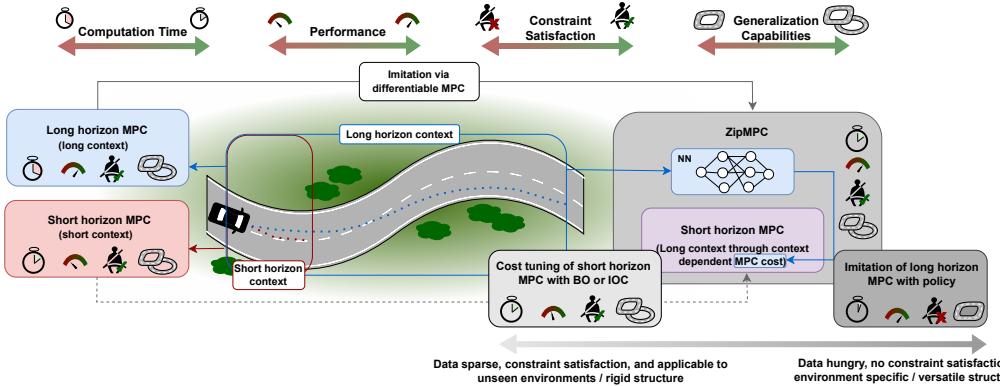
ZipMPC proposes a hybrid approach. Instead of replacing the MPC with a neural network (which loses safety guarantees) or just tuning a static cost function, ZipMPC uses a neural network to dynamically adapt the cost function of a short-horizon MPC based on the environment.
As illustrated in Figure 1, ZipMPC sits nicely between efficient imitation learning and robust optimization.
The Core Concept
The main idea is to use Imitation Learning. We treat the slow, Long-Horizon MPC (\(MPC_{N_L}\)) as the “expert” or “teacher.” We want our fast, Short-Horizon MPC (\(MPC_{N_S}\)) to imitate the teacher.
Since the short horizon physically cannot see the future track curvature, we provide that information (context) to a neural network. The network compresses this long-term context and outputs specific parameters for the cost function of the short MPC.
Ideally, if the neural network does its job, the Short MPC—guided by this “smart” cost function—will produce a trajectory almost identical to the Long MPC.
Under the Hood: The Learning Framework
How do we train a neural network to modify an optimization problem? The architecture involves a flow of information from the environment to the network, and then to the controller.
1. The Architecture
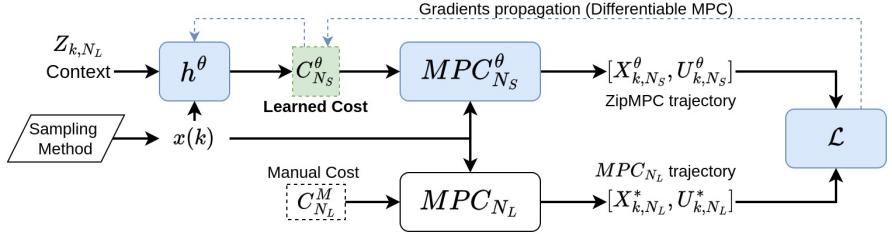
The process is visualized in the diagram below.
- Input: The system takes the current state \(x(k)\) and the Context \(Z_{k, N_L}\) (e.g., the track curvature for the next 50 meters).
- Neural Network (\(h^\theta\)): A Convolutional Neural Network (CNN) processes the context and outputs cost parameters (weights) for the short-horizon MPC.
- Learned Cost MPC: The \(MPC_{N_S}\) uses these learned weights to solve for a trajectory.
- Loss Calculation: The resulting trajectory is compared against the expert trajectory from the manual long-horizon MPC.
2. The Objective Function
The goal is to find the neural network parameters \(\theta^*\) that minimize the difference (loss \(\mathcal{L}\)) between the student’s trajectory and the teacher’s trajectory:

Here, the loss calculates how closely the Short MPC (\(N_S\)) matches the state and input sequences of the Long MPC (\(N_L\)).
3. Differentiable MPC
This is the most technically challenging part. To train the neural network using gradient descent (standard Deep Learning training), we need to calculate the gradient of the Loss with respect to the neural network weights \(\theta\).
Using the chain rule, this looks like:

The middle term—\(\frac{\partial [Trajectory]}{\partial [Cost Parameters]}\)—requires differentiating through the optimization problem itself. This is known as Differentiable MPC. The authors leverage recent advances in this field (specifically using KKT conditions and iterative solvers) to propagate informative gradients back from the trajectory error, through the MPC solver, and into the neural network.
This allows the network to learn exactly how to tweak the cost function to make the car drive better. For example, if the car is approaching a turn, the network might learn to temporarily increase the penalty on velocity, effectively telling the short-horizon MPC: “I know you can’t see the turn, but trust me, slow down now.”
Experimental Validation: Autonomous Racing
The researchers validated ZipMPC using autonomous racing scenarios, a classic problem where foresight and speed are critical. They used two vehicle models:
- Kinematic Bicycle Model: A simpler model for lower speeds.
- Pacejka Model: A complex, high-fidelity model that accounts for tire slip and forces, necessary for aggressive racing.
1. Imitation Performance
First, they checked if ZipMPC could actually copy the teacher. They compared it against BO (Bayesian Optimization, a standard way to tune static parameters) and eMPC (Explicit MPC, replacing the controller with a generic neural network).
As shown in Table 1, ZipMPC achieved the lowest imitation error (RMSE) compared to the long-horizon expert.

Notably, eMPC struggled because standard neural networks have trouble outputting structured predictions that perfectly satisfy physical constraints. ZipMPC, by keeping the MPC solver in the loop, ensures constraints are satisfied naturally.
2. Lap Times and Speed
The ultimate test in racing is the stopwatch. The researchers ran simulations on a complex track.
In Table 3 (using the complex Pacejka model), we see a stark difference. The standard Short Horizon MPC (\(N_S\)) often failed to even complete a lap because it couldn’t react to sharp turns in time. ZipMPC, using the same short horizon, not only completed the laps but achieved times very close to the Long Horizon expert (\(N_L\)).
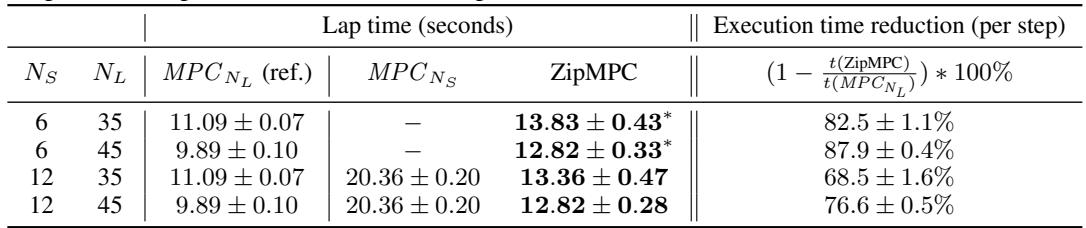
Perhaps most importantly, look at the Execution Time Reduction. ZipMPC runs 68% to 88% faster than the Long Horizon MPC. It provides “expensive” performance at a “cheap” computational price.
3. Visualizing the Trajectories
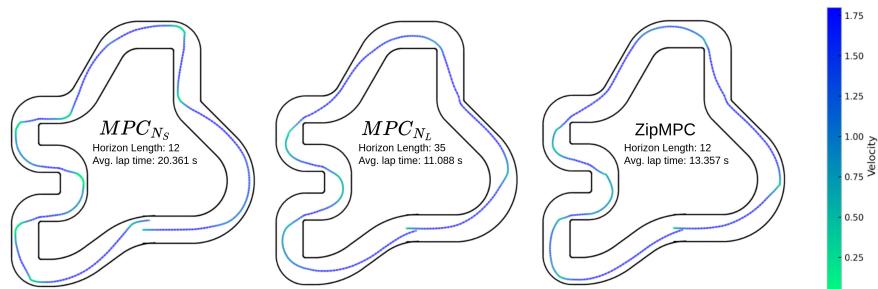
The trajectory plots confirm the data. In Figure 3, you can see the paths taken by the different controllers.
- Red/Failed: The standard Short MPC often creates harsh, jagged lines or crashes.
- Green (ZipMPC): This path is smooth, optimizing the racing line (out-in-out) just like the expert Blue (\(MPC_{N_L}\)) line.
4. Generalization: Unseen Tracks
A common failing of learning-based controls is overfitting—the robot memorizes the training track but fails on a new one.
Because ZipMPC learns a cost function based on local curvature context (rather than memorizing specific coordinates), it generalizes exceptionally well. The researchers tested the system on two tracks it had never seen before.

As shown in Figure 4, ZipMPC (Green) hugs the optimal line almost as tightly as the Long Horizon expert (Blue), even on completely new track layouts.
5. Ablation: Does Context Matter?
The researchers asked: “Is the neural network actually using the curvature information, or is it just finding a better static cost?”
They ran an ablation study comparing “Context-Aware” ZipMPC against a “Context-Free” version.
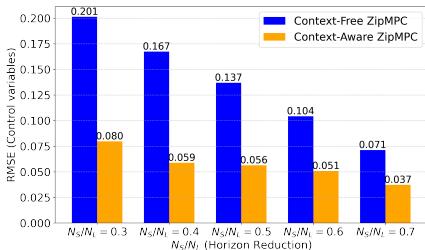
The results in Figure 5(a) show that context is crucial, especially when the horizon is very short (\(N_S/N_L\) is low). Figure 5(b) (right side of the image) visualizes the learned cost parameter \(p_d\) (lateral deviation cost). You can see the cost changes dynamically depending on whether the car is entering a left or right turn. The network has learned to “lean” the car into the turn by manipulating the cost.
Real-World Hardware Experiments
Simulation is one thing; reality is another. The team deployed ZipMPC on a 1/28-scale autonomous race car platform.
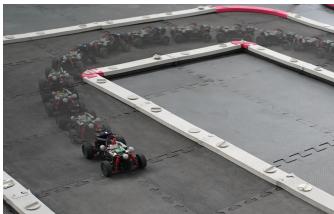
The hardware results mirrored the simulation. In challenging scenarios where a standard Short MPC failed (going off-track due to lack of foresight), ZipMPC successfully navigated the course.
Figure 12 shows a side-by-side comparison. The Green line (ZipMPC) closely tracks the Blue line (Long Horizon Expert).

Even more impressively, in scenarios with extremely short horizons where the standard MPC crashed, ZipMPC managed to complete the lap by effectively “hallucinating” the necessary caution into the cost function.
Conclusion
ZipMPC represents a significant step forward in making advanced control strategies feasible for real-time systems. By combining the structural guarantees of MPC (safety, constraints, physics) with the pattern-recognition capabilities of Neural Networks (learning context), the researchers created a controller that is:
- Fast: Computation times comparable to short-horizon MPC.
- Farsighted: Performance comparable to long-horizon MPC.
- Safe: Maintains hard constraints (unlike pure neural network policies).
- Generalizable: Works on environments unseen during training.
For students and engineers in robotics, this highlights the power of hybrid AI—systems that don’t just replace classical engineering with deep learning, but intelligently fuse them to solve fundamental trade-offs. Whether for autonomous racing, drone flight, or walking robots, “zipping” the horizon might be the key to agile, high-performance behaviors.