](https://deep-paper.org/en/paper/2507.19151/images/cover.png)
Introduction
Imagine a narrow corridor in a busy warehouse. Two autonomous robots, moving in opposite directions, meet in the middle. Neither has enough room to pass the other. A human would instinctively know what to do: one person backs up into a doorway or hugs the wall to let the other pass. But for robots, this simple interaction is a complex mathematical standoff.
In the world of robotics, this is a classic coordination problem. Traditionally, engineers solve this using optimization-based controllers. These are rigid, handcrafted mathematical rules that guarantee safety—ensuring the robot doesn’t hit a wall or another agent. However, these systems are notoriously bad at “social” negotiation. They often result in deadlocks where both robots just freeze, waiting for the other to move.
On the other end of the spectrum is Multi-Agent Reinforcement Learning (MARL). Here, robots learn by trial and error. Over millions of simulations, they figure out how to weave through traffic efficiently. The problem? Pure learning is unpredictable. A robot might learn to navigate perfectly 99% of the time, but in the 1% of cases where it fails, it might ram into a shelf or a person because it lacks formal safety guarantees.
This brings us to a fascinating new research paper: “ReCoDe: Reinforcement Learning-based Dynamic Constraint Design for Multi-Agent Coordination.” The researchers propose a hybrid solution that doesn’t choose between safety and adaptability—it chooses both. Instead of throwing away the reliable, handcrafted controller, ReCoDe keeps it as a foundation and uses a neural network to dynamically constrain it.
In this deep dive, we will explore how ReCoDe manages to marry the mathematical rigor of control theory with the flexibility of deep learning, allowing robots to “negotiate” complex traffic without ever sacrificing safety.
The Core Conflict: Safety vs. Coordination
To understand why ReCoDe is necessary, we first need to understand the limitations of the current standards in the field.
The Handcrafted Expert
Standard robotic control relies on Constrained Optimization. At every fraction of a second, the robot solves a mathematical problem: “Find the velocity vector that gets me closer to my goal, subject to the constraint that I must not collide with anything.”
This is often formulated as a Quadratic Program (QP). It’s powerful because it provides guarantees. If the math says the robot won’t crash, it won’t crash. However, these controllers are “myopic” or short-sighted. They optimize for the immediate next step. They don’t understand high-level concepts like “yielding” or “forming a queue.”
The Learning Agent
Reinforcement Learning (RL) agents, conversely, optimize for long-term rewards. They can learn cooperative behaviors that engineers wouldn’t know how to code explicitly. However, RL is a “black box.” It maps observations directly to actions. If the neural network encounters a situation it hasn’t seen before, its output is unpredictable. In safety-critical environments (like autonomous driving or industrial robotics), “unpredictable” is unacceptable.
The Hybrid Approach
ReCoDe (Reinforcement-based Constraint Design) bridges this gap. The core philosophy is simple: Don’t replace the expert controller; augment it.
The system allows a neural network to observe the environment and the intentions of other robots. But instead of telling the robot exactly what to do (e.g., “move at 1.5 m/s”), the network outputs a constraint. It essentially draws a circle on the ground and tells the classic controller: “You must find a solution inside this circle.”
The ReCoDe Method
Let’s break down the architecture of ReCoDe. It is a decentralized framework, meaning each robot runs its own copy of the software and makes its own decisions based on local information.
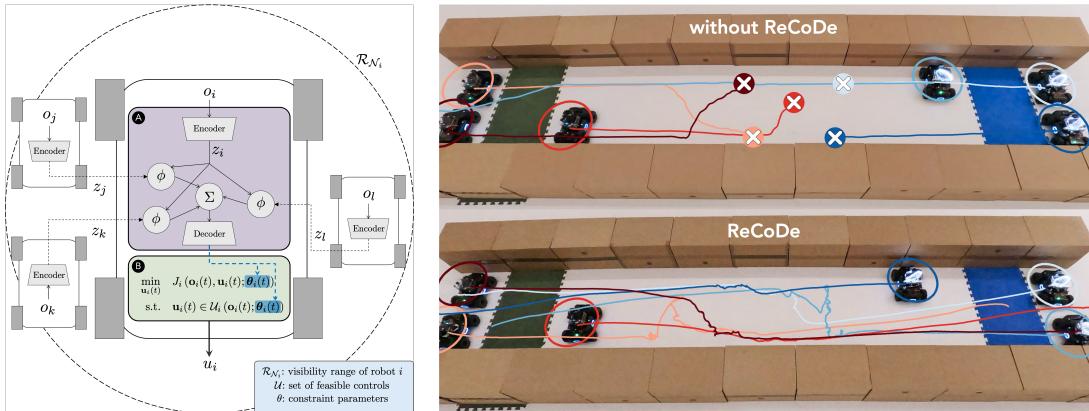
As shown in Figure 1 (Left), the architecture consists of two main blocks:
- The Learning Policy (Purple/Green): A Graph Neural Network (GNN) that processes observations (\(O_i\)) from the robot and its neighbors.
- The Optimization Controller (Green Box): A classic solver that calculates the final control input (\(u_i\)).
Step 1: Perception via Graph Neural Networks
Robots in a swarm need to understand their relationships with neighbors. ReCoDe uses a Graph Neural Network (GNN) for this.
In this graph:
- Nodes represent the agents (robots).
- Edges represent communication links between robots that are close to each other.
The GNN allows the robot to aggregate information. It looks at its own state and “messages” passed from nearby robots. This is crucial because coordination requires consensus. If Robot A moves left, Robot B needs to know that intent to move right. The output of this neural network is not a movement command, but a set of parameters: \(\theta_i(t)\).
Step 2: The Learned Constraint
This is the heart of the paper’s contribution. The neural network outputs parameters that define a Quadratic Constraint.
Specifically, the network outputs two values:
- A Reference Action (\(\mathbf{a}_i(t)\)): Ideally, what the neural network thinks the robot should do.
- An Uncertainty Radius (\(b_i(t)\)): How “strict” the network wants to be.
These parameters form a constraint equation:
\[ \|\mathbf{u}_i(t) - \mathbf{a}_i(t)\|_2 \leq b_i(t) + s_0 \]In plain English, this equation says: “The final control action \(\mathbf{u}\) must be within a distance \(b\) of the reference action \(\mathbf{a}\).”
- If \(b\) is small: The constraint is tight. The neural network is forcing the controller to follow its reference action very closely.
- If \(b\) is large: The constraint is loose. The neural network is saying, “I’m not sure, so I’ll give you a wide range of options. You (the expert controller) figure out the best move within this large area.”
Step 3: The Optimization Problem
The robot then takes this learned constraint and adds it to its existing list of safety rules (like collision avoidance). It solves the following optimization problem:

Let’s dissect this equation:
- Minimize \(J_i\): This is the original, handcrafted objective (e.g., “move toward the goal with minimum energy”).
- Subject to \(\|\mathbf{u} - \mathbf{a}\| \leq b + s_0\): This is the ReCoDe constraint. The solver must find a solution near the neural network’s suggestion.
- Subject to \(\mathcal{U}_i^s\): These are the hard safety constraints (don’t hit walls). These are never removed or altered by the neural network, guaranteeing safety.
- \(\lambda_0 s_0\): This involves a “slack variable” (\(s_0\)). If the neural network suggests something impossible (e.g., “move through that wall”), the solver can use the slack variable to violate the learned constraint (paying a high penalty cost \(\lambda_0\)) rather than crashing or failing to find a solution.
Why This Design is Brilliant
This architecture allows for a dynamic shift in authority.
In easy scenarios (open space), the neural network might output a massive \(b\) (radius), effectively stepping back and letting the mathematically optimal controller take over. In complex social scenarios (a crowded hallway), the controller would normally deadlock. Here, the neural network shrinks \(b\) and shifts \(\mathbf{a}\) to a specific side, forcing the controller to execute a “yielding” maneuver that the math alone wouldn’t have found.
The authors mathematically prove that this setup provides the best of both worlds.
Theoretical Guarantee: Adaptability
The paper provides a proposition stating that if the uncertainty radius is small enough, ReCoDe allows the agent to track any safe trajectory.

This inequality essentially proves that the learned policy can override the greedy nature of the handcrafted controller. If the expert controller wants to go straight (causing a deadlock), but the optimal long-term move is to back up, the learned constraint can force the system to back up by setting \(\mathbf{a}\) backwards and \(b\) to be very small.
Theoretical Guarantee: Uncertainty Mitigation
Conversely, what if the neural network is confused? In standard RL, a confused network outputs garbage, leading to erratic behavior. In ReCoDe, the authors analyze the relationship between the “flatness” of the neural network’s value function (uncertainty) and the radius \(b\).

This analysis suggests that when the learned policy is “uncertain” (the gradient of its Q-value is small/flat), it is beneficial to increase the radius \(b\). This allows the handcrafted objective \(J_i\) (which is strictly convex and decisive) to guide the agent. The empirical results later confirm that the robots actually learn to do this: they tighten the radius in crowds and loosen it in open spaces.
Experiments and Results
The researchers tested ReCoDe in four distinct, challenging scenarios designed to break standard controllers.
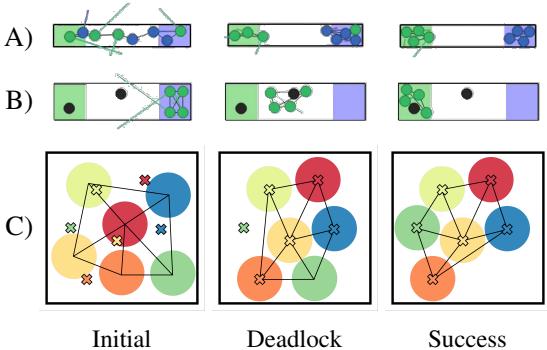
The Scenarios
- Narrow Corridor: Two groups of robots must swap sides in a hallway too narrow for them to pass without coordination.
- Connectivity: Agents must move to a goal while maintaining a communication chain. If they move too far apart, the chain breaks (mission failure).
- Waypoint Navigation: Large robots in a small room with random goals. High risk of blocking each other.
- Sensor Coverage: A multi-objective task where sensors must cover targets while maintaining formation.
Quantitative Dominance
As seen in the table within Figure 2, ReCoDe outperforms every baseline:
- Handcrafted: Often fails in complex coordination (negative rewards in Connectivity).
- Pure MARL: Struggles to learn precise controls, leading to lower scores.
- Other Hybrids (Online CBF, Shielding): ReCoDe achieves significantly higher rewards (e.g., 0.90 vs 0.55 for Shielding in the Narrow Corridor).
On average, ReCoDe attained 18% greater reward than the next-best method across all tasks.
Efficiency and Safety
One of the biggest hurdles in RL is training time. Because ReCoDe uses the expert controller as a “guide,” it learns much faster than pure RL.
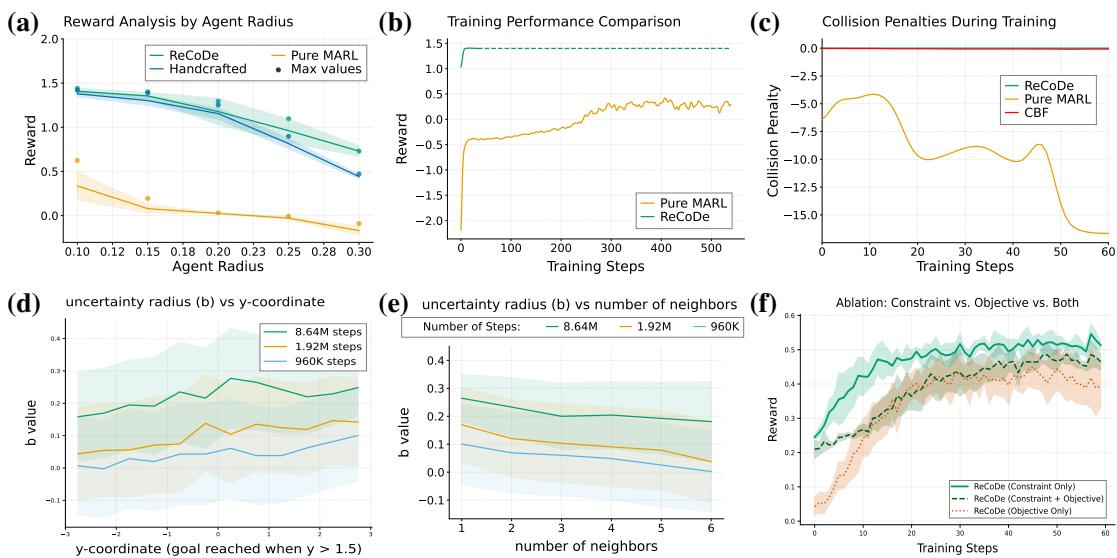
- Sample Efficiency (Figure 3b): Look at the orange line (Pure MARL) vs. the green line (ReCoDe). ReCoDe reaches near-optimal performance almost immediately (within 20 steps), while pure MARL is still struggling after 500 steps.
- Safety (Figure 3c): The blue line represents collision penalties. ReCoDe (green line, barely visible at the top) has near-zero collisions during training. Pure MARL (orange) crashes constantly while learning.
Insight: The “Breathing” Radius
Perhaps the most interesting result is shown in Figures 3d and 3e. The researchers plotted the learned uncertainty radius \(b\).
- Figure 3e: As the number of neighbors increases (crowd density goes up), the value of \(b\) decreases.
- Interpretation: When the robot is alone, it trusts the expert controller (large radius). When the robot is surrounded, it tightens the leash (small radius) to enforce complex coordination that the expert controller can’t handle. The system effectively “breathes”—expanding and contracting its constraints based on social pressure.
Real-World Deployment
Simulation is one thing; reality is another. The authors deployed ReCoDe on physical robots (Swarm of “Cambridge RoboMasters”).
Referencing Figure 1 (Right) again:
- Top row (Baseline): The robots enter the corridor, meet in the middle, and deadlock. They just sit there.
- Bottom row (ReCoDe): The robots meet. The learned constraints kick in. Some robots tuck into the side, changing their formation to allow the opposing team to squeeze past. They successfully swap sides.
This was achieved using a policy trained in simulation and transferred directly to the real world, handling real-world noise and communication delays.
A Note on Multi-Objective Tasks
The Sensor Coverage experiment highlights another strength. Here, robots have competing goals: go to a target and stay close to friends.
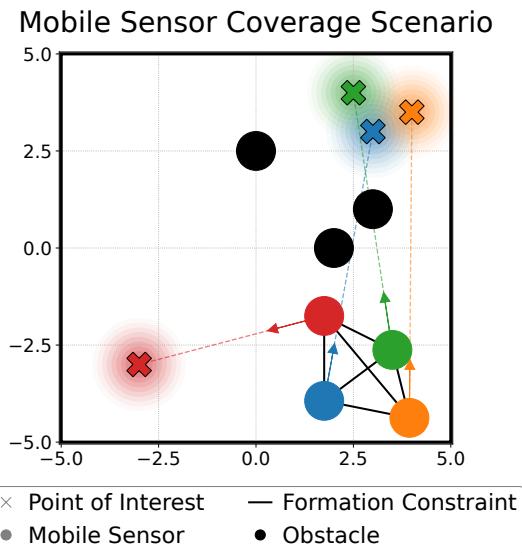
Handcrafted controllers struggle to balance these two opposing forces (often getting stuck in a local minimum). ReCoDe allows the agents to negotiate. One agent might “pull” the formation toward a high-value target by tightening its constraint in that direction, effectively leading the team.
Conclusion
The paper “ReCoDe” presents a compelling argument for hybrid control systems. Pure engineering (Control Theory) is safe but rigid. Pure AI (Reinforcement Learning) is flexible but chaotic. By using RL to design the constraints for Control Theory, we get a system that is:
- Safe: Hard safety constraints are never removed.
- Adaptive: Dynamic constraints solve deadlocks and complex social interactions.
- Efficient: Training is orders of magnitude faster than learning from scratch.
- Interpretable: We can analyze the “uncertainty radius” to understand when the AI is taking charge.
For students and researchers entering the field of robotics, ReCoDe illustrates a vital lesson: AI doesn’t always have to replace classical methods. Sometimes, the most powerful systems are built by letting the AI guide the existing mathematical foundations rather than reinventing them. As we move toward autonomous cars and warehouse fleets, frameworks like ReCoDe will likely become the standard for ensuring these machines can cooperate smoothly without crashing.