](https://deep-paper.org/en/paper/2507.22264/images/cover.png)
If you have experimented with modern AI art generators or image search engines, you have likely interacted with CLIP (Contrastive Language-Image Pre-training). Since its release, CLIP has become the backbone of multimodal AI, serving as the bridge that allows computers to understand images through text.
However, despite its massive success, CLIP has a fundamental problem: it struggles with details. If you describe a complex scene, CLIP tends to mash all the concepts together into a single entangled representation. Conversely, if you use a short caption, CLIP often discards visual information that isn’t explicitly mentioned in the text.
In this post, we will dive deep into a paper titled “SmartCLIP: Modular Vision-language Alignment with Identification Guarantees”. The researchers propose a fascinating solution: instead of trying to align an entire image with a caption, why not learn to “mask” the image dynamically, selecting only the parts relevant to the current text?
The Problem: Misalignment and Entanglement
To understand why we need SmartCLIP, we first need to look at how standard CLIP models are trained and where they fail. CLIP is trained on massive datasets of image-caption pairs using a contrastive loss. Ideally, the model learns that the image and its text description are identical in semantic space.
However, real-world data is messy. The authors identify two primary failures in standard training:
- Information Misalignment: An image often contains much more information than a single caption can describe. If we force the model to align the image only with that specific caption, the model learns to ignore the visual features that weren’t mentioned.
- Entangled Representations: When we use very long, detailed captions (like those generated by GPT-4V), the model is forced to compress everything into one vector. It learns a “soup” of features where concepts like “chair,” “pen,” and “flower” are inextricably mixed, making it hard for the model to understand these objects individually.
Let’s look at a concrete example provided by the researchers:
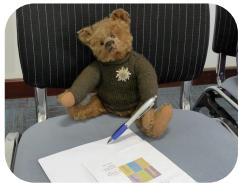
In Figure 1, notice the “Information Misalignment” on the left. The image contains a bear, a pen, and a chair.
- Caption 1 mentions the “bear” and “pen.”
- Caption 2 mentions the “bear” and “paper.”
If the model blindly aligns the image to Caption 1, it might learn to treat the “chair” and “paper” as noise to be discarded. This leads to a loss of visual concepts.
On the right side of the figure, we see “Entangled Representations.” The long caption describes the bear, chair, pen, flower, and floor. The model learns a representation that captures the scene but fails to disentangle the atomic concepts. It knows “bear-on-chair-with-pen,” but it might struggle to understand “pen” in isolation later.
The Theory: Viewing Vision-Language as a Causal Process
The researchers take a step back and model this problem theoretically using latent variable identification.
They propose that every image and text pair originates from a set of underlying semantic concepts, denoted as \(z_I\).
- The Image (\(i\)) is a direct manifestation of all these semantic concepts (\(z_I\)), plus some visual noise (\(\epsilon_I\)).
- The Text (\(t\)) is different. A caption rarely describes everything. Therefore, the text representation (\(z_T\)) is a subset of the image concepts.
They model this using a binary mask (\(m\)). The mask acts like a selector switch, turning specific concepts on or off depending on what the caption describes.

Here is the visualization of this data-generating process:
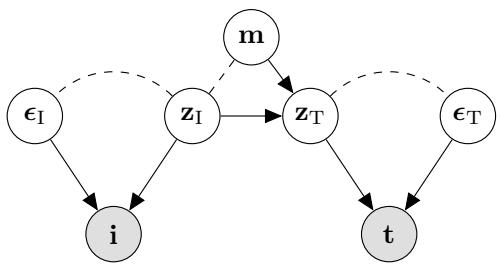
In Figure 2, you can see that the text representation \(z_T\) is derived from the full visual semantics \(z_I\) multiplied by the mask \(m\).
The Goal: Identification and Disentanglement
The theoretical contribution of this paper is significant. The authors prove that if we can correctly estimate this mask \(m\), we can achieve two things:
- Preserve Cross-Modal Information: We can recover the full latent representation \(z_I\) (the “whole picture”) by aggregating information from different captions.
- Disentangle Concepts: We can separate distinct concepts (like “bear” vs. “pen”) even if they never appear alone in the training data, simply by looking at the intersection of different masks.
The Solution: SmartCLIP
Based on this theory, the authors introduce SmartCLIP. The core idea is to modify the CLIP architecture to explicitly include this “masking” mechanism.
Architecture
SmartCLIP adds a lightweight Mask Network to the standard CLIP setup. This network takes the text embedding as input and predicts a binary mask. This mask tells the model: “For this specific caption, which dimensions of the image representation matter?”
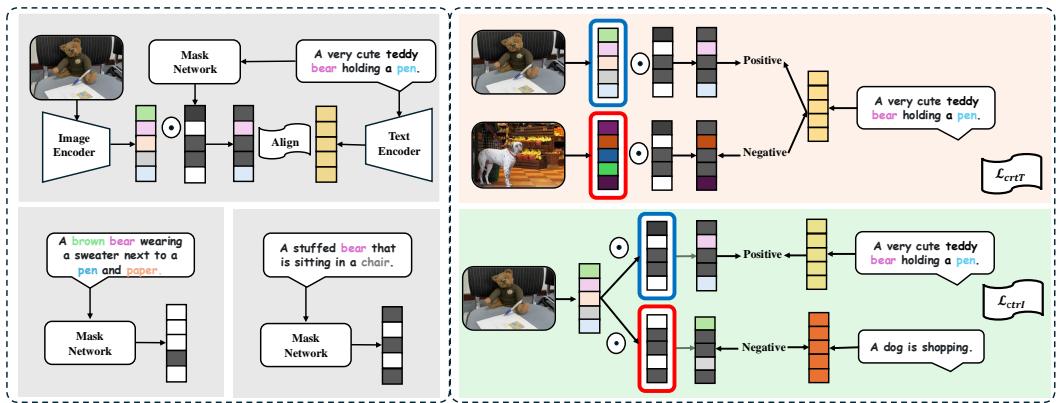
As shown in the diagram above:
- The Image Encoder produces a global image representation.
- The Text Encoder produces a text representation.
- The Mask Network (a small Transformer) looks at the text and outputs a mask.
- This mask is applied to the Image Representation.
- Finally, the model calculates the loss between the masked image representation and the text representation.
This seemingly simple change is profound. It allows the image encoder to learn a rich, full-featured representation of the image (containing the bear, the pen, the chair, and the background), while the alignment step only compares the relevant subset of those features to the text.
The Objective Function
To train this, SmartCLIP uses a specific set of loss functions.
First, there is the Sparsity Loss. We want the mask to be “sparse”—meaning it should select the minimum number of features necessary to explain the text. This prevents the model from cheating by just selecting everything.

Second, there is the Modular Contrastive Loss. This looks similar to the standard CLIP loss, but with a twist. It ensures that the masked image features align with the text.
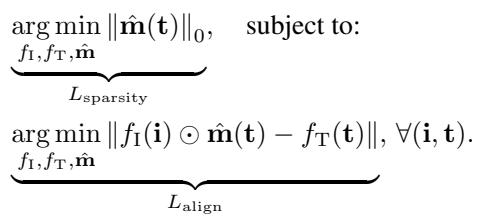
The total loss combines these two goals: aligning the data while keeping the representation efficient (sparse).

Experiments and Results
Does adding a mask network actually help? The authors tested SmartCLIP across several tasks, including image retrieval and zero-shot classification. They compared it against standard CLIP and “Long-CLIP,” a state-of-the-art model designed for long captions.
Text-to-Image Retrieval
Retrieval is the task of finding the correct image given a text query (or vice versa).
Short Text Retrieval (COCO & Flickr30k): On datasets with short, concise captions, SmartCLIP demonstrates a clear advantage.
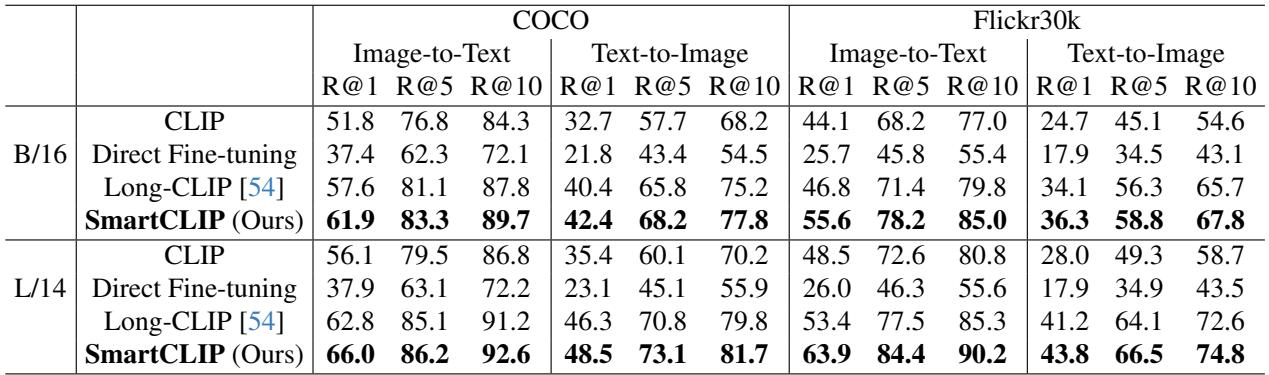
In Table 1, look at the “R@1” (Recall at rank 1) columns. SmartCLIP consistently outperforms both the baseline CLIP and Long-CLIP. This suggests that by using the mask to focus on specific concepts, the model becomes more precise.
Long Text Retrieval (ShareGPT4V & Urban1k): The improvements are even more dramatic when using long, detailed captions.
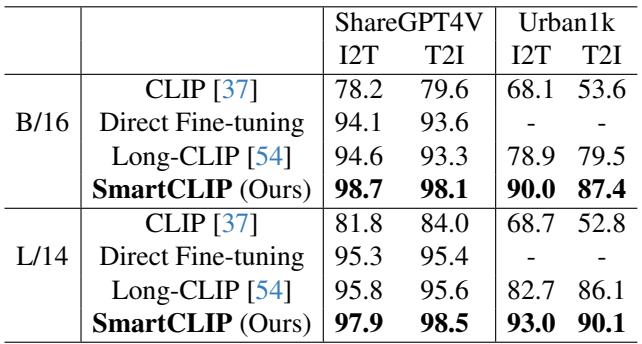
In Table 2, SmartCLIP achieves near-perfect scores (98.7% on ShareGPT4V) and significantly boosts performance on the Urban1k dataset compared to Long-CLIP. This validates the theory that SmartCLIP can effectively handle dense information without getting “tangled.”
Zero-Shot Classification
Can the model recognize objects it hasn’t been explicitly trained to classify?
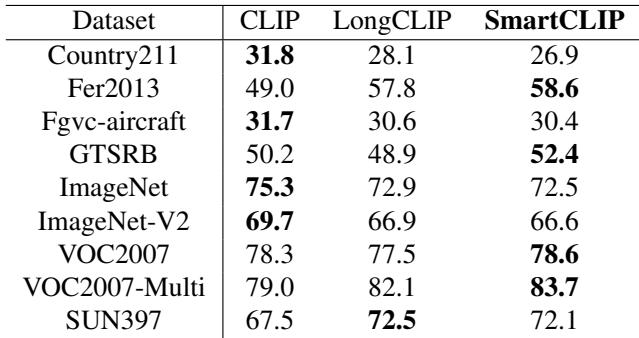
Table 3 shows that SmartCLIP is highly competitive. It performs particularly well on datasets like GTSRB (road signs) where the class names are combinations of words, benefiting from the disentangled representations.
What is the Model Actually Learning?
To verify that the mask is working as intended, the authors visualized the “attention” of the model—essentially, where the model looks when given a specific prompt.
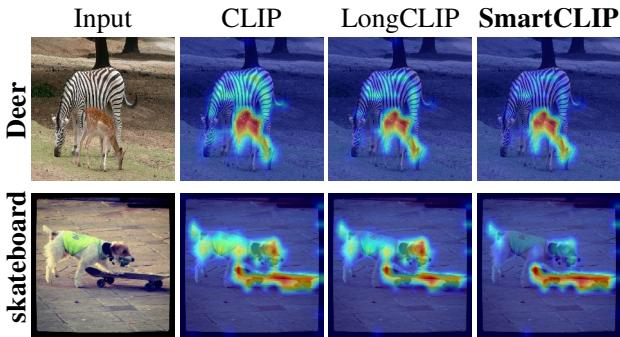
In Figure 6, we see a comparison of heatmaps.
- Left: The prompt is “a zebra.” SmartCLIP (bottom row) tightly focuses on the zebra.
- Right: The prompt is “a zebra and a deer.” SmartCLIP expands its focus to include the deer.
Notice how standard CLIP (top row) produces blurry, non-specific heatmaps. SmartCLIP provides much sharper, “atomic” localizations of objects.
Ablation Studies: Do we need the mask?
You might wonder if the performance boost comes from the architecture or just better training data. The authors performed ablation studies to prove the components matter.

The graphs in Figure 5 show that removing the modular alignment (the “w.o. Modular” line) causes a massive drop in performance (R@1). Furthermore, the graphs confirm that the Sparsity parameter (\(\lambda_{sparsity}\)) is crucial; there is a sweet spot where the mask selects just enough information to be useful without discarding too much.
Application: Better Image Generation
One of the most exciting applications of CLIP models is their use as text encoders for generative models like Stable Diffusion (SDXL). If the text encoder understands the prompt better, the generated image should be more accurate.
The authors swapped the standard CLIP encoder in SDXL with the SmartCLIP encoder. The results are striking.
The “Dinosaur Cucumber” Test: The prompt describes a sculpture of a T-Rex made of cucumbers with carrots for fire and celery leaves.
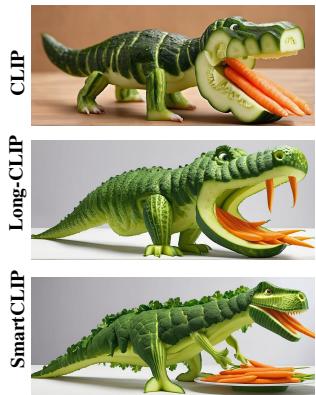
In Figure 4, look at the bottom panel (SmartCLIP).
- Standard CLIP (top) misses the “celery leaves” entirely.
- Long-CLIP (middle) gets closer but misses fine details.
- SmartCLIP (bottom) successfully generates the celery leaves on the back of the dinosaur, exactly as described in the long prompt.
The “Fashionable Corgi” Test: Here is another example with a Dachshund. The prompt asks for a “regal Dachshund” with “pumpkins” and a “vintage lantern.”
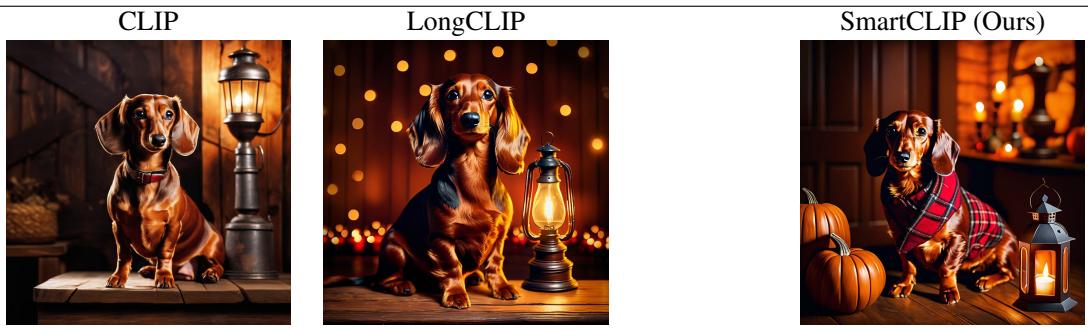
In Figure 8, the SmartCLIP result (right) provides the most detailed texture on the dog’s fur and integrates the pumpkins and lantern naturally, whereas the other models struggle with the lighting or texture details.
Conclusion
SmartCLIP represents a significant step forward in vision-language alignment. By acknowledging that a caption is merely a subset of an image’s reality, the authors designed a “modular” architecture that reflects this truth.
The introduction of the Mask Network allows the model to:
- Disentangle concepts: separating “bear” from “chair.”
- Adapt to context: focusing on the pen when the text mentions a pen, and the chair when the text mentions a chair.
- Identify latent variables: providing a theoretical guarantee that the model is learning meaningful, recoverable features.
For students and researchers in multimodal learning, SmartCLIP highlights the importance of aligning model architecture with the underlying causal structure of the data. It’s not just about bigger datasets; it’s about smarter alignment.