](https://deep-paper.org/en/paper/2508.02093/images/cover.png)
Introduction: The Gap Between Imagination and Execution
Imagine a child drawing a wobbly sketch of the Eiffel Tower and asking a robot, “Build this!” To a human, the request is obvious. We see the drawing, understand the structural intent—a wide base, a tapering tower, a spire on top—and we instinctively know how to arrange blocks to replicate it.
To a robot, however, this is a nightmare.
Current robotic manipulation systems are incredibly literal. They typically require precise 3D goal specifications: exact coordinates (\(x, y, z\)), orientation quaternions, and CAD models. These specifications usually come from complex design software, not a messy scribble on a piece of paper. There is a massive “modality gap” between the intuitive, noisy 2D way humans communicate ideas and the precise, physically grounded 3D data robots need to function.
This is the problem tackled by the research paper “Stack It Up!”: 3D Stable Structure Generation from 2D Hand-drawn Sketch. The researchers propose a system that allows non-experts to sketch a structure from a front view and have a robot automatically infer the 3D poses, depth, and even the hidden support blocks required to make it stand up in the real world.
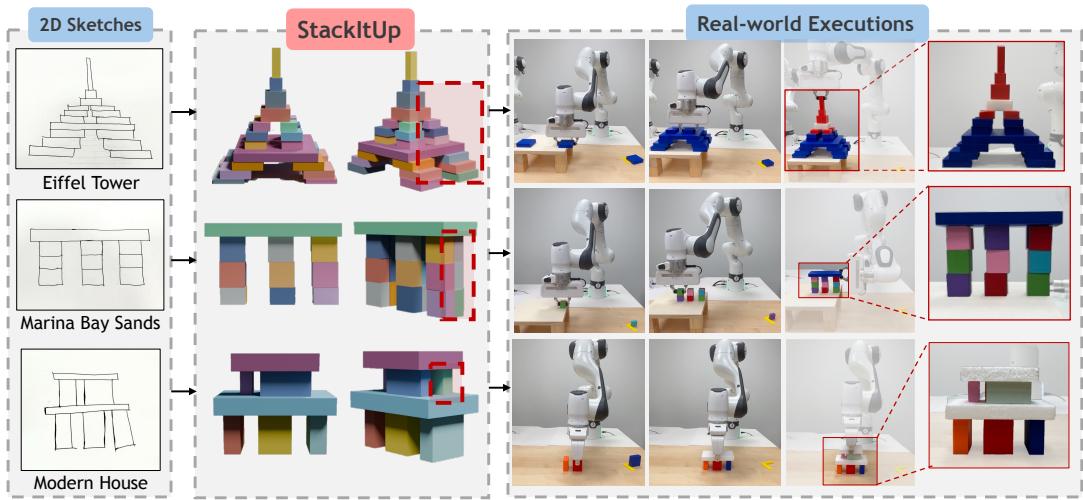
As shown in Figure 1, the system takes a rough sketch (left), hallucinates a stable 3D structure (middle), and outputs the coordinates to a robotic arm for physical execution (right).
The Challenge: Why Is This Hard?
Translating a sketch to a robot isn’t just about computer vision; it’s a physics and logic problem. There are two main hurdles:
- Metric Imprecision: Hand-drawn sketches are geometrically noisy. A line meant to be horizontal might be slanted. Two blocks meant to be the same size might be drawn differently. If a robot tries to replicate the sketch pixel-for-pixel, the resulting structure would likely topple over immediately.
- Missing Information (The 2D to 3D Problem): A front-view sketch is inherently incomplete. It collapses the depth dimension (\(y\)-axis). Furthermore, stable structures often require internal supports or rear “counterbalances” that are completely occluded in a front view. A robot acting only on visible lines would build a facade that collapses under gravity.
To solve this, the researchers moved away from trying to “reconstruct” the sketch directly. Instead, they introduced an intermediate logic layer: the Abstract Relation Graph.
The Core Method: The Abstract Relation Graph (ARG)
The researchers realized that when we look at a sketch, we don’t care about the exact pixel location of a block; we care about its relationship to other blocks. We see that “Block A is on top of Block B” or “Block C is bridging the gap between D and E.”
StackItUp formalizes this intuition using an Abstract Relation Graph (ARG). This graph serves as a bridge between the noisy sketch and the precise 3D arrangement.
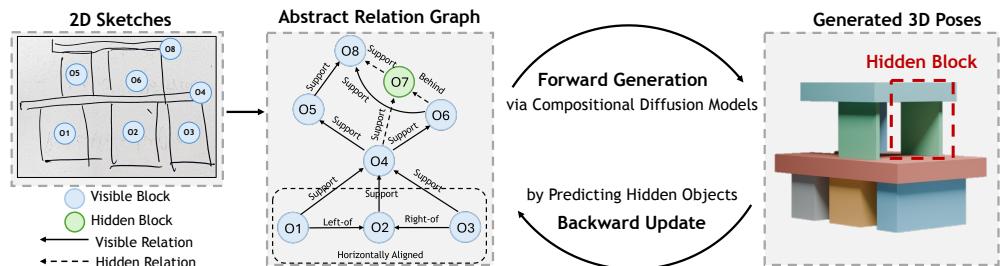
As illustrated in the overview above, the process works in a loop:
- Extract: Turn the sketch into a graph of geometric relations (e.g., “Left-of”, “Supported-by”).
- Ground: Use AI to turn that graph into 3D coordinates.
- Update: Check physics. If it falls, predict missing hidden blocks, update the graph, and try again.
1. Defining the Relations
The system needs a vocabulary to describe the structure. The researchers defined a library of Geometric Relations (spatial layout) and Stability Patterns (structural logic).
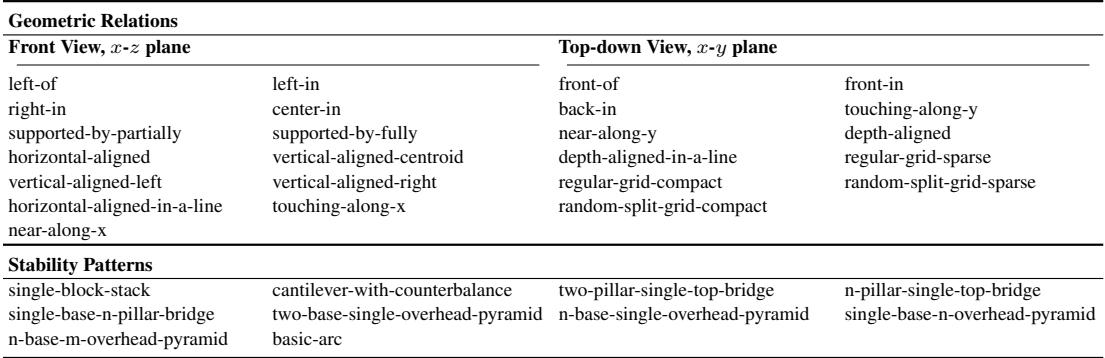
Looking at Table 1 above, you can see the granularity of these relations:
- Geometric:
left-of,horizontal-aligned,front-of,touching-along-x. - Stability Patterns: These are crucial. They describe functional subgroups of blocks, such as a
two-pillar-bridgeor acantilever-with-counterbalance.
2. Forward Grounding: From Graph to Poses
Once the system has an initial graph derived from the sketch, it needs to assign specific \(x, y, z\) coordinates to the blocks. This is where Compositional Generative Models come in.
Instead of training one massive neural network to understand every possible building, the researchers trained many small “diffusion models.” Each small model is an expert at one specific relation.
- Model A knows how to put an object “left of” another.
- Model B knows how to make an object “supported by” another.
To generate a full structure, the system combines these models. It’s like a committee meeting: if the graph says Block 1 is left-of Block 2 AND supported-by Block 3, the system mathematically combines the “opinions” (score functions) of the left-of model and the supported-by model.
This is achieved using Unadjusted Langevin Algorithm (ULA) sampling. The update rule for the position of the blocks (\(p\)) looks like this:

In this equation:
- \(p_t\) is the current noisy pose of the blocks.
- The sum \(\sum\) aggregates the “gradients” (directions to move) from all the relevant relation models \(\epsilon_R\).
- This effectively nudges the blocks into a configuration that satisfies all the constraints simultaneously.
3. Backward Update: The “Stability” Loop
This is the most innovative part of the paper. A graph extracted purely from a front-view sketch is often physically unstable because it lacks depth and rear supports.
If the generated 3D structure is unstable in a physics simulation, StackItUp doesn’t just give up. It performs a Backward Graph Update.
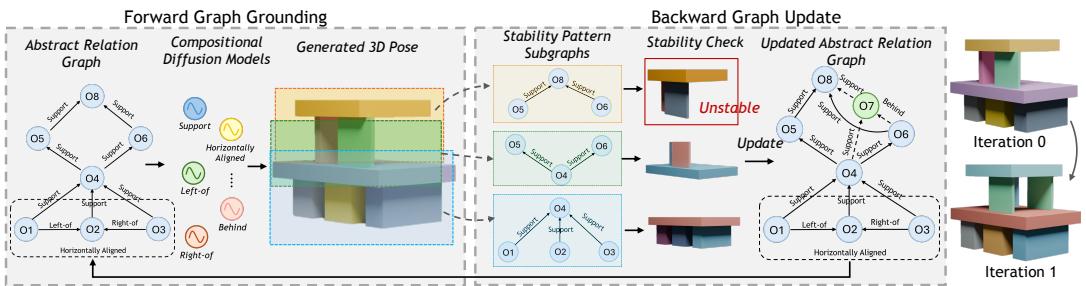
As shown in Figure 3, the system:
- Detects Instability: It realizes the structure will fall.
- Matches Patterns: It looks at the unstable cluster of blocks and compares it to the Stability Patterns library (from Table 1).
- Predicts Hidden Blocks: It might recognize a “bridge” pattern that is missing a pillar. It essentially says, “This looks like a bridge, but it only has one leg. I should add a hidden leg behind the visible one.”
- Updates Graph: It adds a new “hidden” node (green node in the figure) to the graph and runs the generation step again.
This allows the system to hallucinate structural elements that the user didn’t draw but are physically necessary.
The Logic of Stability
How does it know what to add? The system relies on a predefined dictionary of valid structural patterns.
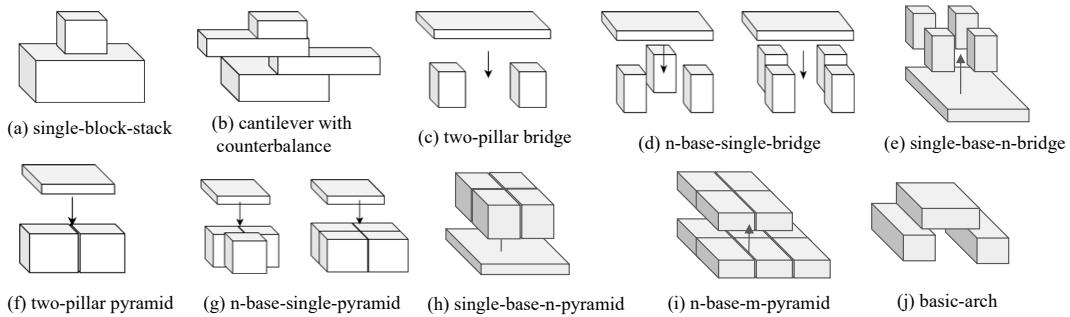
Figure 8 illustrates these patterns. Whether it’s a cantilever (b) or a two-pillar-bridge (c), the system uses these templates to diagnose why a structure is failing and what blocks (hidden from the front view) are needed to fix it.
Experiments and Results
The researchers tested StackItUp against two main baselines:
- End-to-End Diffusion: A standard AI approach that tries to predict 3D poses directly from the sketch image in one shot.
- Direct VLM Prediction: Using a Vision-Language Model (like GPT-4V) to look at the sketch and output coordinates via code/text.
Qualitative Comparison
The visual difference in performance is striking.
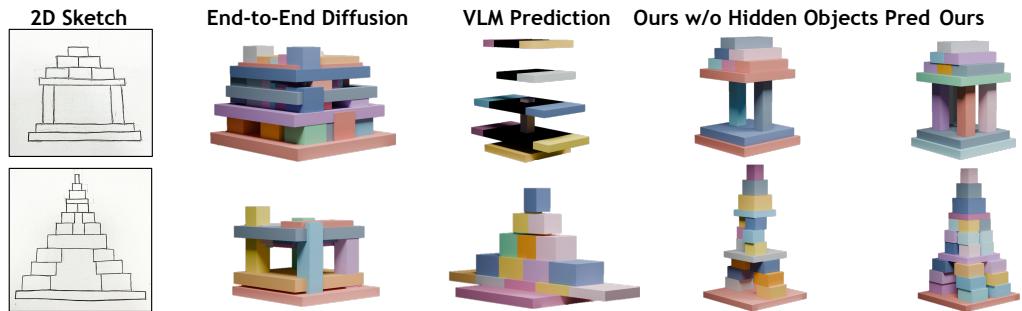
In Figure 5, look at the “End-to-End Diffusion” and “VLM” columns. The structures are often messy, blocks are floating or intersecting, and they don’t capture the clean structural logic of the sketch. The StackItUp column, however, produces clean, aligned, and stable structures that respect the “architectural” intent of the drawing.
Handling Complexity
The system’s robustness is further highlighted when dealing with complex sketches that require hidden supports.
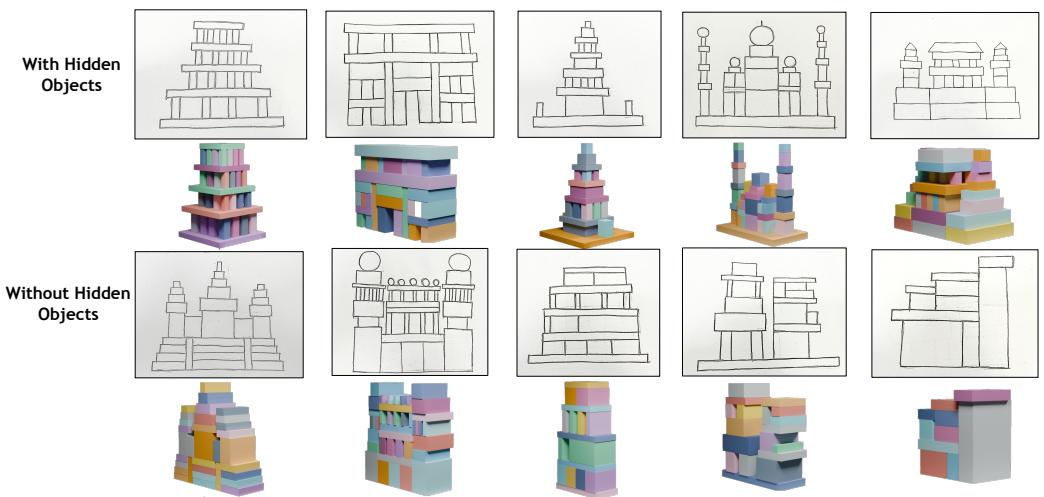
In Figure 4 (Top Row), the sketches imply depth that isn’t drawn. StackItUp successfully infers the hidden green blocks required to hold up the visible blue blocks. In the Bottom Row, simpler structures are generated with high fidelity.
Robustness to Block Variations
A fascinating feature of using an Abstract Relation Graph is that it is agnostic to the specific blocks used. You can change the size of the blocks available to the robot, and the system will adapt the poses to maintain the relationships.

Figure 6 (left side of the image above) shows how the same sketch can result in a “Large Overhead Bridge” or a “Small Overhead Bridge” depending on the blocks available, while preserving the topology. The graphs (Figure 7 on the right) quantitatively show that as complexity (number of blocks) increases, the baseline methods (Blue and Green lines) fail, while StackItUp (Brown line) maintains high stability and resemblance.
Quantitative Analysis
The researchers measured two metrics:
- Resemblance: Does the 3D structure look like the sketch?
- Stability: Does it stay standing under gravity?

While Table 5 (above) outlines the methodological differences, the paper reports that StackItUp achieves nearly 95-98% stability across tasks, whereas end-to-end diffusion models struggle significantly (often below 25% stability for complex scenes).
Conclusion: Implications for Robotics
“Stack It Up!” represents a shift in how we think about human-robot interaction. Instead of forcing humans to learn CAD or complex coordinate systems, it empowers robots to understand human intent through our most natural creative medium: sketching.
By separating the logic (Abstract Relation Graph) from the metric details (Diffusion Grounding), and by incorporating a physics-aware loop (Stability Patterns), the system bridges the gap between a noisy 2D drawing and a precise 3D execution.
This approach suggests a future where we might design furniture, organize warehouses, or direct construction robots simply by doodling on a tablet, trusting the AI to handle the physics and the hidden details.
Key Takeaways
- Abstraction is Key: Converting pixels to a logic graph allows the system to ignore drawing errors.
- Compositional AI: Using many small “expert” models is more flexible than one giant “black box” model.
- Physics-Aware Hallucination: Robots can be taught to infer invisible objects if they understand the rules of stability.