](https://deep-paper.org/en/paper/2508.03027/images/cover.png)
Introduction
Imagine walking into a pitch-black building with a flashlight. Your goal is to find a specific exit or map out the entire floor. As you walk down a corridor, you don’t just see the illuminated patch in front of you; your brain instinctively constructs a mental model—a “cognitive map”—of what lies in the darkness. You might hypothesize, “This looks like a hallway, so it probably extends straight,” or “This looks like a lobby, so there might be doors on the sides.”
This ability to “imagine” the unseen environment allows humans to make efficient navigation decisions. Robots, however, typically lack this foresight. Most autonomous systems operate greedily, moving toward the nearest “frontier” (the edge between known and unknown space) without considering the broader structural context.
In this post, we will explore CogniPlan, a novel framework presented by Wang et al. that bridges this gap. By combining conditional generative AI (to predict potential layouts) with Deep Reinforcement Learning (DRL) on graphs (to plan paths), CogniPlan gives robots the ability to reason about uncertainty and “hallucinate” plausible futures to make better decisions.
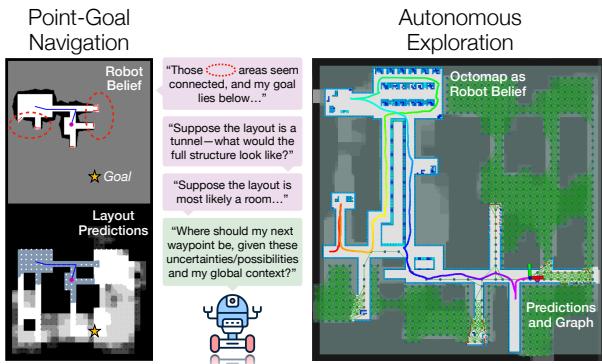
As shown in Figure 1, the robot doesn’t just see what is immediately visible; it generates fuzzy, probabilistic predictions of the layout (shown in the bottom left) and uses them to plan intelligent paths for both exploration and point-goal navigation.
The Problem: Planning in the Unknown
Path planning in unknown environments is a classic robotics problem divided into two coupled tasks:
- Autonomous Exploration: The robot must map the entire environment as quickly as possible.
- Point-Goal Navigation: The robot must reach a specific coordinates in unknown space via the shortest path.
The core challenge is uncertainty. Traditional methods, like frontier-based exploration, rely on heuristics. They essentially ask, “Which unmapped edge is closest?” and move there. While computationally cheap, this is often “myopic”—short-sighted. The robot might enter a room, scan a corner, leave, and then realize later it needs to go back, leading to inefficient backtracking.
Recent learning-based methods have tried to encode spatial knowledge into neural networks, but they often struggle to scale to large environments or fail to explicitly model what the unknown area looks like. CogniPlan addresses this by explicitly predicting the map layout and using those predictions to guide a graph-based planner.
The CogniPlan Framework
CogniPlan functions like a two-part brain. One part is the imagination engine (Generative Inpainting), which predicts what the unknown map looks like. The second part is the reasoning engine (Graph Attention Planner), which decides where to move based on those predictions.
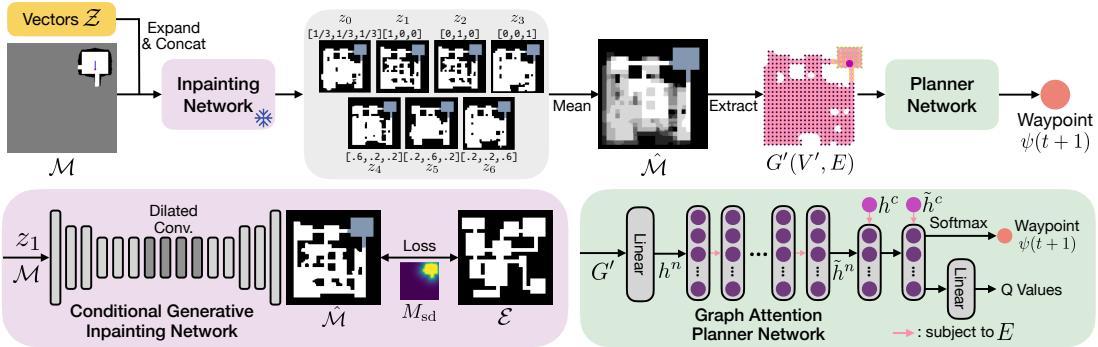
Figure 2 illustrates the pipeline. Let’s break down the two main components: the Generative Inpainting Network and the Graph Attention Planner.
1. Conditional Generative Inpainting
The first step is to fill in the blanks of the robot’s partial map. The researchers employ a Wasserstein Generative Adversarial Network (WGAN) to perform image inpainting.
However, a single prediction isn’t enough. If a robot is facing a T-junction in the dark, predicting only a left turn is dangerous if the path actually goes right. The robot needs to understand uncertainty.
Multiple Hypotheses via Conditioning
To capture this uncertainty, CogniPlan generates multiple plausible layouts. It achieves this by feeding the generator a set of layout conditioning vectors (\(z\)). These vectors act as “style guides,” prompting the network to generate different types of structures, such as rooms, tunnels, or outdoor spaces.
Mathematically, the generator takes the partial map \(\mathcal{M}\), a mask of unknown regions, and a condition vector \(z\) to produce a prediction \(\hat{\mathcal{M}}\). By running this multiple times with different \(z\) vectors, the robot generates a set of varying predictions. When these predictions are averaged, the result is a probabilistic map where pixel values represent the likelihood of an area being free or occupied.
The Training Objective
The inpainting network is trained using a combination of adversarial loss and reconstruction loss. The total loss function for the generator is defined as:

Here is what the terms represent:
- \(-\mathbb{E}[\mathrm{Dis}(\hat{\mathcal{M}})]\): The adversarial loss. The generator tries to fool the discriminator into thinking the inpainted map is real.
- L1 Norms (\(\lambda_1, \lambda_2\)): These terms ensure pixel-wise accuracy compared to the ground truth.
- Spatially Discounted Mask (\(M_{sd}\)): This is a clever addition. The authors apply a weight that decays exponentially with distance from the known area. This forces the network to be highly accurate near the robot’s current position (where traversability matters most) while allowing more “artistic license” deep in the unknown regions.
- F1 Score (\(\lambda_3\)): This optimizes the overlap between predicted and actual obstacles.
2. The Uncertainty-Guided Planner
Once the robot has “imagined” the environment, it needs to plan a path. Planning directly on a high-resolution pixel map is computationally expensive. Instead, CogniPlan converts the map into a graph.
Building the Graph
The framework constructs a collision-free graph where nodes are distributed in the free space. Crucially, the nodes are enriched with features derived from the generative predictions:
- Signal (\(s_i\)): Is this node in a known area or a predicted area?
- Probability (\(p_i\)): What is the probability this space is free? (Derived from averaging the multiple inpainting predictions).
- Utility (\(u_i\)): Does this node help uncover new frontiers?
- Guidepost (\(g_i\)): Is this node on a trajectory toward a frontier?
This graph, \(G'\), encapsulates both the hard data (what the robot has seen) and the soft data (what the robot imagines).
Graph Attention Network (GAT)
The planner itself is a neural network based on the Graph Attention architecture. It consists of an Encoder and a Decoder.
- Encoder: Aggregates information from the graph. It uses self-attention mechanisms to allow nodes to “talk” to their neighbors. By stacking multiple attention layers, a node can gather context from distant parts of the graph. This gives the robot a global understanding of the environment’s topology.
- Decoder: Takes the global context and the robot’s current position to output a policy. It effectively assigns a score to neighboring nodes, deciding which one the robot should visit next.
The planner is trained using Soft Actor-Critic (SAC), a powerful Deep Reinforcement Learning algorithm. The reward function encourages the robot to uncover unknown areas (exploration) or move closer to the target (navigation) while minimizing travel distance.
Experiments and Results
The researchers evaluated CogniPlan extensively against several baselines, including classic heuristics (Nearest Frontier), sampling-based methods (NBVP), and other learning-based planners (ARiADNE+, TARE).
Simulation Performance
The primary metric for success is travel length—how far the robot had to drive to complete the task. Shorter is better.

As shown in Table 1 (Exploration), CogniPlan outperforms all baselines across Room, Tunnel, and Outdoor environments.
- It achieved a 17.7% reduction in travel length compared to “Inpaint+TARE” (a baseline that uses predictions but a traditional planner). This proves that simply having a predicted map isn’t enough; the planner must be trained to understand the uncertainty of that prediction.
- It achieved a 7.0% reduction compared to ARiADNE+, a state-of-the-art DRL planner that doesn’t use generative inpainting.
Table 2 (Navigation) shows similar dominance, with CogniPlan outperforming the “Inpaint+A*” method by 3.9% and the “Context-Aware (CA)” learning baseline by 12.5%.
The Importance of Multiple Predictions
Is it really necessary to generate multiple map predictions? The authors tested this by varying \(|Z|\) (the number of predictions).
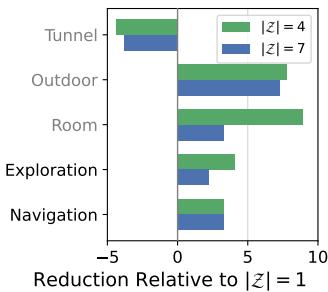
Figure 3 shows the reduction in travel length when using 4 or 7 predictions compared to just 1. In almost every case, using multiple predictions (blue and green bars) leads to better performance. This confirms that capturing uncertainty—by averaging diverse “imagined” layouts—is critical for robust planning.
Robustness to Starting Position
A good explorer should perform well regardless of where it spawns. The authors tested CogniPlan on realistic floor plans with random starting locations.
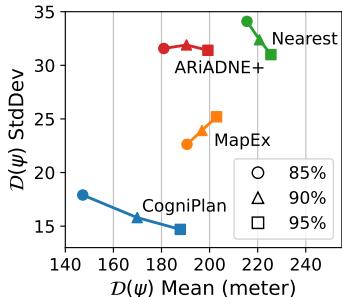
Figure 5 plots the mean travel distance (x-axis) against the standard deviation (y-axis). Ideally, a method should be in the bottom-left corner (efficient and consistent). CogniPlan (blue star) is significantly more consistent than the baselines. The predictions provide a global structural prior that guides the planner, preventing it from getting “lost” or backtracking unnecessarily, regardless of where it starts.
Qualitative Results: Seeing the Path
Numbers are great, but visualizing the robot’s behavior makes the difference clear.
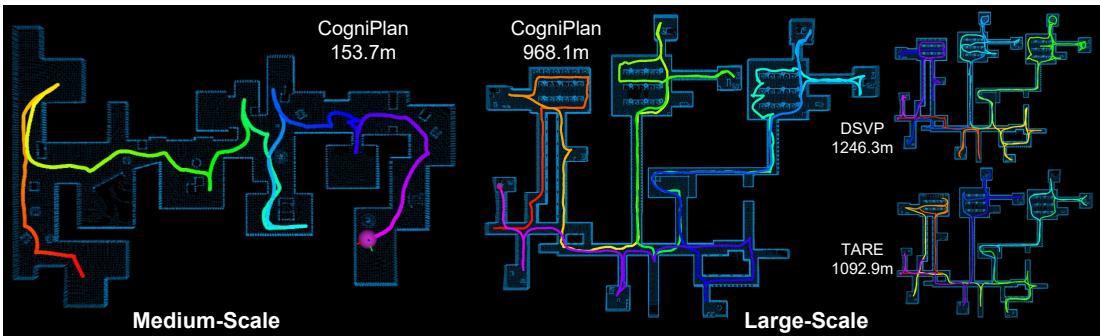
In Figure 7, we see the trajectories of different planners.
- CogniPlan (Left & Center): The paths are smooth and logical. The robot systematically clears rooms and corridors.
- DSVP & TARE (Right): Notice the messy, overlapping lines. These traditional planners often force the robot to zigzag or revisit areas, leading to the “spaghetti” trajectory seen in the DSVP example (top right).
Real-World Deployment
Finally, the authors proved that CogniPlan isn’t just a simulation trick. They deployed it on a physical mobile robot equipped with a LiDAR sensor in a messy indoor laboratory.
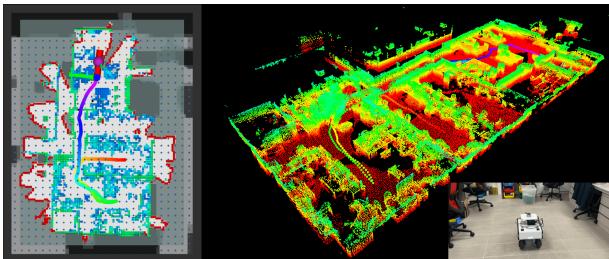
As seen in Figure 6, the robot successfully built a complete point cloud of the lab. It managed to navigate around chairs, tables, and moving people, demonstrating that the framework is computationally efficient enough to run on real hardware.
Conclusion
CogniPlan represents a significant step forward in robotic autonomy. It moves away from purely reactive, greedy behaviors and toward a more “cognitive” approach where robots actively reason about what they cannot see.
Key Takeaways:
- Synergy of Imagination and Reason: The power of CogniPlan lies in the combination of Generative Inpainting (to provide detailed spatial hypotheses) and Graph Attention Networks (to reason over the structural uncertainty).
- Uncertainty is Useful: By generating multiple potential layouts, the robot can identify which areas are ambiguous and which are certain, leading to safer and more efficient paths.
- Better than the Sum of Parts: The experiments showed that simply feeding a predicted map to a standard planner (Inpaint+TARE) performs poorly. The planner must be trained to utilize the probabilistic nature of the prediction.
This work opens exciting doors for future research, including multi-agent exploration and the integration of visual data (cameras) to further enhance the robot’s “imagination.”