](https://deep-paper.org/en/paper/2508.03428/images/cover.png)
Introduction
Imagine a delivery robot navigating a busy warehouse or a cleaning robot moving through a crowded train station. These environments are unstructured and, more importantly, dynamic. Humans, forklifts, and other robots are constantly moving. For a robot to operate safely, it can’t just look at a static map; it must predict the future.
One of the most popular ways to control such robots is Model Predictive Control (MPC). MPC is great because it looks a few seconds into the future, optimizes a trajectory to avoid collisions, executes the first step, and then repeats the process. However, MPC has a blind spot: the end of its horizon. If the robot plans 5 seconds ahead, what ensures it isn’t leading itself into a trap that closes at 5.1 seconds?
To solve this, control theorists use Terminal Constraints—a “safe set” of states the robot must end up in to guarantee long-term safety. Calculating this safe set perfectly in dynamic environments requires heavy mathematics known as Hamilton-Jacobi (HJ) reachability analysis, which is notoriously too slow for real-time robotics.
In this post, we will dive into a paper that proposes a clever hybrid solution: Residual Neural Terminal Constraint (RNTC-MPC). The researchers combine the rigorous safety of control theory with the speed of deep learning. Instead of asking a neural network to learn safety from scratch, they teach it to learn the difference (the residual) between a simple distance check and the complex true safety value. The result? A planner that is up to 30% more successful than state-of-the-art baselines in dynamic collision avoidance.
Background: The Safety Challenge
To understand the contribution of this paper, we need to briefly unpack three concepts: MPC, Reachability Analysis, and the “Curse of Dimensionality.”
Model Predictive Control (MPC)
MPC solves an optimization problem at every time step. It tries to minimize a cost function (like getting to the goal quickly) while adhering to constraints (don’t hit obstacles, don’t speed).

In the formulation above, equation (3f), \(h_{k+N}(x_{k+N}) \geq 0\), is the Terminal Constraint. This is the critical component. It tells the optimizer: “Whatever path you choose, make sure the robot is in a ‘safe’ state at the very end of the prediction horizon (\(N\)).” If this constraint is defined correctly, the robot remains recursively feasible—meaning it can always find a safe path in the next step.
Hamilton-Jacobi Reachability
How do we define that “safe state”? The gold standard is Hamilton-Jacobi (HJ) Reachability Analysis. This method computes a Backward Reachable Tube (BRT). Conceptually, a BRT is the set of all states from which a collision is inevitable, no matter how hard the robot brakes or turns.
The boundary of this safe set is defined by the HJ Value Function, \(V(x,t)\).

If \(V(x, t) > 0\), the robot is safe. If \(V(x, t) \le 0\), the robot is in the danger zone. To find \(V\), one must solve the Hamilton-Jacobi-Bellman Partial Differential Equation:

The Problem: Real-Time Feasibility
Solving the equation above involves dynamic programming over a grid of the state space. This suffers from the Curse of Dimensionality. Adding just one moving obstacle expands the state space significantly (robot states + obstacle states). Computing this online on a mobile robot’s limited hardware is generally impossible.
Therefore, researchers often resort to approximations. But if you approximate the safe set incorrectly, the robot crashes. This paper asks: Can we approximate this value function quickly using Neural Networks while maintaining safety guarantees?
The Core Method: RNTC-MPC
The researchers propose a method that doesn’t just “throw a neural network at the problem.” Instead, they use a specific mathematical property of the HJ value function to design a smarter architecture.
The Insight: Value vs. Distance
Let’s look at two functions:
- \(V(x)\): The HJ Value Function (True safety metric).
- \(F(x)\): The Signed Distance Function (SDF). This is simply the geometric distance to the nearest obstacle.
Calculating the SDF (\(F(x)\)) is fast and easy. Calculating \(V(x)\) is slow and hard. Crucially, \(V(x) \le F(x)\).
Why? Because \(F(x)\) only tells you if you are currently touching an obstacle. \(V(x)\) tells you if you will touch an obstacle eventually. If you are 1 meter away from a wall (\(F(x)=1\)), but moving toward it at high speed effectively unable to stop, your safety value \(V(x)\) might be negative (unsafe). Therefore, the true safety value is always lower than or equal to the geometric distance.
Learning the Residual
Instead of training a neural network to estimate \(V(x)\) directly (which is a complex function), the researchers estimate the Residual (\(R(x)\)). The residual is the “safety gap” between the simple geometric distance and the complex dynamic safety value.

Rearranging this, the estimated value function \(\hat{V}\) becomes:
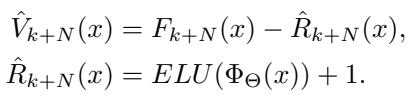
Here is the genius part: If we ensure that our estimated Residual \(\hat{R}\) is always positive ($ \ge 0\(), then our estimated safety $\hat{V}\) will always be lower than the SDF (\(F\)).
While this doesn’t strictly guarantee \(\hat{V} \le V_{true}\), it imparts a strong inductive bias for safety. The network only has to learn the correction to the SDF, rather than the whole function from scratch.
Architecture: Hypernetworks
The environment changes constantly. A static neural network can’t handle a dynamic environment where obstacles pop up in random places. To handle this, the authors use a Hypernetwork.
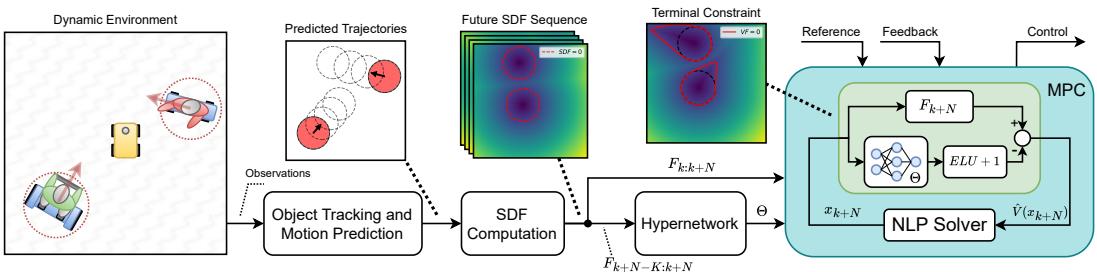
As shown in Figure 1, the architecture works in two stages:
- The Hypernetwork: This takes the environment observation (the sequence of future Signed Distance Functions based on obstacle predictions) as input. It does not output a safety value. Instead, it outputs weights (parameters).
- The Main Network: This is a tiny, lightweight Multi-Layer Perceptron (MLP). It uses the weights generated by the Hypernetwork. It takes the robot’s state \(x\) and outputs the residual \(R\).
This setup allows the system to adapt to new environments instantly. As the obstacles move, the SDF sequence changes, the Hypernetwork updates the weights, and the Main Network changes its shape to represent the new safe set.
Ensuring Non-Negativity
To fulfill the requirement that the residual \(R(x)\) is always non-negative, the researchers use a specific activation function on the output of the Main Network: ELU + 1.

Standard ELU (Exponential Linear Unit) can be negative. By adding +1, the minimum value becomes 0. Unlike ReLU (which is also non-negative but has zero gradients for negative inputs), ELU+1 ensures non-zero gradients everywhere, making training much more stable.
Training with CME Loss
Training this system requires a ground-truth dataset. The researchers simulate thousands of random scenarios and use an offline HJ solver (which takes hours) to generate the true \(V(x)\) labels.
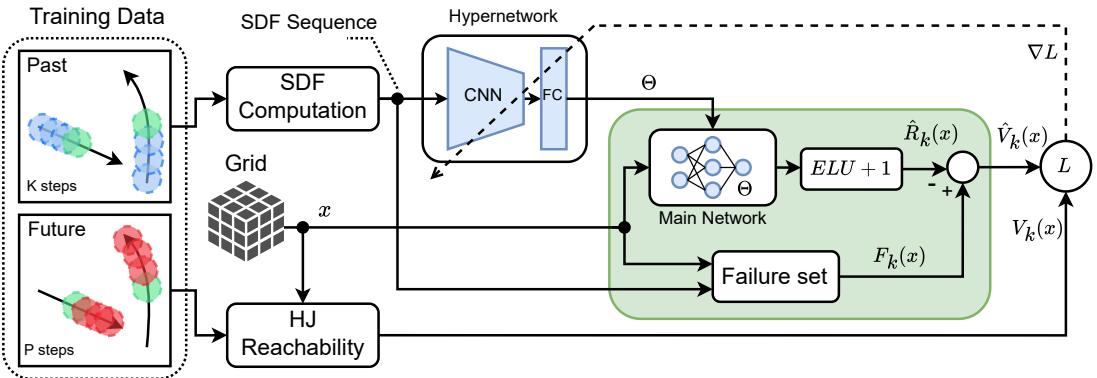
To train the network, they introduce a custom loss function called CME (Combined MSE and Exponential) Loss.

- MSE Term: Ensures the prediction is close to the truth.
- Exponential Term: Heavily penalizes unsafe errors.
This hybrid loss function helps the network converge faster and prioritize safety in critical regions (near the boundary of the safe set).
Experiments and Results
The team validated RNTC-MPC in both Gazebo simulations and on real hardware, comparing it against three baselines:
- SDF-MPC: Uses simple distance constraints (often unsafe).
- DCBF-MPC: Uses Discrete Control Barrier Functions.
- VO-MPC: Uses Velocity Obstacles (a classic robotics technique).
Simulation Performance
In simulation, the robot had to navigate a corridor with 6 moving obstacles bouncing around.
Success Rate: The most critical metric is success rate—how often did the robot reach the goal without crashing?
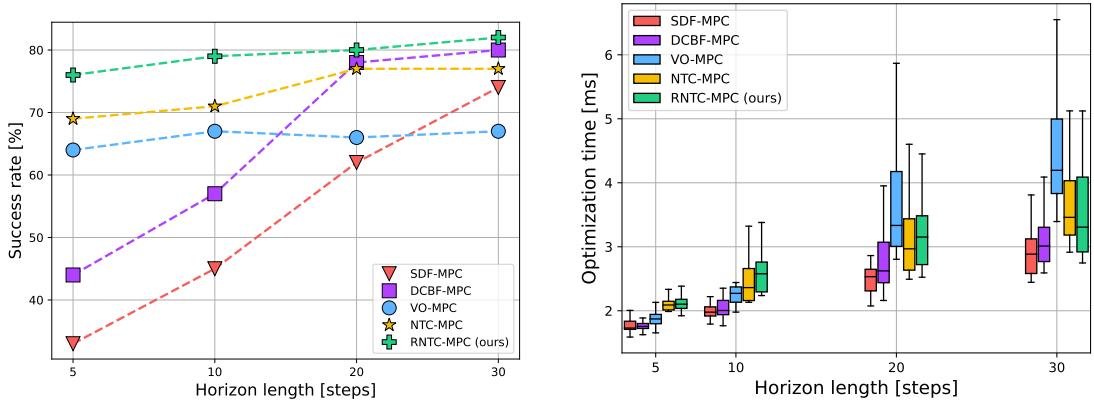
As seen in Figure 3 (Left), RNTC-MPC (green line) achieves nearly 100% success rate even with short prediction horizons. Baselines like SDF-MPC fail catastrophically when the horizon is short because they can’t “see” the inevitable collision coming beyond the horizon. RNTC-MPC’s learned terminal constraint effectively gives it “infinite” foresight.
Travel Time vs. Safety: Safety often comes at the cost of speed (the “freezing robot” problem).
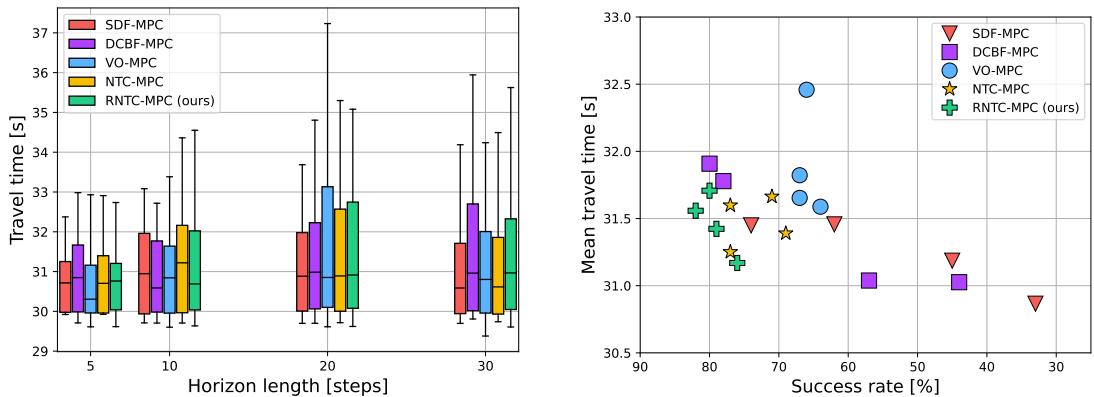
Figure 4 illustrates the trade-off. The ideal planner is in the bottom-right corner (High Success, Low Travel Time). The green crosses (RNTC-MPC) occupy this sweet spot better than the competitors, indicating it navigates safely without being overly conservative or slow.
Ablation: Why Learning the Residual Matters
Is it really better to learn the residual (\(F - V\)) rather than just learning \(V\) directly? The authors compared their method (RNTC) against a version that learns \(V\) directly (NTC).
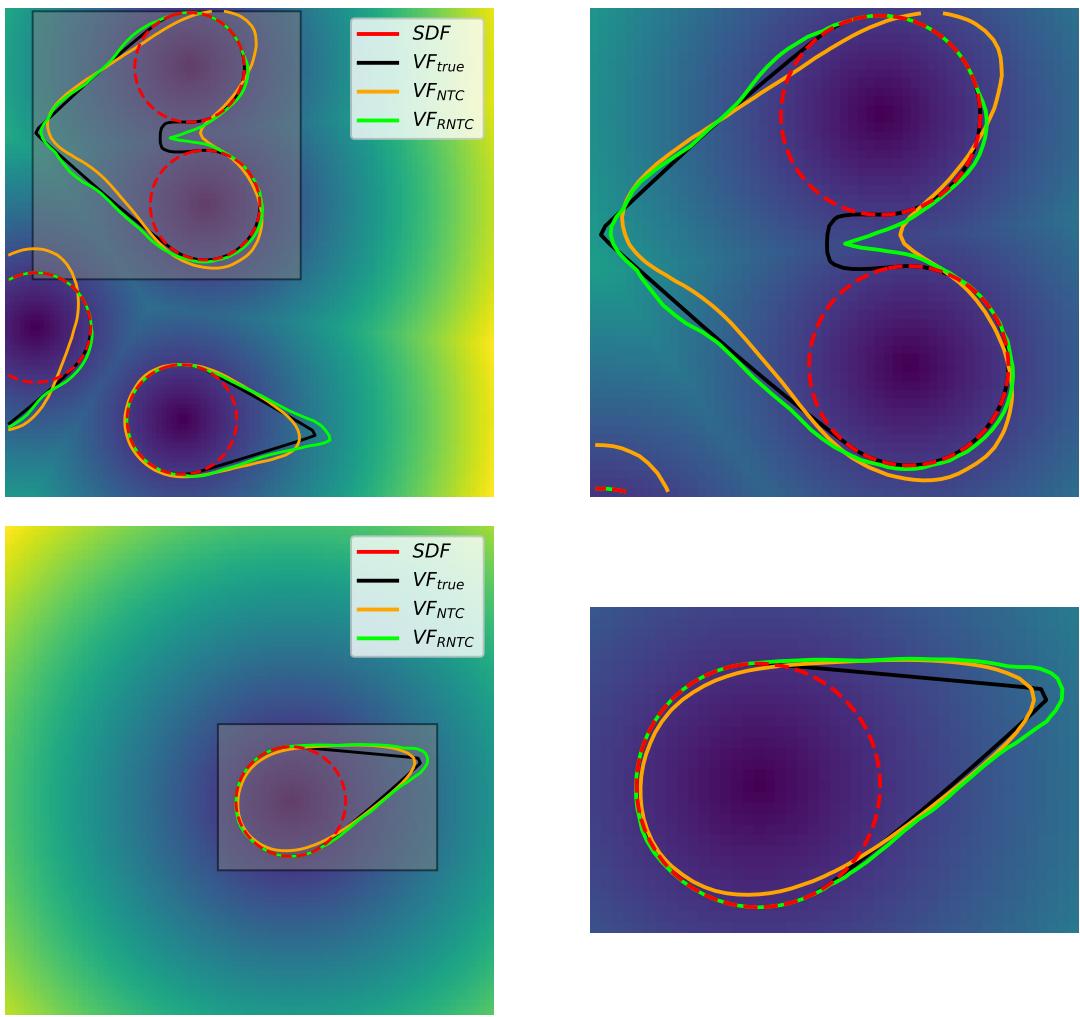
Figure 7 visually demonstrates the difference.
- Black Line: True Safe Set boundary.
- Red Line: SDF boundary (geometric distance).
- Green Line (RNTC): The proposed method. It tightly hugs the True Safe Set.
- Orange Line (NTC): The direct learning method. Notice how the orange line drifts inside the danger zone?
Because NTC tries to learn the function from scratch, it makes dangerous errors. RNTC is anchored to the SDF and only subtracts a positive residual, making it structurally much safer.
Hardware Experiments
Simulations are great, but the real world is messy. The team deployed the code on a robot equipped with LiDAR and cameras. The task: cross a room while pedestrians intentionally try to intersect the robot’s path.

Table 1 shows the results for a 1-second prediction horizon.
- SDF-MPC crashed frequently (40% success).
- RNTC-MPC achieved 100% success.
- Notably, RNTC-MPC also had the lowest average travel time (12.76s), proving that the robot didn’t just stop to wait for people to pass—it actively navigated around them.
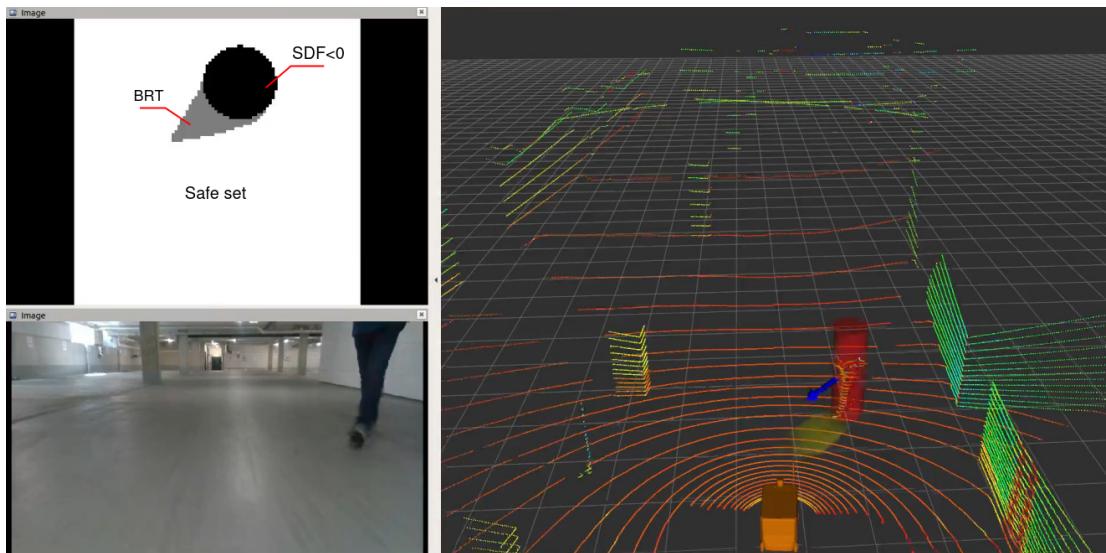
Figure 13 gives us a peek into the “robot’s brain” during these experiments, showing the predicted terminal set (top left) matching the detected human in the camera view (bottom left).
Conclusion & Implications
The Residual Neural Terminal Constraint (RNTC) represents a significant step forward for safe robot navigation. By combining the theoretical rigor of Hamilton-Jacobi reachability with the flexibility of Hypernetworks, the authors created a system that is fast enough for real-time use but safe enough for dynamic environments.
Key Takeaways:
- Don’t Learn from Scratch: Leveraging the relationship between the Signed Distance Function and the Value Function (\(V \le F\)) simplifies the learning problem.
- Structural Safety: Enforcing non-negative residuals ensures the network tends toward conservative (safe) estimates.
- Hypernetworks for Adaptation: Separating the environment encoding (Hypernet) from the state evaluation (Main Net) allows for rapid adaptation to moving obstacles.
This approach offers a blueprint for future research: rather than replacing control theory with black-box neural networks, we should use deep learning to approximate the computationally expensive parts of control theory, while keeping the mathematical guarantees intact. Future work will likely focus on scaling this to higher-dimensional systems, such as drones or robotic arms, where the “Curse of Dimensionality” is even more severe.