](https://deep-paper.org/en/paper/2508.03890/images/cover.png)
If you have ever driven a vehicle off-road, you know that the terrain is rarely forgiving. For a human driver, spotting a sudden dip, a ditch, or a cliff edge requires constant vigilance. For an autonomous robot, this challenge is magnified ten-fold.
In the world of autonomous driving, “negative obstacles”—like ditches or craters—are notoriously difficult to detect. From a distance, a narrow ditch often looks like a continuous flat surface to sensors. If a robot underestimates a slope or misses a ditch, the consequences range from getting stuck to a catastrophic rollover.
To navigate safely at high speeds, a robot needs more than just a camera feed; it needs a precise 3D model of the ground beneath it. More importantly, it needs to know how confident it is about that model. If the robot is unsure about a patch of terrain, it should slow down or avoid it.
In this post, we are diving deep into a paper titled “Uncertainty-aware Accurate Elevation Modeling for Off-road Navigation via Neural Processes.” The researchers propose a novel method that combines the best of deep learning and probabilistic modeling to create accurate, real-time elevation maps that don’t just guess the terrain—they tell you how uncertain they are.
The Problem: Why Off-Road Perception is Hard
Navigating a paved road is essentially a 2D problem; you stay in your lane and avoid obstacles. Off-road navigation is a complex 2.5D or 3D problem. The vehicle must constantly estimate the elevation of the ground (\(z\)) for every point (\(x, y\)) in front of it to decide if the terrain is traversable.
Most autonomous vehicles rely on two main sensor types:
- LiDAR: Shoots laser beams to measure distance. It provides precise depth but is “sparse.” At a distance, the gaps between laser rings become large enough to miss a ditch entirely.
- Cameras: Provide rich visual information (color, texture) but lack inherent depth information.
The “Narrow Gap” Issue
The core issue the authors address is illustrated below. When a LiDAR sensor looks at a ditch from a shallow angle (far away), the laser rays might hit the ground before the ditch and after the ditch, but miss the hole in the middle.
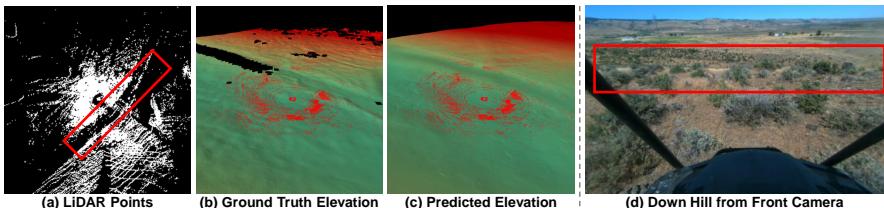
As seen in Figure 1, to a camera (Panel d), the grassy terrain looks continuous. The LiDAR (Panel a) barely registers the drop. Traditional methods often interpolate (connect the dots) linearly, leading the robot to believe the ground is flat. This “optimistic” prediction is dangerous.
Why Existing Methods Fall Short
Historically, roboticists have used two main approaches to solve this:
- Gaussian Processes (GPs): These are excellent at handling uncertainty. They don’t just give you a value; they give you a probability distribution. However, they are computationally expensive (\(O(N^3)\) complexity) and struggle to run in real-time on a moving robot.
- Deep Neural Networks (DNNs): These are fast and can learn complex patterns. However, they tend to “over-smooth” terrain, erasing sharp features like cliffs. Furthermore, standard DNNs are often “over-confident,” providing wrong predictions without signaling high uncertainty.
The Solution: Neural Processes
The researchers propose using Neural Processes (NPs). NPs are a fascinating class of models that attempt to combine the strengths of both approaches:
- Efficiency and flexibility of Neural Networks.
- Uncertainty quantification of Gaussian Processes.
The core idea is to treat the terrain modeling problem as a conditional prediction task. Given a set of “context points” (observed LiDAR hits and camera features), the model predicts the elevation distribution for “target points” (the grid cells in the map we want to fill in).
Architecture Overview
The proposed method isn’t just a vanilla Neural Process; it introduces several key innovations to handle the specific challenges of off-road driving.
- Semantic Conditioning: It fuses geometric data (LiDAR) with semantic data (images) so the model understands that “grass” usually behaves differently than “rock.”
- Temporal Aggregation: It remembers what it saw in previous frames to build a more confident map.
- Ball-Query Attention: A new mechanism to make the processing efficient enough for real-time robotics.
Let’s break down the pipeline, visualized in Figure 2.
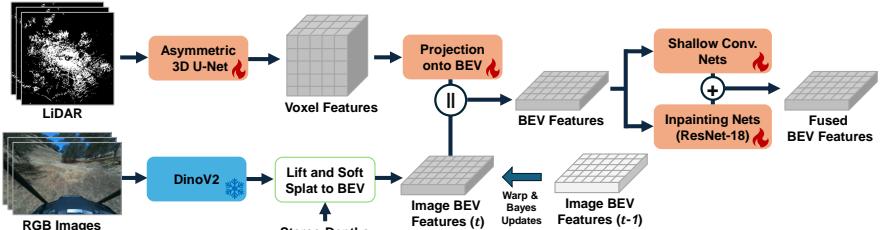
The pipeline has two streams:
- LiDAR Stream: Point clouds are processed by a 3D U-Net to extract geometric features.
- Image Stream: Images are processed by a Vision Transformer (DinoV2) to extract semantic features. These 2D image features are “lifted” into 3D space using stereo depth and projected onto a Bird’s-Eye-View (BEV) grid.
These two streams are concatenated (merged) and passed into the Neural Process module.
The Core Math: How the Model “Thinks”
To understand how the model predicts elevation, we need to look at the Neural Process formulation. The goal is to predict the distribution of terrain heights \(H_T\) at target locations \(X_T\), given the observed context points \(X_C\) and their heights \(\hat{H}_C\).
The model uses a latent variable \(z\) (a hidden variable) that captures the global uncertainty of the environment. The conditional predictive distribution is defined as:

Here is what is happening in that equation:
- The model encodes the context (observations) into a latent representation \(s_C\).
- It samples a global variable \(z\) from this representation. This \(z\) represents the “style” or “mood” of the current terrain (e.g., “we are in a rocky, hilly area”).
- It combines \(z\) with a deterministic representation \(r_C\) to predict the target heights.
To train this model, the researchers maximize the Evidence Lower Bound (ELBO), a standard technique in probabilistic machine learning that balances prediction accuracy with the complexity of the latent distribution.

Semantic-Conditioned Neural Processes
The “Context” in this paper is richer than just \(X\) and \(Y\) coordinates. The authors introduce Semantic-Conditioned NPs.
Instead of just relying on spatial coordinates \((x,y)\) and height \(h\), the model conditions its predictions on feature vectors \(F\) derived from the camera and LiDAR.
- Context: \(\{(x_i, y_i), \text{height}_i, \text{features}_i\}\)
- Target: \(\{(x_j, y_j), \text{features}_j\}\)
This allows the model to hallucinate (interpolate) terrain much better. If the LiDAR misses a spot, but the camera features say “this is the same gravel road as the pixel next to it,” the model can infer the height is likely similar.
The full updated probabilistic model looks like this:

Innovation: Ball Query Attention
One of the biggest bottlenecks in transformer-like models (which ANPs are similar to) is the Attention Mechanism. Standard global attention compares every target point to every context point. If you have a large grid (e.g., \(256 \times 256\)), this operation is massive and kills real-time performance.
The authors propose Ball Query Attention.

As shown in Figure 3, for every query point (a specific location on the map), the model only calculates attention scores for keys (observations) that fall within a small radius \(\epsilon\).
The attention calculation becomes:

Why does this matter?
- Locality: Terrain elevation is locally dependent. The height of the ground 100 meters away usually doesn’t affect the height of the ground right here.
- Efficiency: This reduces Floating Point Operations (FLOPs) by 17% and inference time by 36%, making it feasible to run on a robot’s onboard computer.
Temporal Aggregation: Memory Matters
If the robot saw a ditch 2 seconds ago, it shouldn’t forget it just because the ditch is now out of the camera’s view. The authors implement a Bayesian update rule to aggregate image features over time.
They treat the “density” of projected image pixels as a proxy for confidence (\(p\)). They update the feature map \(f_t\) at the current time step by combining it with the previous feature map \(f_{t-1}\):

This ensures that the semantic map becomes richer and more stable as the vehicle moves, rather than flickering with every new frame.
Experimental Setup
To prove this works, the team didn’t just run simulations. They took a Polaris RZR off-road vehicle (shown in Figure 4) to three distinct and challenging environments:
- CA Hills: Grassy up and down hills.
- Mojave Desert: Trails with bushes, rocks, and Joshua trees.
- Ellensburg: A complex area with ditches, cliffs, and steep slopes.

They compared their method against several strong baselines, including Sparse GPs (SGP), BEVNet (a standard deep learning approach), and TerrainNet.
Results: Does it Work?
Quantitative Analysis
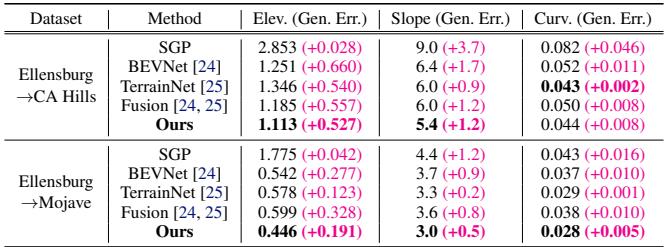
The results, summarized in the table below, show that the proposed method (Ours) consistently achieves the lowest errors in elevation, slope, and curvature estimation.
Key Takeaways from the Data:
- Generalization: One of the hardest things in robotics is training on one terrain (e.g., Ellensburg) and testing on another (e.g., Mojave). The table shows that the proposed method has the smallest “Generalization Gap” (magenta numbers), meaning it adapts well to new environments.
- Slope Accuracy: The method is particularly good at estimating slope, which is the most critical factor for preventing vehicle rollovers.
Qualitative Analysis
Numbers are great, but maps tell the story. Let’s look at a comparison on the “CA Hills” dataset.
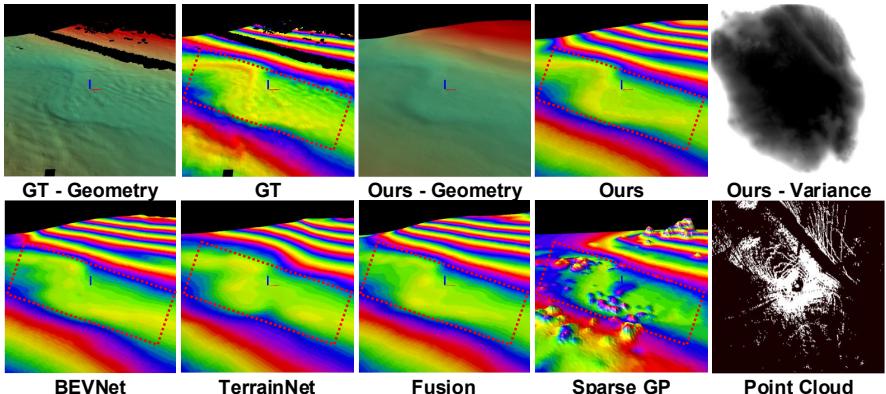
In Figure 5, look at the “Ours - Geometry” column. Notice how it captures the sharp dip in the terrain. Compare this to standard deep learning methods (like BEVNet or TerrainNet in other comparisons), which often smooth this out into a gentle slope.
Furthermore, look at the Variance column. The model highlights areas where it is uncertain. This is the “Uncertainty-aware” part of the title. This map tells the planner: “I think there is a ditch here, but I’m also highly uncertain about the area behind the ridge.”
Visualizing Uncertainty
One of the coolest features of Neural Processes is the ability to sample the latent variable \(z\). By sampling different \(z\) values, we can see different “possible worlds” that the model thinks might exist.
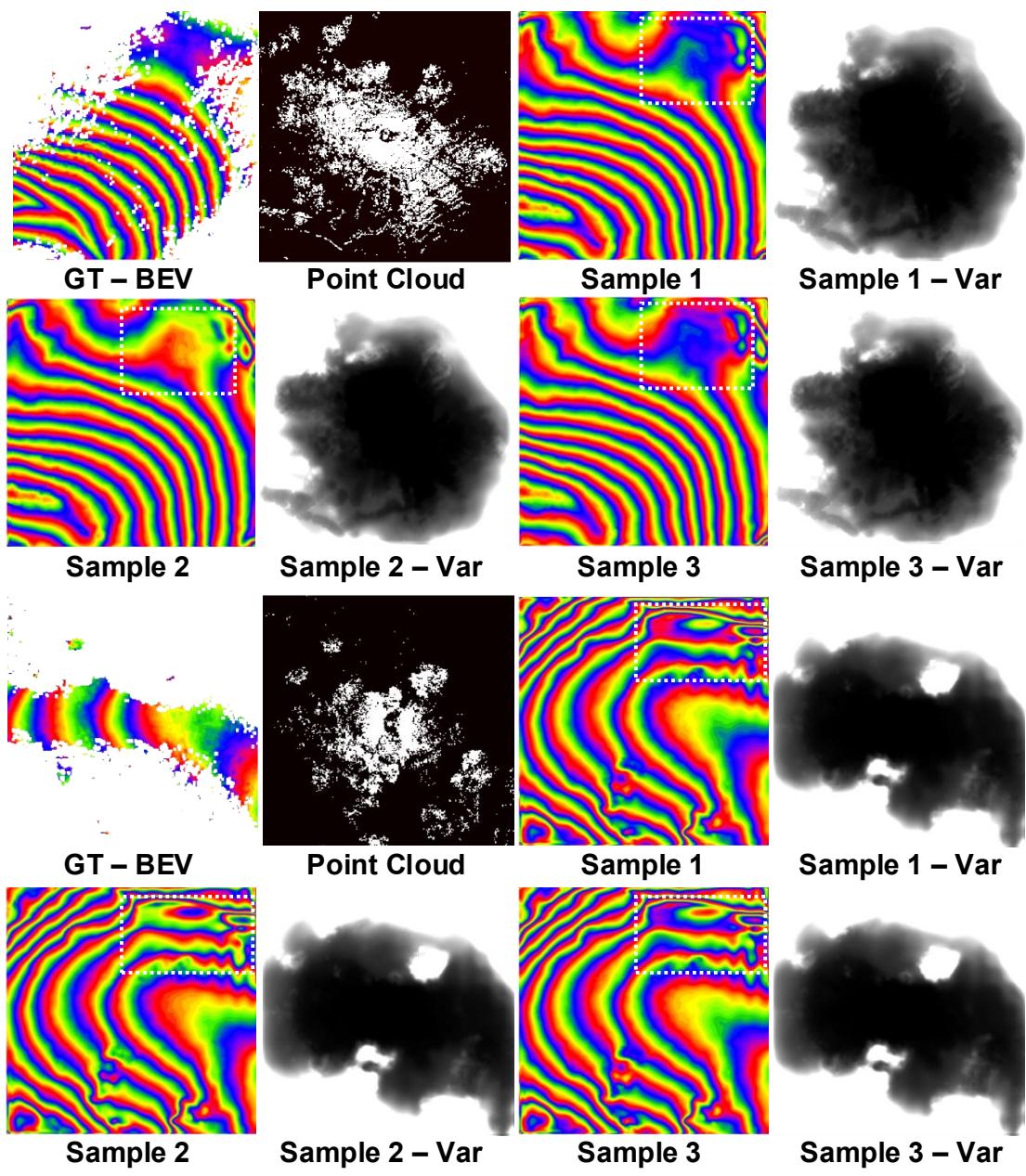
In Figure 9, you can see different realizations of the terrain. In areas where the data is clear, all samples look the same. In areas where the robot is blind (occluded regions), the samples vary, reflecting the model’s uncertainty.
Comparison with Baselines
Finally, let’s look at a side-by-side comparison across all datasets.
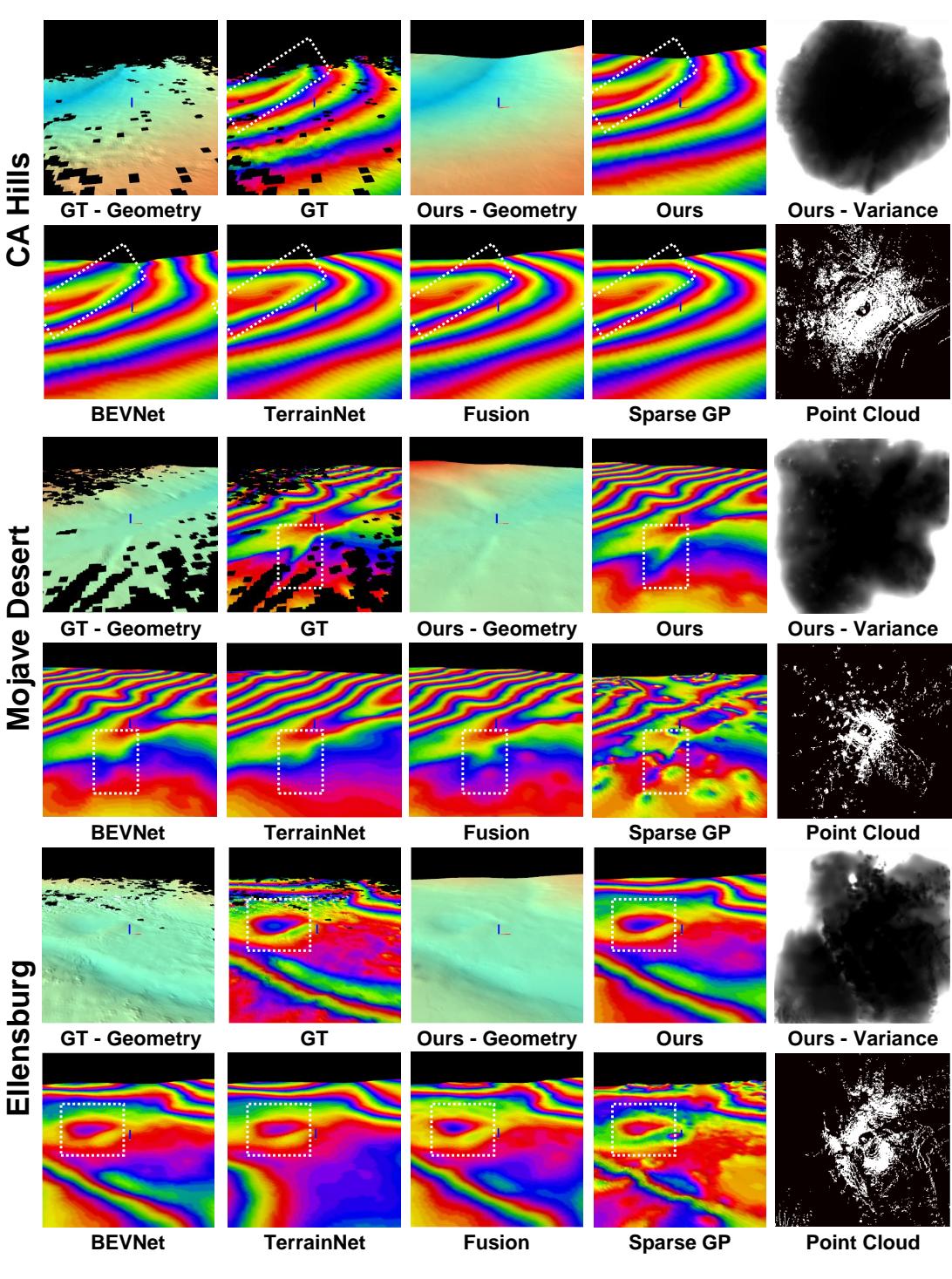
The “Fusion” baseline (which also uses Camera + LiDAR) tends to produce blurrier maps. The “Sparse GP” is sharp but computationally heavy and can struggle with the semantic context. The proposed method strikes the ideal balance.
Conclusion
This paper presents a significant step forward for off-road autonomy. By leveraging Neural Processes, the authors successfully combined the semantic understanding of deep learning with the rigorous uncertainty handling of probabilistic methods.
Why is this important for the future?
- Safety: The ability to detect negative obstacles (ditches) prevents accidents.
- Speed: The “Ball Query Attention” mechanism proves that we don’t need infinite compute power to run sophisticated attention models.
- Reliability: Explicitly modeling uncertainty allows the robot to make smarter decisions—knowing when to charge ahead and when to tread carefully.
As we push autonomous vehicles further off the beaten path, approaches like this—which acknowledge that the world is uncertain and imperfect—will be the key to robust exploration.