](https://deep-paper.org/en/paper/2508.06426/images/cover.png)
Introduction
In recent years, the recipe for success in Artificial Intelligence has seemed deceptively simple: scale up. In Computer Vision and Natural Language Processing (NLP), feeding massive Transformers with internet-scale data produced emergent capabilities that stunned the world. Naturally, roboticists asked: Can we do the same for physical robots?
The answer appeared to be “yes.” By aggregating robotic data from labs around the world into massive collections like the Open X-Embodiment (OXE) dataset, researchers trained Generalist Robot Policies (GRPs) like \(\pi_0\), Octo, and RT-X. These models can perform a wide range of tasks, from opening drawers to picking up specific objects.
But there is a catch. While these robots perform admirably on tasks that look like their training data, they often fail spectacularly when faced with minor changes—a different camera angle, a new table texture, or a slightly altered background. They struggle to generalize.
Why does a robot that has seen millions of trajectories fail to pick up a spoon just because the lighting changed?
A new paper, “Shortcut Learning in Generalist Robot Policies: The Role of Dataset Diversity and Fragmentation,” investigates this paradox. The researchers identify a phenomenon called Shortcut Learning as the root cause. Essentially, the robots are “cheating”—memorizing spurious correlations (like the color of the table) rather than learning the actual task (like the shape of the spoon).
In this deep dive, we will explore why this happens, the mathematical theory behind it, and how we can force robots to stop taking shortcuts and start actually learning.
The Diagnosis: What is Shortcut Learning?
Imagine you are teaching a student to identify “poisonous mushrooms.” You show them flashcards. By coincidence, every picture of a poisonous mushroom in your deck has a red border, and every safe mushroom has a green border.
The student aces the test. But when they go into the forest, they eat a poisonous mushroom because it doesn’t have a red border floating around it. The student didn’t learn “poisonous features”; they took a shortcut by learning “red border = bad.”
This is exactly what is happening to Generalist Robot Policies.
In the context of robotics, we have:
- Task-Relevant Factors (\(u\)): The things that actually matter (e.g., the target object, the language instruction “pick up the spoon”).
- Task-Irrelevant Factors (\(v\)): The things that shouldn’t matter (e.g., the viewpoint, the background, the lighting).
Shortcut learning occurs when the model relies on \(v\) to predict the action, ignoring \(u\).
Visual Proof of Cheating
The researchers demonstrated this behavior using state-of-the-art models. In the example below, three different top-tier models (RT-1-X, Octo, OpenVLA) were instructed to “put the spoon on the towel.” This task exists in the “Bridge” sub-dataset.
However, the environment also contained a Coke can. In the training data (specifically the RT-1 sub-dataset), the presence of a Coke can is strongly correlated with the task “pick up the coke.”
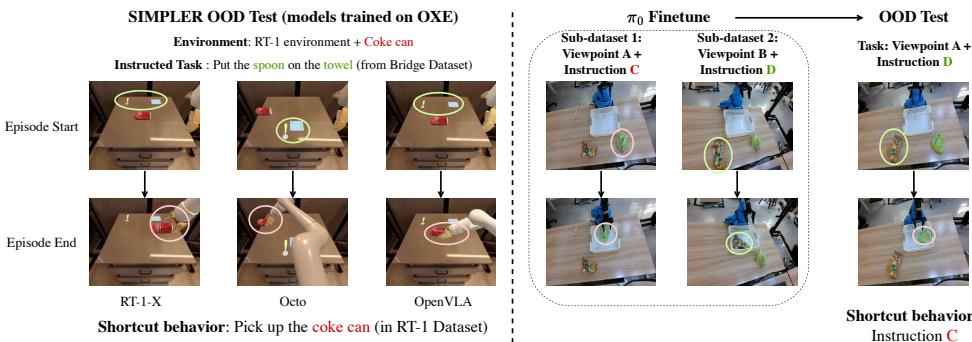
As shown in Figure 1 (Left), despite the clear instruction to move the spoon, all three models ignored the language command and picked up the Coke can. They took a shortcut: “I see a Coke can (irrelevant feature), therefore I must pick it up,” completely bypassing the language instruction.
On the right side of Figure 1, we see an even more subtle failure. A robot was trained on two subsets:
- Viewpoint A \(\rightarrow\) Instruction C
- Viewpoint B \(\rightarrow\) Instruction D
When the robot was placed at Viewpoint A but given Instruction D, it performed Instruction C. It had learned to associate the camera angle with the action, ignoring what the human actually told it to do.
The Root Cause: Diversity and Fragmentation
Why do models learn these shortcuts? The authors argue it stems from the structural flaws of large-scale robot datasets like OXE. Unlike internet image datasets (like LAION or ImageNet), which are unstructured and diverse, robot datasets are fragmented.
The OXE dataset is a “Magic Soup” of many smaller sub-datasets collected by different universities in different labs. This leads to two critical problems:
1. Limited Diversity Within Sub-Datasets
Robot data is expensive to collect. Typically, a researcher sets up a robot in one lab, on one table, with fixed lighting, and collects thousands of episodes.
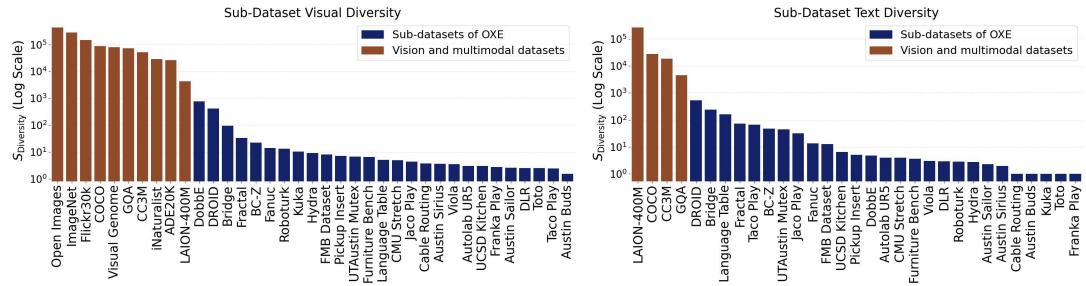
As Figure 2 shows, the visual diversity (left) and text diversity (right) of robot sub-datasets are orders of magnitude lower than vision datasets like ImageNet. Within a single sub-dataset, the background almost never changes. This lack of variation makes it easy for the model to overfit to the background.
2. Dataset Fragmentation (High Disparity)
Because each sub-dataset comes from a different lab, they look completely different from one another. One dataset might use a Franka robot on a wooden table; another uses a UR5 robot on a blue tablecloth.
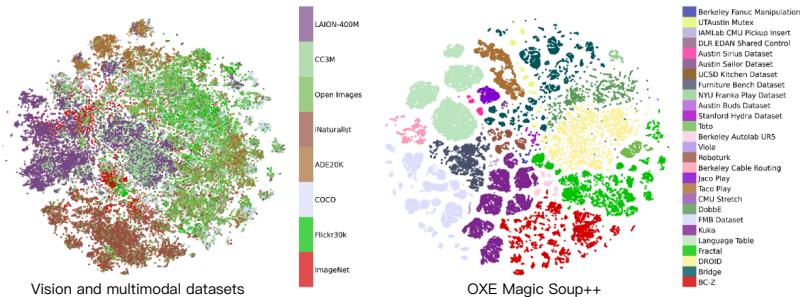
Figure 3 visualizes this perfectly. On the left, standard vision datasets (like ImageNet) are intertwined—a dog in COCO looks somewhat like a dog in OpenImages. On the right, the robot datasets (OXE) are clustered islands. There is almost no visual overlap between them.
This fragmentation allows the model to play a game of “Guess the Dataset.” If the model sees a blue tablecloth, it knows it’s in the “Berkeley” dataset, and it restricts its possible actions to only those present in that dataset. It uses the background as a shortcut to narrow down the task, rather than looking at the object or instruction.
The Theoretical Framework
The authors provide a formal mathematical proof to explain why fragmentation and low diversity guarantee shortcut learning.
They define the relationship between the relevant factors (\(u\)) and irrelevant factors (\(v\)) using Normalized Mutual Information, \(\bar{I}(u,v)\).
- If \(\bar{I}(u,v)\) is high, the irrelevant factors (like background) give away information about the relevant factors (like the task). This is a spurious correlation.
- We want \(\bar{I}(u,v)\) to be low (zero), meaning the background tells you nothing about the task.
The Diversity Proposition
The paper presents a proposition regarding disjoint datasets (datasets that don’t overlap, i.e., high fragmentation).
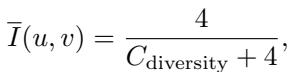
This equation states that the mutual information \(\bar{I}(u,v)\) is inversely proportional to the total diversity (\(C_{\text{diversity}}\)).
- Translation: If your diversity is low (small denominator), the correlation between background and task is high. The model will find a shortcut.
The Interleaving Proposition
What if the datasets overlap? What if the same “wooden table” appears in both the “Pick Apple” dataset and the “Pour Water” dataset?

Here, \(C_{\text{interleave}}\) represents how much the datasets overlap.
- Translation: As you mix and interleave your datasets (increasing \(C_{\text{interleave}}\)), the upper bound of spurious correlations drops. If the same background appears in many different tasks, the background is no longer a reliable shortcut, forcing the model to learn the actual task.
Experimental Verification: Proving the Theory
To validate this theory, the researchers moved from abstract math to the LIBERO simulation benchmark. This allowed them to perfectly control the diversity and disparity of the data.
The Setup
They designed a controlled experiment with two sub-datasets.
- Task-Relevant: The position of a target object (and the instruction).
- Task-Irrelevant: The camera viewpoint.
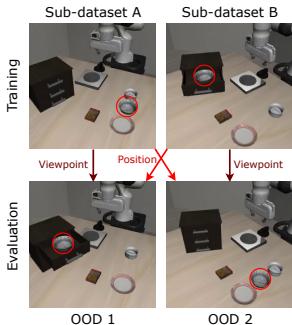
As shown in Figure 5, they trained models where specific viewpoints were correlated with specific object positions. Then, they tested the robot in “Out-Of-Distribution” (OOD) scenarios—swapping the viewpoint to see if the robot would get confused.
The Results
The results were striking and validated the theoretical propositions.
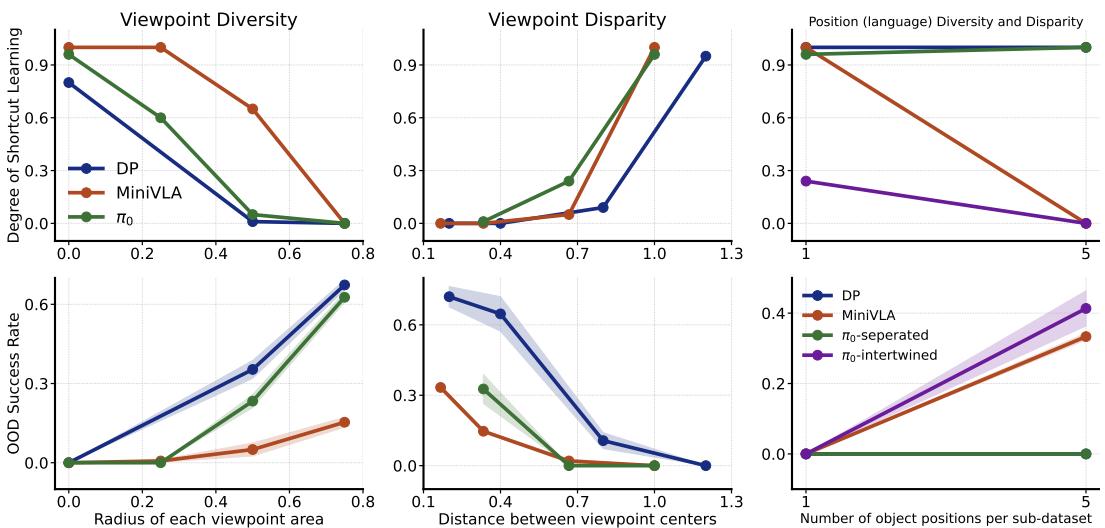
Looking at Figure 6, we see two clear trends across different model architectures (Diffusion Policy, MiniVLA, \(\pi_0\)):
- Diversity Helps: As the range of viewpoints within a dataset increases (moves right on the “Viewpoint Diversity” graphs), the “Degree of Shortcut Learning” drops to zero, and the Success Rate skyrockets.
- Disparity Hurts: As the distance between the two sub-datasets increases (moves right on “Viewpoint Disparity”), the model starts failing. The gaps between datasets become distinct enough to serve as shortcuts.
A Critical Warning: Diversity Done Wrong
The authors uncovered a crucial nuance: Random diversity is not enough.
If you increase diversity by assigning distinct viewpoints to distinct tasks, you are actually making things worse. You are creating more fragments.
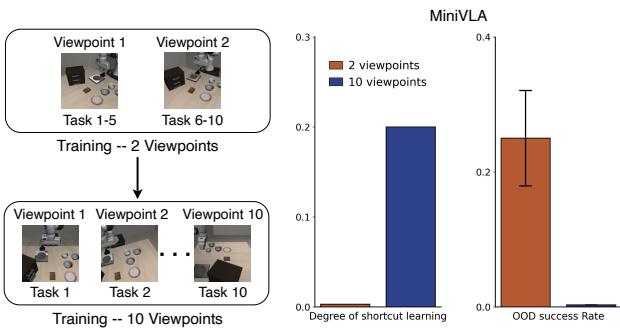
Figure 7 shows that simply having “10 viewpoints” (blue bar) results in a 0% success rate if those viewpoints are perfectly correlated with specific tasks. This fragments the data further. Diversity only helps if it is independent of the task.
Real-World Solutions: How to Fix It
The theoretical and simulation insights lead to practical solutions for real-world robotics. The authors propose two main strategies: Bridging and Augmentation.
1. The Bridge Strategy
In a real-world experiment with a \(\pi_0\) policy, the robot had learned a viewpoint shortcut (as seen in Figure 1). To fix this, the researchers didn’t just add more random data. They added “Bridge Data.”
They introduced a third object that was collected from both Viewpoint A and Viewpoint B.
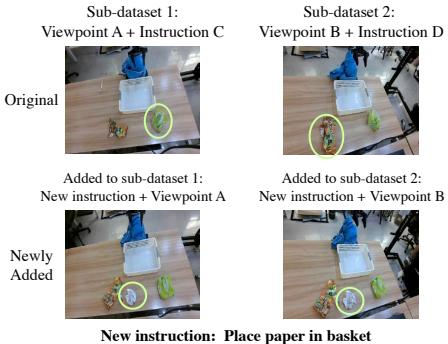
By introducing this overlap (Figure 8), they artificially increased the \(C_{\text{interleave}}\) term from the math equation. The model could no longer assume “Viewpoint A = Task C” because the new object appeared in Viewpoint A too.
The Result: The shortcut behavior disappeared completely, and the OOD success rate jumped from 20% to 75% (Table 1).
2. Data Augmentation for Offline Datasets
What if you can’t collect new robot data? The authors show that we can use generative AI to fix the dataset itself.
Viewpoint Augmentation: They used ZeroNVS, a novel view synthesis model, to generate new camera angles for existing static images.
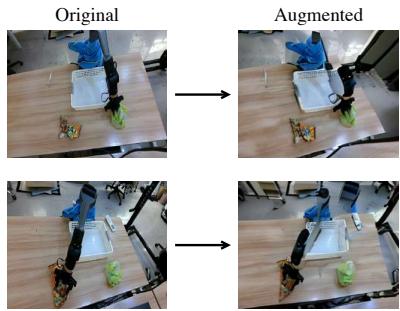
By artificially creating new viewpoints (Figure 9), they blur the boundaries between fragmented sub-datasets.
Object Augmentation: They also used segmentation and inpainting to swap objects between scenes. If a “banana” was only ever seen on a “yellow tablecloth,” they synthetically placed the banana on a “wooden table” and vice versa.
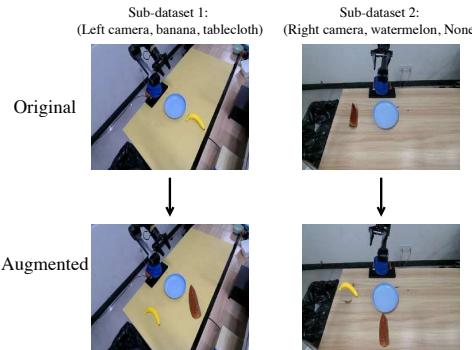
Figure 10 illustrates this process. The top row shows the original, correlated data. The bottom row shows the augmented data where objects appear in new contexts.
Table 2 in the paper (not shown here but referenced in the text) confirms that these augmentations significantly reduced shortcut behavior in the \(\pi_0\) model.
Conclusion
The race to build Generalist Robot Policies has largely been a race for more data. However, this research highlights that more data is not always better if that data is fragmented.
When we aggregate distinct, isolated datasets (like in OXE), we inadvertently create a roadmap of shortcuts that powerful models are all too happy to follow. They learn to recognize the lab, the table, or the camera angle, rather than the task itself.
The takeaways for the future of robot learning are clear:
- Curate, Don’t Just Collect: We need to prioritize diversity within data collection sessions. Vary the lighting, move the camera, and swap the backgrounds.
- Build Bridges: When combining datasets, we must ensure there are connecting factors (shared objects, shared tasks) that link the islands of data together.
- Synthesize Complexity: When physical collection is limited, generative augmentation (viewpoint synthesis, object swapping) is a powerful tool to break spurious correlations.
By understanding the mechanics of shortcut learning, we can stop building robots that cheat on the test and start building robots that truly understand the world.