](https://deep-paper.org/en/paper/2508.08252/images/cover.png)
Introduction
Imagine you are in a cluttered kitchen and you ask a robot to “pick up the red mug next to the laptop.” For a human, this is a trivial task. We process the semantic meaning (“red mug”), but crucially, we also process the spatial relationship (“next to the laptop”) to distinguish it from a red mug that might be on the drying rack.
In the world of 3D computer vision, however, this simple request is a massive hurdle. While recent advances in 3D Gaussian Splatting (3DGS) have revolutionized how we render 3D scenes, enabling real-time, photorealistic views, the ability to understand and segment specific objects within those scenes based on complex language is lagging behind.
Most current methods rely on Open-Vocabulary Segmentation. They can identify a “mug” or a “chair” by matching image features to simple text labels. But they fail when faced with the nuances of natural language, particularly sentences that describe spatial relationships (“the one on the left,” “behind the sofa”). Furthermore, identifying an object that is partially occluded in a new viewing angle remains a significant challenge.
To bridge this gap, a new research paper introduces the task of Referring 3D Gaussian Splatting Segmentation (R3DGS) and a novel framework called ReferSplat. This approach doesn’t just look for labels; it models the 3D scene with an awareness of spatial language, allowing it to pinpoint specific objects described by free-form text.
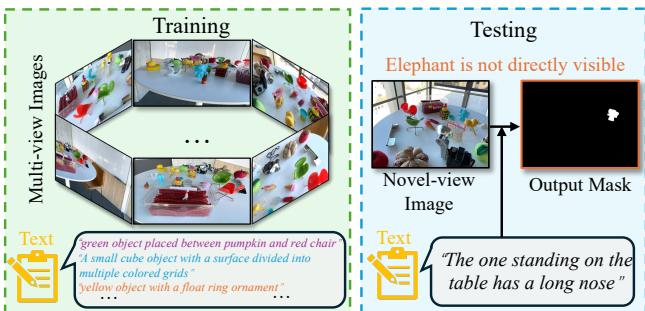
As shown above, the goal is to take a set of multi-view images and a specific description (e.g., “green object placed between pumpkin and red chair”) and accurately segment that object in a completely novel view, even if the object is partially hidden.
Background: The Limits of 2D Thinking in a 3D World
To understand why this new method is necessary, we first need to look at how 3D Gaussian Splatting works and where current segmentation methods fall short.
3D Gaussian Splatting Basics
3DGS represents a scene not as a mesh or a neural network (like NeRFs), but as a collection of millions of 3D Gaussian ellipsoids. Each Gaussian has a position, rotation, scale, opacity, and color. To render an image, these 3D Gaussians are projected (“splatted”) onto a 2D plane. The color of a specific pixel is calculated by blending these overlapping Gaussians.
The rendering equation for the color \(C(v)\) at a pixel \(v\) is:
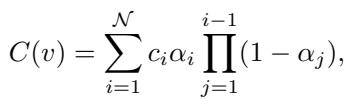
Here, \(c_i\) is the color of the \(i\)-th Gaussian, and \(\alpha_i\) represents its opacity contribution. This explicit representation allows for incredibly fast rendering.
The Problem with Current Segmentation
Existing methods for segmenting objects in 3DGS usually follow a pipeline shown in Figure 2(a) below. They typically use a pre-trained 2D vision-language model (like CLIP) to extract semantic features from the training images. These features are then “lifted” into the 3D Gaussians.
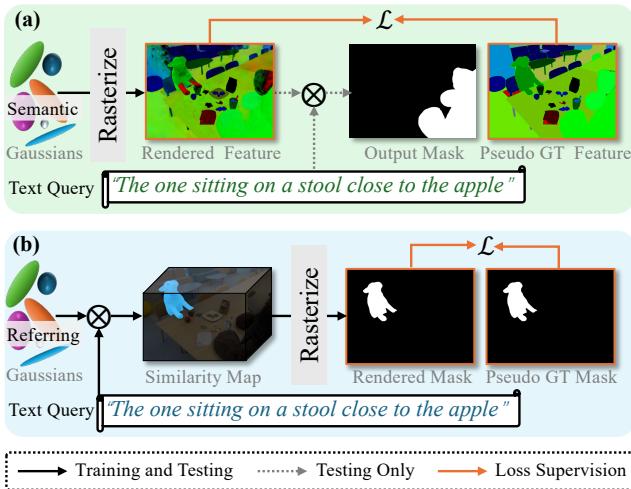
The issue with the pipeline in Figure 2(a) is that it treats the text query as a 2D matching problem. It renders a feature map and compares it to the text. It lacks spatial awareness. The rendered features don’t inherently understand that “left of” or “under” are geometric constraints, not just semantic labels. Consequently, when you ask for “the stool close to the apple,” these models often get confused by other stools in the room.
ReferSplat, shown in Figure 2(b), changes the paradigm. Instead of matching text to a rendered 2D image, it allows the text to interact directly with the 3D Gaussians before rendering. This creates a spatially aware system capable of resolving ambiguities.
The ReferSplat Framework
The researchers propose a comprehensive framework that transforms a standard 3DGS model into one that can “listen” to complex instructions. Let’s break down the architecture, which is visualized in the figure below.
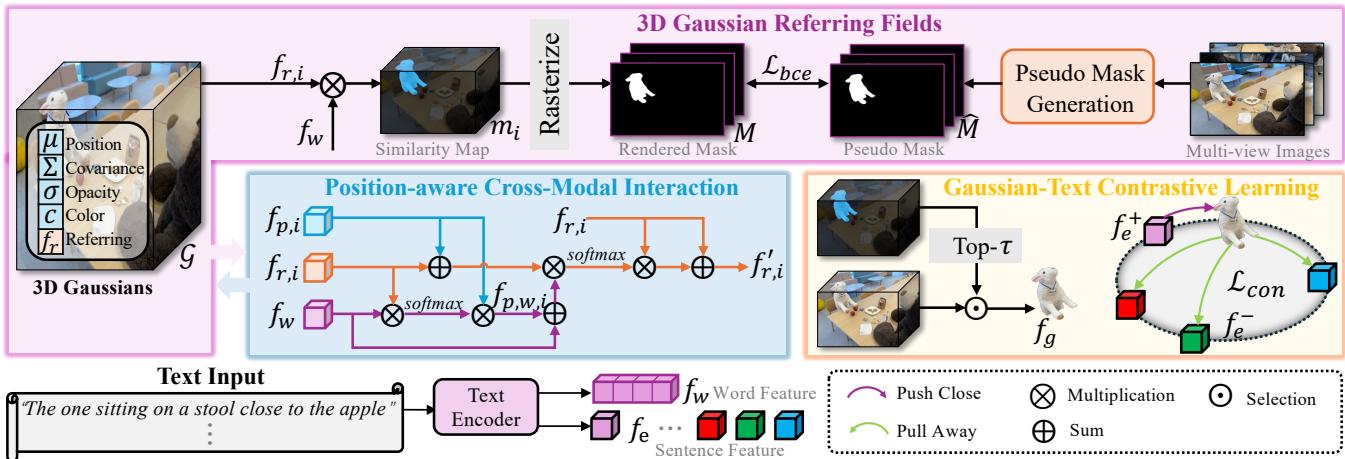
The architecture consists of three main innovations:
- 3D Gaussian Referring Fields: Giving Gaussians the ability to respond to language.
- Position-aware Cross-Modal Interaction: Infusing spatial data into the language understanding.
- Gaussian-Text Contrastive Learning: Sharpening the distinction between similar objects.
1. 3D Gaussian Referring Fields
In standard 3DGS, a Gaussian stores color data (Spherical Harmonics). In ReferSplat, each Gaussian is also assigned a referring feature vector (\(f_{r,i}\)). This vector encodes the semantic and referring information for that specific point in space.
When a text query comes in (e.g., “the white chair”), the model computes the similarity between the text features and the referring features of the Gaussians. This isn’t done on the 2D image; it’s done in 3D space.
The response (similarity score) \(m_i\) for the \(i\)-th Gaussian is calculated by checking how well its referring feature aligns with the word features of the query:
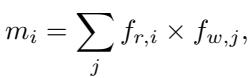
Here, \(f_{r,i}\) is the Gaussian’s referring feature and \(f_{w,j}\) represents the words in the sentence.
Once we have this “response” score for every Gaussian, we can render a 2D segmentation mask. Instead of rendering RGB colors, the system rasterizes these similarity scores \(m_i\):
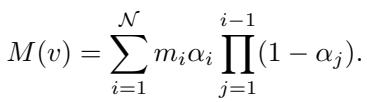
This results in a 2D heatmap where the target object lights up. To train this, the model compares the predicted mask against a “pseudo ground truth” mask using Binary Cross-Entropy (BCE) loss:

But where does this “pseudo ground truth” come from? The authors use a Confidence-Weighted IoU strategy. Since the training data doesn’t have manual masks for every possible sentence, they use off-the-shelf tools like Grounded SAM to generate candidate masks.
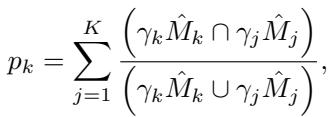
This formula (Eq. 5) helps select the best possible mask from noisy candidates by balancing the model’s confidence (\(\gamma\)) with the geometric consistency (IoU) across different predictions.
2. Position-aware Cross-Modal Interaction (PCMI)
This is the core innovation that allows ReferSplat to handle spatial language. Semantic features capture what an object is, but they are terrible at capturing where it is.
The researchers introduce a module that extracts position features from the Gaussians (based on their coordinates) and injects this information into the attention mechanism. Crucially, it also tries to infer position information from the text itself.
The system calculates a “text position feature” (\(f_{p,w,i}\)) by looking at how the text aligns with the Gaussians:
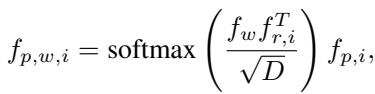
Then, it updates the referring features of the Gaussians using a position-guided attention mechanism. This ensures that the features used for segmentation are enriched with both semantic meaning and spatial context.

In this equation, \(f'_{r,i}\) is the updated feature. Notice how the attention map (the part inside softmax) combines both the raw features (\(f\)) and the position features (\(f_p\)). This forces the model to consider geometry when listening to the text.
3. Gaussian-Text Contrastive Learning
Even with spatial awareness, a model might struggle to distinguish between two very similar objects (e.g., two identical apples on a table). To fix this, the authors employ contrastive learning.
The idea is to push the representation of the target Gaussians closer to their specific text description and further away from descriptions of other objects.
First, the model identifies the “positive” Gaussians—those that have a high response to the text query—and averages their features to create a global object embedding \(f_g\):
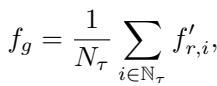
Then, it applies a contrastive loss function. This forces the positive Gaussian embedding (\(f_g\)) to align with the correct text embedding (\(f_e^+\)) while distancing it from incorrect or negative text descriptions (\(f_e'\)):

The final training objective combines the segmentation loss (BCE) and this contrastive loss:

The Ref-LERF Dataset
To test this system, the researchers needed a dataset that actually contained complex spatial descriptions. Existing datasets mostly used simple labels.
They introduced Ref-LERF, a dataset based on real-world scenes but annotated with rich natural language.
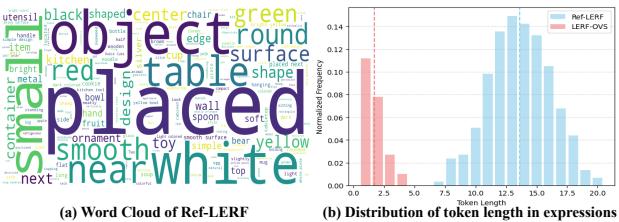
As seen in the word cloud (Fig 4a), the dataset is heavy on spatial prepositions like “placed,” “near,” “next,” and “center.” The histogram (Fig 4b) shows that the descriptions in Ref-LERF are significantly longer and more complex than previous datasets like LERF-OVS, making it a much harder benchmark.
Experiments and Results
The authors compared ReferSplat against several state-of-the-art methods, including LangSplat (a leading 3DGS segmentation method) and Grounded SAM (a 2D foundational model).
Qualitative Results
The visual results are striking. In the figure below, you can see how different models respond to the prompt “A brightly colored toy placed next to the box.”
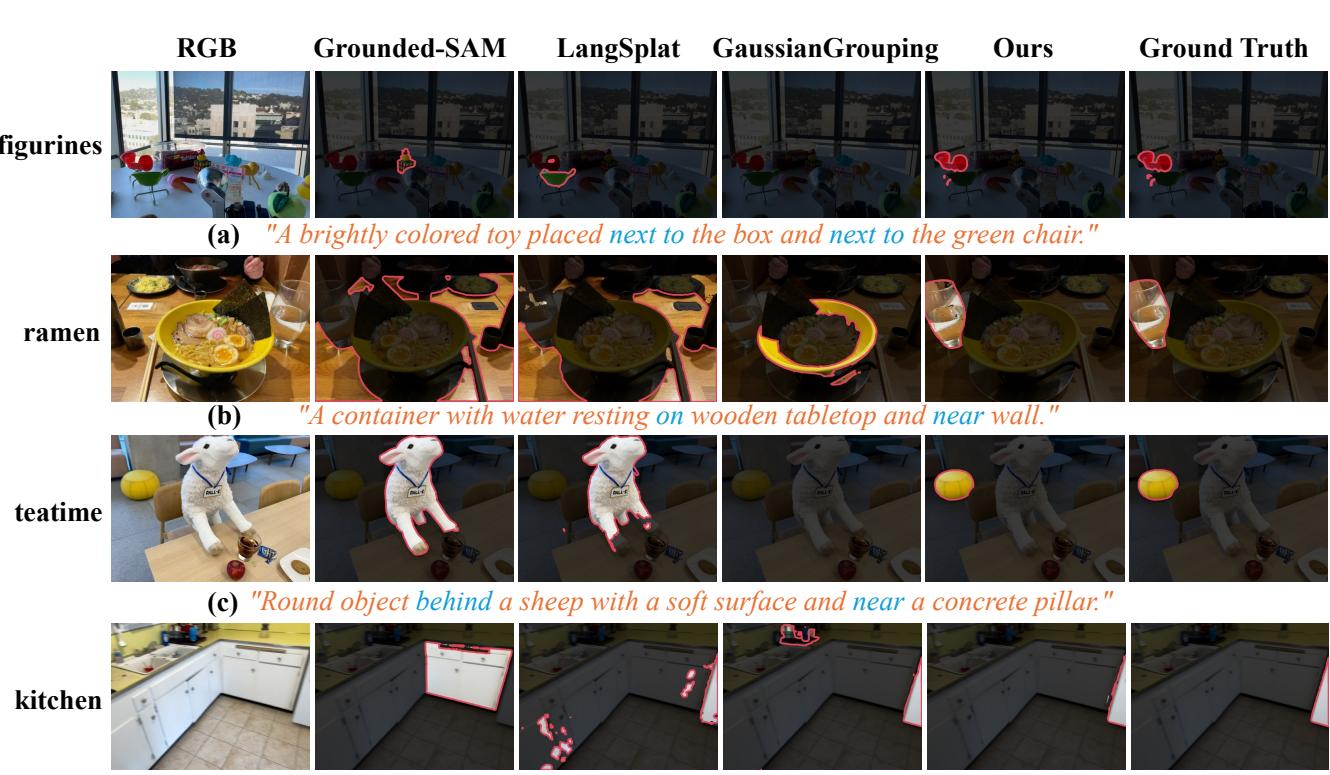
- RGB: The raw scene.
- Grounded SAM: Struggles with consistency across views because it operates in 2D.
- LangSplat: Often captures the wrong object or includes background noise because it relies on simple feature matching.
- Ours (ReferSplat): produces a clean, accurate mask that closely matches the Ground Truth, respecting the “next to the box” constraint.
Quantitative Performance
The numbers back up the visuals. In the benchmark results on the Ref-LERF dataset, ReferSplat achieves significantly higher Intersection over Union (IoU) scores compared to competitors.
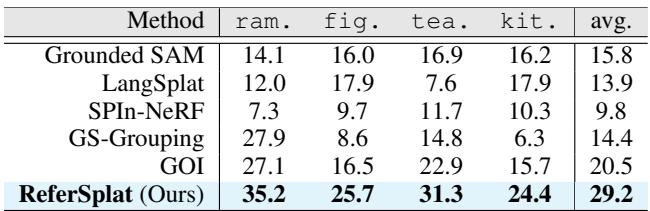
ReferSplat achieves an average score of 29.2, nearly double that of LangSplat (13.9) and significantly higher than Grounded SAM (15.8). This proves that simply lifting 2D features into 3D isn’t enough; the explicit spatial modeling in ReferSplat is necessary for referring segmentation.
Why does it work? (Ablation Studies)
The authors performed ablation studies to prove that their specific contributions (PCMI and Contrastive Learning) were actually driving the performance.
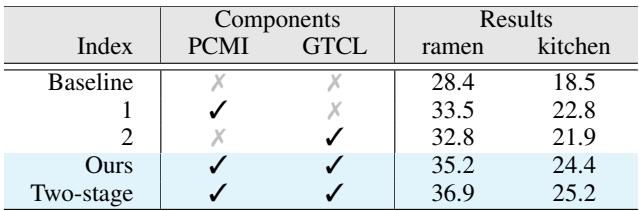
- Baseline: 28.4 (ramen scene).
- Adding PCMI (Index 1): Jumps to 33.5. This confirms that adding spatial awareness is the biggest single contributor to performance.
- Adding Contrastive Learning (Index 2): Jumps to 32.8.
- Full Model (Ours): Reaches 35.2.
- Two-stage: A refinement stage pushes it even higher to 36.9.
Efficiency
One might assume that adding all this spatial reasoning makes the model slow. Surprisingly, ReferSplat is extremely efficient.

ReferSplat trains in 58 minutes, compared to 176 minutes for LangSplat. It also maintains a healthy rendering speed of nearly 27 FPS. This efficiency comes from the fact that ReferSplat learns to align 3D Gaussians directly with text during training, rather than relying on heavy feature processing pipelines like CLIP feature compression used in other methods.
Conclusion
The paper “Referring 3D Gaussian Splatting Segmentation” marks a significant step forward in embodied AI and 3D scene understanding. By moving beyond simple class names and enabling systems to understand complex, spatially-grounded natural language, we get closer to robots and AR systems that can truly understand human intent.
Key Takeaways:
- R3DGS is a new standard: The ability to find objects based on descriptions like “the one behind the chair” is crucial for real-world interaction.
- Geometry matters: You cannot solve spatial problems with semantic features alone. ReferSplat’s Position-aware Cross-Modal Interaction proves that injecting geometric data into the attention mechanism is vital.
- Direct 3D-Text Interaction: Instead of relying on 2D proxies, ReferSplat allows text to modulate 3D Gaussian features directly, leading to better accuracy and faster training times.
As 3D Gaussian Splatting continues to dominate the neural rendering landscape, techniques like ReferSplat will be essential for turning these pretty visualizations into interactive, intelligent environments.