](https://deep-paper.org/en/paper/2508.12166/images/cover.png)
Introduction
Imagine you are hiking through a dense forest at night. To navigate safely, you have a flashlight, a GPS device, and a map. Keeping all of them on continuously guarantees you won’t get lost, but it drains your batteries rapidly. If your batteries die, you’re stranded. On the other hand, turning everything off to save power is dangerous—you might fall off a cliff. The smartest strategy is to switch devices on only when necessary: use the flashlight for rocky terrain, check the GPS only when the trail forks, and walk in the dark when the path is straight and clear.
This “energy vs. certainty” dilemma is a fundamental problem in modern robotics. Autonomous systems, from drones to maritime vessels, are equipped with power-hungry sensor suites (LiDARs, cameras, GPUs). Keeping every sensor active ensures reliable localization but drastically shortens mission time.
In this post, we explore a fascinating solution presented in the paper “Belief-Conditioned One-Step Diffusion (B-COD).” The researchers propose a novel navigation system that doesn’t just plan a path; it simultaneously predicts how lost the robot will get if it turns specific sensors off. By using a diffusion model to generate both motion plans and uncertainty estimates in a single, rapid forward pass, the system achieves “just-enough sensing”—using the minimum energy required to reach the goal safely.
The Context: Why is this Hard?
To understand the breakthrough of B-COD, we first need to look at why robots struggle to manage their own sensors.
The Problem of Belief Space Planning
When a robot moves, it doesn’t know its exact position (\(x, y\)). Instead, it maintains a belief—a probability distribution over where it might be. As the robot moves, this distribution spreads out (uncertainty grows). When it uses sensors, the distribution shrinks (uncertainty decreases).
Traditional “Belief-Space Planners” try to predict this expansion and contraction mathematically. They propagate covariance matrices into the future. While accurate, this is computationally expensive (\(O(N^2)\) or worse). Doing this in real-time while checking thousands of combinations of “Sensor A on, Sensor B off” is practically impossible on embedded hardware.
The Brittleness of Heuristics
Because the math is too slow, engineers often rely on simple rules (heuristics). For example: “If the battery is low, turn off the LiDAR.” Or “If it is dark, turn on the night camera.”
The problem is that heuristics are brittle. They don’t account for the specific geometry of the environment. Turning off a LiDAR in an open ocean is fine; turning it off in a narrow canal is catastrophic, even if the battery is low.
The Core Innovation: B-COD
The researchers introduce B-COD (Belief-Conditioned One-Step Diffusion). The core idea is to replace the heavy mathematical covariance propagation with a learned neural network that is fast, accurate, and intuitive.
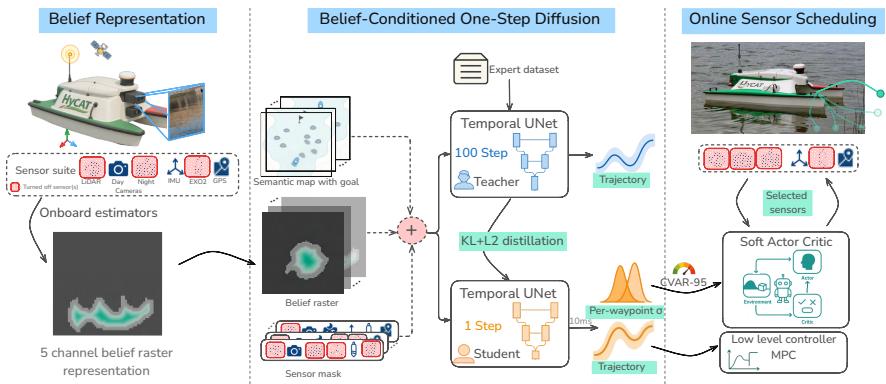
As shown in Figure 1, the architecture consists of three main parts:
- Belief Representation: Converting the robot’s confusion into an image.
- Diffusion Planner: Predicting trajectory and uncertainty.
- Sensor Scheduler: A lightweight controller that decides which switches to flip.
Let’s break these down.
1. Visualizing Uncertainty: The Belief Raster
Neural networks excel at processing images (Convolutional Neural Networks). However, a robot’s belief is usually a cloud of thousands of “particles” (guesses of where it is). To make this digestible for a neural network, the authors create a Belief Raster.
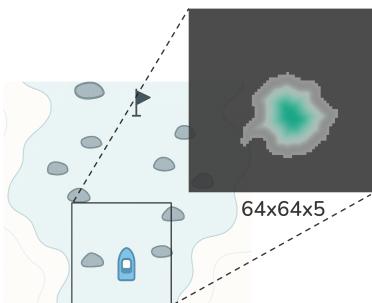
The rasterization process compresses the complex particle cloud into a fixed-size \(64 \times 64\) image with five channels.
- Mass: Where is the robot most likely located?
- Heading: Which way is it facing? (Encoded as sine and cosine).
- Spread: How “flat” or “spiky” is the distribution? (Encoded as the log-determinant of the local covariance).
- Circular Variance: How unsure is the robot about its heading?
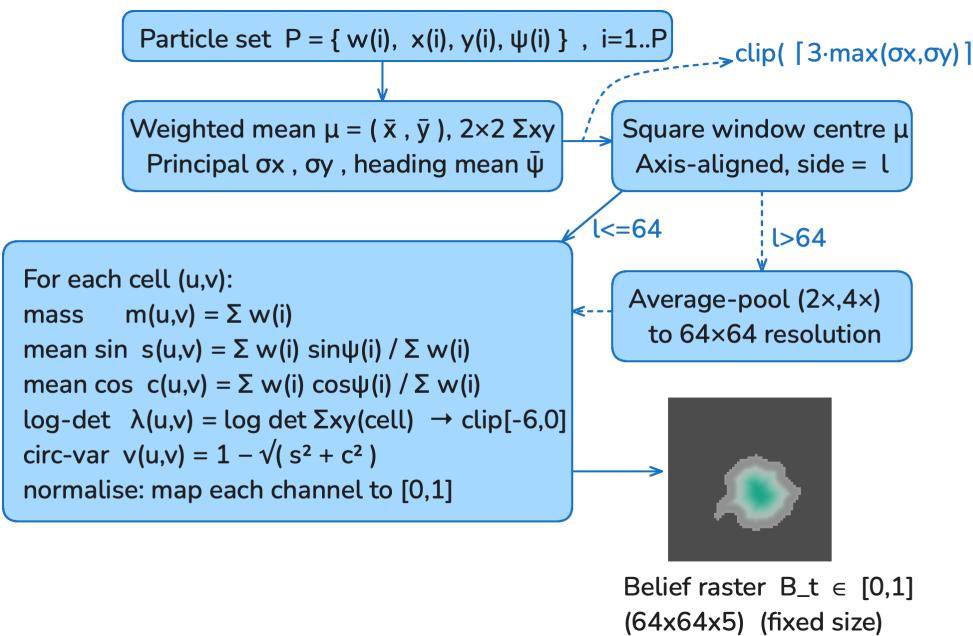
This representation creates a standardized input that captures not just the robot’s location, but the shape of its uncertainty. If the robot is unsure about its position, the “mass” channel is blurry. If it is unsure about direction, the “circular variance” channel lights up.
2. The Engine: One-Step Diffusion
This is the heart of the method. Diffusion models are famous for generating images (like Stable Diffusion), but here they are used for trajectory planning.
Standard diffusion planners are iterative: they start with random noise and “denoise” it over 50 or 100 steps to find a path. While powerful, this is too slow for a robot moving at high speeds. B-COD solves this using a technique called Consistency Distillation.
The Teacher and the Student
The team first trains a “Teacher” model. This is a standard multi-step diffusion model. It takes the Belief Raster, the Map, the Goal, and a Sensor Mask (which sensors are currently on) as input.
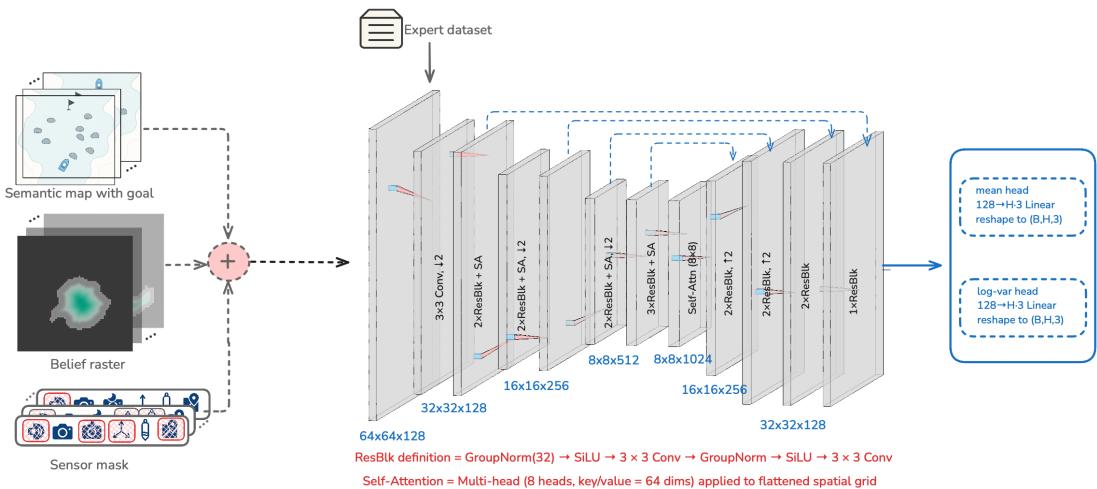
The Teacher learns to predict two things:
- The Trajectory: The physical path the robot should take.
- The Aleatoric Uncertainty: A variance score for every point along that path.
This second output is critical. The model learns that if the input sensor mask has the LiDAR turned off, the resulting path should have high variance (uncertainty). If the LiDAR is on, the variance should be low.
The Teacher’s loss function (Equation below) explicitly rewards the model for “confessing” its uncertainty. The \(\hat{\sigma}\) term ensures the predicted variance matches the actual spread of errors in the training data.

The Fast Student
To make this run in real-time (10 milliseconds), the Teacher is distilled into a “Student” model using a consistency loss. This allows the Student to predict the trajectory and the uncertainty in a single forward pass, effectively jumping from noise to solution instantly.

3. The Decision Maker: Constrained SAC
Now the robot has a fast neural network that says: “Given your current belief and these active sensors, here is your path, and here is how uncertain you will be.”
The final piece is the Scheduler. This is a Reinforcement Learning (RL) agent (specifically Soft Actor-Critic) that looks at the uncertainty prediction.
The optimization problem is elegant: Minimize energy consumption subject to a safety constraint.

Or, in the language of Reinforcement Learning:

The RL agent receives a specific risk metric called CVaR-95 (Conditional Value at Risk) from the diffusion model. If the predicted risk is higher than the safety budget (e.g., 2 meters of drift), the agent turns on more sensors. If the risk is low, it turns them off.
Experimental Validation
Theory is great, but does it work on water? The researchers deployed B-COD on a SeaRobotics Surveyor, an autonomous surface vehicle (ASV).
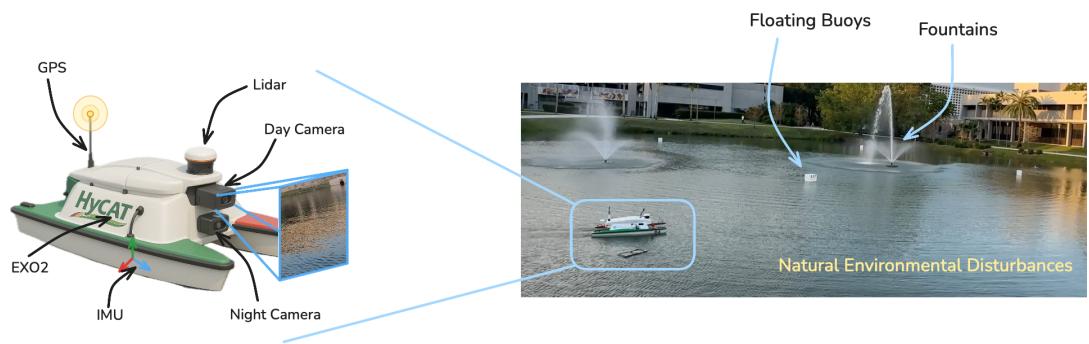
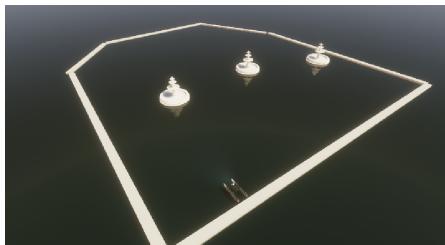
The testing environment was a freshwater lake with real disturbances: wind, waves, fountains, and buoys. The team also used a high-fidelity Unity simulator to safely train the RL agent before deployment.
Did it save energy?
The results were impressive. The team compared B-COD against several baselines:
- Always-ON: The safe but wasteful standard.
- Greedy-OFF: A heuristic that turns sensors off based on light levels and recent detections.
- InfoGain-Greedy: A mathematical approach that selects sensors to maximize information gain.
As shown in Table 1:
- Success Rate: B-COD reached the goal 97.9% of the time, statistically identical to the “Always-ON” baseline (100%).
- Energy Efficiency: B-COD used only 42.3% of the energy compared to “Always-ON.”
- Comparison: The heuristic “Greedy-OFF” saved energy but crashed or failed nearly half the time (47.3% success). The mathematical “InfoGain” approach was accurate but violated safety constraints more often.
Is it fast?
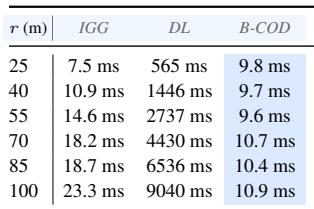
One of the main claims of the paper is speed. Analytic belief planners slow down drastically as the map gets larger because they have to calculate covariance over a larger grid.
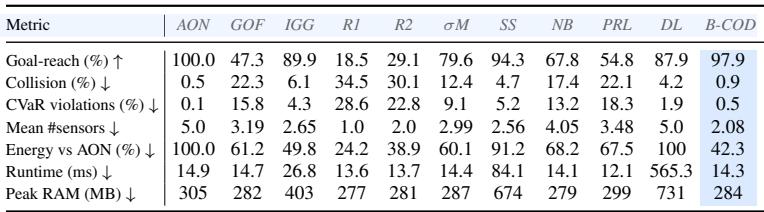
Table 2 highlights a massive advantage: B-COD’s runtime is constant (~10ms) regardless of the map size. In contrast, the analytic planner (DESPOT-Lite) slowed down to 9 seconds per step on a large map—completely unusable for a moving robot.
The “Psychology” of the Planner
What makes B-COD interesting is observing why it makes decisions. It doesn’t use hard-coded rules; it uses the calibrated uncertainty from the diffusion model.
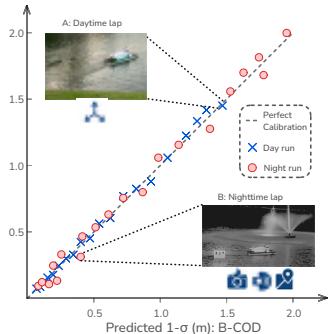
Figure 4 proves the model is calibrated. When B-COD predicts a 1-meter error (x-axis), the robot actually experiences a ~1-meter error (y-axis). It knows exactly how unsure it is.
We can see this intelligence in action during a real lap:
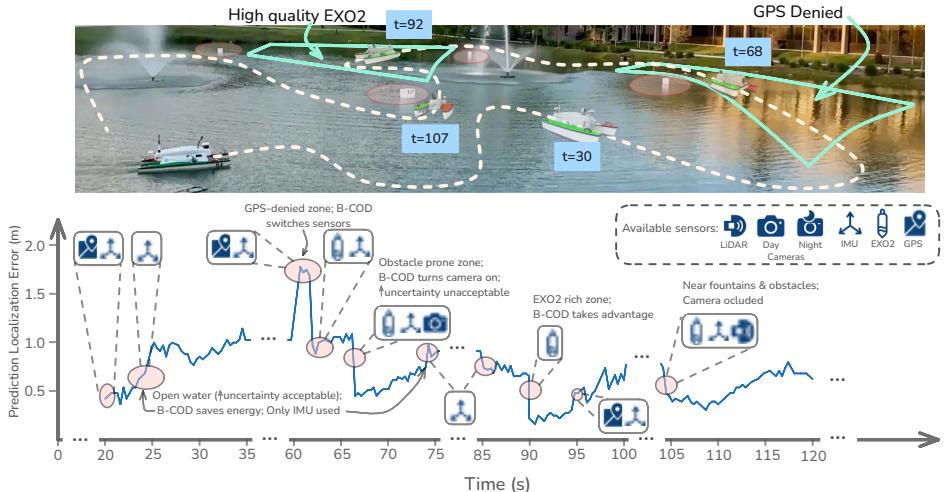
Looking at Figure 3:
- Open Water (t=40): The robot is in open water. The diffusion model predicts low risk even with just the IMU. The scheduler turns expensive sensors off.
- GPS Denied (t=60): The robot enters an area where GPS is blocked. Uncertainty spikes. The scheduler immediately activates the LiDAR and Cameras.
- Obstacles (t=105): Near fountains, precise positioning is required. The system keeps sensors hot to ensure safety.
Robustness to Failure
Perhaps the most compelling result is how the system handles broken sensors. In one test, the researchers deliberately disabled the LiDAR mid-mission.
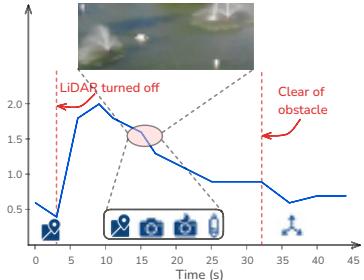
As shown in Figure 5, the moment the LiDAR is killed, the predicted risk (blue line) spikes massively. The planner realizes it is effectively blind. Without any human programming telling it what to do, the RL agent immediately switches on the Cameras and the EXO2 sonde. It realized that to maintain the safety budget without LiDAR, it needed every other piece of data available. The risk drops back down, and the mission continues.
Conclusion & Implications
Belief-Conditioned One-Step Diffusion (B-COD) represents a significant step forward in robotic autonomy. By training a neural network to understand not just where to go, but how well it knows where it is, the researchers have created a system that manages its own resources intelligently.
The key takeaways are:
- Speed: Consistency distillation allows complex belief-space planning in 10ms.
- Efficiency: It reduces sensing energy by over 50% without sacrificing reliability.
- Simplicity: It replaces complex, hand-tuned heuristics with a unified learning-based approach.
This technology has broad implications beyond just boats. Drones with limited battery life, rovers on Mars managing power cycles, and warehouse robots could all benefit from the ability to navigate with “just-enough” sensing. Instead of fearing the dark, robots can now learn exactly when they need to turn on the lights.