](https://deep-paper.org/en/paper/2508.12252/images/cover.png)
Introduction
Imagine a toddler learning to walk. They stumble, they teeter, and inevitably, they fall. But usually, a parent is there—holding their hands, guiding their weight, catching them before they hit the ground, and picking them back up to try again. This biological “teacher-student” loop is fundamental to how humans master motor skills.
In the world of robotics, specifically humanoid locomotion, we often skip this step. We typically train robots in a digital “matrix”—a physics simulation—where they can fall millions of times without breaking. Then, we copy-paste that brain into a physical robot and hope for the best. This is known as Sim-to-Real transfer. While effective, it suffers from the “reality gap”: friction, sensor noise, and complex physics in the real world never perfectly match the simulation.
The alternative—learning directly in the real world—is arguably better for performance but is terrifyingly impractical. A humanoid robot falling over repeatedly damages expensive hardware and requires a human researcher to reset it manually every few seconds.
But what if a robot could have a parent?
In a fascinating paper titled “Robot Trains Robot: Automatic Real-World Policy Adaptation and Learning for Humanoids,” researchers from Stanford University propose a novel framework called RTR. They pair a “Student” humanoid robot with a “Teacher” robotic arm. The arm doesn’t just hold the humanoid; it actively teaches it, providing safety, guidance, feedback, and automatic resets.
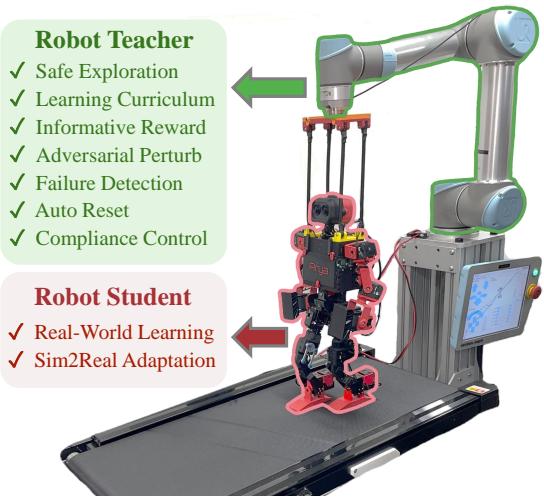
This blog post will dive deep into the RTR framework, breaking down the hardware ecosystem, the clever algorithmic innovations used to bridge the reality gap, and the experiments that show a robot can learn to walk efficiently in the real world with almost no human intervention.
The Real-World Learning Problem
Before analyzing the solution, we must understand why training humanoids in the real world is so notoriously difficult. There are three primary bottlenecks:
- Safety: Humanoids are inherently unstable. During the exploration phase of Reinforcement Learning (RL), a robot will try random, often chaotic movements. Without protection, this leads to catastrophic falls. Passive gantries (harnesses attached to a frame) exist, but they are “dumb”—they restrict movement and don’t provide useful feedback.
- Reward Design: In a simulation, we know the exact velocity, position, and forces acting on the robot. In the real world, measuring these values to calculate a “reward” (score) for the AI is hard. How do you measure the robot’s forward velocity accurately if it’s slipping on a treadmill?
- Efficiency: RL is data-hungry. It needs thousands of trials. If a human has to manually pick up the robot after every fall, the training process becomes prohibitively slow and labor-intensive.
The RTR framework addresses these by automating the entire loop.
The System: Teacher and Student
The researchers built a physical ecosystem designed to run autonomously.
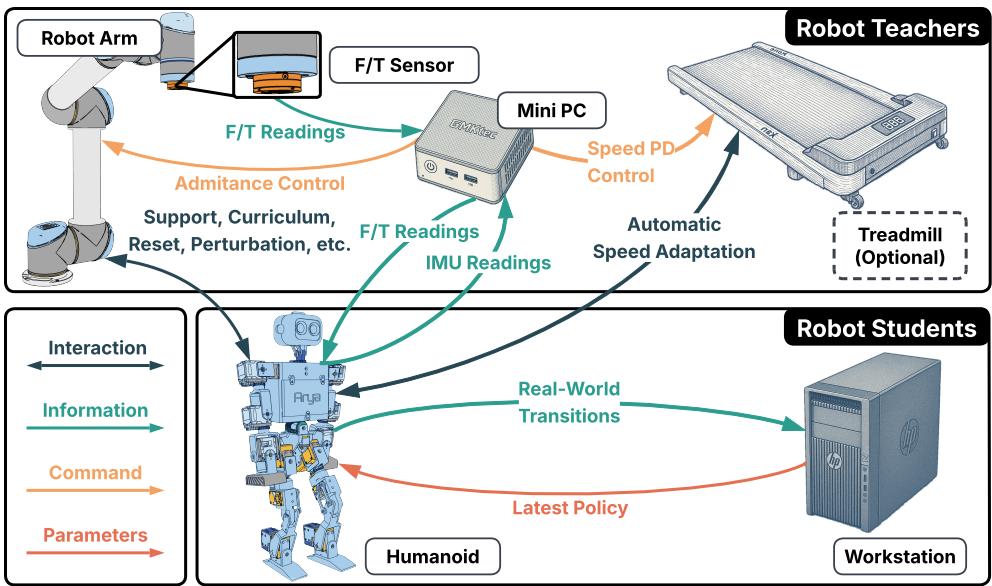
The Hardware Setup
As shown in Figure 2, the setup is divided into two groups:
1. The Robot Teacher The teacher is a 6-DoF (Degrees of Freedom) UR5 robotic arm. Crucially, it is equipped with a Force-Torque (F/T) sensor at its wrist. It connects to the humanoid student via four elastic ropes. These ropes are vital; unlike a rigid metal bar, elasticity allows for smoother force transmission, preventing the teacher from jerking the student around abruptly.
For locomotion tasks, the teacher group also includes a programmable treadmill that adjusts its speed based on the robot’s performance.
2. The Robot Student The student is ToddlerBot, a small-scale, open-source humanoid robot. It is lightweight (3.4 kg) and robust, making it an ideal candidate for experimental learning where falls are inevitable.
The Teacher’s Syllabus
The robotic arm isn’t just a passive hanger; it runs specific control policies to act as an active instructor. Its roles include:
- Compliance Control (Guidance): Using the F/T sensor, the arm employs admittance control. If the humanoid walks forward, the arm feels the pull and moves with it. It supports the robot’s weight vertically (Z-axis) while allowing it to move freely horizontally (XY-axes). This mimics a parent holding a child’s hand—providing balance without restricting motion.
- Curriculum Scheduling: At the start of training, the arm supports the robot heavily. As training progresses, the arm automatically lowers itself, slacking the ropes and forcing the humanoid to support its own weight.
- Informative Rewards: The F/T sensor provides real-time data on how much the robot is pulling or leaning. This data is fed into the learning algorithm as part of the reward function, a signal that is usually impossible to get without external sensors.
- Automatic Resets: When the system detects a fall (via the F/T sensor or the robot’s IMU), the arm lifts the humanoid back to a standing position. This allows for continuous, unattended training.
The Core Method: Dynamics-Aware Adaptation
Hardware is only half the battle. The researchers also introduced a sophisticated algorithmic pipeline to ensure the robot learns effectively. The core philosophy is Sim-to-Real Adaptation.
The goal is to train a “brain” (policy) in simulation, but structure it so that it can quickly be fine-tuned in the real world to account for physical differences (like specific motor friction or treadmill slippage).
The pipeline consists of three distinct stages.
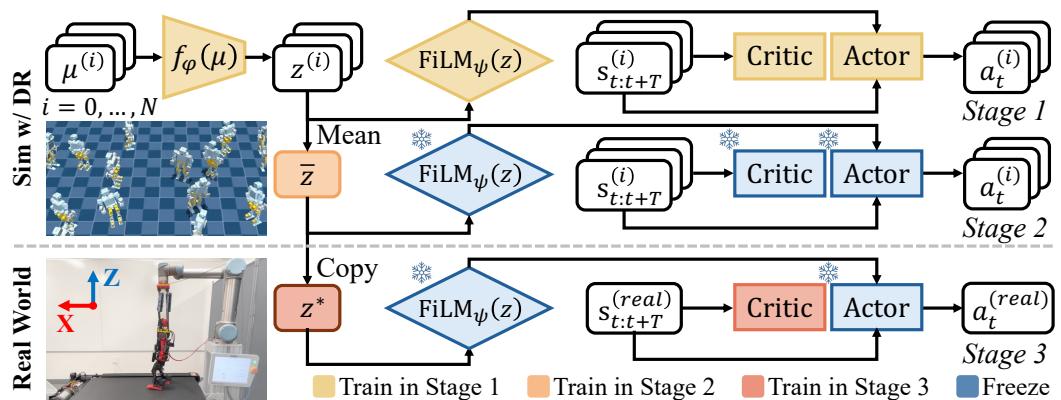
Stage 1: Simulation with Domain Randomization
In the first stage, the policy is trained in simulation. The researchers use Domain Randomization, creating thousands of versions of the environment with different physical properties (friction, mass, damping).
The policy \(\pi(s, z)\) takes two inputs:
- The robot’s state \(s\) (joint angles, velocity).
- A latent vector \(z\).
This latent vector \(z\) is the secret sauce. It is a compressed representation of the physics of the current environment. A neural network encoder takes the physical parameters \(\mu\) (like friction) and compresses them into \(z\).
To inject this physics knowledge into the policy, the authors use FiLM (Feature-wise Linear Modulation) layers. Instead of just concatenating \(z\) to the input, FiLM layers use \(z\) to scale and shift the neural network’s activations deeper in the model.
\[ \gamma _ { j } ^ { ( i ) } , \beta _ { j } ^ { ( i ) } = \mathrm { F i L M } _ { j } ( z ^ { ( i ) } ) , \quad h _ { j } ^ { ( i ) } \gets \gamma _ { j } ^ { ( i ) } \odot h _ { j } ^ { ( i ) } + \beta _ { j } ^ { ( i ) } , \]
In simple terms, \(z\) acts like a set of dials that changes how the brain processes information based on the physics of the world it’s currently in.
Stage 2: Universal Latent Optimization
Here lies a problem: When we move to the real world, we don’t know the exact physical parameters (friction, damping), so we can’t calculate \(z\) using the encoder.
To solve this, the researchers freeze the policy network and search for a universal latent vector \(\tilde{z}\) that works “well enough” across all the randomized simulation environments.
\[ \tilde { z } = \arg \operatorname* { m a x } _ { z } \sum _ { i } \mathbb { E } _ { \tau \sim \pi ( \cdot | z ) , \mathcal { T } _ { i } } [ J ( \tau ) ] \]
This universal vector serves as a robust starting point—a “best guess” of what the real world might feel like.
Stage 3: Real-World Fine-Tuning
Finally, the robot is placed in the RTR rig. In this stage, the main policy network (the “brain”) is frozen. The only thing that gets updated is the latent vector \(z\).
Using the PPO (Proximal Policy Optimization) algorithm, the robot interacts with the real world. Based on the rewards it gets, it adjusts only the \(z\) vector.
This is brilliant for two reasons:
- Efficiency: Optimizing a small vector is much faster than retraining a massive neural network.
- Safety: Because the core walking behaviors are frozen in the main network, the robot won’t suddenly forget how to walk and start flailing (a phenomenon known as catastrophic forgetting). It just adjusts its “physics settings” to match reality.
Experiment 1: Fine-tuning a Walking Policy
The first major test of RTR was a walking task. The goal: walk on a treadmill while accurately tracking a target speed.
The Reward Signal: The robot is rewarded for matching the target velocity.
\[ r = \exp \left( - \sigma \cdot ( v - v ^ { \mathrm { t a r g e t } } ) ^ { 2 } \right) , \] In the real world, measuring true velocity \(v\) is hard. However, because the robot is on a treadmill, if it stays in place relative to the room, its velocity matches the treadmill’s speed. The RTR system ensures the robot stays centered, allowing the treadmill speed to act as a proxy for the robot’s speed.
Does Active Teaching Help?
The researchers performed “ablation studies”—removing parts of the system to see if they mattered.
- Compliance: They compared the active, compliant arm against a fixed, rigid arm. The result? The rigid arm dragged the robot, preventing it from learning natural dynamics. The compliant arm (RTR) allowed for much better policy adaptation.
- Scheduling: They tested lowering the arm gradually (curriculum) vs. keeping it high (easy) or low (hard). The gradual schedule produced the best long-term results, preventing the robot from becoming reliant on the support.
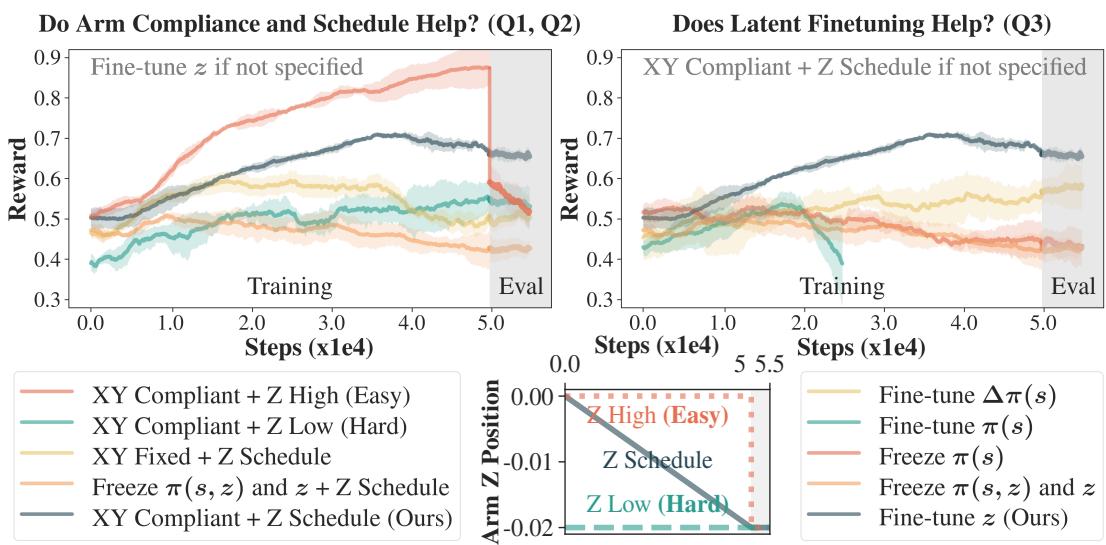
As seen in Figure 4 (Left), the RTR method (Dark Blue line) achieves consistently higher rewards during evaluation compared to baselines where the arm is fixed or the schedule is static.
Does Latent Tuning Work?
Figure 4 (Right) answers the algorithmic question. The researchers compared their method (tuning only \(z\)) against tuning the whole network or adding a residual network. The RTR approach (Dark Grey/Blue line) was the most data-efficient and stable.
The Result: With just 20 minutes of real-world training, the robot doubled its walking speed compared to the zero-shot baseline.
Comparison with RMA
The researchers also compared RTR against Rapid Motor Adaptation (RMA), a state-of-the-art baseline for legged robots. RMA uses a history of observations to predict the latent \(z\).

Table 3 shows that RTR’s method of using FiLM layers (bottom row) outperforms RMA’s concatenation method (top row) significantly in simulation. Furthermore, in the real world, the RTR policy was much more stable, whereas the RMA policy frequently caused the robot to lean too far forward.
Experiment 2: Learning from Scratch (Swing-Up)
Sim-to-real is great for walking, but some tasks are incredibly hard to simulate accurately. For example, interacting with soft, deformable objects—or swinging on a rope. The complex dynamics of a flexible cable are a nightmare for physics engines.
In this experiment, the robot had to learn to swing itself up (like a gymnast on rings) directly in the real world, starting with zero knowledge.
The Setup: The robot holds the elastic ropes. The goal is to pump its legs and body to maximize the swing amplitude.
The Teacher’s Role: Here, the teacher arm played a more dynamic role. It could either:
- Help: Move in sync with the swing to amplify energy (teaching the robot what a “good” high swing feels like).
- Perturb: Move against the swing to dampen energy (forcing the robot to fight harder).
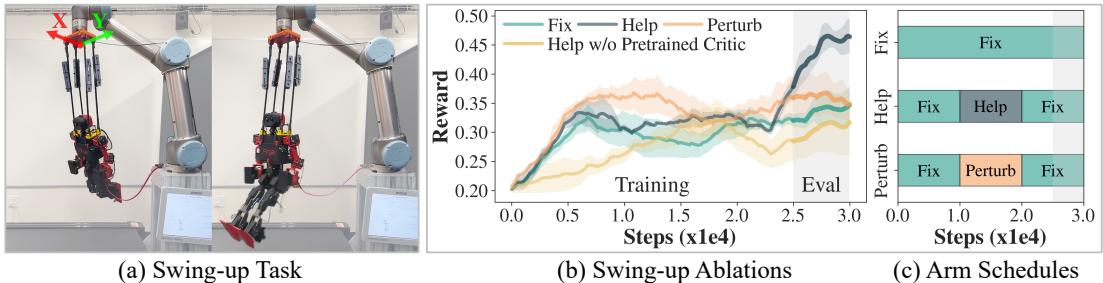
The Reward: The system calculated the reward based on the force amplitude measured by the F/T sensor on the arm.
\[ r = \exp \left( - \alpha \cdot ( \hat { A } _ { \nu _ { x } } - A ^ { \mathrm { t a r g e t } } ) ^ { 2 } \right) , \]
Results
The graph in Figure 5(b) shows that the “Help” schedule (Dark Grey line) was superior. By artificially boosting the swing height early in training, the teacher allowed the student’s “Critic” (the part of the AI that estimates value) to see high-value states that it normally wouldn’t reach for hours. This “guided experience” accelerated learning significantly.
Within 15 minutes of real-world interaction, the humanoid successfully learned a periodic swing-up motion from scratch.
Conclusion and Implications
The “Robot-Trains-Robot” framework represents a significant step forward in robotic learning. By introducing a teacher robot, the researchers effectively automated the role of the graduate student—the person who usually has to catch the falling robot.
Key takeaways from this work:
- Active Protection is Key: A compliant, sensing robotic arm enables safe exploration that passive gantries cannot match.
- Hybrid Learning Pipeline: The 3-stage process (Sim with FiLM \(\rightarrow\) Universal Latent \(\rightarrow\) Real-world Tuning) balances the speed of simulation with the accuracy of real-world data.
- Efficiency: Tasks that previously might have taken hours of manual supervision can now be learned in 15-20 minutes of autonomous operation.
While the current setup uses a small humanoid, the principles are scalable. Future iterations could see massive industrial arms training full-sized humanoids, or bridge cranes acting as teachers in large warehouses. As robots begin to teach each other, the pace of robotic evolution may be about to shift into high gear.