](https://deep-paper.org/en/paper/2508.13534/images/cover.png)
Imagine you are teaching a friend how to scoop beans. You pick up a silver spoon, scoop the beans, and dump them into a bowl. Now, you hand your friend a large plastic ladle. Without hesitation, your friend adjusts their grip, accounts for the ladle’s larger size, and performs the exact same scooping action. They understood the function of the action, not just the specific geometry of the spoon.
For robots, this simple act of transfer is incredibly difficult. Traditional robotic learning often relies on rote memorization of specific objects. If you teach a robot to pour with a red mug, it is likely to fail when handed a glass measuring cup. The shapes, sizes, and grasp points are mathematically different, even if the “function” (pouring) is identical.
This limitation is a major bottleneck in robotics. We want generalist robots that can watch a YouTube video of a human fixing a sink or cooking a meal and immediately replicate the task using whatever tools are on hand.
In this post, we will deep dive into MimicFunc, a new framework presented by researchers from the Southern University of Science and Technology and the National University of Singapore. MimicFunc enables robots to imitate tool manipulation from a single human video and generalize that skill to novel tools by understanding functional correspondence rather than just visual similarity.
The Problem: Intra-Function Variation
The core challenge MimicFunc addresses is intra-function variation. This term describes the significant geometric differences between tools that serve the same purpose.
Consider the task of “pouring.” You can pour with a mug, a bottle, a kettle, or a beaker.
- Mug: Handle on the side, wide opening.
- Bottle: No handle, narrow neck.
- Kettle: Handle on top, long spout.
To a standard computer vision algorithm looking for shape matches, these objects look nothing alike. Previous methods often tried to establish dense correspondence—matching every pixel or point on the demonstration tool to the new tool. When the shapes are too different (e.g., matching a knife to a cleaver), these methods break down.
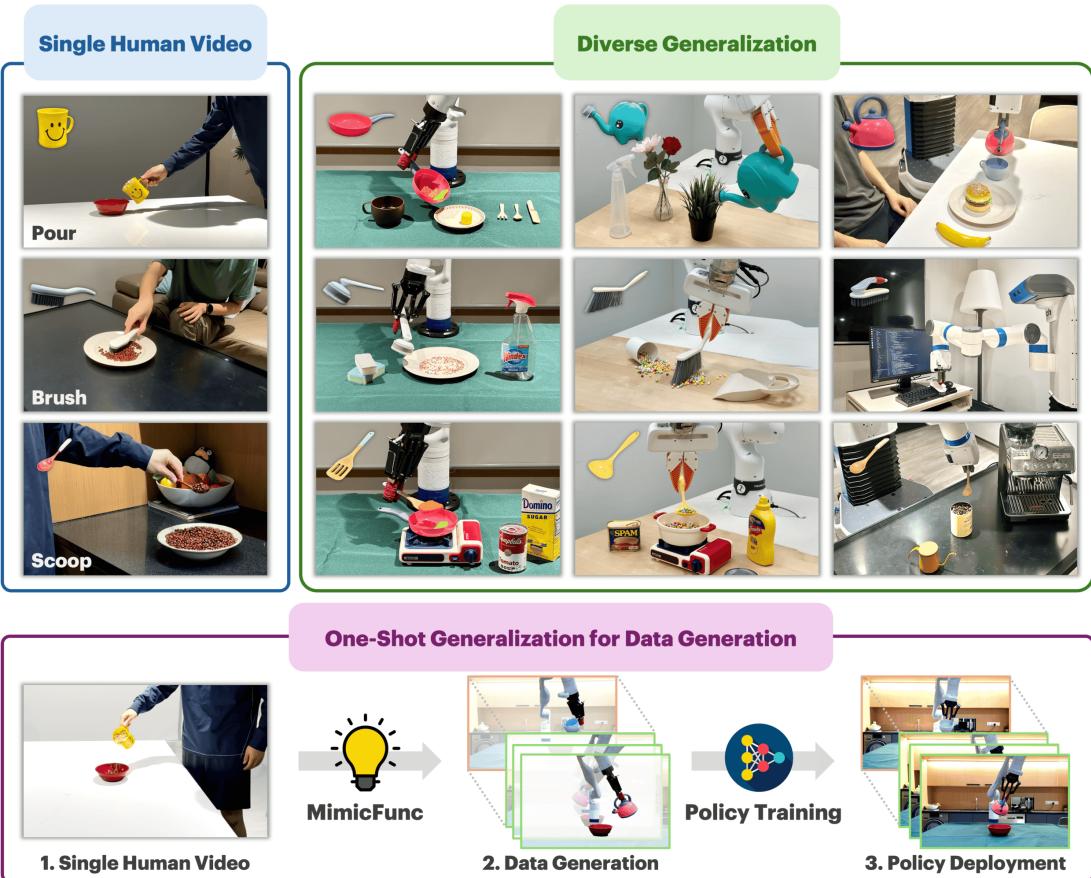
As shown in Figure 1 above, the goal is “One-Shot Generalization.” The robot watches a human pour with a mug (top left) and should be able to pour with a watering can or a coffee pot (right grid). To achieve this, we need a system that captures the invariance in tool manipulation—the logical rules of the task that remain true regardless of the tool’s shape.
The Core Solution: Functional Correspondence
The researchers argue that while the tool’s shape changes, the spatiotemporal pattern of the function remains consistent. Pouring always involves approaching a target, tilting the container, and directing the liquid out.
To capture this, MimicFunc moves away from matching object meshes and instead builds a Function Frame. This is a local coordinate system attached to the active part of the tool.
The pipeline is divided into three distinct stages:
- Functional Keypoint Extraction: Understanding the human video.
- Functional Correspondence Establishment: Mapping the human’s tool to the robot’s tool.
- Function Frame-Based Action Generation: Creating the robot’s movement trajectory.
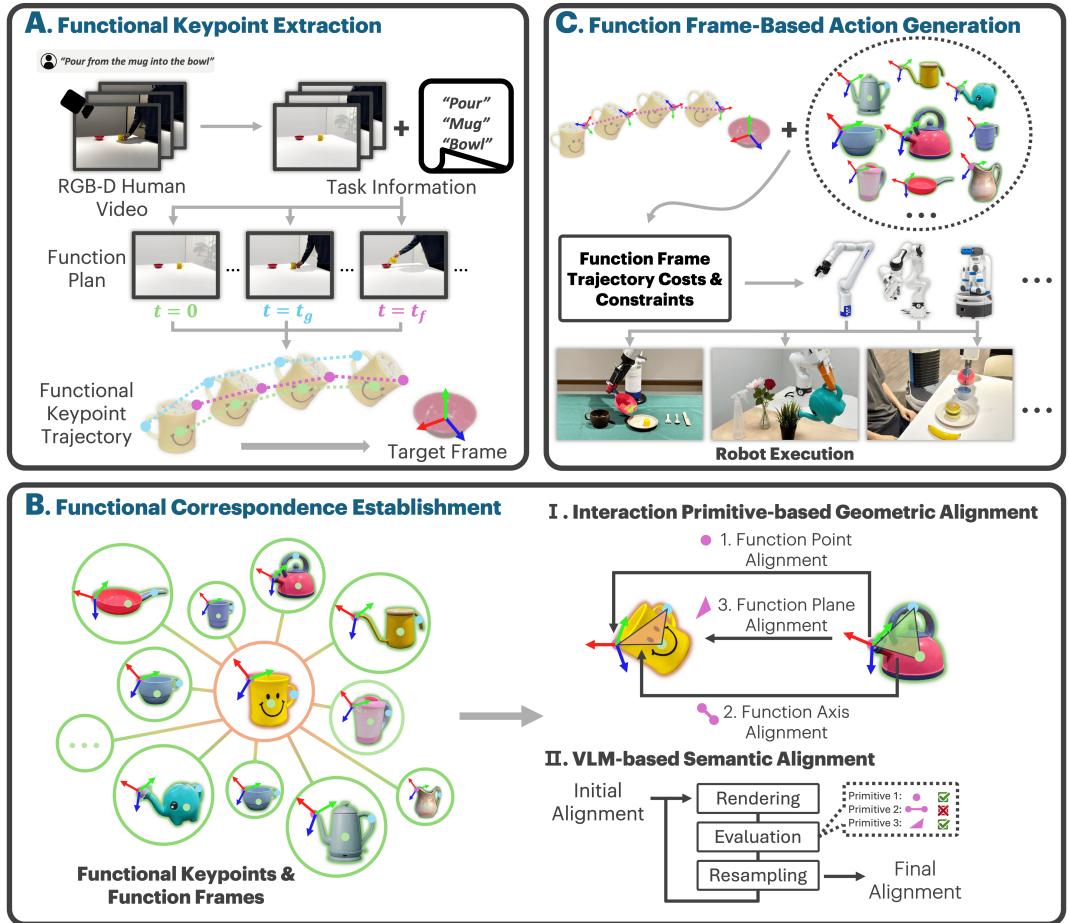
Let’s break down each stage of the pipeline illustrated in Figure 2.
Stage 1: Functional Keypoint Extraction
Before the robot can move, it must understand what the human is doing. The system analyzes the RGB-D (color + depth) video of the human demonstration. It breaks the video down into a “Function Plan” containing key moments: the initial state, the grasping moment, and the function execution (e.g., the moment the water leaves the spout).
Crucially, MimicFunc abstracts the tool into three Functional Keypoints:
- The Grasp Point (\(p_{grasp}\)): Where the hand interacts with the tool.
- The Function Point (\(p_{func}\)): The specific part of the tool that interacts with the target (e.g., the tip of a knife, the spout of a kettle, the bowl of a spoon).
- The Center Point (\(p_{center}\)): The geometric center of the tool, serving as a stable reference.
By reducing a complex 3D object to these three points, the system ignores irrelevant details (like the color or decorative shape of a handle) and focuses on the “skeleton” of the interaction.
Stage 2: Establishing Correspondence with Function Frames
This is the heart of the paper. Once the system has the keypoints from the human video, it needs to find the equivalent points on the new tool the robot is holding.
The Function Frame
The researchers introduce the concept of a Function Frame (\(\Pi\)). Think of this as a personalized coordinate system for the tool’s job.
- Origin: Placed at the Function Point (e.g., the knife tip).
- Principal Axis (Function Axis): A vector pointing from the tool’s center to the function point. This gives the robot a directional cue on how the tool is oriented relative to its work.
The system constructs a Function Frame for the human’s tool (\(\Pi_H\)) and attempts to construct an aligned frame for the robot’s tool (\(\Pi_R\)).
Alignment via Primitives and VLMs
How does the robot know where the “spout” is on a new, strange-looking kettle? MimicFunc uses a coarse-to-fine approach.
- Visual Prompting: It uses a Vision-Language Model (VLM) to propose a rough region for the grasp and function points.
- Dense Semantic Correspondence: It uses learned geometric priors to refine these points.
However, geometric matching isn’t always enough. Sometimes, a mathematically perfect alignment makes no physical sense (e.g., the robot might try to pour while holding the kettle upside down). To solve this, MimicFunc employs a VLM-based Semantic Alignment.
The system “imagines” the interaction by rendering the point clouds of the tool and target. It then asks a VLM (like GPT-4V): “Is this interaction valid?” If the VLM spots an issue (e.g., “The spout is facing away from the cup”), the system resamples the alignment until a valid configuration is found.

Figure 10 visualizes this refinement. The system iterates through different alignments (shown in the panels) until the semantic evaluator confirms the tool is oriented correctly for the task.
Stage 3: Action Generation
Once the robot knows how the new tool corresponds to the old one, it needs to move. The goal is to generate a trajectory that mimics the human’s intent.
The researchers formulate this as a constrained optimization problem. The robot tries to minimize the difference between its function frame and the human’s function frame over time.

In this equation:
- The first term minimizes the distance between the robot’s function point (\(q_{func}\)) and the human’s function point (\(p_{func}\)).
- The second term minimizes the difference in rotation/orientation between the two frames.
- Constraints ensure the robot starts at the correct position and ends at the correct function keyframe.
By solving this, MimicFunc generates a smooth path that replicates the “pouring” or “cutting” motion, adjusted specifically for the geometry of the new tool.
Experiments and Results
Does it actually work? The researchers tested MimicFunc on five core tasks: Pour, Cut, Scoop, Brush, and Pound.
They compared MimicFunc against several baselines, including DINOBot (which uses visual features from DINOv2) and ORION (which uses geometric point cloud matching).
Quantitative Success
The results were stark. While baseline methods performed okay when the new tool was spatially moved, they failed catastrophically when the tool category changed (e.g., switching from a knife to an axe).
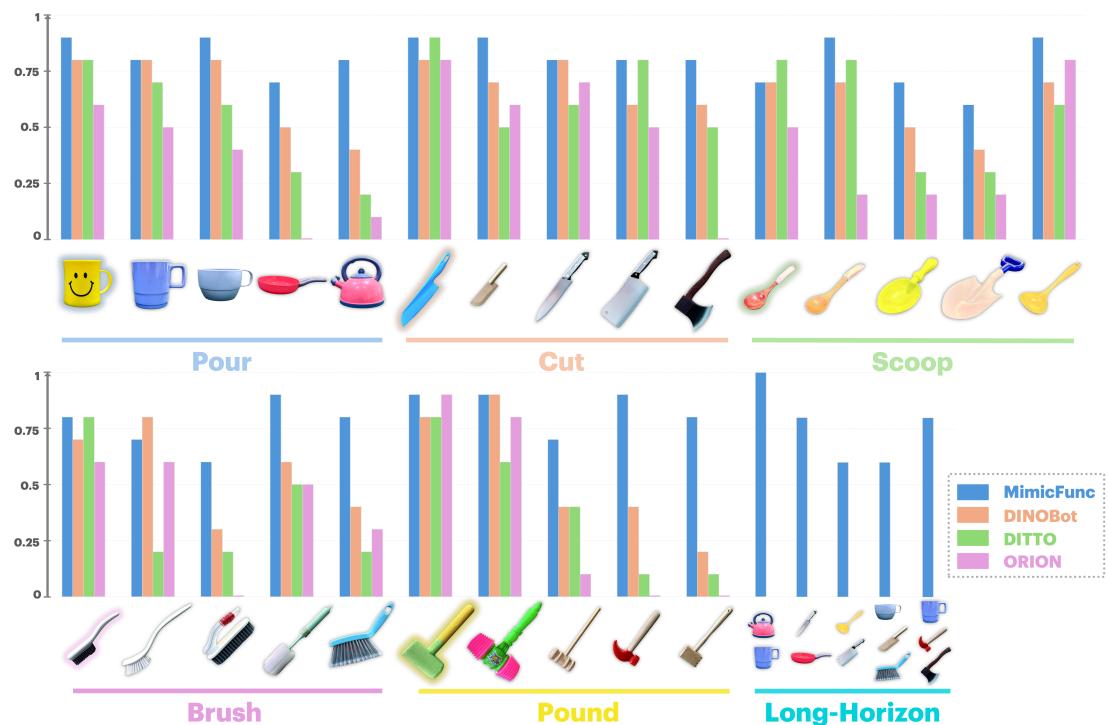
As shown in Figure 3, MimicFunc (blue bars) consistently outperforms the baselines (orange, green, pink) across almost all categories.
- Instance Generalization: Using a different type of mug.
- Category Generalization: Using a completely different object (e.g., pouring with a teapot instead of a mug).
MimicFunc achieved an average success rate of 79.5% on novel tool generalization, significantly higher than the closest competitor.
Qualitative Visualization
The visual results clarify why MimicFunc succeeds. In Figure 5 below, you can see the Human Demonstration on the left and the Robot Execution on the right.
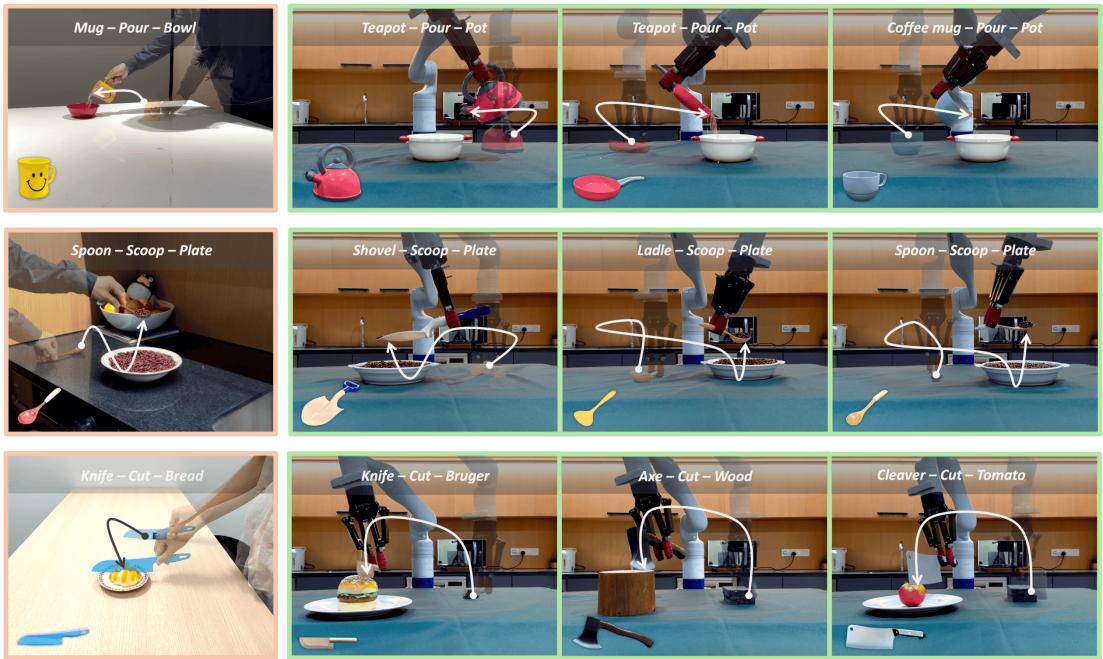
Look at the Cut row (bottom). The human uses a standard kitchen knife. The robot, using MimicFunc, successfully transfers this cutting motion to a cleaver (chopping a tomato) and even an axe (chopping wood). A purely geometric method would struggle to map the thin blade of a knife to the head of an axe, but MimicFunc understands that the edge is the function point and aligns the motion accordingly.
Real-World Execution
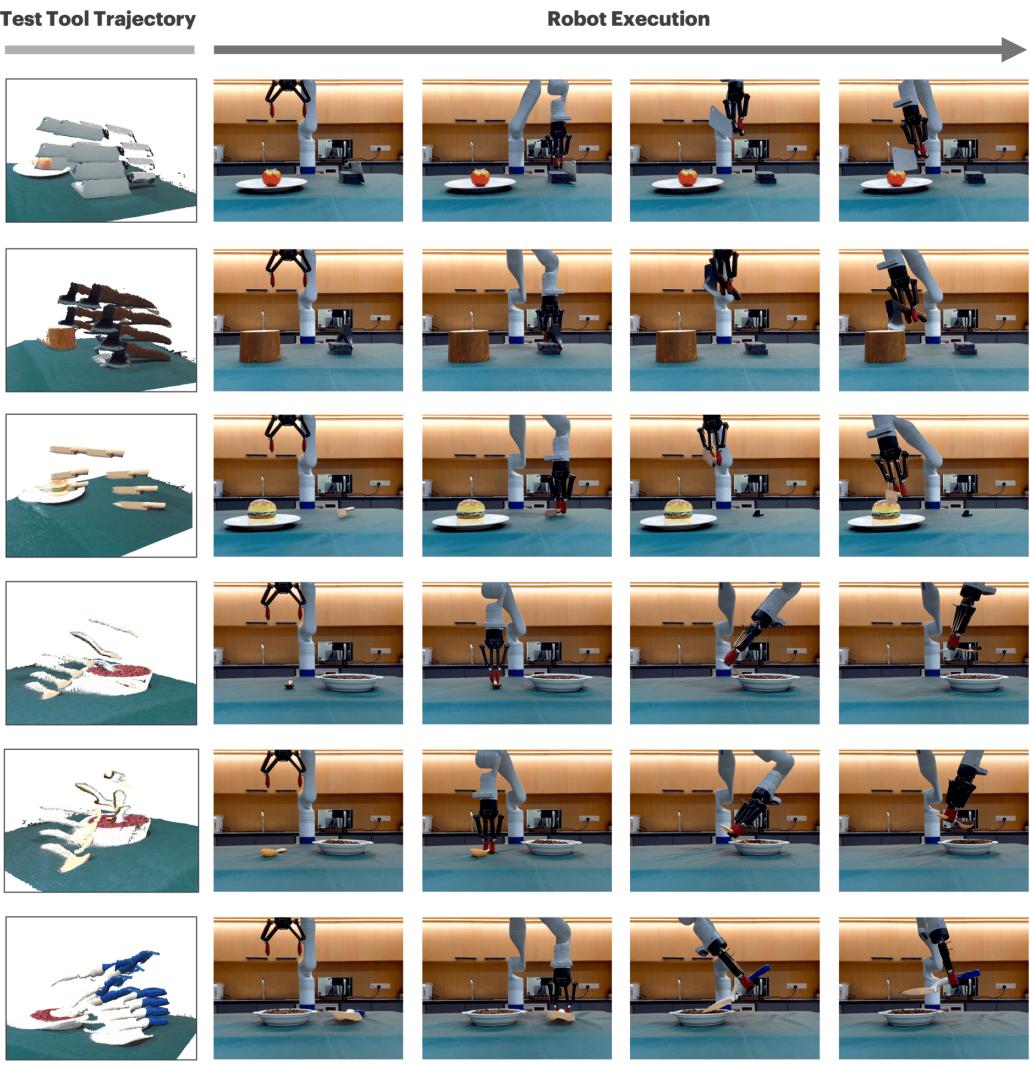
The system’s robustness is further highlighted in real-world rollouts. The image below shows the planned trajectory (left) and the actual robot executing it (right). Whether it is stacking blocks or scooping with a ladle, the alignment between the “Function Frame” plan and reality is precise.
Scaling Up: Generating Data for Policies
One of the most exciting implications of MimicFunc is its potential to solve the data scarcity problem in robotics.
Training robust neural networks (like Visuomotor Policies) requires thousands of demonstrations. Collecting these via teleoperation (a human controlling the robot remotely) is slow and tedious—taking about 48 seconds per demo.
MimicFunc can automate this.
- Record one human video (takes ~5 seconds).
- Use MimicFunc to generate hundreds of successful rollouts with various tools in simulation or the real world.
- Use this generated data to train a robust policy (like ACT).
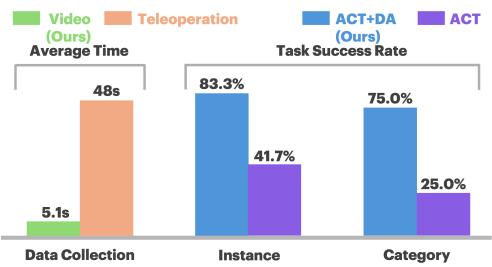
Figure 4 illustrates this impact. The “Video (Ours)” data collection is nearly 10x faster than teleoperation. More importantly, policies trained with this synthetic data (ACT+DA) significantly outperformed policies trained on expensive human teleoperation data, specifically in generalization tasks.
Conclusion
MimicFunc represents a significant step forward in robotic imitation learning. By shifting the focus from visual appearance to functional correspondence, the authors have created a system that mimics the human ability to use tools intuitively.
The key takeaways are:
- Function Frames: Abstracting tools into functional skeletons (grasp, center, function point) is more robust than matching meshes.
- Semantic Awareness: Using VLMs to verify “does this interaction make sense?” prevents physical absurdities that purely geometric methods fall into.
- Data Engine: MimicFunc isn’t just a controller; it’s a data generator that can bootstrap large-scale learning for future robot brains.
While limitations exist—it currently relies on depth cameras (RGB-D) and handles only single-arm tasks—MimicFunc offers a glimpse into a future where robots can learn to use any tool in the garage just by watching us use one in the kitchen.