](https://deep-paper.org/en/paper/2508.17547/images/cover.png)
Introduction: The Challenge of the “Simple” Task
Imagine a task as simple as watering a plant. For a human, this is trivial: you pick up the spray bottle, aim it, squeeze the trigger, and put it back. But for a robot, this is a nightmare of complexity.
To achieve this, a robot must possess dexterity—the ability to manipulate objects with fingers, not just a simple gripper—and long-horizon planning, the ability to string together a sequence of actions where a small mistake in step one causes a catastrophic failure in step five.
Roboticists have long turned to Imitation Learning (IL) to solve this. The idea is simple: show the robot how to do it, and let it copy you. However, there is a catch. To learn a robust policy that can handle slightly different bottle positions or lighting conditions, IL typically requires massive datasets. Collecting thousands of hours of human experts controlling robots is expensive and time-consuming.
In this post, we are diving into a new framework called LODESTAR, presented at CoRL 2025. This research introduces a way to take just a handful of human demonstrations and turn them into a robust, autonomous policy capable of complex tasks like assembling light bulbs or handling liquids.
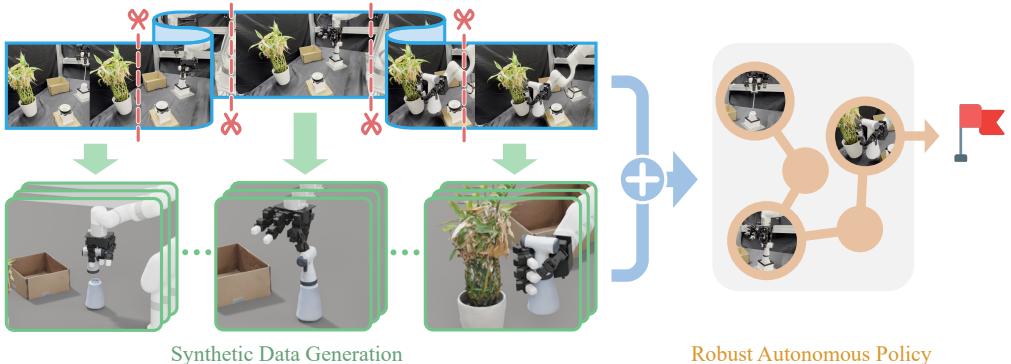
The core innovation? LODESTAR uses “Digital Twins”—simulated versions of the real world—to practice and augment those few human demos, using a technique called Residual Reinforcement Learning. Let’s explore how it works.
The Background: Why is Long-Horizon Dexterity Hard?
Before we unpack the method, we need to understand the two main bottlenecks in current robotic manipulation:
- The Data Bottleneck: Deep learning is hungry for data. If you train a robot with only 10 demonstrations, it will likely overfit. It will only know how to move if the object is in the exact same spot as the demo. If you move the object by an inch, the robot fails.
- The Hand-Off Problem: Long-horizon tasks are chains of skills (e.g., Grasp \(\rightarrow\) Lift \(\rightarrow\) Insert \(\rightarrow\) Twist). If the “Grasp” skill finishes with the object slightly crooked, the “Lift” skill might drop it. These errors compound over time.
LODESTAR addresses these by using simulation to generate synthetic data (solving the data bottleneck) and a Skill Routing Transformer to manage the connections between steps (solving the hand-off problem).
The LODESTAR Framework
The LODESTAR pipeline is divided into three distinct stages. It starts with real-world human demonstrations and ends with a robust policy running on the robot.
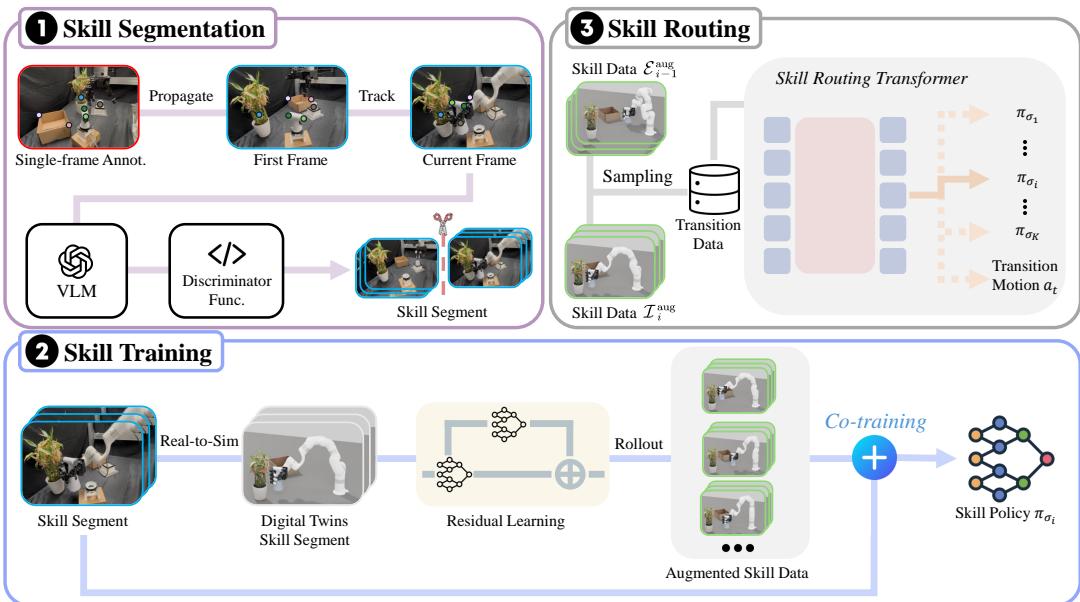
As shown in Figure 2 above, the process flows as follows:
- Skill Segmentation: Breaking the long task into manageable chunks.
- Synthetic Data Generation: Using simulation to learn robust policies for each chunk.
- Skill Composition: Stitching the chunks back together.
Let’s break these down in detail.
Stage 1: Skill Segmentation with Foundation Models
How does the robot know that “grasping the bottle” has ended and “lifting the bottle” has begun? Hard-coding these rules is brittle. Instead, LODESTAR leverages modern Vision-Language Models (VLMs).
The researchers treat a long demonstration as a sequence of Manipulation Skills (complex, contact-rich moves like twisting) and Transitions (moving the hand from point A to B).
To automate this, they use a two-step process:
- Keypoint Tracking: They annotate semantic keypoints on the objects in the first frame of one demo (e.g., the tip of the spray nozzle). Using a model called Co-Tracker, they track how these points move across all frames.
- VLM Reasoning: They feed the visual data and a text description of the task into an OpenAI model (specifically o3). The model writes Python functions—discriminators—that look at the keypoints and geometric relationships to decide exactly when a skill starts and ends.
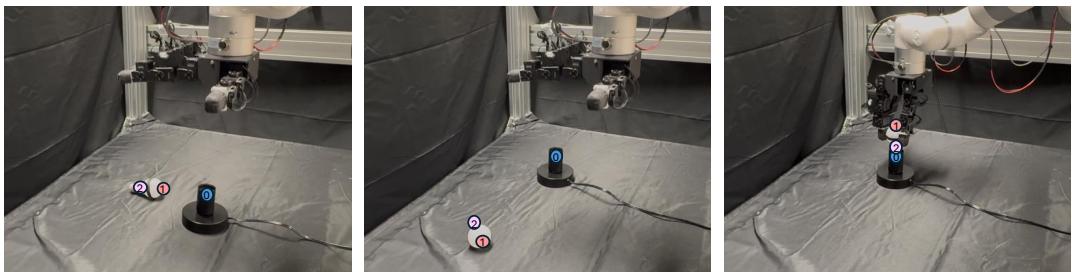
This creates a structured timeline of the task without requiring a human to manually label every frame of every video.
Stage 2: Synthetic Data and Residual RL
This is the engine room of LODESTAR. The system has a few real-world demos, but it needs thousands of varying examples to learn robustness.
Real-to-Sim Transfer
First, the system builds a simulation environment that mimics the real world. They scan the physical objects to create textured 3D meshes and estimate their physical properties (friction, mass).

Residual Reinforcement Learning (Residual RL)
Here is the clever part. The researchers don’t just use standard Reinforcement Learning (which takes forever to train from scratch) or standard Imitation Learning (which copies errors). They use Residual RL.
Here is how it works:
- Base Policy: A policy is trained to mimic the human demonstration exactly. This gives the robot a “good guess” of what to do.
- Residual Policy: An RL agent is trained to output corrections (residuals) to the Base Policy.
Think of it like learning to ride a bike with a parent holding the seat. The parent (Base Policy) provides the general motion and balance. The child (Residual Policy) learns the small adjustments needed to handle bumps in the road or wind.
By training in simulation, LODESTAR can run thousands of trials where it randomizes the object’s position, the friction of the fingers, and sensor noise. This allows the policy to encounter (and solve) situations that never appeared in the original human demos.
Stage 3: The Skill Routing Transformer (SRT)
Now we have robust policies for “Grasping,” “Inserting,” and “Twisting.” But we need a conductor to orchestrate them.
The team introduces the Skill Routing Transformer (SRT). This is a high-level policy that takes the current history of observations and decides two things:
- Which Stage is next? (Should I be transitioning? Or executing Skill #2?)
- What is the action? (It outputs the motor commands).
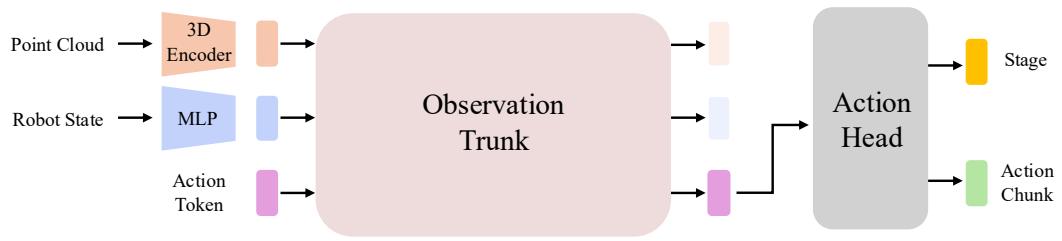
This architecture is crucial because it doesn’t just switch blindly between skills. It uses the Transition phases to smooth out the “hand-off.” If the “Grasp” skill ends with the hand in a slightly awkward pose, the SRT ensures the robot adjusts its trajectory during the transition so it arrives at the “Insert” stage in the correct configuration.
Hardware and Setup
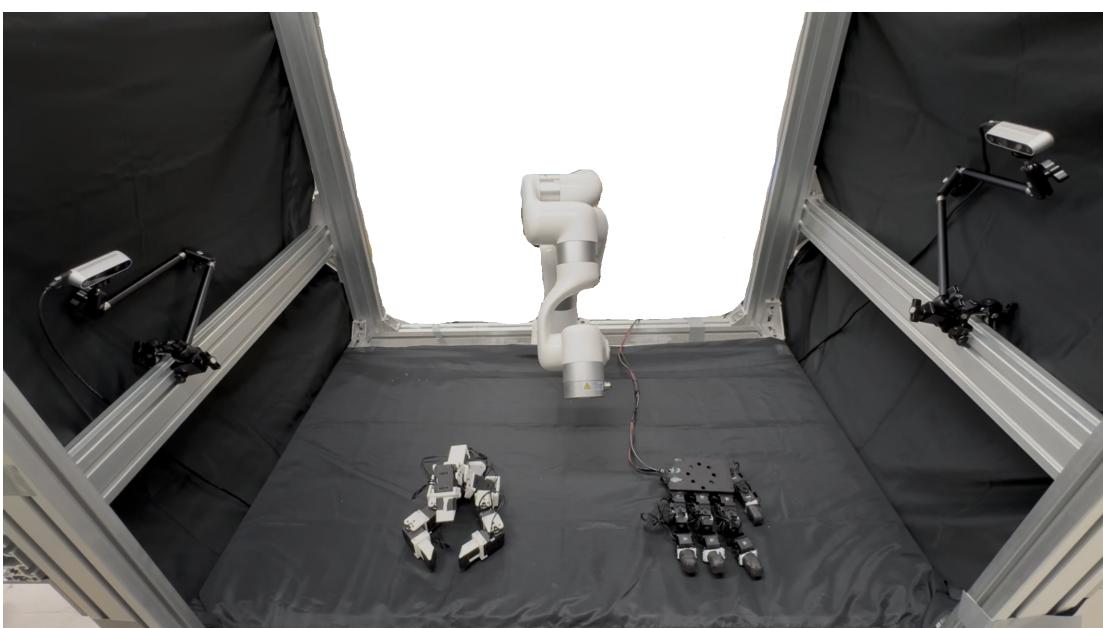
The experiments were conducted on a serious piece of hardware: an xArm7 robotic arm equipped with multi-fingered hands. They tested two different end-effectors:
- A 3-Finger Hand (custom design, 9 Degrees of Freedom) for liquid handling.
- A LEAP Hand (4 fingers, 16 Degrees of Freedom) for more complex grasping.
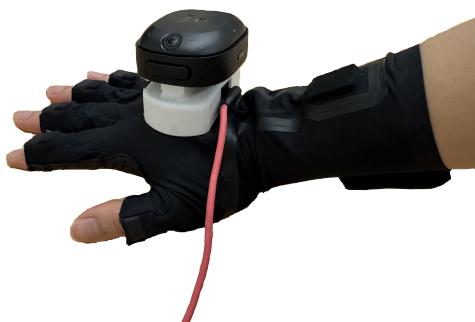
To collect the human demonstrations, the researchers didn’t use a joystick. They built a teleoperation rig using a Rokoko Smart Glove to track finger joints and a Vive Ultimate Tracker for wrist position. This allowed them to transfer human dexterity directly to the robot.
Experimental Results
The researchers evaluated LODESTAR on three highly complex tasks that require fine motor skills:
- Liquid Handling: Using a pipette to draw liquid and move it to a test tube.
- Plant Watering: Assembling a spray bottle (inserting the nozzle, twisting it) and spraying.
- Light Bulb Assembly: Grasping a bulb, reorienting it in the hand, and screwing it into a socket.

Performance Comparison
The results were impressive. The team compared LODESTAR against several state-of-the-art baselines, including MimicGen (which augments data by replaying it) and Real-only training.
As seen in Figure 4, LODESTAR (specifically the Point Cloud version, “LodeStar-PC”) outperformed the baselines significantly, achieving nearly 50% average success across these very difficult tasks, while “Real-only” approaches struggled below 20%.

Why did it perform better?
The secret lies in handling the “compounding errors” we discussed earlier. Figure 5 shows the cumulative failure rate for the Plant Watering task.
Look at the Real-only (blue) line. It shoots up quickly. This means the robot often fails at the very first step (Grasp) or the second (Insert). Even if it passes those, it almost certainly fails by the “Screw” stage.
In contrast, LODESTAR (purple) keeps the failure rate low throughout the entire sequence. Because the individual skills were trained with Residual RL in simulation, they are robust enough to recover from small errors, preventing the chain reaction of failure.

Robustness “Out of Distribution”
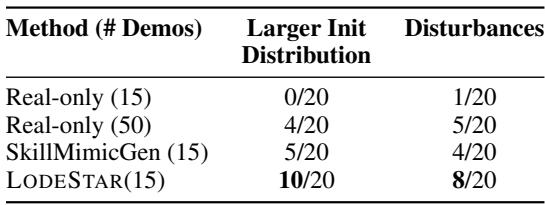
Finally, the true test of a robot is how it handles things it hasn’t seen before (Out-of-Distribution or OOD). The researchers tested the Light Bulb task by initializing the objects in positions much wider than the training data, and by actively disturbing the robot.
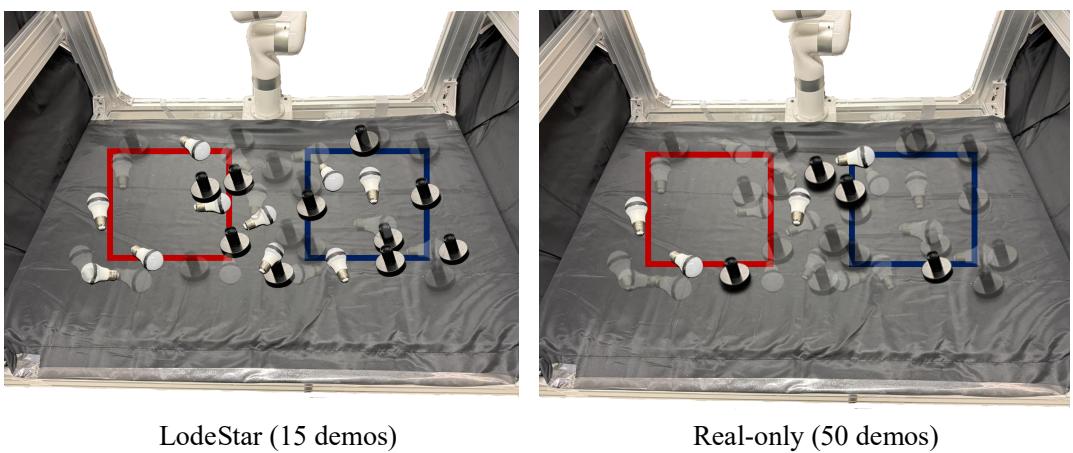
In the visualization above, the faded bulbs represent failures and solid ones represent successes. LODESTAR (left) maintains a high density of successes even as the bulb’s position varies. The Real-only baseline (right), even when trained with more demonstrations (50 vs 15), struggles to generalize beyond the specific spots where the human demonstrated the task.
Table 1 further quantifies this. With only 15 demonstrations, LODESTAR achieves double the success rate of the baseline trained with 50 demonstrations when facing disturbances.
Conclusion
LODESTAR represents a significant step forward in robotic manipulation. It tackles the “data hunger” of deep learning by treating human demonstrations not as the final dataset, but as a seed.
By planting this seed in a simulation engine and using Residual RL to grow it, the system generates a wealth of synthetic experience. When combined with a smart routing policy, the result is a robot that can perform long, multi-step dexterous tasks with a level of reliability that pure imitation learning struggles to match.
For students and researchers in robotics, the takeaway is clear: Hybrid approaches win. Combining the semantic reasoning of Foundation Models, the exploration power of RL, and the structure of Imitation Learning allows us to solve problems that none of these methods could solve alone.