](https://deep-paper.org/en/paper/2508.18268/images/cover.png)
Introduction
Imagine you are asking a robot to help you prepare breakfast. It needs to pick up a bottle of milk with one hand, a bowl with the other, and pour the milk without spilling it, crushing the bowl, or banging its two arms together. For a human, this bimanual (two-handed) coordination is intuitive. For a robot, it is a geometric and kinematic nightmare.
In the world of robotic learning, Diffusion Policies have emerged as the reigning champions. By learning from human demonstrations, these models are incredibly good at cloning behaviors and handling complex, multi-modal tasks. However, they have a significant blind spot: Physical Safety.
Standard diffusion policies learn to mimic where the robot should go, but they often lack an explicit understanding of physical constraints. They don’t inherently know that pulling two grippers apart while holding a single object will tear it, or that tilting a bottle too early will spill the liquid. They are effectively hallucinating a trajectory based on training data, and sometimes, those hallucinations drift into dangerous territory.
This brings us to a new paper titled SafeBimanual. The researchers behind this work asked a critical question: Can we take a pre-trained, “dumb” diffusion policy and force it to be safe at test time without retraining it?
Their answer is yes. By combining trajectory optimization with the reasoning capabilities of Vision-Language Models (VLMs), they created a system that “guides” the robot’s hands away from danger, ensuring that tasks are not just completed, but completed safely.
In this deep dive, we will explore how SafeBimanual works, the mathematics behind its guidance system, and how it uses GPT-4o to dynamically understand safety requirements in real-time.
Background: The Challenge of Two Hands
Before we dissect the solution, we need to understand why the problem is so hard.
Bimanual Manipulation
Single-arm manipulation is difficult enough, but bimanual manipulation explodes the complexity of the state space. The robot isn’t just controlling one end-effector; it is coordinating two, often in close proximity. This introduces specific failure modes that don’t exist for single-arm robots:
- Self-Collision: The left arm hitting the right arm.
- Closed-Chain Constraints: When both hands hold the same object, the arms form a “closed kinematic chain.” If one arm moves left and the other moves right, they might tear the object or burn out the robot’s motors.
- Coordination: Actions must be synchronized temporally (timing) and spatially (location).
Diffusion Policies in Robotics
If you are familiar with image generation tools like Stable Diffusion or Midjourney, you know the basic premise: the model starts with random noise and iteratively “denoises” it to reveal a clear image.
In robotics, we do the same thing, but instead of pixels, we generate action trajectories. The model starts with a sequence of random actions (noise) and iteratively refines them into a smooth, purposeful movement path. This is powerful because it handles “multimodality” well—if there are two valid ways to pick up a cup, a diffusion model won’t average them out (which would result in grasping empty air); it will commit to one valid path.
However, standard diffusion policies are unconstrained. They generate what looks like the training data. If the model drifts slightly, or if the environment is slightly different, the generated path might clip through a table or stretch a cloth too tight.
The SafeBimanual Taxonomy
To solve a problem, you first have to classify it. The researchers analyzed 1,320 demonstrations across 65 different bimanual tasks to understand exactly how robots fail. They condensed these failures into a Taxonomy of Unsafe Behaviors, shown below.
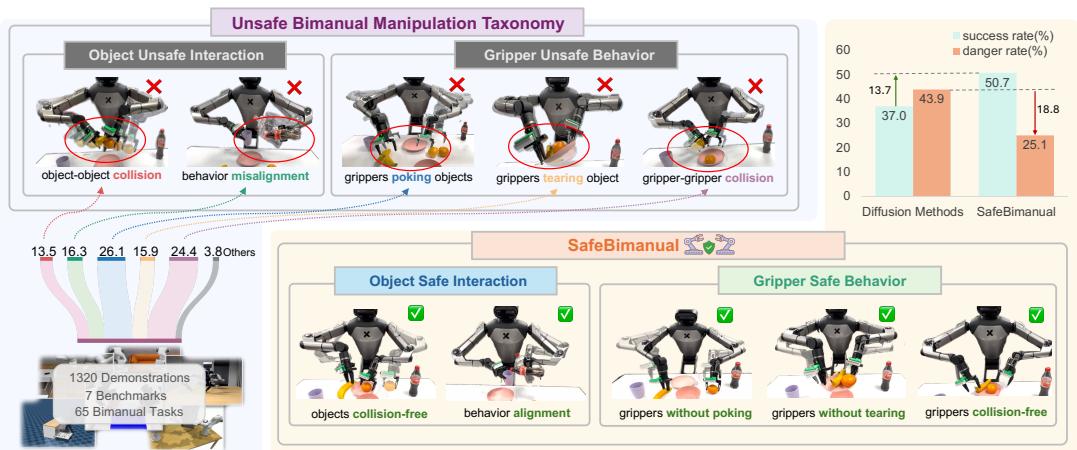
As you can see in Figure 1, the failures (marked with red Xs) fall into two broad categories:
- Object Unsafe Interaction:
- Object-Object Collision: Smashing two items together.
- Behavior Misalignment: e.g., pouring water next to the cup instead of inside it.
- Gripper Unsafe Behavior:
- Poking: The gripper drives into the table or object surface.
- Tearing: The grippers pull apart while holding a rigid or semi-rigid object.
- Gripper-Gripper Collision: The hands crash into each other.
The goal of SafeBimanual is to mathematically forbid these behaviors during the robot’s “thinking” (inference) process.
Core Method: Guiding the Diffusion
The core innovation of SafeBimanual is a test-time trajectory optimization framework. This acts as a “safety wrapper” around any pre-trained diffusion policy.
Here is the high-level workflow, illustrated in Figure 2:
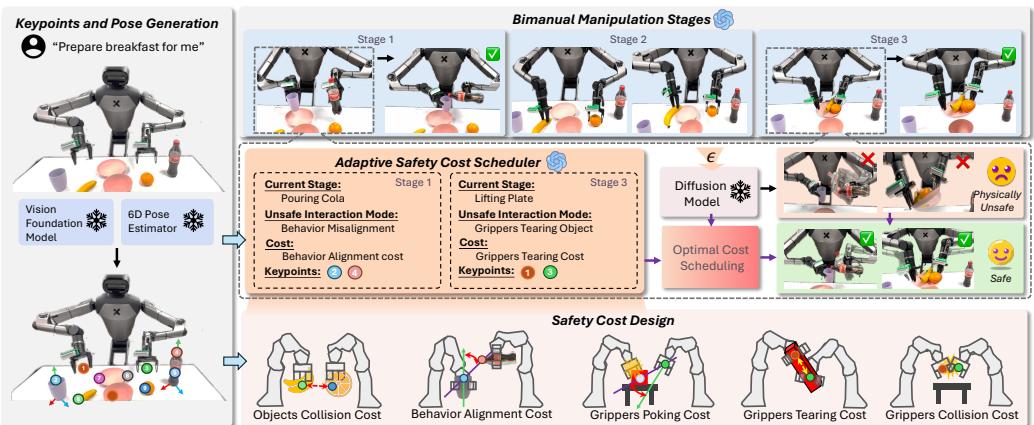
The pipeline consists of three main steps:
- VLM Scheduler: A Vision-Language Model (GPT-4o) looks at the scene and decides which safety constraints are currently relevant.
- Cost Function Selection: Based on the VLM’s decision, specific mathematical cost functions are activated.
- Guided Sampling: The diffusion process is modified to steer the trajectory away from high-cost (dangerous) areas.
Let’s break down the mathematics and logic of each step.
1. Guided Sampling in the Denoising Process
In a standard Denoising Diffusion Probabilistic Model (DDPM), the policy generates actions by iteratively removing noise. The probability of the previous step’s action \(A_{t}^{k-1}\), given the current noisy action \(A_{t}^{k}\) and observation \(O_t\), is modeled as a Gaussian distribution:

Here, \(\mu\) is the predicted mean (where the model thinks the clean action should be), and \(k\) represents the denoising timestep.
SafeBimanual intervenes in this process. Instead of just accepting the mean \(\mu\), the method calculates the gradient of a Safety Cost Function (\(\mathcal{C}_{\text{sched}}\)) and shifts the mean in the opposite direction. If the cost function represents “collision energy,” we want to move the trajectory “downhill” to a state of zero collision.
The update rule changes to this:

Let’s analyze this equation:
- \(\mu(A_t^k, O_t, k)\): This is what the original robot policy wants to do.
- \(\mathcal{C}_{\mathrm{sched}}\): This is the calculated “danger score” of the current trajectory.
- \(\nabla_{A_k}\): This is the gradient—it points in the direction of increasing danger.
- \(-\rho_k\): We subtract this gradient (move away from danger). \(\rho_k\) is a weight parameter that controls how strongly we enforce safety.
By applying this at every step of the denoising process (or just the final few steps for efficiency), the generated trajectory gradually morphs from a potentially dangerous path into a safe one, while still trying to satisfy the original policy’s goal.
2. Defining the Safety Costs
For this gradient guidance to work, the “danger” must be mathematically differentiable. The researchers formulated five specific cost functions corresponding to the taxonomy we discussed earlier.
To calculate these, they need Keypoints. They define keypoints on the grippers and the objects, calculated using Forward Kinematics (FK) and object pose estimation:

Here, \(k_t\) represents the position of a keypoint in 3D space. Now, let’s look at the specific costs.
Cost 1: Object Collision
To prevent the robot from smashing two items together (like clinking two glass bottles too hard), the system penalizes the trajectory if the distance between object keypoints gets too small.

This simple Euclidean distance metric acts as a repulsive force field between the two objects.
Cost 2: Behavior Alignment
This is crucial for tasks like pouring. If you are pouring water, the bottle’s spout must align with the cup’s opening. This cost function creates a penalty if the relative vector between the two objects deviates from the desired axis (vector \(z\)) or if the vertical distance (\(h_0\)) is incorrect.

The first term penalizes misalignment of the axis, and the second term maintains the correct height offset.
Cost 3: Gripper Poking
Robots often damage surfaces by driving their grippers straight down into them. This cost penalizes any movement where the gripper tip moves “into” the surface keypoint along the approach axis \(a\).

This acts like a virtual wall, preventing the gripper from penetrating the object or table.
Cost 4: Gripper Tearing
This is a classic bimanual failure. If the robot holds a box with both hands and moves its left hand left and right hand right, it will rip the box. This cost function measures the distance between gripper tips and penalizes any deviation from the initial grasp distance \(d_0\).

This constraint essentially locks the two arms together virtually when they are handling a rigid object.
Cost 5: Gripper Collision
Finally, we must prevent the robot’s own hands from colliding. This is similar to the object collision cost but applied to the gripper tips.

3. The Adaptive Safety Cost Scheduler
We have five powerful safety constraints. But we can’t just turn them all on at once.
- If we turn on Alignment during the “grasping” phase, the robot might try to pour the bottle before it has even picked it up.
- If we turn on Tearing constraints before the robot has grabbed the object, the arms will be locked in space relative to each other, preventing them from reaching widely separated objects.
We need a brain to decide when to apply which constraint. This is where the Vision-Language Model (VLM) comes in.
The authors use GPT-4o as a dynamic scheduler. The process works as follows:
- Observation: The system feeds the VLM the current image of the workspace, along with the identified keypoints overlaid on the image.
- Chain-of-Thought: The VLM is prompted to reason about the current stage of the task (e.g., “Stage 1: Grasping,” “Stage 2: Lifting,” “Stage 3: Pouring”).
- Selection: Based on the identified stage, the VLM selects the appropriate cost functions from the library.
- Example: If the robot is lifting a plate with both hands, the VLM selects “Gripper Tearing Cost.” If it is reaching for two separate bottles, it selects “Gripper Collision Cost.”
This is a “plug-and-play” module. You don’t need to manually hardcode the stages for every new task; the VLM infers the physics and logic from the image and the text description of the task.
Experiments and Results
Does this complex combination of diffusion math and LLM reasoning actually work? The authors tested SafeBimanual in both the RoboTwin simulator and on real hardware using a Galaxea-R1 humanoid robot.
Simulation Results
They compared SafeBimanual against three strong baselines:
- DP: 2D Diffusion Policy.
- DP3: 3D Diffusion Policy (uses point clouds).
- RDT-1b: A large-scale bimanual foundation model.
The metrics used were Success Rate (SR) and Danger Rate (DR). A “Danger” is recorded if any of the unsafe behaviors from the taxonomy occur, even if the task is eventually completed.
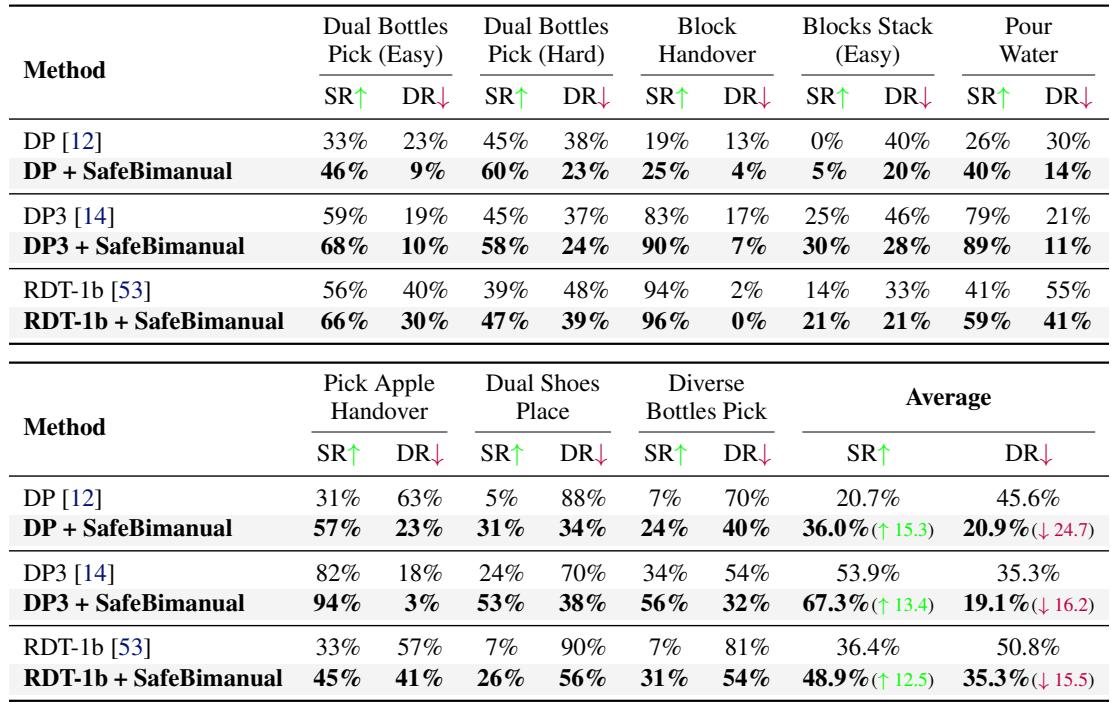
Looking at Table 1, the results are compelling:
- Success Rate Increase: SafeBimanual improved the success rate of the standard DP3 method from 53.9% to 67.3% on average.
- Safety Improvement: More importantly, it slashed the danger rate from 35.3% down to 19.1%.
Notice the “Dual Bottles Pick (Hard)” task. The baseline DP3 had a 37% danger rate—meaning more than 1 in 3 attempts resulted in a collision or mishandling. With SafeBimanual, that dropped to 24%, while success jumped significantly.
The visuals in Figure 3 and Figure 7 highlight these differences clearly.
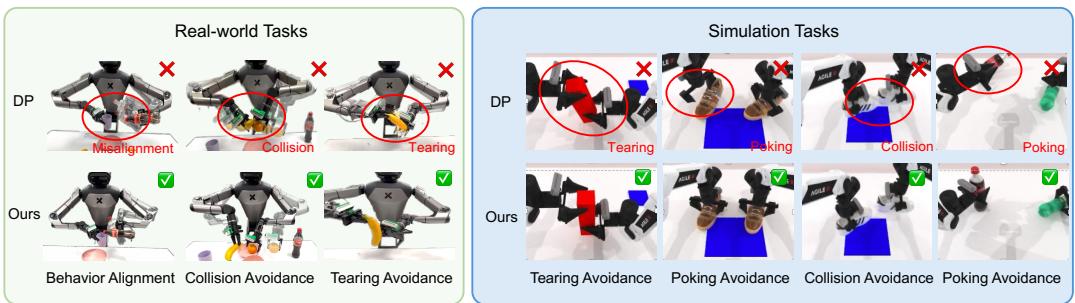
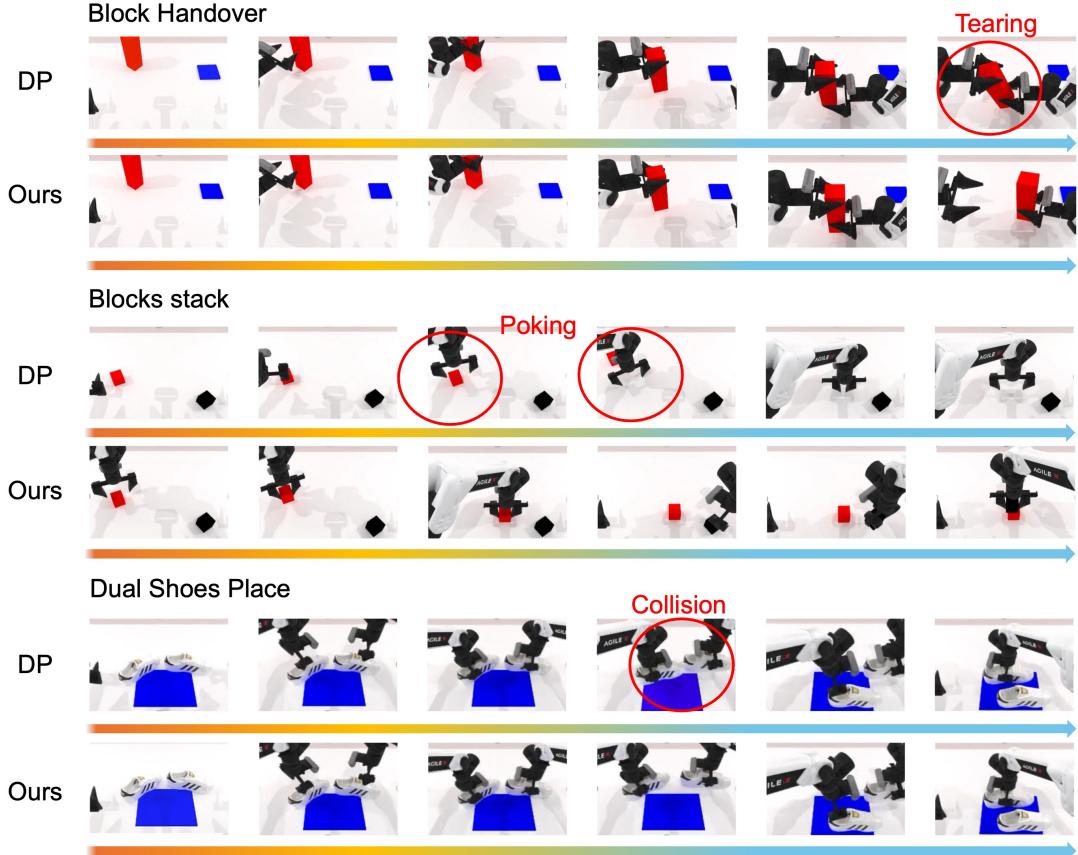
In Figure 7, look at the “Block Handover” task (top row). The baseline method (DP) pulls the block apart (Tearing), visualized by the red warning. SafeBimanual (Ours) maintains the distance between grippers, resulting in a smooth handover.
Ablation Studies: Do we need all the parts?
The authors performed ablation studies to ensure every component was necessary.
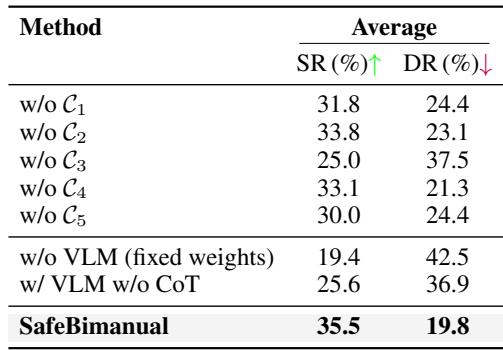
Table 2 reveals two key insights:
- Every Cost Matters: Removing any single cost function (\(C_1\) through \(C_5\)) increased the Danger Rate. Removing the “Gripper Poking” cost (\(C_3\)), for example, nearly doubled the danger rate from 19.8% to 37.5%.
- The VLM is Crucial: The row “w/o VLM (fixed weights)” shows what happens if you just turn on all costs with fixed weights. The success rate plummets to 19.4%. Why? Because the constraints conflict. You cannot enforce “alignment” and “grasping” simultaneously without confusing the robot. The adaptive scheduling is the “secret sauce.”
Real-World Validation
Simulation is useful, but the real world is messy. The authors deployed the system on the Galaxea R1 robot for tasks like pouring water, wiping a bowl, and passing fruit.
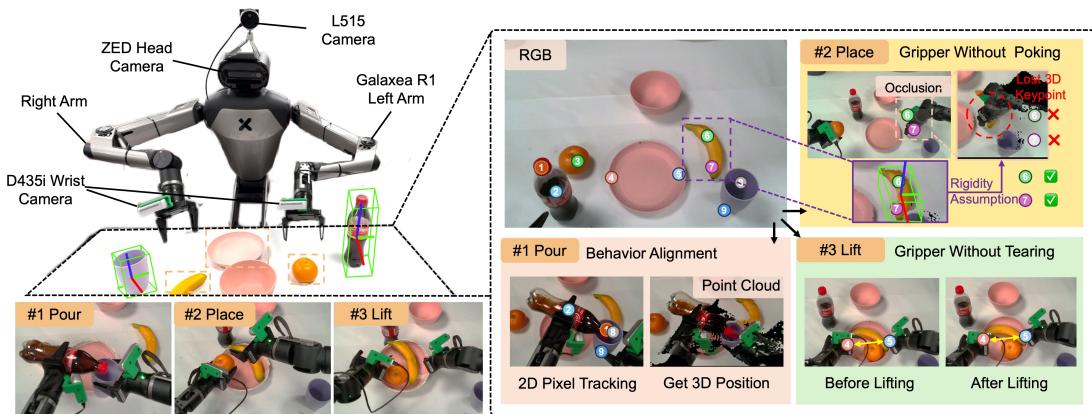
The system uses cameras (ZED and Intel D435i) to track keypoints in real-time. Even if occlusion occurs (the robot’s arm blocks the camera’s view of the mug), the system uses a rigidity assumption to estimate where the mug is based on the gripper’s position.
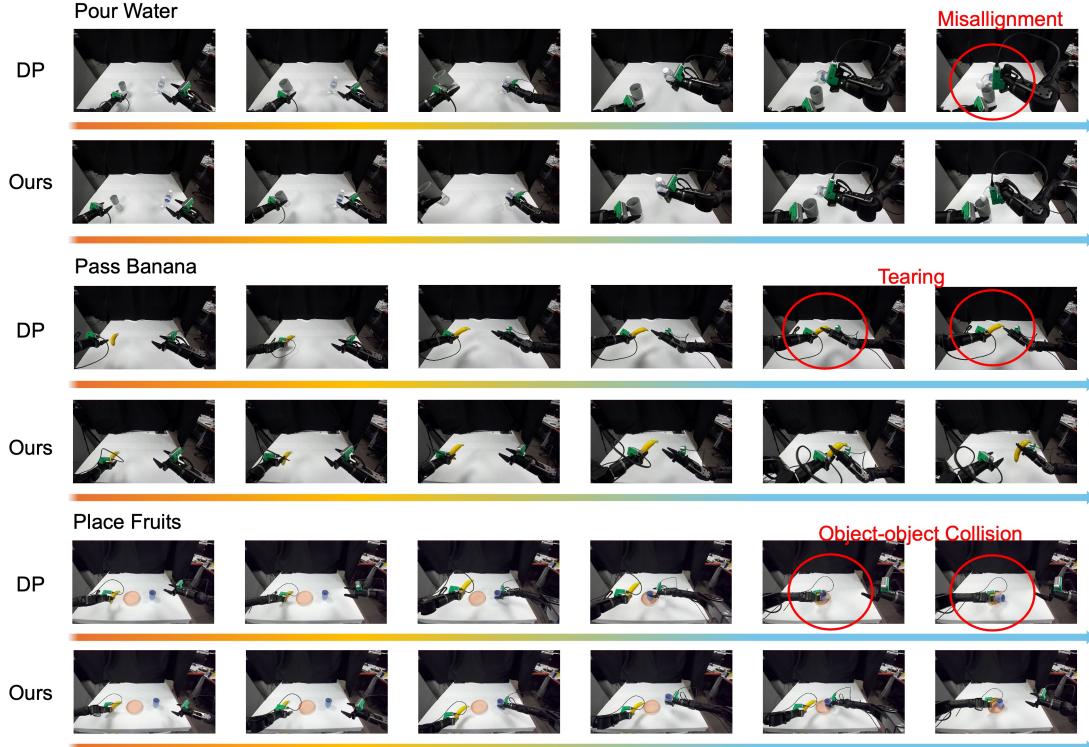
Figure 8 shows the real-world difference. In “Pass Banana,” the baseline (DP) tears the banana apart. SafeBimanual respects the structural integrity of the fruit.
The aggregated real-world stats are impressive:
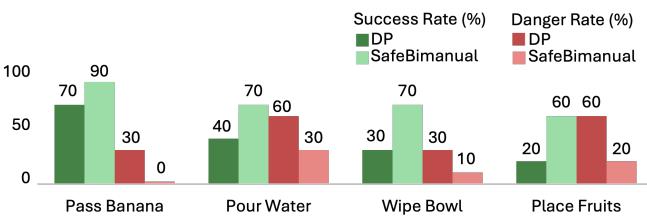
In the “Pass Banana” task, SafeBimanual achieved a 0% Danger Rate compared to the baseline’s 30%, while boosting success to 90%.
Conclusion & Implications
SafeBimanual represents a significant step forward in making robotic learning practical for the real world.
The key takeaway here is the shift from implicit to explicit safety.
- Implicit: Hoping the neural network learned “not to crash” from the training data.
- Explicit: Mathematically forbidding the robot from crashing using trajectory optimization.
By combining the generative power of diffusion models with the logical reasoning of Large Language Models and the strict boundaries of control theory (cost functions), this paper offers a robust solution for complex bimanual tasks.
This approach—using a “test-time wrapper”—is particularly exciting because it is model-agnostic. As diffusion policies get better (like RDT-1b), SafeBimanual can essentially be “snapped on” to them to provide that final layer of safety assurance.
For students and researchers entering this field, this paper highlights a growing trend: the most effective robotic systems often aren’t single, massive “black box” neural networks. Instead, they are modular systems where different components (Vision, Policy, Planning, Safety) work in concert, guided by the increasingly capable reasoning of Foundation Models.