](https://deep-paper.org/en/paper/2508.19391/images/cover.png)
Introduction
Imagine you are teaching a child to “close the door.” You don’t necessarily describe the muscle movements required to rotate the handle and push. Instead, the child learns by understanding the causality: there is an open door, a command is given, and the desired result is a closed door. If the child can mentally visualize the “closed door” state based on the current scene and your instruction, they implicitly understand the action required to get there.
In the world of robotics, bridging the gap between seeing (vision) and doing (action) is a monumental challenge. While we have powerful models like CLIP that can align images and text, simply knowing that an image of a spoon matches the word “spoon” isn’t enough to tell a robot how to pick it up.
Enter LaVA-Man (Language-guided Visual-Action representations for Robot Manipulation). This new framework, proposed by researchers at Queen Mary University of London and University College London, suggests a fascinating approach: teaching robots to act by teaching them to predict the future visual state.
In this post, we will break down how LaVA-Man works, why it introduces a massive new dataset of 3,200 objects, and how “dreaming” of the future helps robots perform complex tasks in the real world.
The Problem: The Gap Between Vision and Action
Current state-of-the-art methods in robotic manipulation often rely on pre-trained Vision-Language Models (VLMs). The standard workflow usually looks like this:
- The robot looks at the scene (encodes the image).
- The robot reads the instruction (encodes the text).
- The model calculates the similarity between the two.
- A policy network tries to map that similarity to a physical movement.
The flaw here is a lack of causal grounding. These models are excellent at identifying objects (“That is a red block”), but they struggle to capture the dynamics of manipulation (“If I push the red block, it will move there”). They treat the scene as a static snapshot rather than a dynamic environment waiting to be changed.
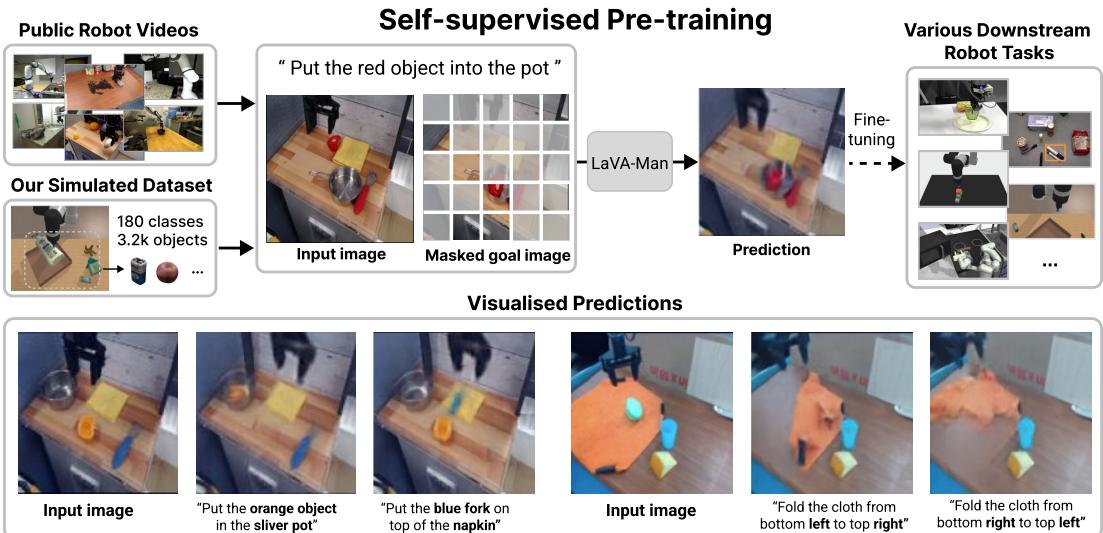
LaVA-Man addresses this by using a self-supervised pretext task. Instead of just matching text to images, the model is trained to reconstruct a masked goal image. Essentially, the robot is asked: “Given this starting image and this instruction, fill in the blanks of what the world looks like after you act.”
The Data Bottleneck: Introducing OOPP
Before diving into the architecture, we must address a common bottleneck in machine learning: data. To learn generalizable skills, a robot needs to see a wide variety of objects. However, existing datasets for tabletop manipulation (like Ravens or VIMA) are somewhat limited. They often feature simple geometric shapes or a small set of repeated objects.
If a robot only trains on cubes and spheres, it will be confused when asked to pick up a dinosaur toy or a bag of chips.
To solve this, the authors introduced the Omni-Object Pick-and-Place (OOPP) dataset.
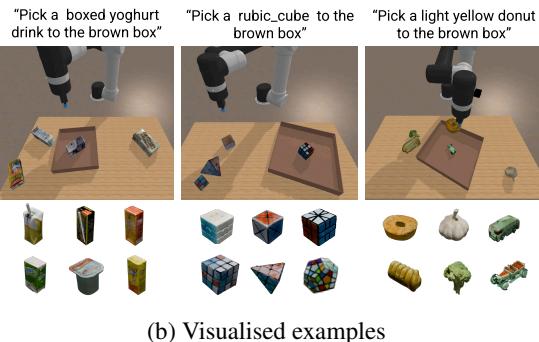
As shown in Figure 3 above, the OOPP dataset is a significant leap forward:
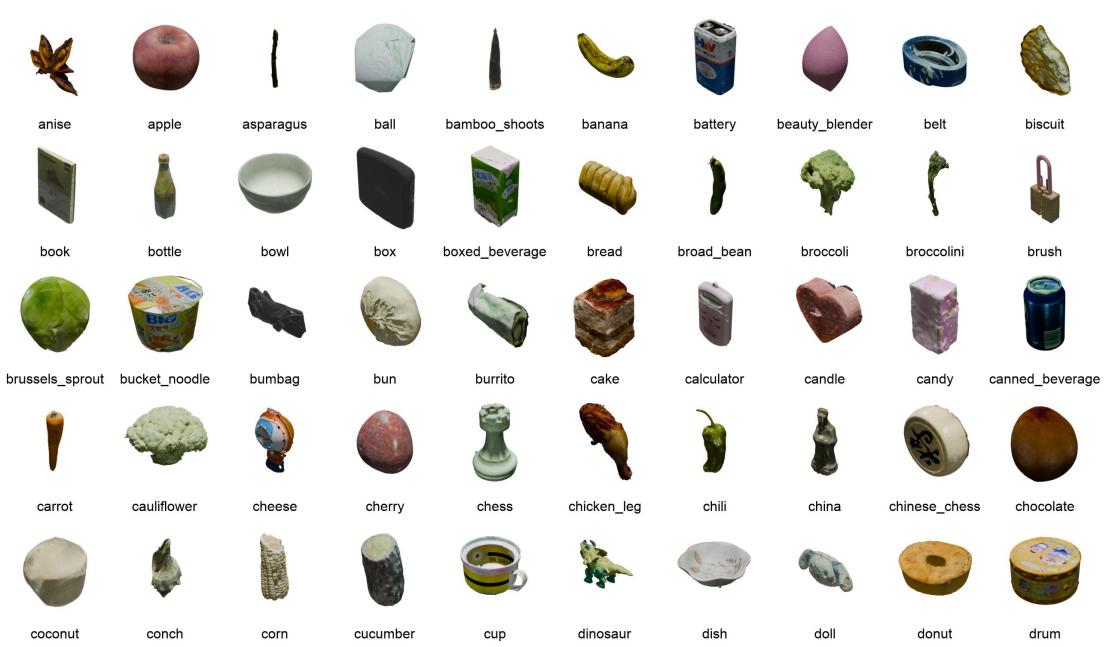
- 180 Object Classes: Ranging from food and daily tools to toys.
- 3,200 Unique Instances: High-quality, real-scanned objects.
- Rich Language Annotations: Diverse instructions beyond simple templates.
This diversity ensures that when the model is trained, it isn’t just memorizing specific shapes; it is learning an “object prior”—a general understanding of how different types of physical objects exist and behave in space.
The Core Method: Learning by Dreaming
The heart of LaVA-Man is its self-supervised learning approach. The goal is to learn a representation that connects visual observations, language, and actions without needing expensive, manual action labels (like precise joint angles) for every single training step.
The Pretext Task: Goal Image Prediction
The researchers propose a “pretext task”—an auxiliary job the model performs to learn useful features. In this case, the task is Goal Image Prediction.
Here is the setup:
- Input: An initial image of the workspace (\(o_s\)) and a text instruction (\(l_{s \to f}\)).
- Target: The goal image (\(o_f\)), showing the scene after the action is complete.
The model isn’t given the full goal image. Instead, the authors use Asymmetric Masking. They take the goal image and black out (mask) a large percentage of it. The model must use the full input image and the text instruction to reconstruct the missing pixels of the goal image.
To do this successfully, the model must “understand” the instruction. If the text says “Put the red apple in the bowl,” the model has to generate red pixels inside the bowl in the goal image. This forces the neural network to learn the causal relationship between the instruction and the visual change.
The Architecture
The architecture uses a Siamese Vision Transformer (ViT). Let’s look at the structure:
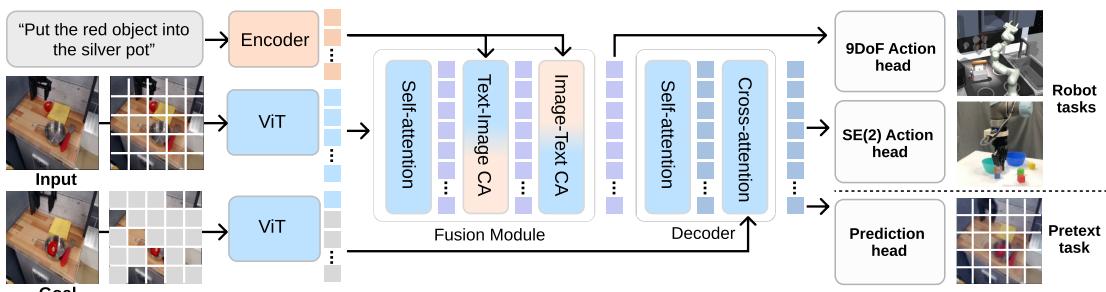
- Siamese Encoders: Two identical ViT encoders process the input image and the masked goal image separately.
- Fusion Module: This is a critical step. The model cannot just process images and text in isolation. It uses Cross-Attention layers to mix the modalities:
- Text-Image Cross Attention: How does the instruction relate to the input image?
- Image-Text Cross Attention: How does the input image relate to the instruction?
- Decoder: The decoder takes the fused features and tries to predict the missing patches of the goal image.
Mathematically, the pretext task looks like this:
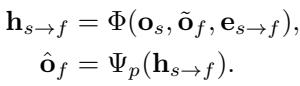
Where \(\Phi\) is the encoder/fusion process, and \(\Psi_p\) is the prediction head that outputs the reconstructed goal image \(\hat{o}_f\).
From Prediction to Action
Once the model is pre-trained on this “dreaming” task, it has learned a rich understanding of visual dynamics. But a robot needs to actually move.
For downstream tasks (like actually picking up an object), the researchers fine-tune the model. They attach a lightweight Action Head (\(\Psi_a\)).
Interestingly, during inference (testing), the robot obviously doesn’t have the real goal image (because it hasn’t happened yet!). However, the model is designed to handle masked inputs. The researchers feed the model a fully masked (blank) goal image. The pre-trained model then generates a predicted goal image (\(\hat{o}_f\)) based on its training.
This predicted “imagination” is then fed into the action head alongside the current observation to decide the movement:

By explicitly using the predicted future state (\(\hat{o}_f\)), the robot plans its action based on where it thinks the object should end up.
Experiments and Results
The authors evaluated LaVA-Man across widely used simulation benchmarks and real-world robot tasks.
Simulation: The Ravens Benchmark
The Ravens benchmark is a standard test for tabletop manipulation (stacking blocks, packing boxes, etc.). LaVA-Man was compared against strong baselines like CLIPort and Voltron.
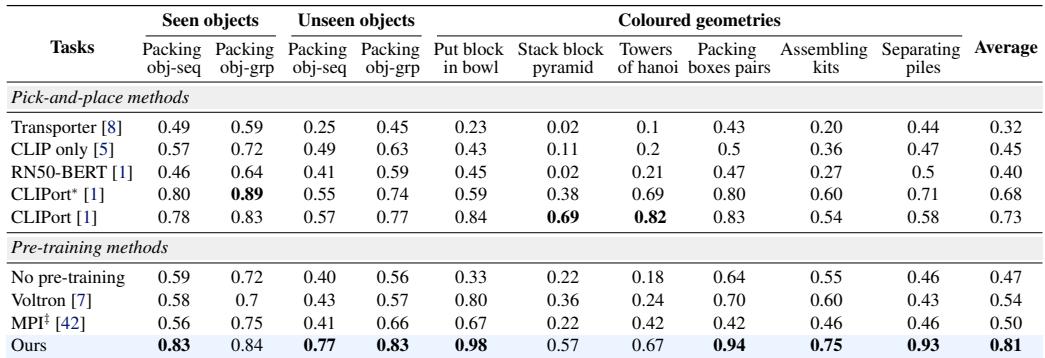
As Table 1 shows, LaVA-Man outperforms the baselines significantly. It achieves an average success rate of 81%, compared to 73% for CLIPort and 54% for Voltron. It shines particularly in tasks involving “unseen objects,” proving that the pre-training on the diverse OOPP dataset allowed it to generalize to new items it hadn’t encountered before.
Visualizing the “Dreams”
One might wonder: how good are these predicted goal images? Since the model uses a Masked Autoencoder (MAE) approach, the outputs can be a bit blurry (lacking high-frequency details). However, the semantic content is what matters.
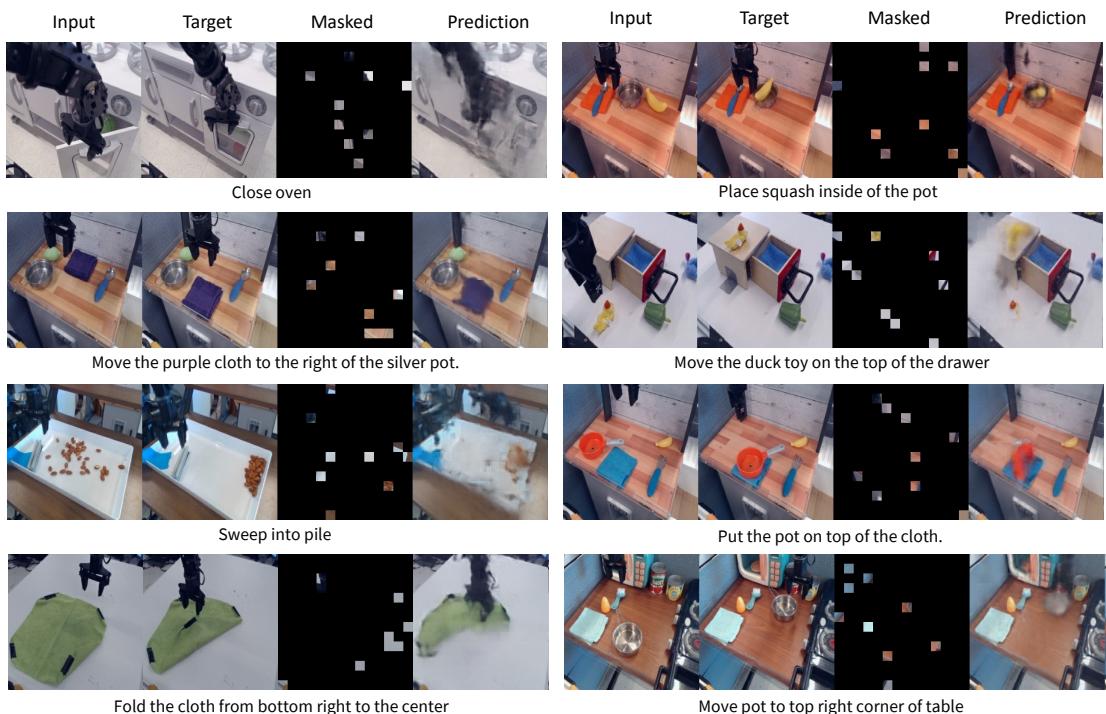
In Figure 13, look at the “Prediction” column. Even though the images are fuzzy, the structural changes are correct.
- In the second row (“Place squash inside of the pot”), the model successfully hallucinates a squash shape inside the metal pot.
- In the fourth row (“Move the duck toy”), the yellow blob correctly appears on top of the drawer.
This proves the model isn’t just copying pixels; it is reasoning about spatial relationships and object persistence.
Real-World Robot Performance
Simulation is useful, but the real world is messy. The authors deployed LaVA-Man on a physical UR5 robot arm to perform tasks like stacking blocks, folding cloths, and packing objects.
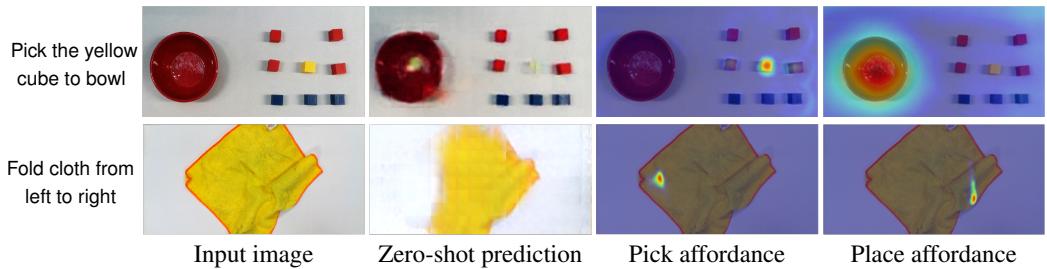
Figure 5 visualizes the Affordance Maps. These heatmaps show where the robot decided to move.
- Top Row: The instruction is “Pick the yellow cube to bowl.” The Pick map (center) glows brightly over the yellow cube. The Place map (right) glows over the bowl.
- Bottom Row: “Fold cloth from left to right.” The model identifies the corner of the cloth as the pick point and the center of the cloth as the target.
The model achieved high success rates on real hardware, demonstrating that the visual representations learned in simulation transferred effectively to reality.
Ablation: Do we really need the masking?
The researchers performed ablation studies to ensure their design choices were sound.
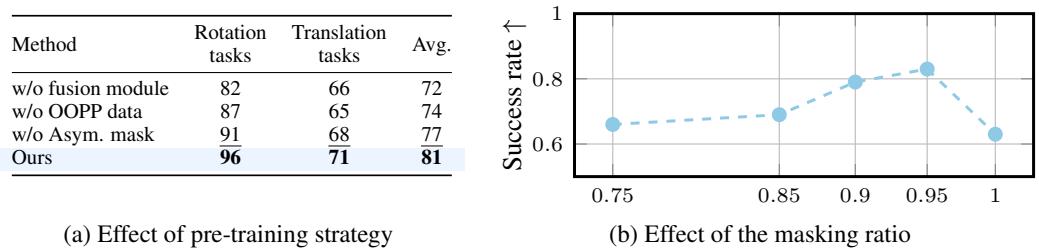
In Figure 6(a), they tested the model without asymmetric masking (“w/o Asym. mask”). The performance dropped from 81% to 77%. This confirms that forcing the model to reconstruct the goal from partial information is a stronger learning signal than simply showing it the answer.
Figure 6(b) is also interesting: it shows the effect of the masking ratio. A ratio of 0.95 (masking 95% of the goal image) yielded the best results. If the ratio is too low (0.75), the task is too easy and the model doesn’t learn robust features. If it’s 1.0 (100% masked), the model struggles to converge because the problem becomes too ambiguous without any visual hints from the goal state.
Conclusion and Implications
LaVA-Man represents a shift in how we think about robot learning. Rather than treating an instruction as a simple label for a movement, this framework treats an instruction as a description of a future state.
By combining the massive diversity of the OOPP dataset with the causal reasoning of Goal Image Prediction, LaVA-Man achieves state-of-the-art results on multiple benchmarks. It essentially teaches robots to “look before they leap”—or more accurately, “visualize before they leap.”
Limitations and Future Work
The authors note a few limitations that define the path for future research:
- Blurry Predictions: The MAE architecture produces low-resolution “dreams.” While semantically correct, clearer predictions could improve precision for fine-grained tasks.
- 2D Limitations: The current model operates on 2D images. It sometimes struggles with depth-dependent tasks (like stacking very specific geometries) because it lacks explicit 3D awareness.
- Pseudo Affordance: The model picks the pixel with the highest heatmap value. For complex objects, the “center” pixel might not be the best place to grab (e.g., grabbing a mug by the handle vs. the rim).
Despite these limitations, LaVA-Man provides a robust, generalizable foundation for the next generation of language-guided robots. As visual generation models (like diffusion models) become faster and more accurate, we can expect this “predict-then-act” paradigm to become even more powerful.