](https://deep-paper.org/en/paper/2508.19953/images/cover.png)
Reinforcement Learning (RL) has gifted robotics with some incredible capabilities, from parkour-performing quadrupeds to drones that can beat human champions. However, there is a significant bottleneck in this pipeline: the reward function. Designing a reward function that explicitly tells a robot how to perform a complex task requires immense engineering effort. As tasks get harder, the math gets messier.
Unsupervised Skill Discovery (USD) promises a way out. Ideally, USD allows an agent to play around in its environment and autonomously learn a diverse library of “skills”—like walking, rolling, or jumping—without any task-specific rewards. The problem? Robots trained this way often behave like toddlers on a sugar rush. Their movements, while diverse, are often erratic, unsafe, and impossible to control or deploy on real hardware.
In this post, we are diving deep into a framework called “Divide, Discover, Deploy” (D3). This research proposes a method to bring order to the chaos of unsupervised learning. By breaking the robot’s state into logical factors, applying symmetry based on the robot’s morphology, and introducing a “style” prior for safety, this approach allows a quadrupedal robot to learn distinct, safe, and deployable skills entirely in simulation—and then execute them zero-shot on the real world.
The Problem with “Jack of All Trades” Learning
Standard USD methods usually treat the robot’s state and the latent “skill” (a vector representing a specific behavior) as monolithic blocks. They try to maximize the mutual information between the entire state and the entire skill vector.
While this encourages the robot to do something distinguishable, it often leads to entangled behaviors. For example, a robot might learn a skill that combines “moving forward” with “spinning in circles.” If you want the robot just to move forward, you can’t, because that specific motion is tied to the spinning. Furthermore, without safety constraints, “maximizing diversity” often translates to “maximizing the chance of breaking the gearbox.”
The researchers behind D3 tackle this by asking: What if we treat different parts of the robot’s state differently?
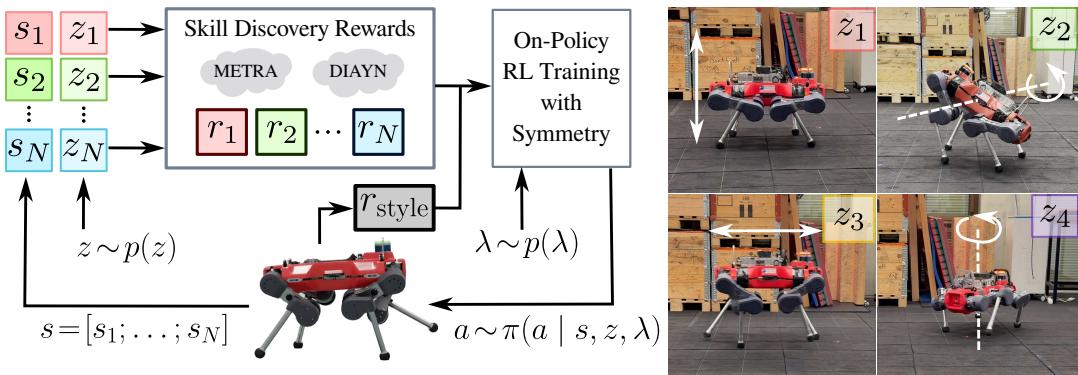
As shown in Figure 1 above, the core philosophy here is modularity. Instead of one giant neural network trying to figure everything out, the state space is factorized. The robot learns distinct skills for its position, its orientation, and its height, using different algorithms suited for each.
Background: The USD Landscape
Before dissecting the method, we need to understand the tools in the box. The D3 framework utilizes two popular USD algorithms, leveraging the specific strengths of each.
1. DIAYN (Diversity Is All You Need)
DIAYN optimizes for distinguishable skills. It uses a discriminator that tries to guess which skill \(z\) the robot is performing based on the state \(s\). If the discriminator can easily guess the skill, the robot is doing a good job of making that behavior distinct.
- Best for: Bounded state spaces where distinctiveness matters more than distance, like orientation or heading.
2. METRA (Metric-Aware Abstraction)
METRA focuses on coverage. It maximizes the distance a robot travels in a learned latent space. It essentially tells the robot: “Pick a direction and go as far as possible in that direction.”
- Best for: Unbounded state spaces where covering ground is the goal, like planar position (\(x, y\) coordinates).
The Core Method: Divide, Discover, Deploy
The D3 framework introduces a structured approach to learning that separates concerns. Let’s break down the architecture step-by-step.
1. Factorization and Algorithm Assignment
The robot’s state space \(S\) is split into \(N\) user-defined factors. For a quadruped, these might be:
- Planar Position (\(x, y\)): Unbounded.
- Heading Rate: Bounded.
- Base Height: Bounded.
- Base Roll/Pitch: Bounded.
Crucially, the authors assign a specific USD algorithm to each factor. They found that METRA is superior for the position factor (encouraging the robot to explore the room), while DIAYN is better for factors like heading (encouraging distinct turning angles).
2. The Objective Function
The agent is trained to maximize a composite objective function. It looks complex, but it’s just a weighted sum of different goals:

Here is what the terms mean:
- \(\lambda_i\): The weight for a specific factor.
- \(I_{\text{USD}_i}\): The intrinsic reward (from METRA or DIAYN) for factor \(i\).
- \(J_{\text{style}}\): The “style” reward (more on this below).
The policy \(\pi\) takes in the state, the desired skill vector \(z\), and the factor weights \(\lambda\). This creates a multi-objective reinforcement learning setup.
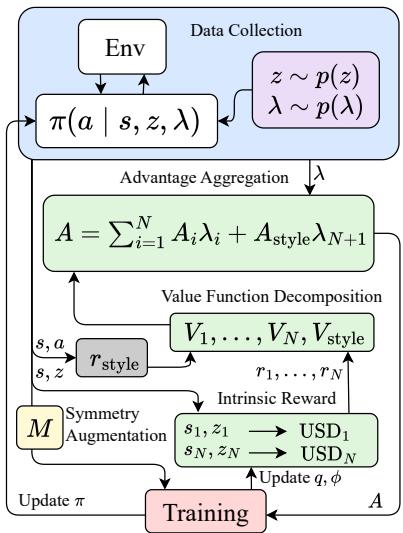
As visualized in Figure 2, the system runs an on-policy RL loop. The robot tries an action, and the rewards are calculated separately for each factor. For example, if the robot moves forward but doesn’t turn, it might get a high reward from the “Position” factor but a low reward from the “Heading” factor. These are aggregated to update the policy.
3. The Style Factor: Safety First
One of the biggest innovations here is the Style Factor. In pure USD, there is no incentive to be safe. The Style Factor is a special “zeroth” skill factor that doesn’t try to discover new behaviors. Instead, it is an extrinsic reward signal that encourages:
- Smooth joint velocities (no jittering).
- Proper foot contact (no dragging feet).
- Standing still when no other skill is commanded.
This acts as a “default” behavior. Because the policy inputs the weights \(\lambda\), the user can dial up the Style Factor to make the robot behave conservatively, or dial it down to encourage aggressive exploration.
4. Symmetry Augmentation
Quadrupedal robots are symmetric. They have a left side and a right side (sagittal symmetry). If a robot knows how to turn left, it theoretically knows how to turn right—it just needs to mirror the muscle movements. Standard RL doesn’t know this; it has to learn “left” and “right” as two totally separate skills.
D3 forces the policy to respect these physical symmetries. However, this gets tricky with latent skills. If you mirror the robot’s state (flip left/right), you must also mirror the skill vector \(z\).
For METRA (geometric skills), this is simple: if the skill vector points “left,” the mirrored skill points “right.”
For DIAYN (categorical skills), the authors use a mathematical structure called a Latin Square to permute the skill indices. This ensures that the mathematical group structure of the symmetries is preserved in the skill space.

This matrix ensures that if you flip the state, the skill vector transforms in a consistent way. This drastically reduces the search space for the algorithm and leads to much cleaner, more interpretable movements.
Experiments & Results
The researchers trained this framework on an ANYmal-D robot simulation using Isaac Lab and then deployed it to the real world.
Zero-Shot Real World Deployment
The most impressive result is the deployability. Because of the Style Factor and Symmetry constraints, the skills learned in simulation worked immediately on the real robot without fine-tuning.
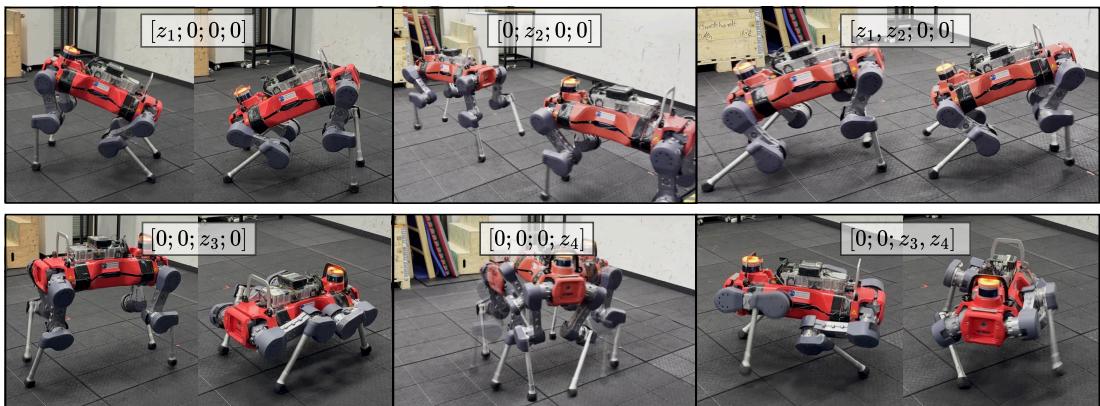
Figure 3 illustrates the composability. The operator can command the robot to “Walk Forward” (Position factor) while simultaneously “Pitching Up” (Orientation factor). Because the factors were disentangled during training, they don’t interfere with each other. The robot can combine these distinct skills smoothly.
The Power of Weights
Does the factor weighting mechanism actually help? The authors tested this by comparing a weighted approach against a non-weighted one.
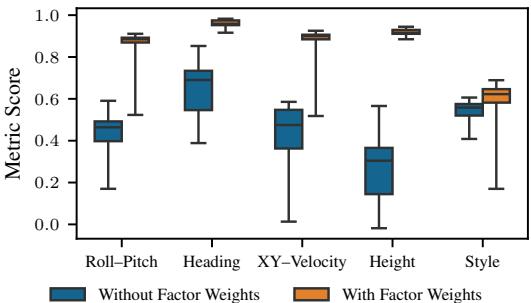
As shown in Figure 4, using factor weights (\(\lambda\)) significantly improves the metric scores across all dimensions (Roll-Pitch, Heading, Velocity, etc.). This confirms that allowing the network to prioritize specific factors dynamically helps it learn better representations for each one.
Safety Analysis
The Style Factor isn’t just for aesthetics; it’s a safety requirement. The table below compares the robot’s behavior with and without the Style Factor.

Without the Style Factor, the robot generates a massive amount of “Illegal Contacts” (e.g., banging its thighs against the body). With the Style Factor, illegal contacts drop to near zero for the base and thighs. This is the difference between a robot that breaks itself in 5 minutes and one that can run for hours.
Diversity Comparison
How does D3 compare to other USD methods like standard DIAYN or DUSDi (a previous disentangled method)?
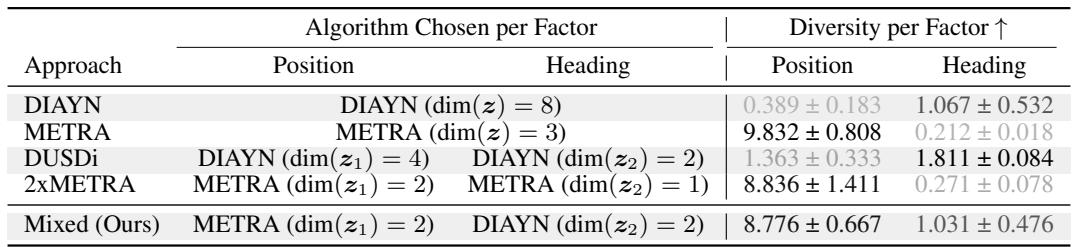
Table 2 validates the “Mixed” strategy. Notice the Position Diversity column. Pure DIAYN struggles to cover distance (0.389 score), while pure METRA excels (9.832). However, for Heading, METRA is poor (0.212) while DIAYN is strong (1.067).
The Mixed (Ours) approach gets the best of both worlds: high position diversity (8.776) and high heading diversity (1.031).
The Impact of Symmetry
Finally, let’s look at how symmetry affects the learned latent space.
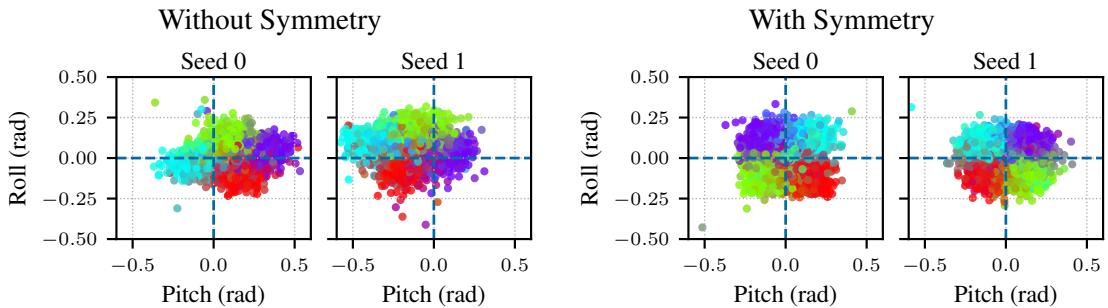
In Figure 5, the scatter plots show the roll and pitch angles achieved by different skills.
- Left (Without Symmetry): The distribution is messy and skewed. A “turn” skill might bias the robot slightly forward for no reason.
- Right (With Symmetry): The distribution is beautifully centered and balanced. The skills are clean, meaning a “roll” skill purely affects roll without bleeding into other movements arbitrarily.
Downstream Application: Navigation
To prove these skills are useful, the authors used them to solve a navigation task (reaching a goal position and heading). They compared a hierarchical policy (using D3 skills) against a “Direct” PPO policy and an “Oracle” (a hand-tuned expert).
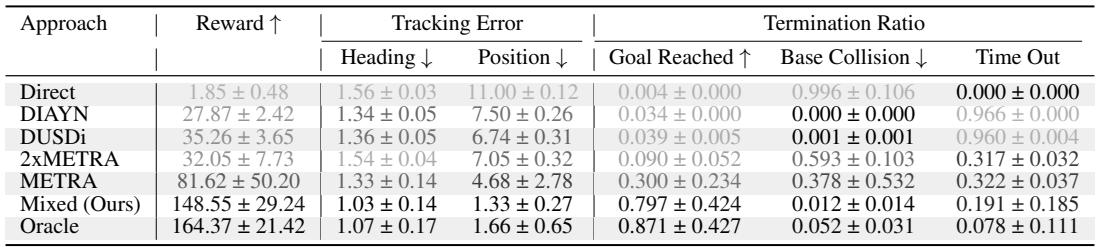
The results in Table 3 are striking. The Direct RL approach fails completely (Reward: 1.85). The Mixed (Ours) approach achieves a reward of 148.55, which is statistically very close to the Oracle (164.37). This demonstrates that the unsupervised skills provide a high-quality, controllable action space for downstream tasks.
Conclusion and Implications
The “Divide, Discover, Deploy” framework represents a maturation of Unsupervised Skill Discovery. It moves away from the “magic black box” approach where we hope a single objective function solves everything, and moves toward a structured, engineering-aware methodology.
By acknowledging that position is different from orientation (Factorization), that robots are symmetric (Symmetry Priors), and that robots shouldn’t break themselves (Style Priors), the authors successfully bridged the “Sim-to-Real” gap for unsupervised skills.
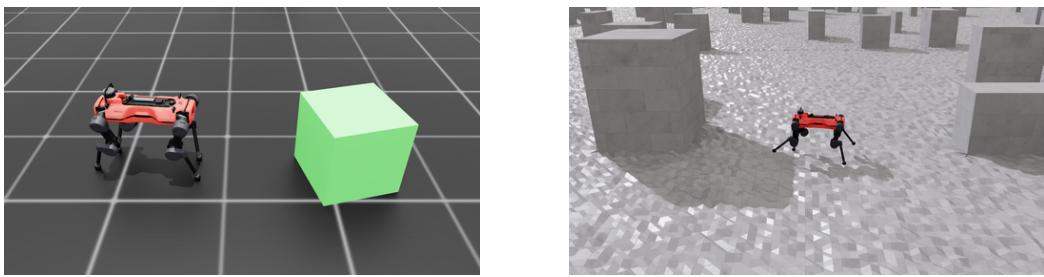
Limitations: The work isn’t without limits. As seen in Figure 6 below, the framework struggled with complex interaction tasks, like pushing boxes or avoiding obstacles without explicit rewards. The agent often resorted to brute force rather than manipulation.
However, for locomotion and body control, D3 offers a robust blueprint. It suggests that the future of robot learning might lie in this hybrid space: unsupervised discovery guided by strong structural priors and human insights.