](https://deep-paper.org/en/paper/2508.19958/images/cover.png)
Introduction
Imagine asking a robot to clean a kitchen. The instruction seems simple: “Clean up the kitchen.” However, for a robot, this isn’t a single action. It is a complex sequence: navigate to the counter, locate the sponge, pick it up, move to the sink, turn on the water, scrub the plate, and place it in the rack.
In recent years, Vision-Language-Action (VLA) models have revolutionized robotics. By training on massive datasets of robot behavior and language, these models have become excellent at understanding instructions and performing short, discrete tasks. But there is a catch: while they are great at “picking up the sponge,” they often fail miserably when asked to string ten such actions together without failing.
This is the problem of long-horizon manipulation. As tasks get longer, small errors accumulate. A robot might pick up an object successfully, but if it’s slightly off-center, the next step (placing it) becomes exponentially harder. This is known as the skill chaining problem.
In this post, we will deep dive into Long-VLA, a new research paper that proposes a unified, end-to-end solution to this problem. We will explore how the researchers used a clever “masking” strategy to help robots focus on what matters at the right time, allowing them to perform long sequences of actions with state-of-the-art success rates.
Background: The Struggle with Long Horizons
To understand why Long-VLA is necessary, we first need to look at how robots currently learn.
The Standard VLA Model
A standard Vision-Language-Action model takes a language instruction (e.g., “Open the drawer”) and a visual observation (camera feed) as input, and outputs robot actions.
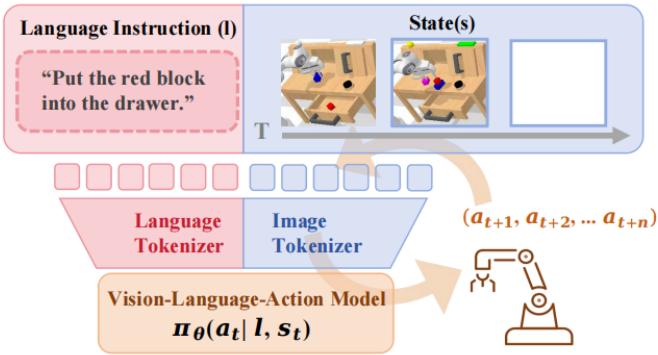
As shown in Figure 8 above, the model acts as a “brain” that translates perception into motion. These models are typically “unified,” meaning a single neural network handles everything. While this is great for scalability and data efficiency, these models struggle when a task requires a long chain of diverse skills.
The Skill Chaining Problem
Why do long tasks fail? It usually comes down to distribution shift.
When a robot is trained, it sees “perfect” examples. But during a long sequence, if the robot finishes Task A (e.g., opening a drawer) but leaves the gripper in a slightly weird position, Task B (e.g., putting a block inside) starts from a state the robot has never seen before.
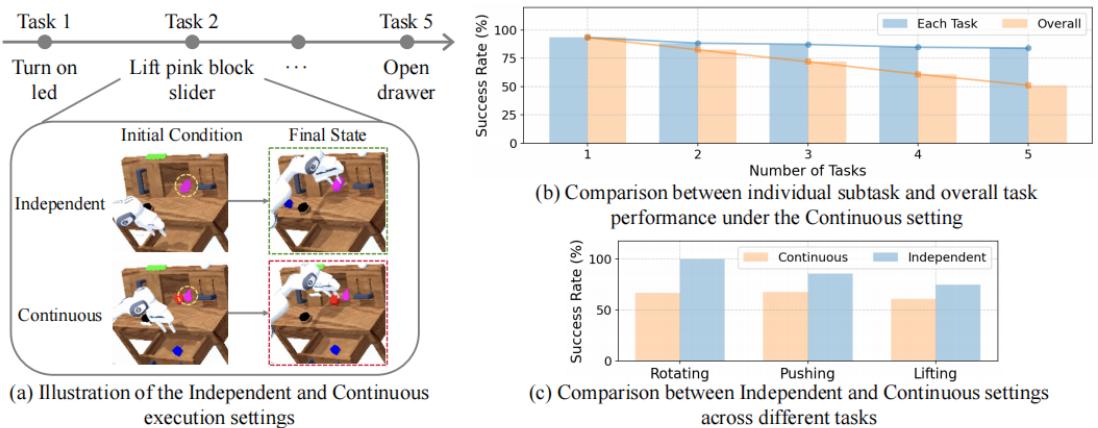
Figure 9 illustrates this beautifully. In an independent setting (top left), tasks start perfectly. In a continuous setting (bottom left), the robot has to deal with the messy aftermath of the previous task. The graph in part (b) shows the painful reality: as the number of chained tasks increases, the success rate plummets.
Existing Solutions and Their Flaws
Researchers have tried to fix this, usually by decomposition—breaking a big task into smaller chunks.
- Unified Models (a): One big model does everything. Good for learning, bad for long sequences.
- Separate Models (b): One model handles “moving” (getting to the object), and a completely different model handles “interaction” (manipulating it). This works better but breaks the “end-to-end” learning pipeline. You can’t train them jointly, and they don’t share knowledge.
- Adaptive Input (c): Using different inputs for different stages but still relying on separate modules.
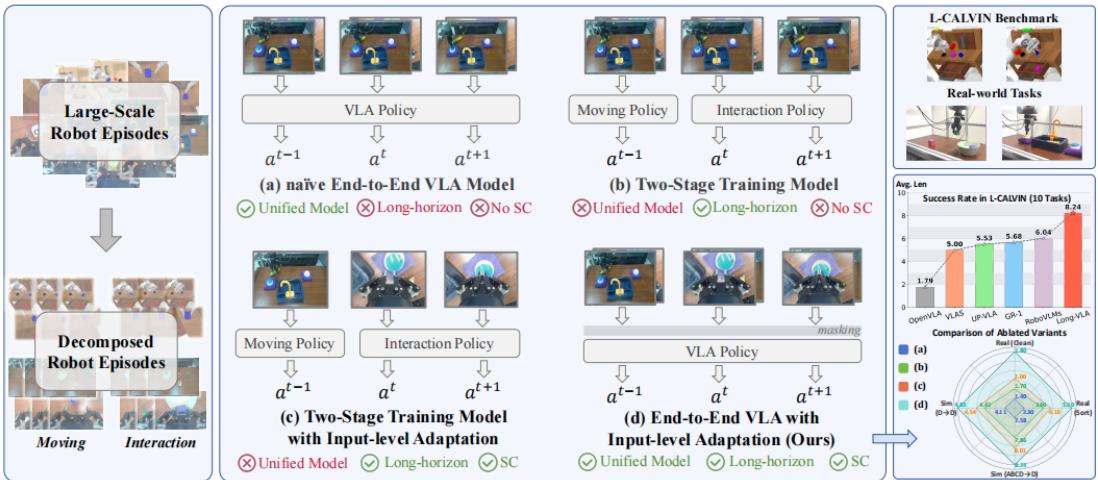
As visualized in Figure 1, Long-VLA (d) offers a fourth way: a unified model that uses input-level adaptation. It keeps the benefits of a single powerful brain but adapts its “senses” depending on what phase of the task it is performing.
Core Method: Long-VLA
The researchers’ key insight is that a robot needs to pay attention to different things at different times.
- Phase 1: The Moving Phase. When the robot is moving toward an object, it needs to see the whole scene. It needs to know where the table is, where the obstacles are, and the general location of the target. It does not need to worry about the millimeter-level details of its gripper fingers yet.
- Phase 2: The Interaction Phase. When the robot is grasping or manipulating, the general room layout matters less. It needs to focus intensely on its hand and the object. Background distractions (like a person walking by or changing lights) should be ignored.
Long-VLA achieves this distinction within a single model using a technique called Phase-Aware Input Masking.
1. Data and Phase Decomposition
First, the researchers take their training data (robot trajectories) and chop them into two phases:
- Moving Phase: From the start until the robot is close to the object.
- Interaction Phase: From the approach until the task is done.
Crucially, they don’t just split the data; they add a “phase identifier” token (\(s_p\)) to the action space. This tells the model explicitly which mode it should be in.
2. Input-Level Adaptation via Masking
This is the heart of the paper. The model receives inputs from multiple cameras:
- Static Camera (\(s_b\)): Fixed view of the workspace (Third-person view).
- Gripper Camera (\(s_g\)): Mounted on the robot hand (First-person/Egocentric view).
In a standard VLA, the model processes all these images all the time. Long-VLA introduces a masking strategy:
- During Moving: The model is forced to focus on the Static Camera and object detection information. The Gripper Camera input is masked out (ignored).
- During Interaction: The model focuses on the Gripper Camera. The Static Camera is masked out to prevent background distractions.
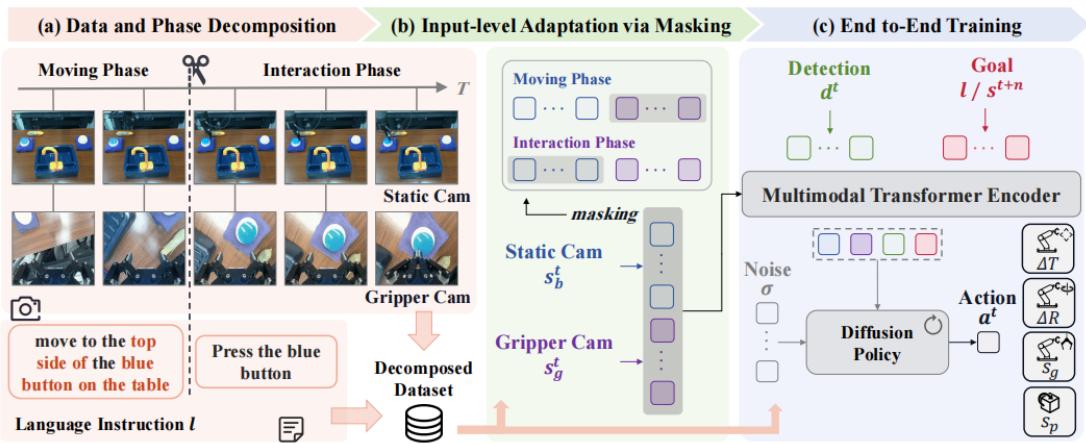
As shown in Figure 2 above:
- Panel (a) shows the data being split and labeled.
- Panel (b) visualizes the masking. Notice how different modalities are blocked depending on the phase.
- Panel (c) shows the Transformer architecture ingesting these masked tokens.
The Mathematics of Masking
The masking isn’t just deleting data; it’s implemented mathematically in the Attention mechanism of the Transformer.
The attention weights \(\mathbf{A}\) are computed as follows:

Here, \(\mathbf{M}_{ij}\) is the mask matrix. If \(\mathbf{M}_{ij} = 0\), the attention score becomes zero. This effectively cuts off the flow of information between specific tokens. By setting the mask based on the current phase, the network “blindfolds” itself to irrelevant data, allowing it to focus entirely on the sensors that matter for the current millisecond of the task.
3. Enhancing Navigation with Detection
To help the robot navigate during the “Moving” phase (where it relies on the static camera), the researchers integrated an object detection module (using Grounding DINO).
The detection module draws bounding boxes around the target object in the static image. These boxes are encoded and fused into the static image features. This gives the robot a clear “target lock” from the third-person view, reducing the error when it arrives at the object.
4. Unified End-to-End Training
Despite these distinct phases, the entire system is trained as one large model. The loss function includes a standard diffusion loss for action generation:

And an alignment loss to keep visual goals consistent with language instructions:

Because it is a single model, it retains the data efficiency of VLAs. It learns shared representations where useful, but the masking forces it to specialize its attention where necessary.
Experiments & Results
To prove that Long-VLA actually solves the “long-horizon” problem, the authors had to test it on tasks that require chaining many actions together.
The Setup: L-CALVIN and Real World
The standard benchmark, CALVIN, typically tests sequences of 5 tasks. The authors created L-CALVIN, extending this to 10 tasks, creating a much harsher test for error accumulation.
They also set up a real-world robotic station using a UR5e robot arm, testing it on two scenarios:
- Sorting: Moving colored blocks into a bowl (emphasizes repetitive accuracy).
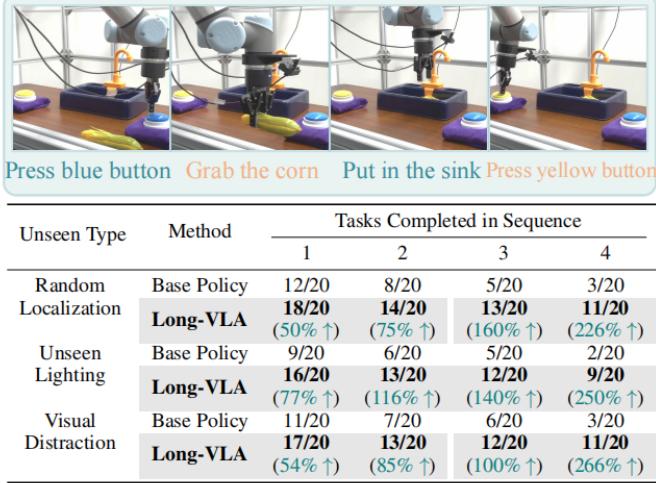
- Cleaning: A complex kitchen task involving buttons, faucets, and objects (emphasizes diverse skills).
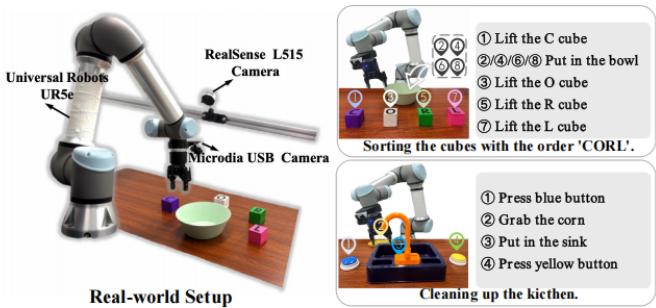
Simulation Results
The results on the L-CALVIN benchmark were striking.
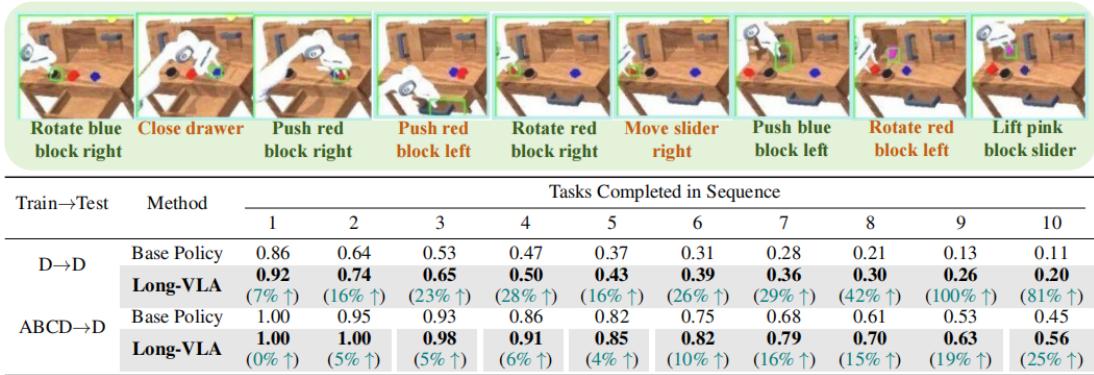
Looking at the table in Figure 4, compare the Base Policy (standard VLA) against Long-VLA.
- In the \(D \rightarrow D\) setting (seen environment), notice the “10” column (success on 10 consecutive tasks).
- The Base Policy success rate is 0.11.
- Long-VLA success rate is 0.20—an 81% improvement.
The gap widens as the task length increases. This confirms that Long-VLA is significantly better at preventing the errors that usually kill long sequences.
Real-World Robustness
The real-world experiments highlighted why Long-VLA works so well: it ignores distractions.
The Sorting Task
In the sorting task, the robot has to pick up blocks and put them in a bowl.
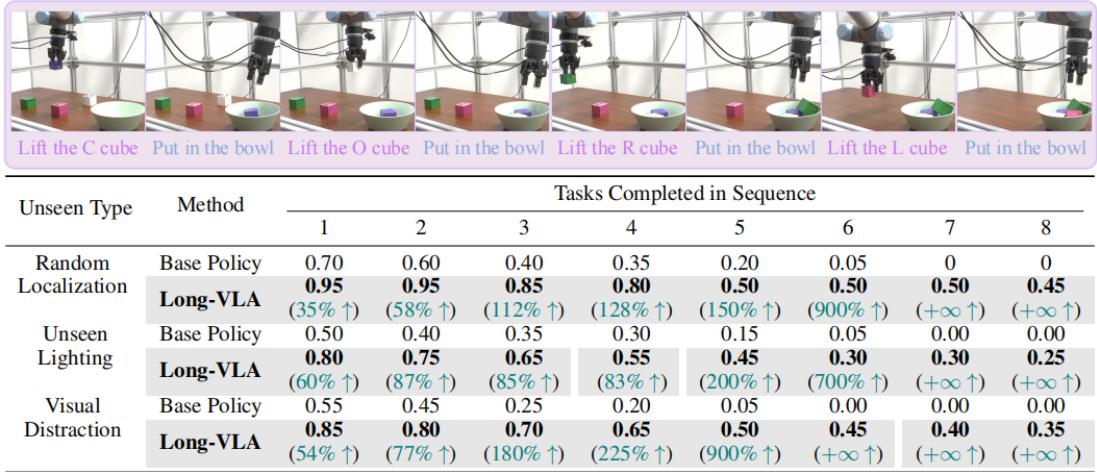
In Figure 5, look at the rows for Unseen Lighting and Visual Distraction. Standard models collapse when the lighting changes or visual clutter is added. Long-VLA retains high success rates. Why? Because during the critical “Interaction” phase (picking up the block), the masking forces the robot to look at the Gripper Camera and ignore the messy table background seen by the Static Camera.
The Cleaning Task
The cleaning task is even harder.
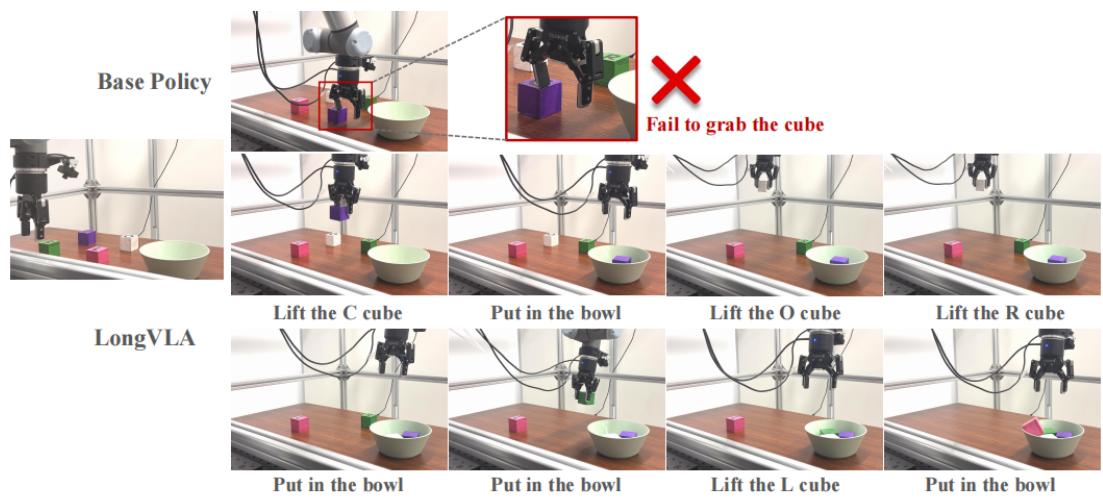
Figure 14 shows a qualitative comparison. The Base Policy (top) fails to grab the cube, likely due to a slight calibration error or visual distraction. Long-VLA (bottom) smoothly executes the entire sequence: Press button -> Grab corn -> Put in sink -> Press yellow button.
The quantitative results for cleaning (Figure 6 below) mirror the sorting results: Long-VLA dominates, especially in the later stages of the chain.
Comparison with State-of-the-Art
The authors compared Long-VLA against major competitors, including GR-1, RoboVLMs, and the powerful \(\pi_0\) model.
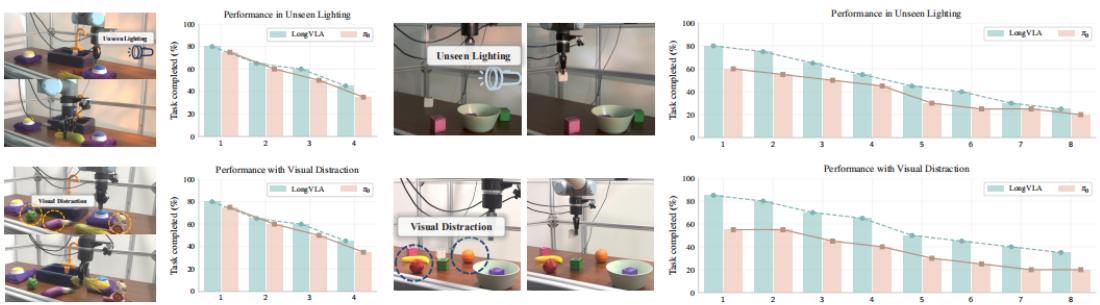
In the real-world comparisons (Figure 11), Long-VLA consistently outperforms \(\pi_0\), particularly when faced with visual distractions (bottom row). The line graphs show that while other models degrade rapidly over time (slope downwards), Long-VLA maintains a flatter, more stable success curve.
Conclusion
Long-VLA represents a significant step forward in making generalist robots practical. The paper identifies that the main hurdle for long tasks isn’t just “learning actions,” but managing the accumulated errors that occur when stringing those actions together.
By acknowledging that a robot needs different “senses” for different phases of a task—wide-angle vision for moving, focused macro-vision for interacting—and enforcing this through architecture-agnostic masking, Long-VLA achieves the best of both worlds. It acts like a modular system during inference but trains like a unified system during learning.
Key Takeaways
- Unified yet Adaptive: You don’t need separate models for different subtasks; you just need to control the information flow within a single model.
- Attention Matters: Forcing the model to ignore irrelevant data (masking) is a powerful way to improve robustness against lighting changes and visual clutter.
- Longer Horizons are Possible: With these techniques, robots can move beyond simple “pick and place” to performing 10+ step complex workflows reliably.
As robots move out of the lab and into our messy, unpredictable homes, techniques like Long-VLA that emphasize robustness and error handling will be essential. This paper shows that sometimes, to see the solution clearly, you have to know what not to look at.