](https://deep-paper.org/en/paper/2508.20561/images/cover.png)
Introduction
In the world of robotics, vision has long been king. We have taught robots to see obstacles, classify objects, and navigate rooms with impressive accuracy. But when it comes to manipulation—actually grabbing, holding, and moving things—sight isn’t enough. Try tying your shoelaces with numb fingers; even if you watch your hands closely, it’s incredibly difficult. You need the sense of touch.
Specifically, you need to feel shear. Shear is the lateral force that stretches your skin when an object slides across your fingertips or when gravity pulls on a heavy object you’re holding. It’s the sensation that tells you a glass is about to slip from your hand before it actually falls.
For years, teaching robots to use shear has been a stumbling block. We prefer to train robots in simulation (where it’s safe and fast), but standard physics simulators treat objects as rigid bodies. They simulate contact depth, but they don’t simulate the complex deformation and skin stretch of a real tactile sensor. This creates a massive “sim-to-real gap.” A policy trained in a rigid simulation fails in the real world because the sensory data looks completely different.
In this post, we’ll dive into SimShear, a research paper that proposes a clever solution to this problem. Instead of trying to build a computationally expensive “soft” physics simulator, the researchers use Generative Adversarial Networks (GANs) to hallucinate realistic shear effects onto rigid simulation data. The result? Robots that can learn complex, delicate manipulation tasks in simulation and execute them flawlessly in the real world.
Background: The Tactile Gap
To understand SimShear, we first need to understand the hardware and the simulation problem.
The researchers use a vision-based tactile sensor (specifically, the TacTip). Imagine a small camera looking at the inside of a rubber dome. The inside of the dome has markers on it. When the dome presses against an object, the rubber deforms, and the markers move. By tracking these markers, the robot “feels” the contact.
The Simulation Problem
We want to train robots using reinforcement learning or deep learning, which requires thousands of trials. Doing this on a real robot is slow and causes wear and tear. We prefer simulation.
However, most fast physics engines (like PyBullet) are rigid-body simulators. When a simulated sensor touches a simulated object, the objects might interpenetrate slightly to calculate force, but the sensor doesn’t “stretch” laterally.
- Simulated Image: Shows contact geometry (depth) but looks perfect and undeformed.
- Real Image: Shows contact geometry plus complex warping due to friction and drag (shear).
The Old Way: Real-to-Sim
Previous approaches tried to solve this by degrading the real-world data. They would take the rich, complex real-world image and use a filter to make it look like the simple simulation image. This is called a Real-to-Sim pipeline.
The problem? You are throwing away data. You are discarding the shear information because the simulation doesn’t support it. This limits the robot to tasks that only require knowing where the contact is, not how the object is pulling or sliding.
The Core Method: SimShear
The SimShear pipeline flips the script. Instead of downgrading real data, it upgrades simulated data. It aims to generate realistic, shear-inclusive images from rigid simulation data, enabling the robot to learn from “fake” but highly realistic sensory inputs.
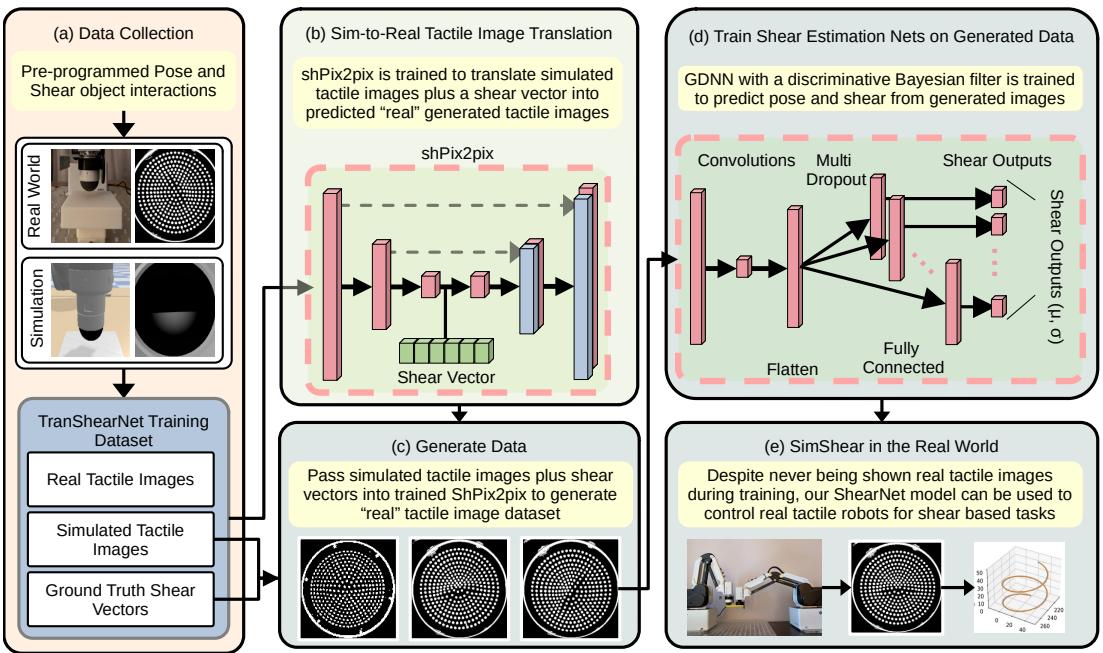
As shown in Figure 1, the pipeline consists of five distinct stages. Let’s break down the most critical innovations: the Image Translation (b) and the Training (d).
1. shPix2pix: Injecting Shear into the Dream
The heart of this method is a neural network model the authors call shPix2pix.
Standard image-to-image translation models (like the famous pix2pix) use a U-Net architecture. They take an input image (simulation) and try to produce an output image (real). However, a standard U-Net fails here. Why? Because of the one-to-many problem.
In a rigid simulator, a sensor pressing down on an object looks exactly the same whether the sensor is stationary or sliding sideways. In reality, those two scenarios produce very different images due to shear. A standard network looking only at the simulation image has no way of knowing which “real” version to generate.
The Solution: The authors modify the U-Net architecture to accept a “hint.”
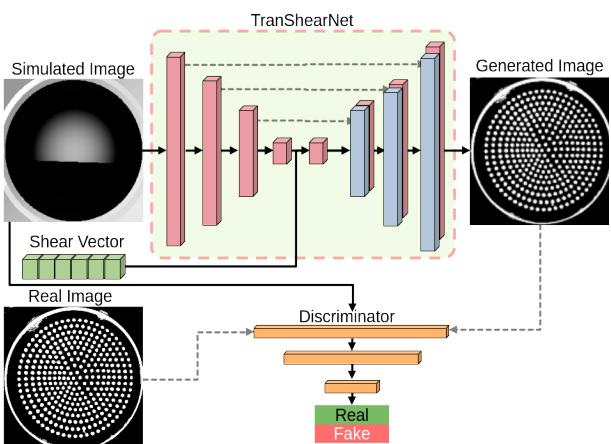
As detailed in Figure 2, the shPix2pix network takes two inputs:
- The Simulated Tactile Image: The depth map from the physics engine.
- The Shear Vector: A vector extracted from the physics engine that describes the lateral movement and rotation (how much the sensor is sliding relative to the object).
The network processes the image through convolutional layers (encoding). Then, right at the “bottleneck” (the deepest part of the network), it injects the shear vector via a fully connected layer. This tells the network how to distort the image as it reconstructs it (decoding).
This allows the generator to “paint” the shear effects onto the rigid simulation image, creating a synthetic image that looks indistinguishable from a real sensor undergoing lateral stress.
2. Training the ShearNet
Once the shPix2pix model is trained, the researchers can generate infinite amounts of data. They run the simulation, collect rigid images + shear vectors, and pass them through shPix2pix to create a massive dataset of “synthetic real” images.
They use this dataset to train a ShearNet (specifically a Gaussian Density Neural Network). This network learns to look at a tactile image and output the Pose (position) and Shear (force/direction).
Key Takeaway: The robot’s control policy is trained entirely on these synthetic images. It never sees a real tactile image during training. Yet, because the synthetic images are so realistic, the policy transfers to the real world zero-shot (without fine-tuning).
Experiments & Results
Does this complex pipeline actually work? The authors validated the method through both image analysis and physical robotic tasks.
1. Image Translation Quality
First, they checked if shPix2pix actually produces better images than a standard pix2pix model.
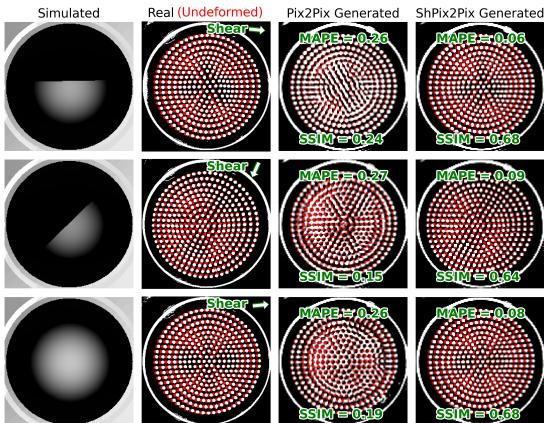
Figure 3 offers a striking visual comparison.
- Column 1 (Simulated): The inputs are perfect, symmetric circles.
- Column 2 (Real): The ground truth shows significant warping (shear).
- Column 3 (Pix2Pix): The baseline model fails to capture the shear. It basically outputs a blurry version of the symmetric simulation input.
- Column 4 (ShPix2Pix): The proposed method accurately reproduces the warping and deformation seen in the real images.
The quantitative metrics back this up, with SimShear achieving significantly lower pixel error (MAPE) and higher structural similarity (SSIM) than the baseline.
2. Prediction Accuracy
Next, can a network trained on this fake data actually predict shear in the real world?
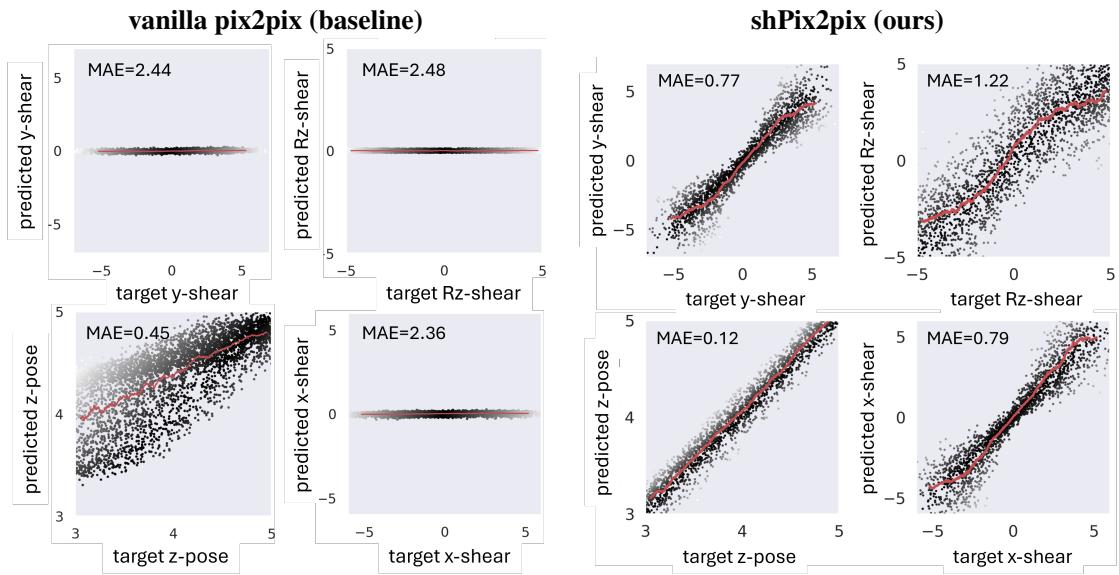
Figure 4 compares the prediction errors. The red line represents a perfect prediction.
- Baseline (Left): The standard pix2pix approach (which ignores shear vectors) fails miserably at predicting shear (y-shear and x-shear). The dots are scattered everywhere; the robot is essentially guessing.
- SimShear (Right): The predictions tightly hug the red line. Even though the network was trained on “hallucinated” shear, it predicts real-world shear with high accuracy.
3. Real-World Robotic Tasks
Finally, the rubber meets the road. The researchers deployed the model on two Dobot MG400 robotic arms for collaborative tasks.
Task A: Tactile Tracking
One robot (Leader) moves an object, and the second robot (Follower) must keep its sensor pressed against the surface, tracking the movement. This requires detecting if the object is sliding away to correct the position.
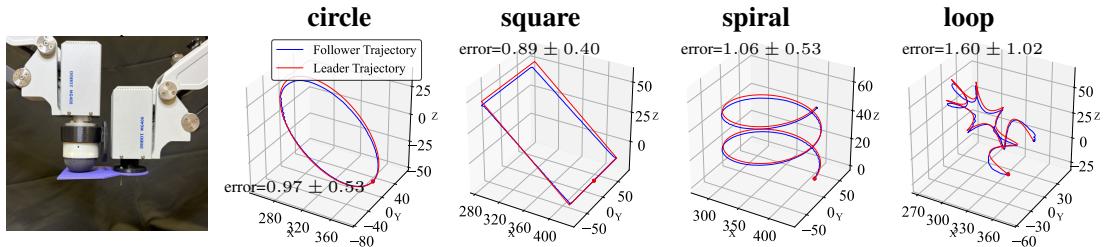
In Figure 5, you can see the results for complex shapes like spirals and loops. The blue line (Follower) tracks the red line (Leader) almost perfectly, with errors of only 1-2 mm. Without shear sensing, the robot would likely lose contact or press too hard as the object changed direction.
Task B: Collaborative Co-Lifting
This is a harder task. Both robots hold an object. The leader moves, and the follower must move in sync to keep the object from dropping. This relies heavily on feeling the weight and drag (shear) on the sensor.
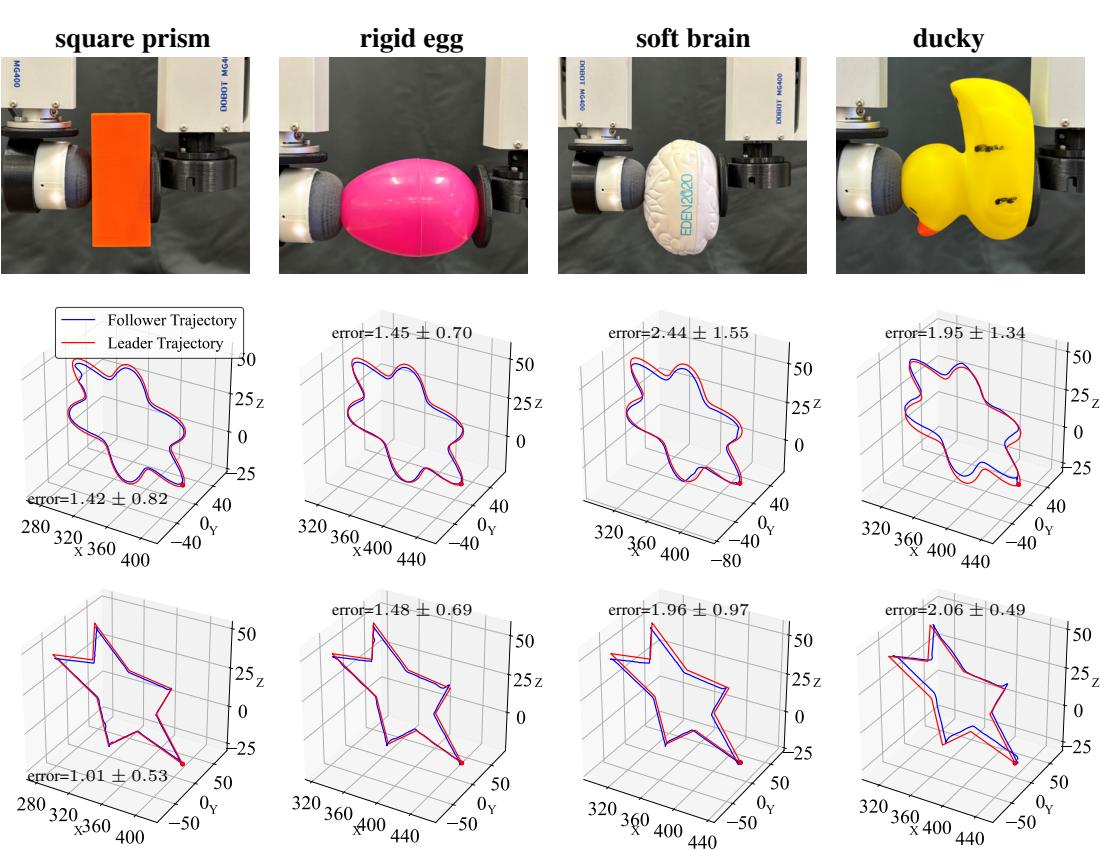
Figure 6 shows the setup with various objects: a square prism, a rigid egg, a soft brain, and a rubber duck. The system generalized incredibly well. It successfully handled the soft brain (which deforms differently than the training data) and the heavy duck, maintaining a secure grasp throughout the trajectory. This demonstrates that the “concept” of shear learned by the network is robust enough to handle objects it hasn’t seen before.
Conclusion & Implications
SimShear represents a significant step forward in robotic dexterity. By acknowledging that simple physics simulations aren’t enough—and by using Generative AI to bridge that gap—the researchers have enabled robots to utilize shear forces without the massive computational cost of soft-body simulation.
Key Takeaways:
- Shear Matters: For dynamic tasks like lifting and tracking, knowing where you are touching isn’t enough; you need to feel the forces.
- Sim-to-Real works for Touch: We don’t need to degrade real data to match simulation. We can upgrade simulation to match reality.
- Generative AI in Control Loops: GANs aren’t just for making art; here, they are an integral part of the control theory pipeline, acting as a translator between physics engines and the real world.
The implications for this are exciting. If we can accurately simulate the “feeling” of slip and weight, we are one step closer to robots that can handle fragile items (like eggs or glassware) or manipulate flexible objects (like cloth or cables) with the same casual ease that humans do.