](https://deep-paper.org/en/paper/2508.20981/images/cover.png)
Introduction
Imagine navigating a familiar room in the dark with a flashlight. To figure out where you are, you wouldn’t point your light at a blank patch of white wall; that wouldn’t tell you anything. Instead, you would instinctively shine the light toward distinct features—a door frame, a bookshelf, or a unique piece of furniture. By actively selecting where to look, you maximize your ability to localize yourself in the space.
This intuitive human behavior is exactly what roboticists call Active Visual Localization.
Reliable localization is the backbone of robot navigation. While LiDAR sensors offer precise 360-degree views, they are expensive, heavy, and power-hungry. Cameras, on the other hand, are affordable and lightweight, making them ideal for everything from household vacuums to aerial drones. However, cameras have a limited Field of View (FoV). If a robot’s camera happens to point at a featureless area—like that blank wall—its localization system can fail, causing the robot to get lost.
Most existing visual localization systems are “passive.” They simply try to figure out where they are based on whatever the camera happens to be seeing at that moment. But what if the robot could choose where to look?
In this post, we will explore ActLoc, a new framework presented by researchers from ETH Zürich, Sapienza University of Rome, and Microsoft. ActLoc transforms the robot from a passive observer into an active agent that intelligently selects viewpoints to ensure it never loses its way.
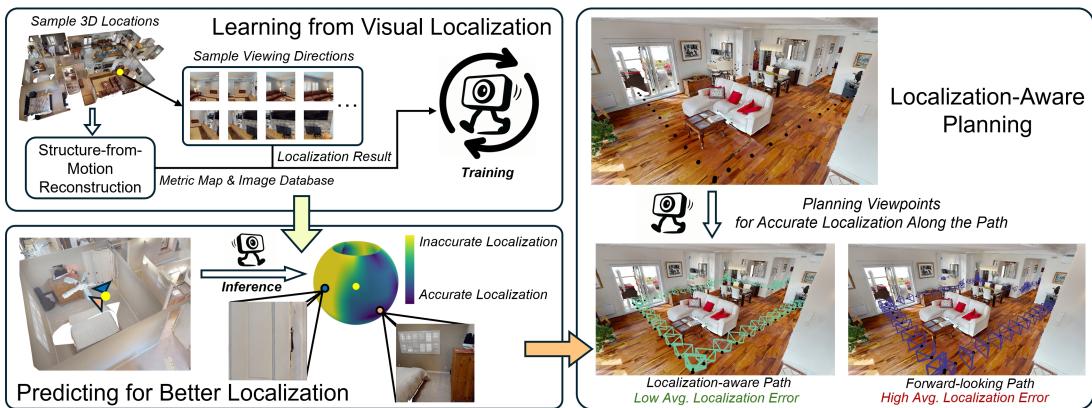
As illustrated above, ActLoc learns to predict how good a specific viewing direction will be for localization and integrates this knowledge directly into the robot’s movement plan.
The Problem with Passive Localization
To understand why ActLoc is necessary, we first need to look at how visual localization generally works. Typically, a robot captures an image and compares it against a pre-built map (often a database of images or a 3D point cloud) to estimate its position and orientation (pose).
Passive systems assume that all viewing directions are equally informative, which is rarely true in the real world. A view of a kitchen counter covered in objects provides rich data for localization; a view of the floor or ceiling usually does not.
Previous attempts to solve this (“active” methods) have faced significant hurdles:
- Computational Cost: Many methods evaluate viewpoints one by one. For a robot needing to make split-second decisions, calculating the potential quality of every possible angle is too slow.
- Lack of Context: Some methods look at local geometric features but fail to consider the broader map structure.
- Separation from Planning: Often, the “where to look” decision is made separately from the “where to move” decision, leading to jerky or inefficient movement.
ActLoc addresses these issues by using a deep learning model to predict the localization quality of all possible viewing directions at once, in a single efficient step.
The ActLoc Method
The core of ActLoc is a unified framework that combines a prediction network with a path planner. The goal is to look at a 3D location (a waypoint) and generate a “LocMap”—a heatmap indicating which directions offer the most reliable localization.
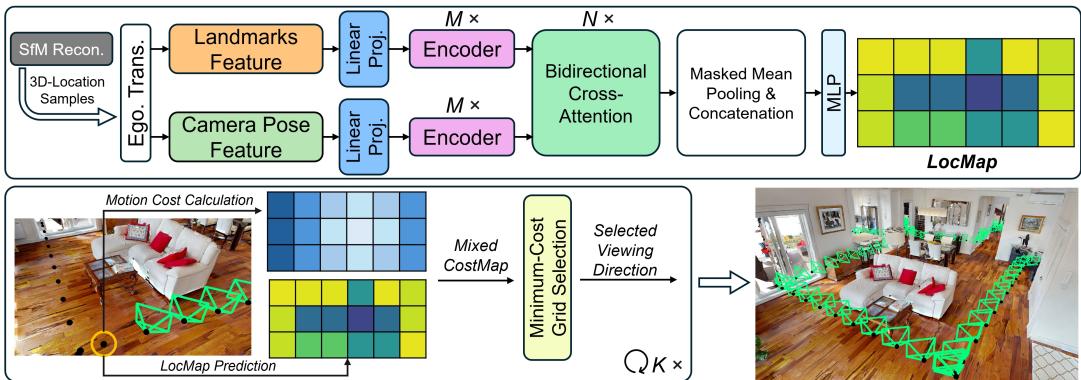
1. The Inputs: Leveraging the Map
How does the robot know which view is good before it even looks? It relies on the map it already possesses. Specifically, ActLoc utilizes data from Structure-from-Motion (SfM) reconstruction.
SfM is a technique used to build 3D models from 2D images. An SfM reconstruction consists of:
- 3D Landmarks: Distinct points in space (corners, edges) that the robot can recognize.
- Camera Poses: The positions and angles from which the map images were originally taken.
ActLoc takes these sparse 3D landmarks and camera poses as input. This is a clever design choice because it uses the data the robot naturally has access to after mapping an environment.
2. Data Preprocessing
Before feeding data into the neural network, the system processes the raw point cloud to make it digestible for the model.
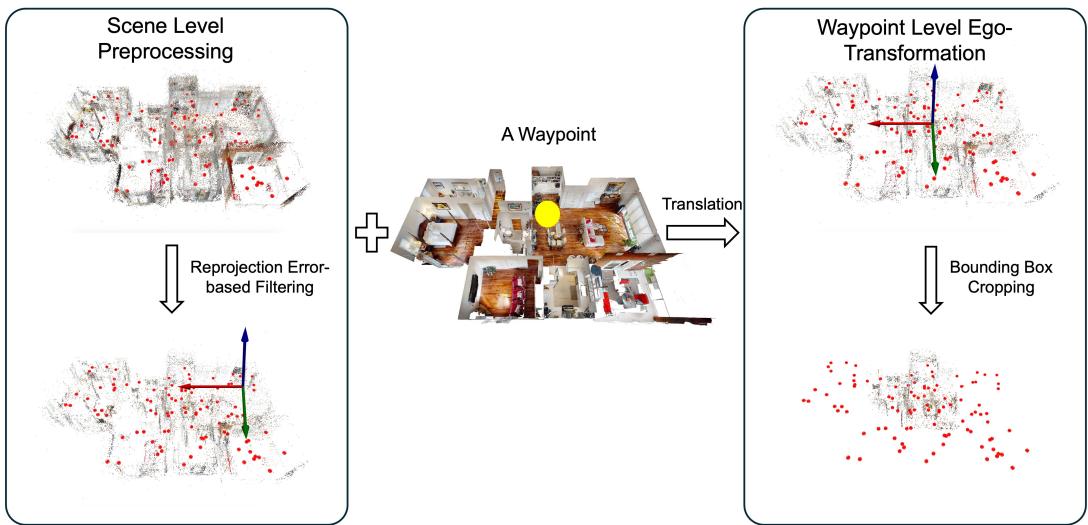
As shown in the figure above, the pipeline performs three key steps:
- Filtering: Removes highly uncertain landmarks that might confuse the model.
- Ego-Transformation: Shifts the coordinate system to be centered on the robot’s current waypoint. This ensures the model understands the geometry relative to where the robot is standing.
- Cropping: Focuses on a bounding box around the robot. Distant landmarks are less relevant for immediate localization, so the model focuses on the local vicinity.
3. The Neural Architecture
The heart of ActLoc is an attention-based neural network. The researchers recognized that the relationship between where the robot is and where the landmarks are is complex. To solve this, they use Transformers, the same type of architecture behind Large Language Models (LLMs).
The network processes the camera poses and landmarks separately at first, extracting features from each. Then, it uses a Bidirectional Cross-Attention mechanism. This allows the model to “reason” about the spatial relationship between the sparse camera poses and the dense 3D landmarks.
The output of this network is the LocMap (\(\mathbf{C}_{\mathbf{x}}\)). Instead of outputting a single score, the model predicts a grid of scores representing different yaw (horizontal) and pitch (vertical) angles.

In this equation:
- \(\mathbf{P}\) represents the 3D landmarks (Point cloud).
- \(\mathbf{T}\) represents the camera poses (Trajectory/Training views).
- \(\mathbf{x}\) is the current waypoint.
- \(\mathbf{C}_{\mathbf{x}}\) is the resulting grid of predicted accuracy.
By predicting this entire grid in a single forward pass, ActLoc is drastically faster than methods that iterate through angles one by one.
4. Training the Model
To train this network, the researchers needed a massive amount of labeled data—specifically, they needed to know the actual localization error for millions of different viewpoints. Gathering this data with a real robot would take years.
Instead, they used the Habitat-Matterport 3D (HM3D) dataset, a collection of high-fidelity digital replicas of real interiors.
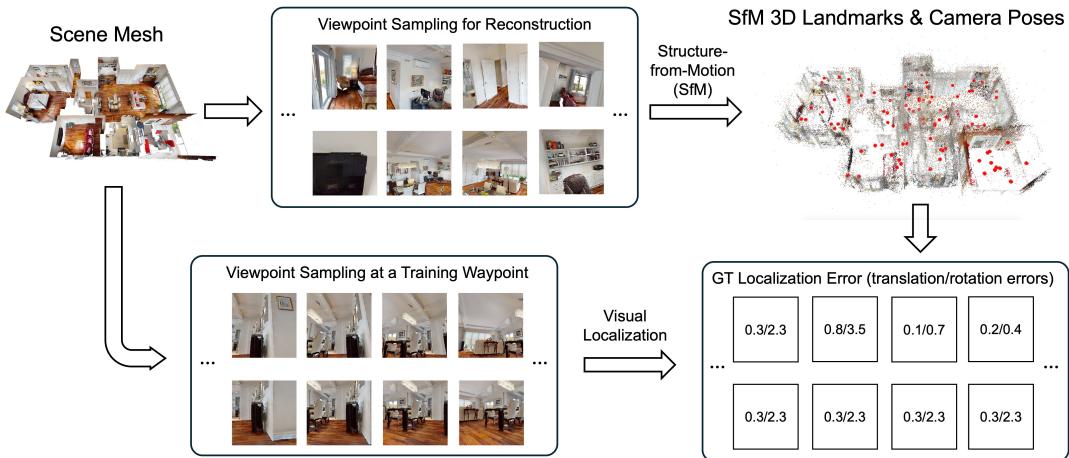
They simulated a camera looking in every direction at thousands of points in these virtual environments. They then ran a standard localization algorithm to see if it succeeded or failed. This created a rich dataset where the network could learn the correlation between the geometry of the room (the SfM map) and the likelihood of successful localization.
5. Localization-Aware Planning
A robot cannot simply snap its camera to the “best” angle at every millisecond; that would result in erratic, jittery motion that might violate kinematic constraints or cause motion blur.
ActLoc integrates the predicted LocMap into a path planner using a cost function that balances two competing goals:
- High Localization Accuracy: Look where the LocMap says accuracy is highest.
- Smooth Motion: Minimize the difference in rotation between the current step and the previous step.

Here, \(\mathbf{C}_{\mathbf{x}}\) is the localization cost (from the network), and \(\mathbf{D}_{\mathbf{x}}\) is the motion cost (how much the robot has to turn). The parameter \(\lambda\) controls the trade-off. This ensures the robot follows a smooth path while keeping its “eyes” on feature-rich areas.
Experiments and Results
The researchers compared ActLoc against state-of-the-art baselines, including LWL (Learning Where to Look) and FIF (Fisher Information Field).
Visualizing the Prediction
First, let’s look at what the model actually predicts. The visualization below shows the 3D scene (top) and the corresponding predicted LocMap (bottom). Dark blue/indigo areas represent viewpoints predicted to be accurate, while yellow/green areas are predicted to be difficult.
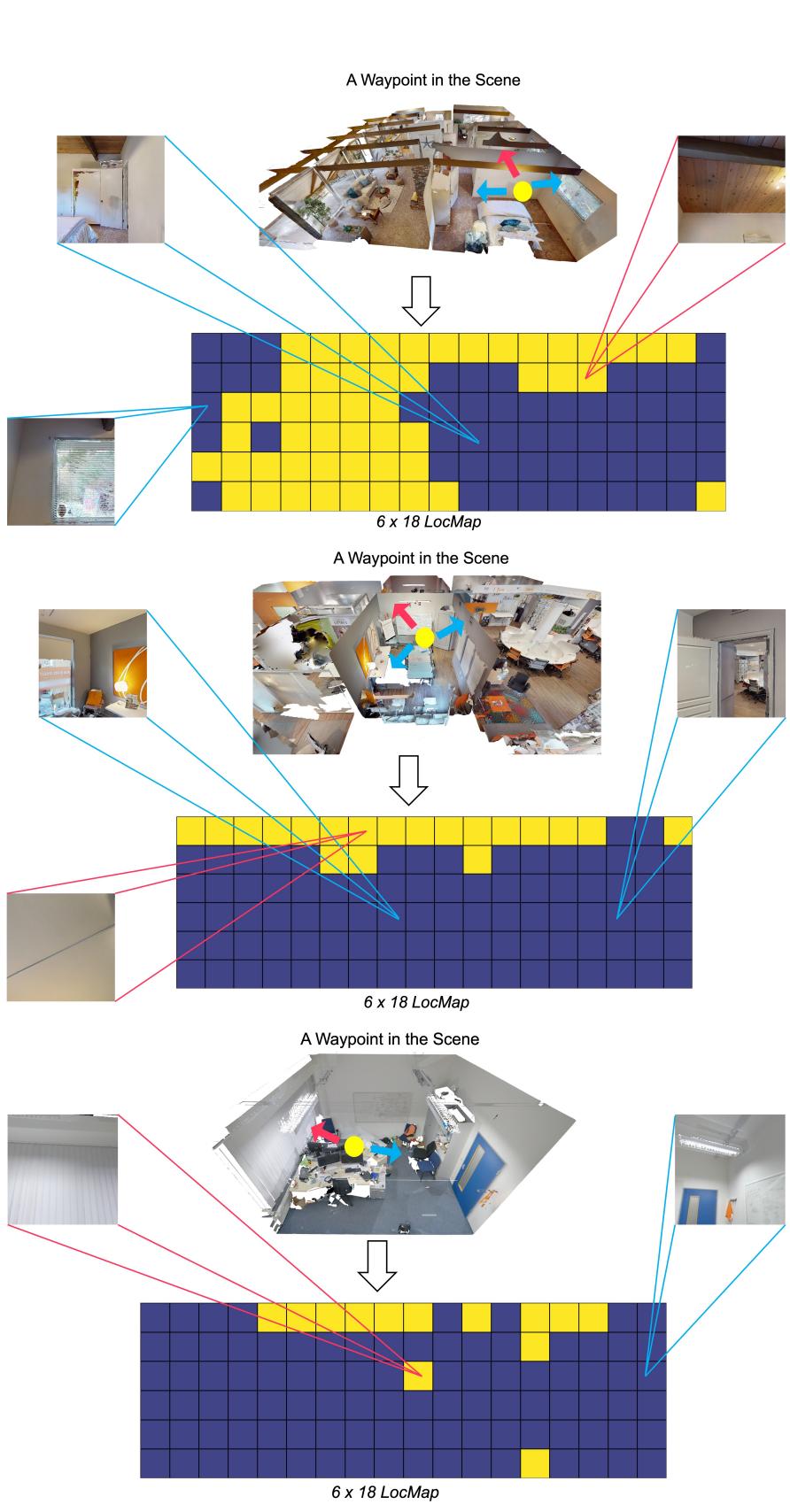
You can see that the model correctly identifies that looking at feature-rich areas (like a furnished corner) yields better localization than looking at empty space.
Path Planning Performance
The true test is whether this improves navigation. The researchers ran simulations where a robot had to traverse a path. They compared ActLoc against a standard “Forward-Facing” baseline (where the robot just looks where it’s going) and LWL.
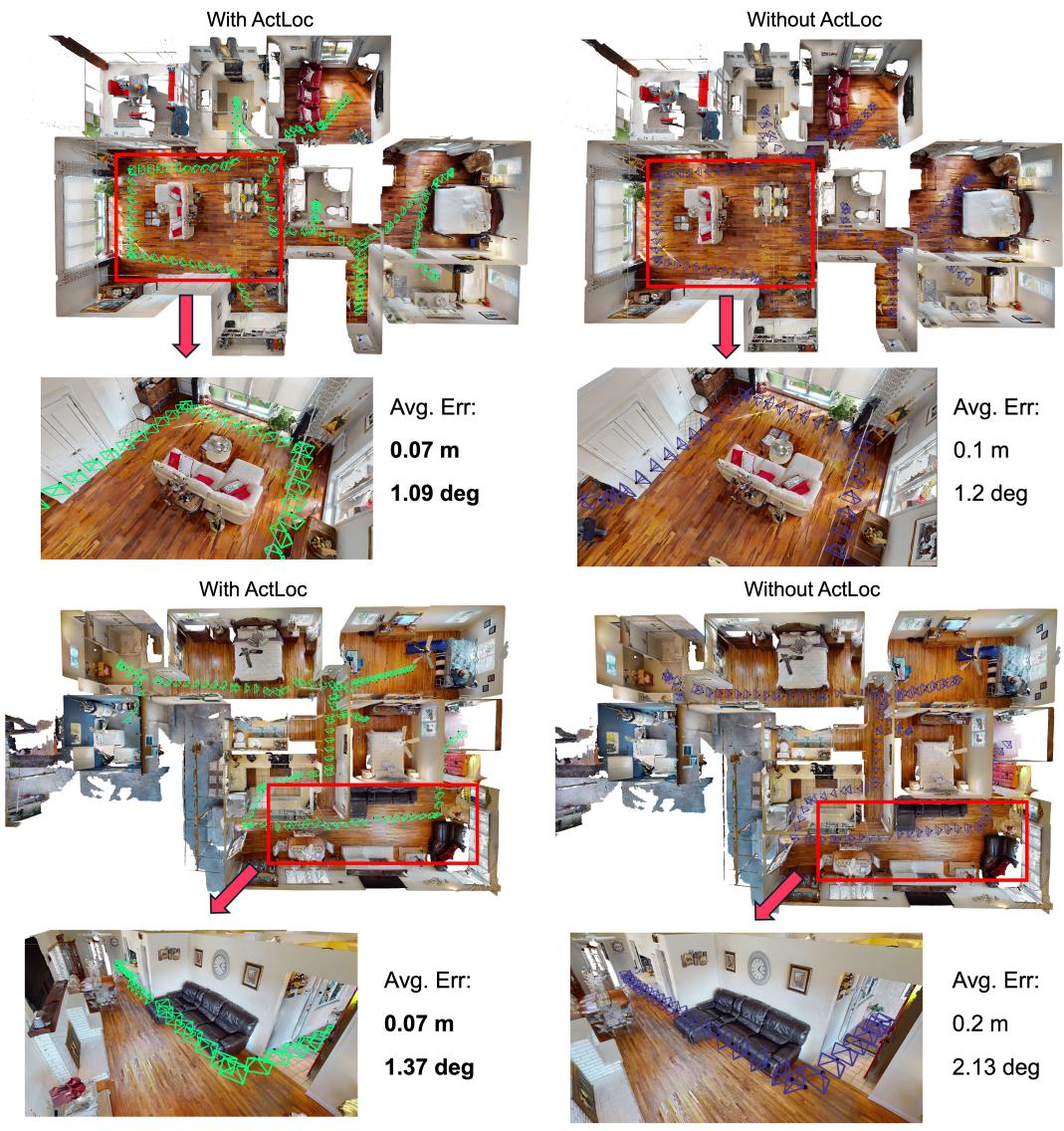
In the figure above, the green paths (ActLoc) show the robot adjusting its gaze to maintain lock on features. The blue paths (Baseline) show the robot staring straightforward, often resulting in higher localization errors (indicated by the red boxes and error metrics).
ActLoc consistently achieved higher success rates and lower translation/rotation errors. It allows the robot to “crab walk” or pan its camera smoothly to keep landmarks in view while moving toward its goal.
Speed and Efficiency
One of the most impressive results is the computational efficiency. Because ActLoc predicts the entire view grid in one pass, it is orders of magnitude faster than its competitors.

As shown in Table 7, ActLoc takes about 108 milliseconds to process a waypoint, regardless of the resolution. The competing method, LWL, takes over 8 seconds for a low-resolution grid and over 100 seconds for a high-resolution one. This speed is critical for real-time robotics; a robot moving at speed cannot wait 8 seconds to decide where to look.
Robustness
The researchers also tested how ActLoc handles “sparse” maps—situations where the pre-built map is not perfect or has missing data.
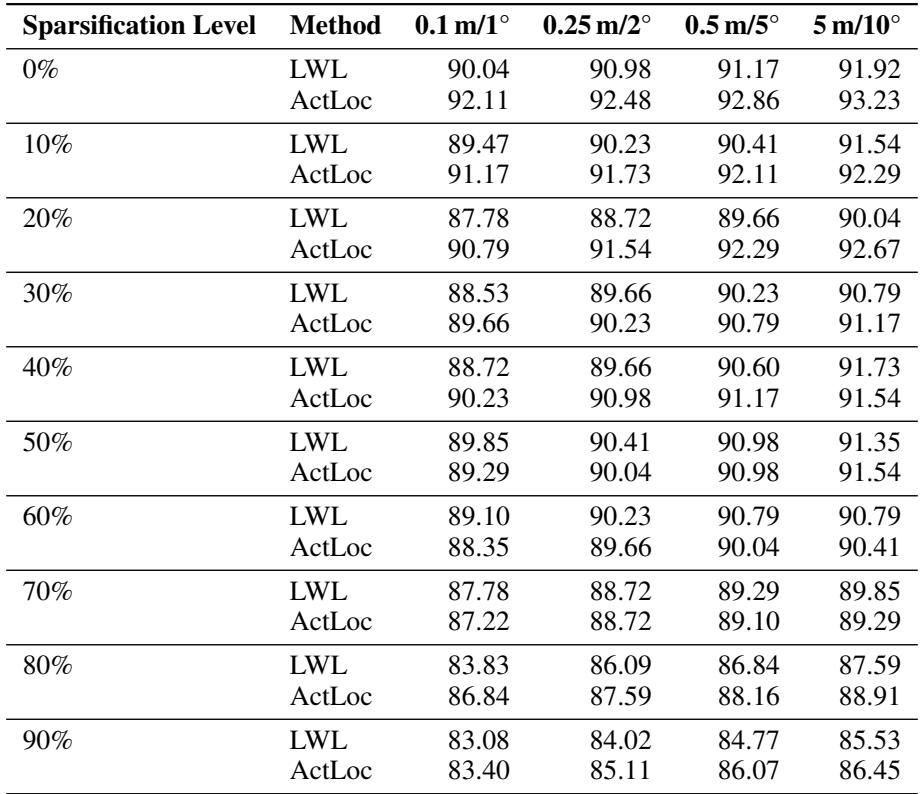
The results indicate that even when significant portions of the map data are removed (sparsification), ActLoc (bottom rows) maintains high success rates, degrading much more gracefully than LWL.
Conclusion and Implications
ActLoc represents a significant step forward in robotic autonomy. By moving from passive observation to active perception, it allows robots to navigate more robustly in complex environments.
The key takeaways are:
- Holistic Prediction: Predicting accuracy for all angles simultaneously is far more efficient than evaluating them sequentially.
- Map Utilization: Leveraging the underlying SfM map provides the geometric context needed for accurate predictions.
- Smooth Integration: Combining localization confidence with motion constraints creates trajectories that are both accurate and feasible for real hardware.
This technology has broad implications. It could allow cheaper robots with lower-quality cameras to navigate with the precision of high-end machines. It could improve the reliability of augmented reality (AR) headsets that rely on visual localization. Ultimately, it brings us closer to robots that don’t just move through our world, but actively understand how to see it.