](https://deep-paper.org/en/paper/2508.21001/images/cover.png)
Imagine you are trying to drive a car through a dense, unfamiliar warehouse. You can’t just draw a straight line to the exit—you have to steer, accelerate, brake, and avoid pillars, all while respecting the car’s turning radius. This is the essence of Kinodynamic Motion Planning (KMP). It’s not just about geometry; it’s about physics.
For decades, roboticists have struggled to solve KMP efficiently. We essentially had two choices: algorithms that are mathematically guaranteed to work but are painfully slow (Search), or modern AI models that are incredibly fast but often crash or hallucinate (Learning).
What if we didn’t have to choose? In the research paper “Train-Once Plan-Anywhere: Kinodynamic Motion Planning via Diffusion Trees,” researchers introduce DiTree, a framework that fuses the rigorous safety of search trees with the generative power of diffusion models. The result is a planner that can be trained on a single map and successfully navigate complex environments it has never seen before—from racing cars to multi-legged walking robots.
The Problem: The Tortoise and the Hare
To understand why DiTree is significant, we first need to look at the two distinct camps in motion planning.
The Tortoise: Sampling-Based Planners (SBPs)
The traditional way to solve these problems is using algorithms like RRT (Rapidly-exploring Random Trees). The logic is simple:
- Start at the robot’s current position.
- Pick a random point in space.
- Try to steer the robot toward that point.
- If you don’t hit an obstacle, add that path to your “tree.”
- Repeat until a branch hits the goal.
The Good: They are Probabilistically Complete. If a path exists, RRT is guaranteed to eventually find it given enough time. They also guarantee collision-free paths. The Bad: They are “blind.” They waste thousands of calculations exploring dead ends or trying impossible maneuvers because they sample actions randomly.
The Hare: Learning-Based Approaches (Diffusion)
Recently, Diffusion Models (the tech behind DALL-E and Midjourney) have been applied to robotics. Instead of generating pixels, they generate trajectories.
- Feed the model the current state and a goal.
- The model “denoises” a random curve into a smooth, expert-like path.
The Good: They are incredibly fast and produce human-like motions. The Bad: They lack guarantees. A diffusion model might generate a path that looks plausible but actually clips a wall (collision) or violates physics. Worse, they suffer from Out-of-Distribution (OOD) failure. If you train a model on a warehouse map, and then test it in a narrow corridor, it often fails catastrophically because it relies on memorizing the global environment.
Enter DiTree: The Best of Both Worlds
DiTree (Diffusion Tree) proposes a hybrid architecture. It keeps the “tree” structure of SBPs to ensure safety and completeness but replaces the “random” blind guessing with a smart Diffusion Policy.
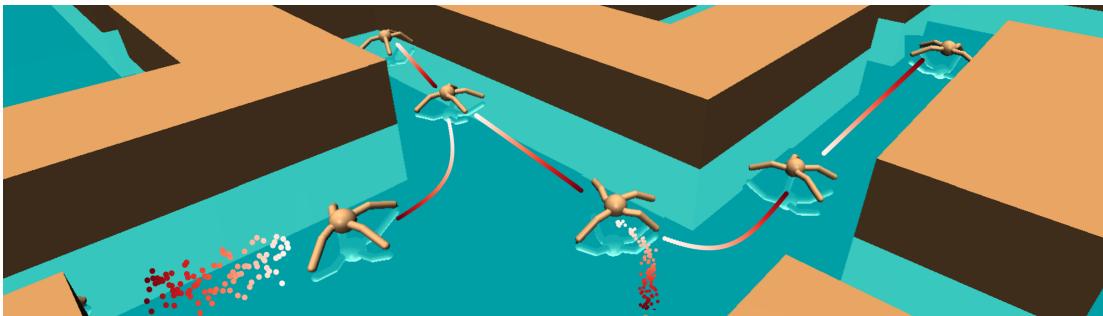 Figure 1: A visualization of DiTree navigating a complex “AntMaze” environment. The algorithm grows a tree (white/red lines) to explore the space, guided by a learned diffusion model.
How It Works: The “Informed” Sampler
In a standard RRT, the robot picks a random direction and tries to move there. In DiTree, the robot looks at its immediate surroundings and asks a Diffusion Model: “Given what I see right here, what would an expert do?”
Here is the step-by-step process illustrated in the framework:
- Node Selection: The algorithm picks a node in the existing tree to extend.
- Local Observation: It extracts a local map (occupancy grid) around that node. This is a crucial design choice. By looking only at the local geometry (e.g., “there is a wall to my left”), the model learns behaviors that apply anywhere. A wall is a wall, whether it’s in Training Map A or Testing Map B.
- Diffusion Inference: A conditional Diffusion Policy (specifically a Flow Matching model) generates a sequence of actions. It is conditioned on the local obstacles and a relative goal.
- Propagation & Safety Check: The generated actions are simulated using the robot’s actual physics engine. The system checks for collisions. If the path is safe, it is added to the tree as a new edge.
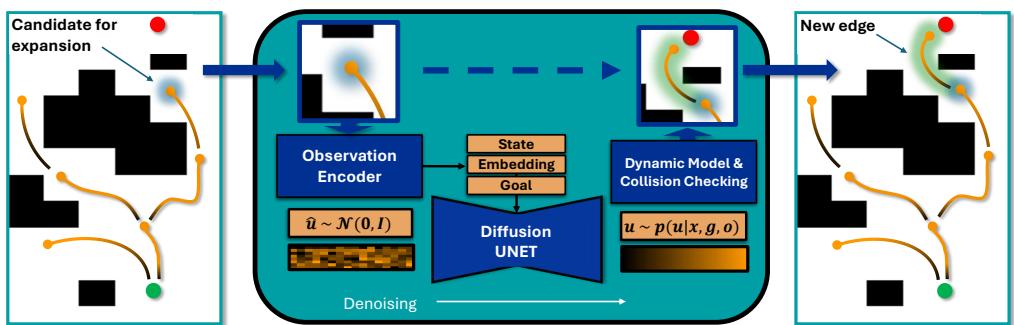 Figure 2: The DiTree pipeline. (Left) A node is selected and the local environment is observed. (Center) The Diffusion Model, conditioned on this local view, generates an action sequence. (Right) The valid trajectory is added to the search tree.
This method solves the two biggest problems of the previous approaches:
- Unlike pure Diffusion, the Tree structure catches failures. If the model suggests a path that hits a wall, the physics check rejects it. The robot doesn’t crash; it just tries a different branch.
- Unlike pure RRT, the Sampling is efficient. It doesn’t waste time exploring random voids. It explores promising areas suggested by the learned model.
Theoretical Backbone: Why is it Safe?
One might worry: if we stop sampling randomly and start listening to a Neural Network, do we lose the mathematical guarantee that we will eventually find a path?
The authors provide a theoretical proof based on the concept of Full Support. In simple terms, for an algorithm to be “complete,” there must be a non-zero probability of sampling any valid action. Standard Neural Networks often collapse to a single deterministic output (zero support for other options).
However, Diffusion Models operate by transforming Gaussian noise into trajectories. Because Gaussian distributions have “full support” (there is a tiny but non-zero probability of sampling any value), the Diffusion Model technically retains the ability to generate any trajectory. Therefore, DiTree inherits the Probabilistic Completeness of RRT. It is smart, but it retains the ability to “get lucky” if the smart path fails.
Experimental Results: Train Once, Plan Anywhere
The boldest claim of the paper is in its title. Can you really train a robot on one map and have it plan successfully in a completely different one?
The Setup
The researchers tested two robots:
- CarMaze: A non-holonomic car (cannot move sideways, must steer) with complex dynamics.
- AntMaze: A 29-dimensional quadruped robot (MuJoCo physics). This is notoriously difficult for search-based planners due to the high dimensionality.
They trained the diffusion model on a single map (D4RL AntMaze Large) and tested it on 15 different unseen scenarios, including race tracks, warehouses, and tight corridors.
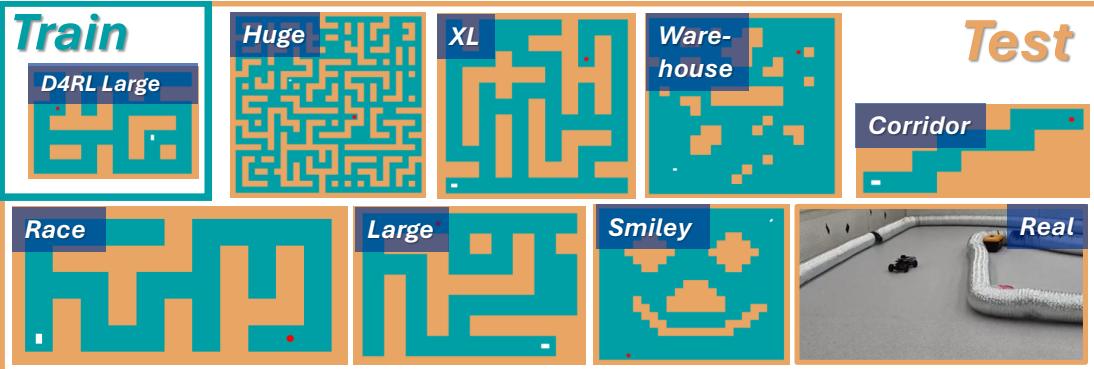 Figure 3: The Generalization Test. Top-left shows the ONLY map used for training. All other maps (Race, Warehouse, Corridor, etc.) were never seen by the model during training.
The Performance
The results were stark. In the AntMaze environment—where the robot has to coordinate 8 joints to walk—traditional planners like RRT and SST failed almost completely (0% success rate in many trials) because the search space was too vast.
DiTree, however, succeeded. By leveraging the learned priors of how to walk and how to avoid local walls, it navigated the high-dimensional space effectively.
On the CarMaze scenarios:
- Pure Diffusion (DP): Often failed in complex maps because it couldn’t generalize its global path predictions.
- Pure Search (RRT/SST): Worked eventually, but was slow and produced “jerky” paths.
- DiTree: Achieved the highest success rates and usually found solutions significantly faster than traditional search.
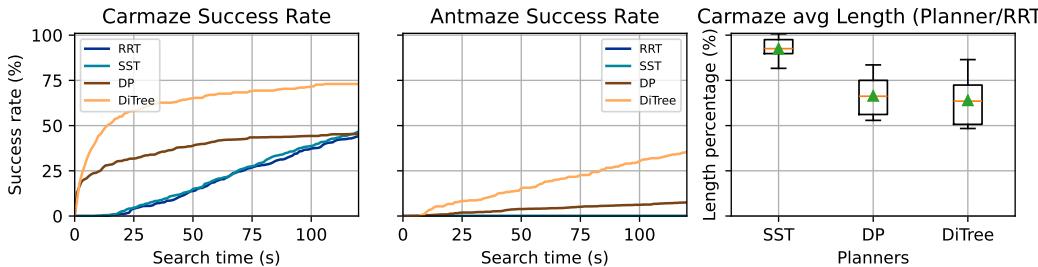 Figure 4: (Left/Middle) Success rates over time. Notice DiTree (Orange) climbs to high success rates much faster than RRT (Blue) or SST (Green), especially in the complex AntMaze. (Right) DiTree also produces significantly shorter, more efficient paths.
Design Choices: Speed vs. Quality
The researchers performed ablation studies to fine-tune the “Diffusion” part of DiTree. A standard diffusion model for image generation might take 50 or 100 steps to “denoise” an image. In robotics, that is too slow to run inside a search loop.
They found that using Flow Matching (a faster variant of diffusion) with just one single iteration worked best. Why? Because inside a search tree, you don’t need a perfect trajectory every time; you just need a good enough guess to extend the tree. Doing a single fast inference allowed the planner to expand the tree thousands of times more quickly than if it waited for a “perfect” 10-step diffusion sample.
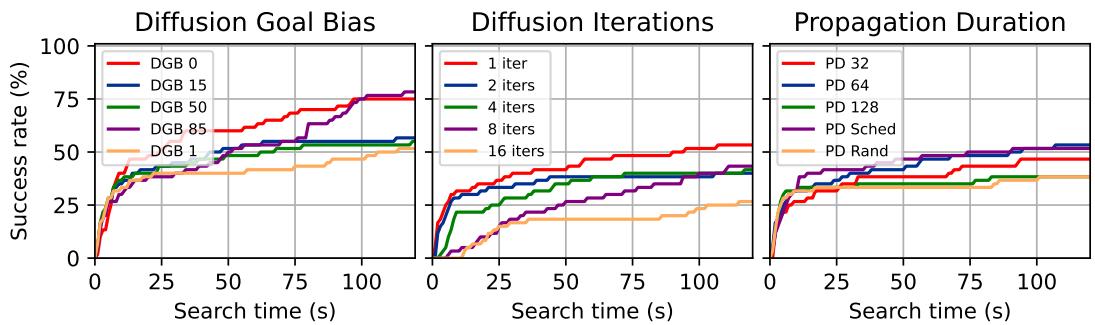 Figure 5: Ablation results. The middle graph is particularly interesting—the Red line (1 iteration) actually performs better or equal to higher iterations because it allows for faster tree growth.
Real-World Verification
Simulation is one thing, but real hardware is the ultimate test. The authors deployed DiTree on a physical scale-model car attempting to perform a sharp turn.
Standard RRT generated a path that was mathematically valid but jagged. When the real car tried to track it, the physical controller couldn’t keep up with the sharp changes, leading to collisions (yellow X marks in the image below).
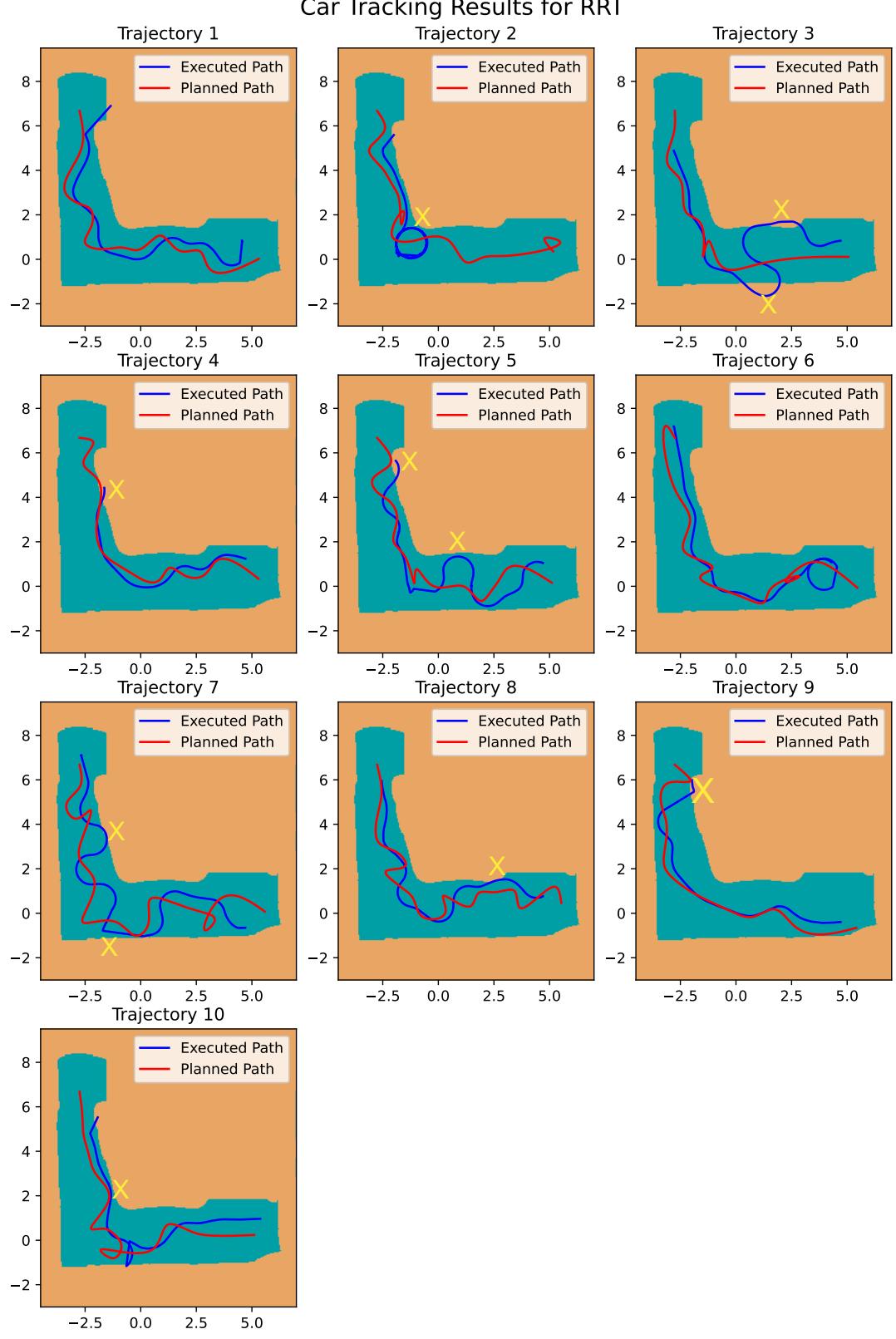 Figure 7 (RRT): The standard RRT planner creates paths that are difficult for a real controller to track, resulting in collisions (Yellow X).
In contrast, DiTree generated smooth, expert-like curves derived from the training data. The real car could track these trajectories easily, resulting in a 100% collision-free success rate in the experiment.
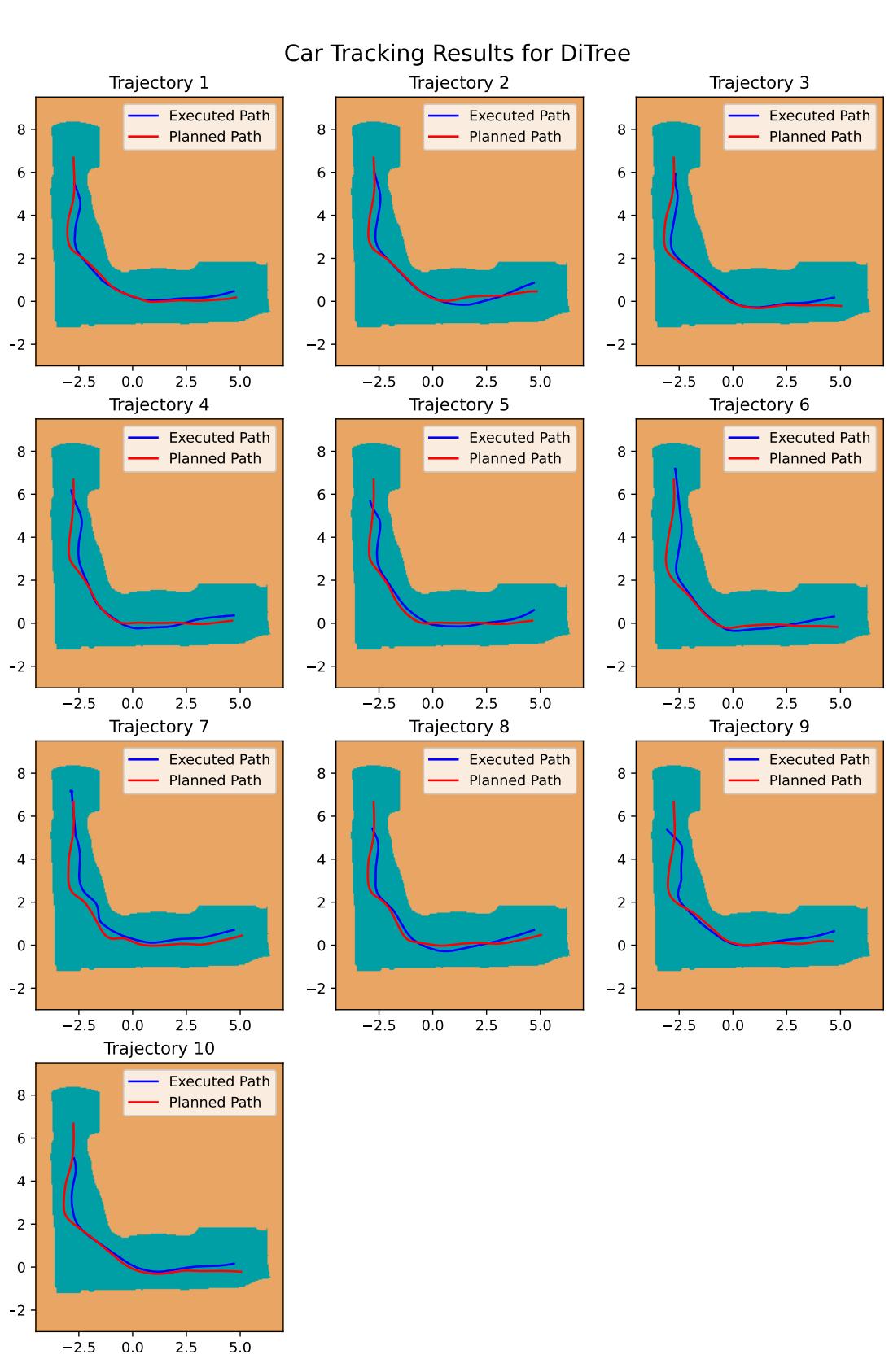 Figure 8 (DiTree): The DiTree planner generates smooth, drivable paths that the real car executes without collision.
Conclusion
DiTree represents a significant step forward in robotic motion planning. It acknowledges a fundamental truth: we don’t need to choose between the rigorous guarantees of classical algorithms and the intuitive speed of modern AI.
By using a local-view Diffusion Model as a “brain” to guide the “body” of a Sampling-Based Planner, DiTree achieves:
- Generalization: Train on one map, deploy on many.
- Safety: Collision checks and dynamic feasibility are guaranteed by the tree structure.
- Efficiency: It searches complex spaces orders of magnitude faster than random sampling.
As robots move out of controlled factories and into unstructured homes and streets, “Train-Once Plan-Anywhere” capabilities will be essential. DiTree provides a robust blueprint for how to get there.