](https://deep-paper.org/en/paper/2508.21007/images/cover.png)
Imagine walking up to a cardboard box. You don’t know if it’s empty, filled with Styrofoam peanuts, or packed with heavy books. You reach out, lift it, and in a split second, your brain processes the proprioceptive feedback from your muscles. If it’s heavier than expected, you instantly recruit more motor units to stabilize your posture; if it’s lighter, you ease off to prevent throwing it over your shoulder. You do this naturally, safely, and—most importantly—rapidly.
For robots, this simple act is a nightmare.
Most robotic control systems rely on precise mathematical models of their own dynamics (the weight and length of their arms) and the objects they interact with. If a robot thinks a box weighs 1 kg but it actually weighs 5 kg, the controller might fail, causing the robot to droop, oscillate, or become unstable. To fix this, engineers often rely on expensive Force-Torque (FT) sensors at the wrist or stiff, non-compliant control schemes that make the robot dangerous to be around.
In this post, we will explore a fascinating paper titled “Rapid Mismatch Estimation via Neural Network Informed Variational Inference.” The researchers introduce a framework called Rapid Mismatch Estimation (RME). It enables a robot to estimate the mass and center of mass of an unknown object in about 400 milliseconds using only its internal joint torque sensors—no external cameras or wrist sensors required.
We will break down how they combine the pattern-matching power of Neural Networks with the mathematical rigor of Variational Inference to give robots the “muscle sense” humans take for granted.
1. The Problem: The Fragility of Model-Based Control
To understand why this research is significant, we first need to understand how modern “soft” robots are controlled.
Impedance Control and Passivity
In human-centric environments, we don’t want robots to be stiff position-controlled machines (like those in a car factory) that will punch through a wall to reach a coordinate. We want Impedance Control. This makes the robot act like a spring-damper system. If you push it, it complies; if it hits something, it exerts a controlled force rather than a rigid motion.
The “holy grail” of safety in this field is Passivity. A passive system is one that does not generate energy internally to destabilize the system; it only dissipates energy (like friction) or stores it (like a spring). If a robot is passive, it is mathematically guaranteed not to go unstable when interacting with the environment.
The governing equation for a robot’s dynamics is generally written as:

Here:
- \(M(q)\): The inertia (mass) matrix.
- \(C(q, \dot{q})\): Coriolis and centrifugal forces.
- \(G(q)\): Gravity.
- \(\tau_{ext}\): External torques (contact with the world).
For a controller to guarantee safety (passivity), it relies heavily on the accuracy of \(M\), \(C\), and \(G\).
The Mismatch Nightmare
The problem arises when the robot picks up an object. Suddenly, the dynamics change. The “nominal” model the robot has in its brain no longer matches the physical reality.

As seen in the equation above, the Nominal Dynamics (left side) equal the control torques plus the Model Mismatch (right side). The term \(\tau_{mm}\) includes the gravitational force of the new mass (\(F_m\)) and the torque generated by the object’s center of mass (\(r_{CoM}\)) acting at a distance.
If the robot doesn’t know about \(\tau_{mm}\), the mismatch acts like a “ghost force” constantly pulling the robot away from its target or causing it to fight its own controller. The goal of RME is to find the parameters \(\theta = \{m, r_x, r_y, r_z\}\) (mass and 3D center of mass) so the robot can cancel out this ghost force.
2. The Solution: Rapid Mismatch Estimation (RME)
The authors propose a framework that runs parallel to the robot’s main controller. It doesn’t replace the controller; it informs it.
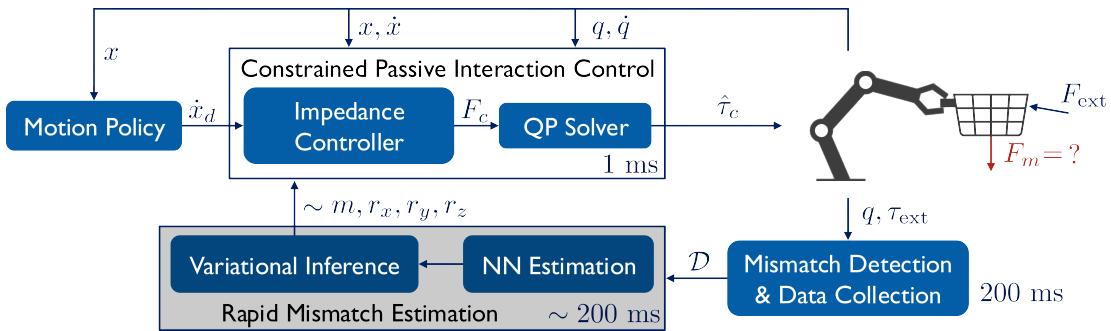
As shown in Figure 1, the RME framework operates in a loop:
- Mismatch Detection: The system watches for sudden unexpected torques.
- Data Collection: Once a mismatch is flagged, it records joint positions (\(q\)) and external torques (\(\tau_{ext}\)) for a short window (200 ms).
- Neural Network Estimation: A deep learning model provides a rapid “best guess” (a prior) for the unknown parameters.
- Variational Inference: An optimization algorithm refines this guess to calculate the final parameters and the uncertainty.
- Compensation: The controller is updated with the new model, restoring performance.
Let’s break down each component.
Step 1: Mismatch Detection
You don’t want the estimator running constantly, as it might mistake a human high-fiving the robot for a change in the object’s mass. The system uses a detection algorithm that monitors the squared norm of external torques \(\|\tau_{ext}\|^2\).
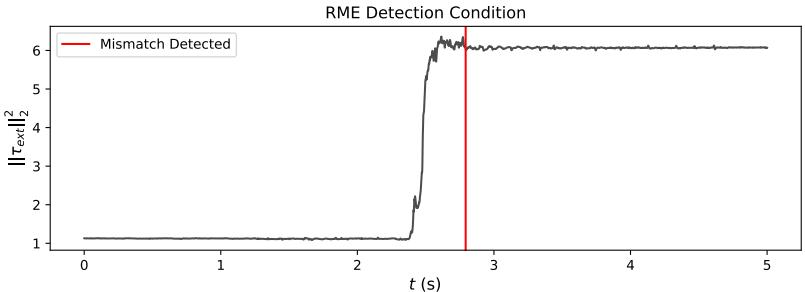
Figure 7 illustrates this detection. The system looks for a rapid spike in torque followed by a stabilization. This signature suggests an object has been picked up or placed on the robot. It waits for the signal to stabilize (roughly 200ms) before triggering the estimation engine.
Step 2: The Neural Network (The Prior)
Calculating the mass and Center of Mass (CoM) from raw torque data is theoretically possible using standard physics (Inverse Dynamics), but it’s messy. Noise in the sensors and the non-linear nature of the robot’s movement make it hard to get a clean answer instantly.
To solve this, the authors train a Neural Network (NN) to learn the inverse dynamics.

The architecture (shown in Figure 2) takes a sequence of “pseudo-wrenches” (forces and torques estimated at the end-effector) as input.
- Convolutional Layer: Captures local temporal patterns in the force data.
- Attention Mechanism: A Transformer-style multi-head attention block helps the network focus on specific parts of the time series that are most informative about the mass.
- MLP (Multilayer Perceptron): The final layers regress the specific values for Mass (\(m\)) and Center of Mass (\(r_x, r_y, r_z\)).
Why use a Neural Network? The NN is trained in simulation on thousands of interactions. It learns the “shape” of the problem. However, Neural Networks can be confident but wrong. They give a point estimate, but they don’t naturally handle the noise and uncertainty of the real world perfectly on their own. That’s why the NN isn’t the final step—it generates a Prior.
In Bayesian terms, the NN says, “Based on this torque data, I’m 80% sure the mass is 1.2kg.” This gives the mathematical solver a huge head start.
Step 3: Variational Inference (The Refinement)
This is the mathematical core of the paper. The goal is to compute the probability of the mismatch parameters \(\theta\) given the observed data \(\mathcal{D}\). This is defined by Bayes’ Rule:

Calculating the exact “posterior” \(p(\theta | \mathcal{D})\) is computationally intractable because the denominator \(p(\mathcal{D})\) involves integrating over all possible mass configurations.
Instead of integrating, the authors use Variational Inference (VI). VI turns this integration problem into an optimization problem. The goal is to find a simple distribution \(q_{\phi}(\theta)\) (like a Gaussian) that is as close as possible to the complex true posterior \(p(\theta | \mathcal{D})\).
The distance between these two distributions is measured using the Kullback-Leibler (KL) Divergence:

To minimize the KL divergence, they maximize a quantity called the Evidence Lower Bound (ELBO).

The Synergy: This is where the Neural Network from Step 2 shines. The optimization process for VI needs a starting point (a prior). If you start with a random guess, VI might get stuck in a local minimum (thinking the object is light but far away, rather than heavy and close). By using the NN’s prediction as the mean for the Prior distribution (\(p(\theta)\)), the VI solver starts very close to the truth and just needs to refine the estimate and calculate the variance (uncertainty).
Step 4: Closing the Loop
Once the VI solver converges (which happens very fast thanks to the NN prior), the system outputs the estimated mass and CoM. These parameters are plugged directly into the controller’s logic:

The controller subtracts the estimated mismatch forces (\(J(q)^T [\dots]\)), effectively neutralizing the weight of the object.
3. Experimental Evaluation
The authors validated RME on a 7-DoF Franka Emika robot. They performed static holding tests, dynamic trajectory tracking, and human-robot interaction scenarios.
Does the Neural Network actually help?
The researchers ran an ablation study comparing the system with and without the Neural Network guiding the Variational Inference.
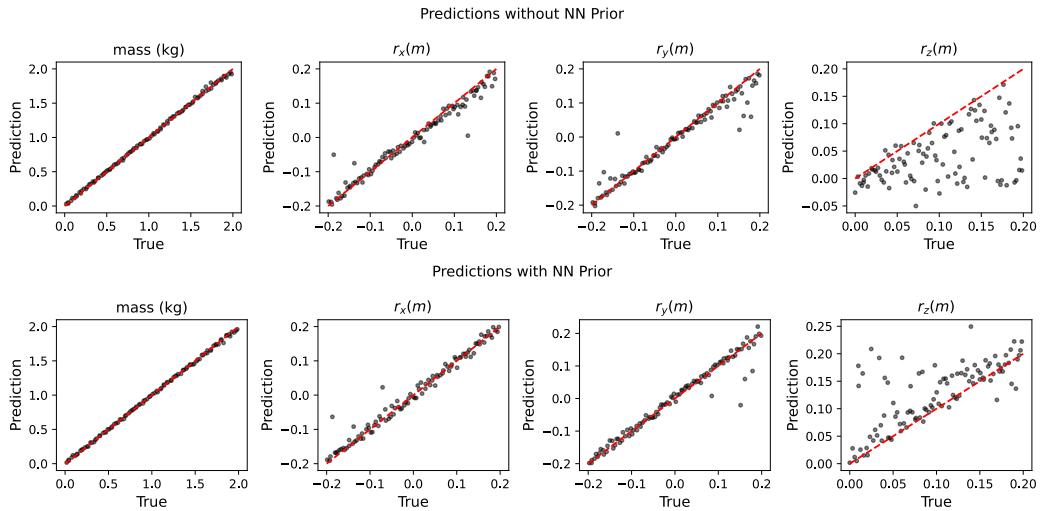
Figure 8 shows the results. The top row (Without NN) shows scattered predictions, especially for the Center of Mass (\(r_z\)). The bottom row (With NN) shows tight alignment along the diagonal red line, indicating high accuracy. The NN effectively “guides” the solver through the non-linear observability issues of the robot’s dynamics.
Static Adaptation
In this experiment, the robot holds a position while a weight is suddenly added.
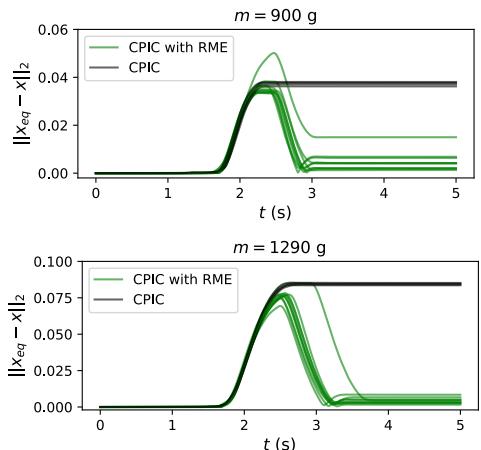
Figure 4 plots the position error over time.
- At \(t \approx 1.75s\), weight is added.
- Black Line (Standard Controller): The error spikes and stays high. The robot sags under the weight.
- Green Line (RME): The error spikes, but within ~400ms, the RME kicks in, estimates the mass, and the robot pulls itself back up to the correct position (error approaches zero).
The visual difference is stark:
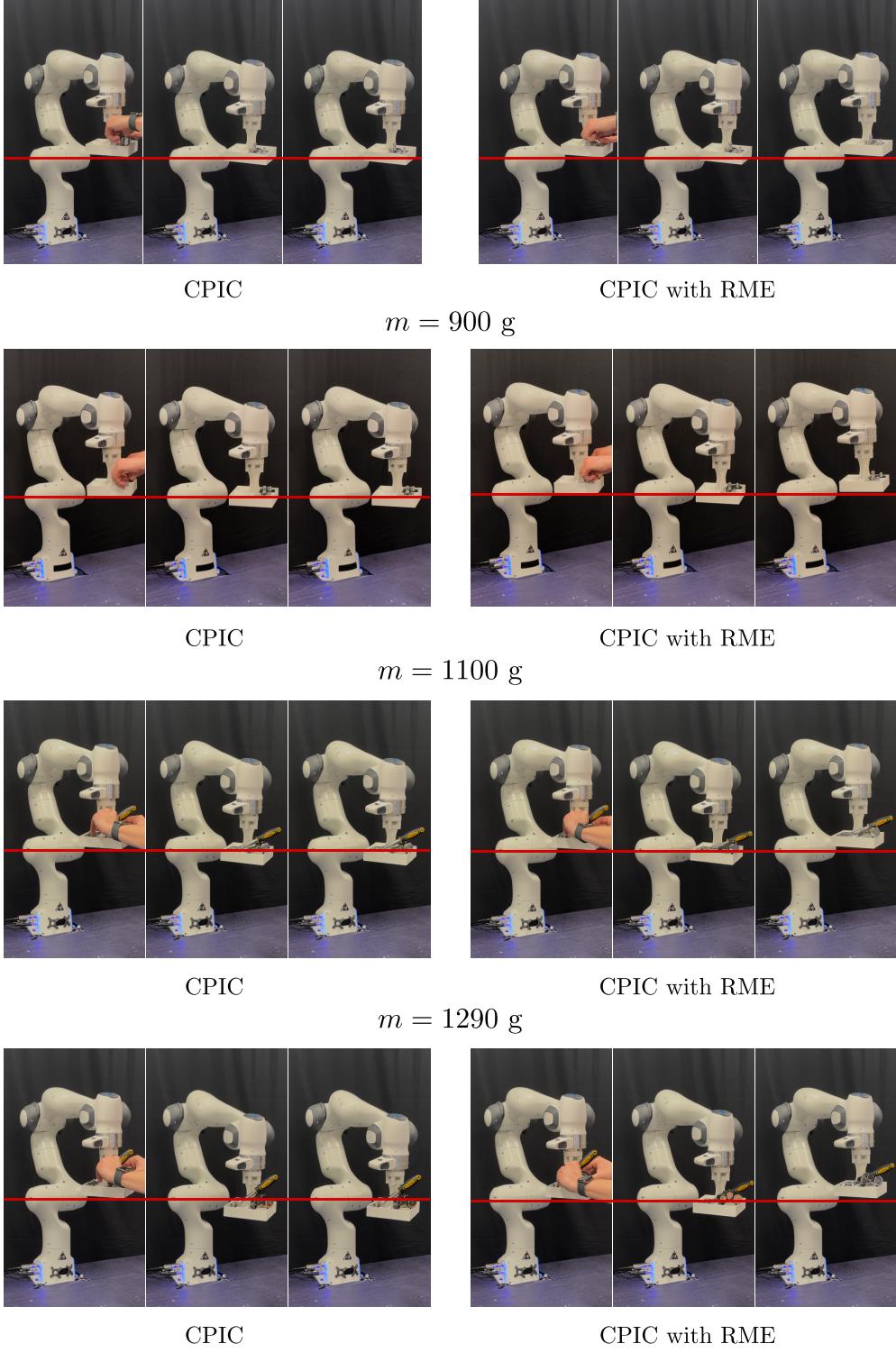
In Figure 12, look at the “CPIC” column (standard control). The robot droops significantly under 1290g of weight. In the “CPIC with RME” column, the robot maintains its posture perfectly.
Dynamic Tracking
It’s one thing to hold a weight still; it’s another to swing it around. The authors tested the robot tracking a “limit cycle” (a circular repetitive motion) while carrying an unknown load.
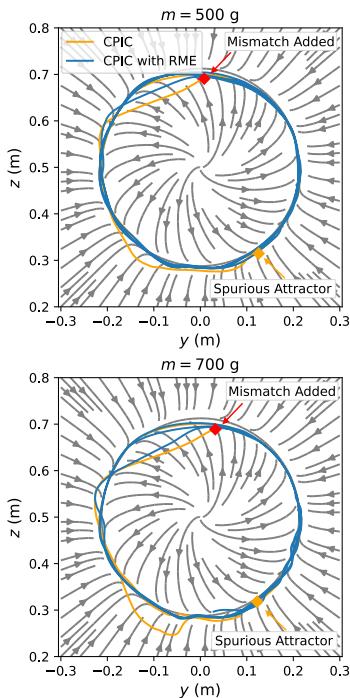
Figure 5 shows the trajectory in the Y-Z plane.
- Orange Line (No RME): The robot gets dragged down by gravity into a “spurious attractor”—it gets stuck in a loop lower than it should be.
- Blue Line (With RME): The robot tightly follows the intended circular path, behaving as if the weight isn’t there.
Human-Robot Collaboration
Perhaps the most impressive demonstration is the continuous adaptation during interaction.
In one experiment (shown in Figure 6), a human places a basket on the robot, adds objects, removes objects, and then removes the basket.
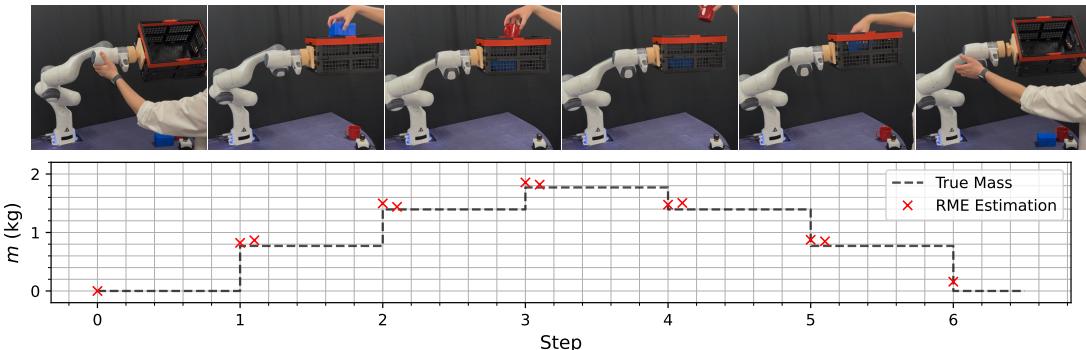
The graph in Figure 6 tracks the true mass (dashed line) vs. the RME estimation (red crosses).
- Step 1: Basket added (0 to 1kg). RME jumps to ~1kg.
- Step 2: Object added (1 to 2kg). RME jumps to ~2kg.
- Step 3: Object removed. RME drops.
The critical takeaway here is that the robot remained passive. Even when the human was touching the robot to add items, the mismatch detector distinguished between “human pushing” and “mass changing,” ensuring the robot didn’t accidentally fight the human.
Another scenario involved the robot receiving a heavy basket (1200g) directly from a human hand and placing it on a box.
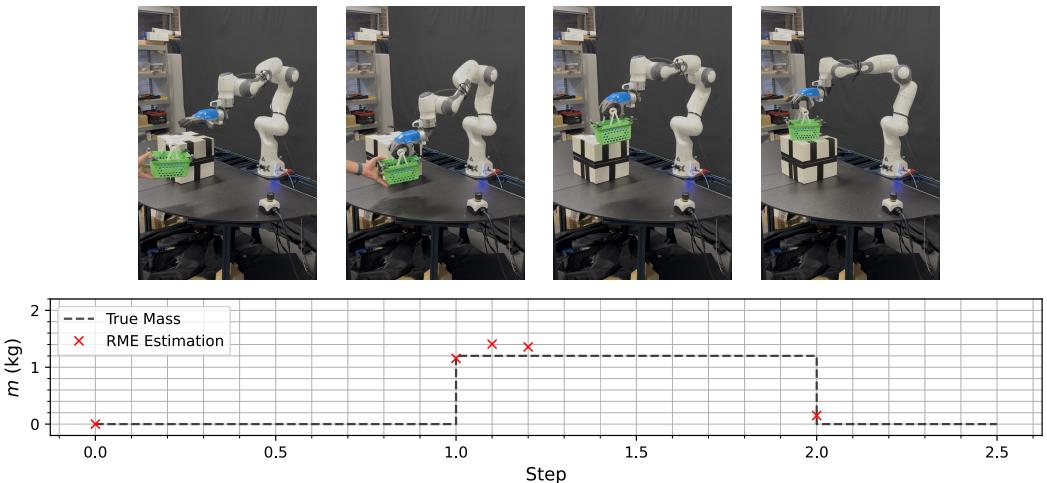
As seen in Figure 10, the robot accepts the heavy load, instantly estimates the 1.2kg mass, and executes the placement task smoothly. Without RME, the robot would likely drop the basket or trigger a safety stop due to the unexpected force.
4. Conclusion
This paper presents a robust solution to a classic robotics problem: handling the unknown. By combining Deep Learning (for pattern recognition and initialization) with Variational Inference (for probabilistic refinement), RME achieves the best of both worlds.
Key Takeaways:
- Speed: The system adapts in ~400ms, which is comparable to human reaction times for similar load changes.
- Hardware Agnostic: It uses standard joint torque sensors found in many collaborative robots, removing the need for fragile external sensors.
- Controller Agnostic: RME generates a model estimate that can be plugged into almost any impedance controller, making it a versatile add-on for existing systems.
The implications for this are significant for domestic robots and warehouse automation. A robot that can pick up a frying pan, a pillow, or a book and immediately “know” how to handle it—without being told the weight beforehand—is a robot that can truly work alongside humans.
While limitations exist (such as distinguishing between a very slow continuous human push and a mass change), the use of probabilistic uncertainty in RME paves the way for even smarter motion planning that knows when it “doesn’t know” something, prompting the robot to explore or ask for help.