](https://deep-paper.org/en/paper/2508.21375/images/cover.png)
In the world of industrial robotics, specifications are often treated as gospel. If a robot manufacturer states that a robotic arm has a maximum payload capacity of 3 kilograms, engineers typically treat 3.01 kilograms as a hard “do not cross” line.
But here is a secret: those numbers are conservative. Extremely conservative.
Manufacturer ratings are typically derived from “worst-case” scenarios—configurations where the robot arm is fully extended, exerting maximum leverage on its joints. However, in vast regions of the robot’s workspace, the mechanical structure is capable of handling significantly more weight. The hardware is over-provisioned to ensure safety, but this leads to inefficiency. If you need to move a 35kg object, you might be forced to buy a massive, expensive 50kg-rated robot, even though a smaller, cheaper 30kg-rated robot could physically handle the task if it moved intelligently.
This brings us to a fascinating new research paper: “Dynamics-Compliant Trajectory Diffusion for Super-Nominal Payload Manipulation.” The researchers propose a novel approach using Diffusion Models to unlock the latent potential of robotic hardware. By learning to generate trajectories that explicitly account for dynamics (forces and torques), they demonstrate that a robot can safely manipulate payloads up to 3 times its nominal capacity.
In this post, we will dive deep into how they achieved this, moving from the physics of manipulation to the architecture of the diffusion model, and finally to the impressive results.
The Problem: The Gap Between Hardware and Software
To understand why this research is significant, we first need to understand the limitations of current motion planning strategies.
When a robot moves from Point A to Point B, it needs a Motion Planner. Most standard planners in industry are geometric. They look at the robot’s kinematics (the lengths of the links and the angles of the joints) to find a path that avoids collisions. They answer the question: “Does this path fit?”
However, they rarely ask: “Can the motors actually support this weight during this movement?”
Traditionally, this is handled by a “plan-and-filter” approach:
- Plan a geometric path.
- Check if the path violates torque limits.
- If it does, scrap it and try again.
When you are operating well within safety limits (e.g., lifting 1kg with a 3kg robot), this works fine. But when you try to lift “super-nominal” payloads (e.g., lifting 6kg with a 3kg robot), the feasible solution space shrinks dramatically. Most random geometric paths will result in torque violations. The planner ends up failing repeatedly, trying to find a needle in a haystack.
Other approaches exist, such as Kinodynamic Planning (which plans in the space of position, velocity, and acceleration) or Trajectory Optimization (using math to minimize forces). However, kinodynamic planning suffers from the “curse of dimensionality”—it becomes exponentially slower as you add degrees of freedom. Optimization methods are powerful but slow and prone to getting stuck in local optima (bad solutions).
The researchers realized that Diffusion Models—the same technology behind image generators like Stable Diffusion—could offer a way out.
The Solution: Payload-Conditioned Diffusion
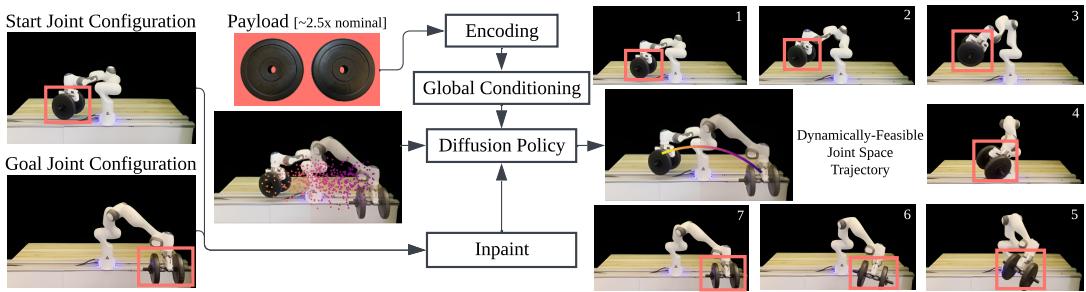
The core idea is to train a generative model that learns the distribution of successful, dynamically feasible trajectories. Instead of searching for a path from scratch every time (like a traditional planner), the model learns to “hallucinate” a valid path based on the start position, goal position, and the mass of the object being lifted.
1. Creating the Expert Dataset
Diffusion models require data. To teach a model how to lift heavy objects, you first need a massive dataset of valid examples. But as we discussed, finding these examples is hard!
The authors used a “Plan-and-Filter” pipeline to brute-force the generation of training data. They used cuRobo, a GPU-accelerated trajectory optimizer, to generate thousands of potential paths.
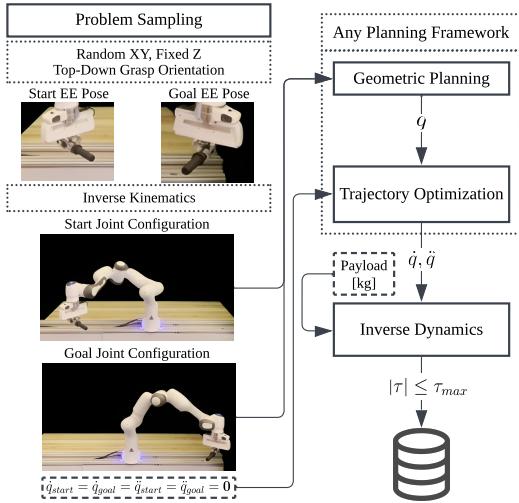
As shown in Figure 2, the process works as follows:
- Problem Sampling: Random start and goal positions are selected.
- Geometric Planning: A path is generated (\(q\)).
- Trajectory Optimization: The path is time-parameterized to determine velocities (\(\dot{q}\)) and accelerations (\(\ddot{q}\)).
- Inverse Dynamics: This is the critical step. They feed the trajectory into a rigorous dynamics model to calculate the required torque (\(\tau\)) at every joint.
The dynamics of a robot arm are governed by the manipulator equation:

Here, \(\tau\) represents torque. To be a valid data point, the calculated torque must be less than the robot’s hardware maximum (\(\tau_{max}\)). By running this simulation millions of times, they curated a dataset of 25,000 feasible trajectories, each labeled with the maximum payload mass it could support.
This dataset contains the “wisdom” of physics. It implicitly captures techniques like keeping a heavy load close to the body to reduce the moment arm, or swinging an object to use momentum (inertia) to assist the lift.
2. The Diffusion Policy Architecture
With the dataset in hand, the researchers trained a 1D U-Net Diffusion Policy.
If you are familiar with image diffusion, you know the process involves taking an image, adding noise until it’s static, and then training a network to reverse that process. Here, the “image” is a trajectory.
A trajectory is defined not just by joint positions, but by the full state:
\[ \pi = [q, \dot{q}, \ddot{q}] \]By predicting positions, velocities, and accelerations simultaneously, the model generates motions that are smooth and consistent with physics.
Global Conditioning: Telling the Robot the Weight
A crucial innovation in this paper is how they inform the model about the payload. A trajectory that works for a 1kg object might cause a motor burnout with a 5kg object. The model must be conditioned on the mass.
![Figure 3: Our model conditions a 1D UNet denoising architecture [6] on various payload embeddings.](/en/paper/2508.21375/images/004.jpg#center)
As visualized in Figure 3, the researchers tested several ways to encode the mass (\(m_i\)) into the network:
- Numeric: Just feeding the number (e.g., “3.5 kg”).
- One-Hot: Discretizing the weight (e.g., bins for 1kg, 2kg, 3kg…) and activating a single neuron.
- Less-Than: Activating all neurons below the weight limit (logic being: if you can carry 5kg, you can carry 4kg).
- Supported-Range: Encoding the full range of weights a specific trajectory could handle.
The embedding is injected into the U-Net using FiLM (Feature-wise Linear Modulation) layers, effectively “steering” the denoising process toward trajectories that are valid for that specific weight.
3. Fast Inference
Once trained, the model (specifically using DDIM, a faster sampling method) can generate a trajectory in constant time—approximately 10 milliseconds.
Compare this to optimization-based methods, which might churn for seconds or minutes trying to converge. The diffusion model doesn’t “search”; it simply samples from the learned distribution of valid physics.
Experimental Results
The team validated their approach on a 7-DoF Franka Emika Panda robot. The results were compelling, particularly when pushing the robot beyond its rated specs.
Which Encoding Worked Best?
Interestingly, the One-Hot encoding performed the best. While intuitive logic might suggest the “Less-Than” encoding (since capability is cumulative), the One-Hot encoding likely allowed the model to cluster specific “strategies” for specific weight classes.
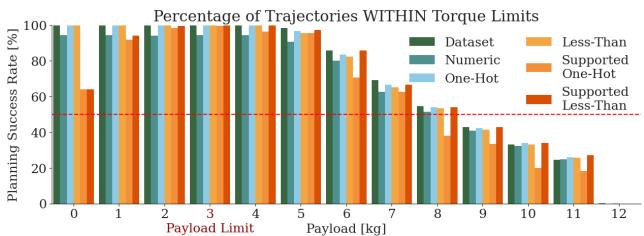
Figure 4 shows the success rates. Notice the drop-off as the payload increases—this is expected, as the physics simply become impossible in many parts of the workspace. However, the diffusion model (colored bars) closely matches the theoretical limit of the dataset (dark green bar), proving it successfully learned the underlying physics distribution.
Comparisons Against Baselines
The true test is comparing the Diffusion approach against traditional planners like Kinodynamic RRT and Trajectory Optimization.
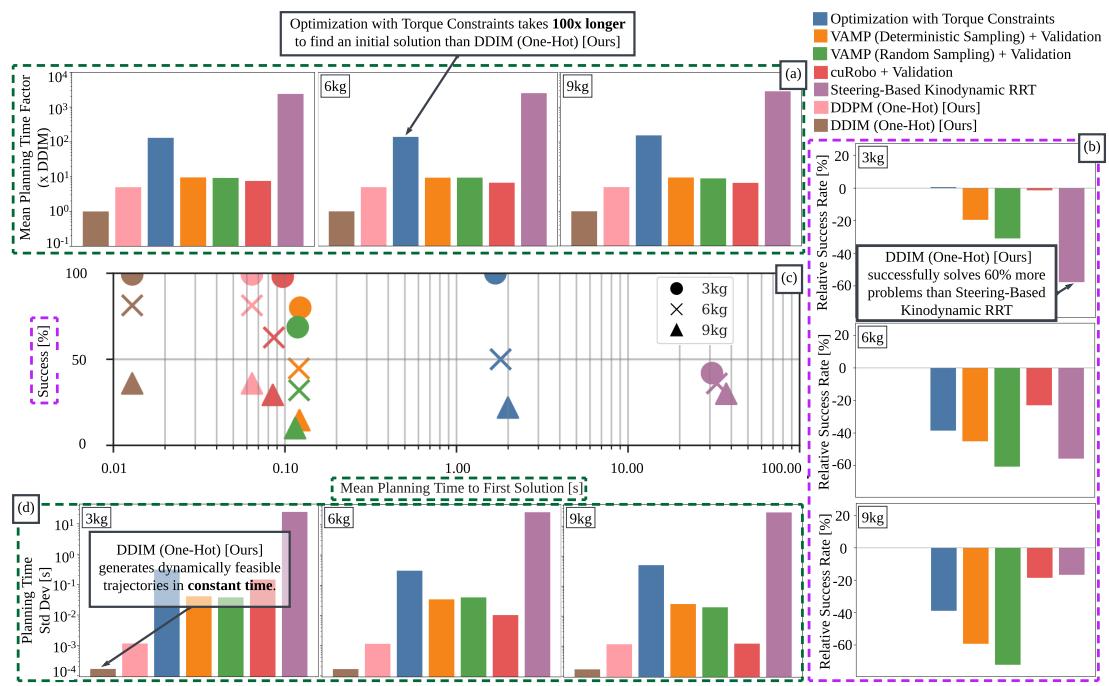
Figure 5 summarizes the dominance of the proposed method:
- Speed (Figure 5a): The Diffusion model (DDIM) is orders of magnitude faster. Optimization methods took ~100x longer.
- Success Rate (Figure 5b & 5c):
- At 3kg (nominal payload), most methods work reasonably well.
- At 6kg (2x nominal) and 9kg (3x nominal), traditional methods collapse. Kinodynamic RRT fails because the search space is too complex. Optimization fails because it relies on good initial seeds.
- The Diffusion model maintains a high success rate because it isn’t searching blindly; it’s recalling valid patterns from training.
Qualitative Analysis: Seeing the Physics
What do these “super-nominal” trajectories look like? They aren’t just standard paths. The robot learns to adopt poses that minimize torque on the weakest joints.
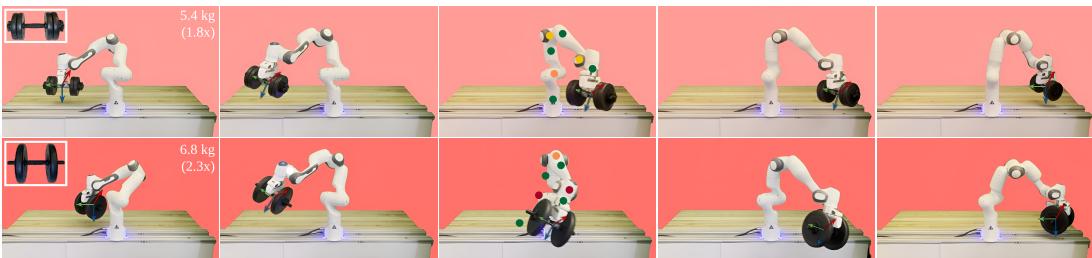
In Figure 6, you can see the robot lifting 6.8kg—more than double its rating. The colored dots represent torque load on the joints.
- Blue/Green: Low torque.
- Red: High torque (near limit).
Notice how the robot keeps the heavy dumbbell close to its base and avoids fully extending the arm horizontally. The diffusion model has learned that extending the arm increases the moment arm (and thus torque), so it generates trajectories that “tuck” the payload during transport.
Why This Matters
This research highlights a shift in how we think about robotic capabilities. We are moving from hardware-defined limits to software-defined capabilities.
- Efficiency: Factories could use smaller, energy-efficient robots for tasks that previously required massive arms, simply by using smarter software.
- Safety vs. Capacity: The “nominal” rating is a safety buffer for “dumb” planning. If the planning becomes “smart” (physics-aware), we can safely eat into that buffer without risking hardware damage.
- Speed: The ability to generate these complex, constrained trajectories in 10ms means this can be run in real-time loops, reacting to changes in the environment.
Conclusion
The paper “Dynamics-Compliant Trajectory Diffusion for Super-Nominal Payload Manipulation” presents a compelling argument for the use of generative AI in classical robotics control. By treating motion planning as a denoising problem conditioned on physics constraints, the authors achieved what traditional planners struggled to do: fast, reliable, and high-capacity manipulation.
They demonstrated that a robot is often stronger than its manual suggests—it just needs a brain that understands its own body dynamics to unlock that strength. As diffusion models continue to permeate robotics, we can expect to see machines that are not only more versatile but also significantly more capable than their hardware specs would have us believe.