](https://deep-paper.org/en/paper/2509.00215/images/cover.png)
Breaking the Cycle of Error: How Decoupled Gradients are Revolutionizing Model-Based RL
In the world of robotics, we are constantly chasing a specific dream: a robot that can learn complex agile behaviors—like parkour or bipedal walking—in minutes rather than days.
Reinforcement Learning (RL) has given us some incredible results, but it comes with a heavy price tag: sample inefficiency. Standard “model-free” algorithms like PPO (Proximal Policy Optimization) act like trial-and-error machines. They try an action, see the result, and nudge their behavior slightly. This works, but it requires millions, sometimes billions, of interactions to converge.
To speed this up, researchers have turned to differentiable simulators. Imagine if the robot knew exactly how the physics worked—mathematically. It could calculate the derivative of the reward with respect to its action and update its policy in one large, precise step (a first-order update) rather than a blind guess. However, building fully differentiable simulators for complex environments with contact physics (like feet hitting the ground) is notoriously difficult.
This brings us to Model-Based RL (MBRL), where the robot learns its own model of the world. It sounds perfect, but it suffers from a fatal flaw: compounding prediction errors. If the robot’s internal model is slightly wrong at step 1, it will be very wrong at step 10. The “imagined” trajectory diverges from reality, and the robot learns a policy for a fantasy world that doesn’t exist.
Today, we are deep-diving into a research paper that proposes a clever solution to this dilemma: Decoupled forward-backward Model-based policy Optimization (DMO).
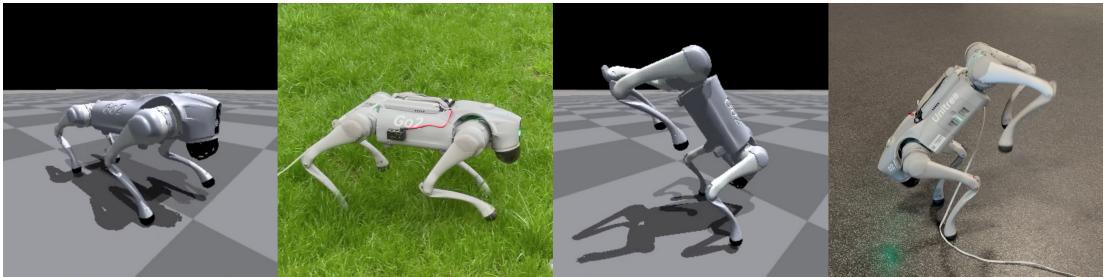
As shown in Figure 1, this method is robust enough to teach a quadruped robot not just to walk, but to perform dynamic maneuvers and even balance on two legs—a feat that requires high-precision control.
The Core Problem: Gradients vs. Reality
To understand DMO, we first need to understand the tension between trajectory generation and gradient computation.
The Objective
In Reinforcement Learning, our goal is to find a policy \(\pi\) that maximizes the expected sum of future rewards. Mathematically, it looks like this:
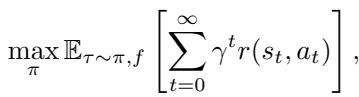
To optimize this efficiently, we want to use gradient ascent. We want to take the derivative of that total return with respect to our policy parameters \(\theta\). This is where things get tricky.

Look at the equation above. To compute the gradient, we need to know how the state \(s\) changes when we change the parameters \(\theta\) (the term \(\frac{ds}{d\theta}\)).
In a standard physics engine, this relationship is often a “black box.” You give it an action, it gives you the next state, but it doesn’t tell you the mathematical slope (derivative) of that transition.
The “Compounding Error” Villain
Traditional First-Order Gradient MBRL (FoG-MBRL) attempts to solve this by learning a neural network, \(\hat{f}\), that approximates the physics engine. The robot uses this learned model to “imagine” a sequence of steps (a rollout):
- Start at \(s_0\).
- Use policy to get \(a_0\).
- Use learned model to predict \(\hat{s}_1\).
- Use policy to get \(a_1\).
- Use learned model to predict \(\hat{s}_2\)… and so on.
The problem is that \(\hat{f}\) is never perfect. The error in \(\hat{s}_1\) feeds into the prediction of \(\hat{s}_2\), amplifying the error. By the time you reach step 20, the predicted state might be physically impossible. If you optimize your policy based on this hallucinated trajectory, your policy fails in the real world.
The Solution: Decoupling Forward and Backward Passes
The authors of DMO propose a surprisingly elegant fix: Don’t use the learned model to generate the trajectory.
Instead, they decouple the process into two distinct phases:
- The Forward Pass (Trajectory Unrolling): Use a high-fidelity simulator (like Isaac Gym or MuJoCo) to generate the trajectory. Even if the simulator isn’t differentiable, it is accurate. This ensures the states \(s_t\) are real, physically valid states.
- The Backward Pass (Gradient Computation): Use the learned differentiable model only to calculate the gradients during backpropagation.
By doing this, DMO ensures that the gradients are calculated locally at valid points in state space, preventing the “drift” that kills traditional model-based methods.
How It Works Mathematically
Let’s break down the gradient calculation. We need to compute how the next state changes with respect to the policy parameters. The chain rule gives us:
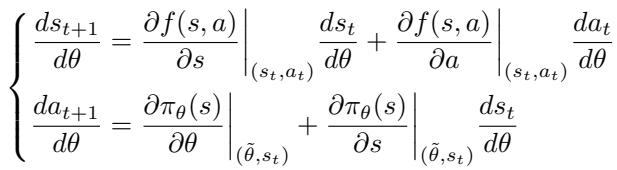
In this equation:
- \(f(s,a)\) is the dynamics function.
- We need the partial derivatives \(\frac{\partial f}{\partial s}\) and \(\frac{\partial f}{\partial a}\).
DMO replaces the true dynamics derivatives with the derivatives of the learned model, \(\hat{f}_\phi\). The learned model is trained to output a distribution over the next state:

This model is trained simply by maximizing the likelihood of observed transitions from the replay buffer:

The “Gradient Swapping” Trick
The implementation of this concept is where the engineering magic happens. In frameworks like PyTorch, the computation graph is built automatically as you run the forward pass. But here, we want the forward pass to use one function (the simulator) and the backward pass to use another (the learned model).
The authors achieve this using a “Gradient Swapping Function.”
- Forward: The algorithm takes the state \(s_t\) and action \(a_t\). It asks the simulator for the true next state, let’s call it \(s_{t+1}^{real}\). It also asks the learned model for the predicted next state, \(s_{t+1}^{pred}\).
- Graph Construction: It discards the value of \(s_{t+1}^{pred}\) but keeps \(s_{t+1}^{real}\). However, it tricks the software into thinking \(s_{t+1}^{real}\) came from the learned model graph.
- Backward: When PyTorch calculates gradients, it looks at the graph. It sees the learned model components and flows the gradients back through \(\hat{f}_\phi\).
This allows us to approximate the gradients as follows:

Specifically, we approximate the simulator’s derivative using the learned model’s derivative, evaluated at the true simulator states:
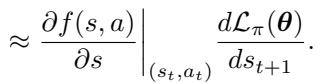
This leads to a clean substitution in the chain rule:
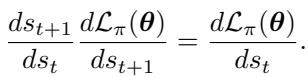
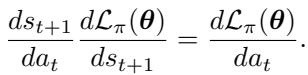
By evaluating the learned model’s derivative at the true state \(s_t\) (provided by the simulator) rather than a predicted state \(\hat{s}_t\) (which would contain errors), the gradient estimate remains accurate and low-variance.
Algorithm Variants: BPTT, SHAC, and SAPO
The DMO framework is flexible. The authors demonstrated its effectiveness by applying it to three different optimization strategies:
DMO-BPTT: This is the simplest version. It truncates the trajectory and calculates the gradient on the sum of rewards. It is lightweight but struggles with long-term horizons or sparse rewards.

DMO-SHAC: This builds on the SHAC algorithm. It adds a learned Value Function (Critic) to the end of the truncated trajectory. This helps the robot account for long-term rewards beyond the short rollout horizon.

DMO-SAPO: Designed for exploration-heavy environments, this version adds entropy regularization (encouraging the robot to try diverse actions) to the objective.

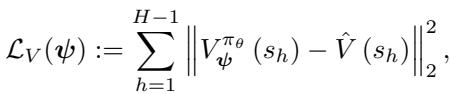
The Critic (Value Function) is trained simultaneously to predict the expected future return, minimizing the error between its prediction and the actual returns:
Experimental Results
The researchers tested DMO across a suite of difficult control tasks using the DFlex simulator and Isaac Gym. The environments included the standard Ant, Hopper, and Cheetah, as well as complex Humanoids and a dexterous Allegro Hand.

Sample Efficiency
The most striking result is DMO’s sample efficiency. In Reinforcement Learning, “sample efficiency” refers to how many data points (simulation steps) the robot needs to learn a good policy.
Take a look at the comparison below:
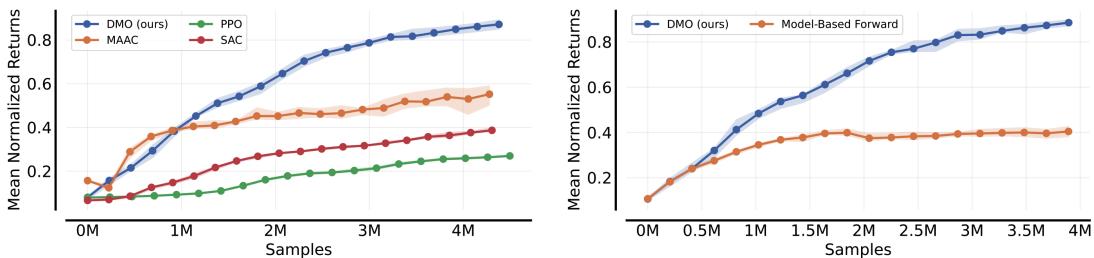
In the Left chart:
- DMO (Blue line): Shoots up almost immediately, solving tasks with under 4 million samples.
- PPO (Green line): A standard model-free baseline. It barely gets off the ground within the same sample budget.
- MAAC (Red line): A traditional model-based method. It performs worse than DMO, likely due to the compounding error issues DMO avoids.
In the Right chart (The Ablation): This is the scientific smoking gun. The “Model-Based Forward” line (Orange) represents the exact same algorithm as DMO, but without the decoupling (using the learned model for the forward pass). The performance gap is massive. This proves that decoupling trajectory generation from gradient estimation is the key factor driving performance.
Wall-Clock Time
Sample efficiency is great, but sometimes complex model-based methods are computationally slow. DMO, however, leverages GPU parallelism efficiently.
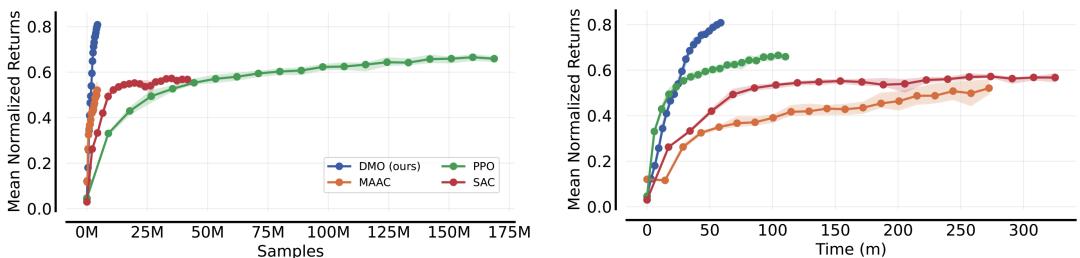
Even when PPO is allowed to train on 40x more data (160M samples vs DMO’s 4M), DMO often reaches higher final returns. Crucially, the right chart shows that DMO (Blue) achieves these results faster in real-world time (minutes) compared to the baselines.
Does the Gradient Approximation Actually Work?
You might wonder: “If we are using a learned model to guess the gradients, aren’t the gradients wrong?”
The authors tested this by comparing the DMO gradients against the true analytical gradients provided by the DFlex differentiable simulator.
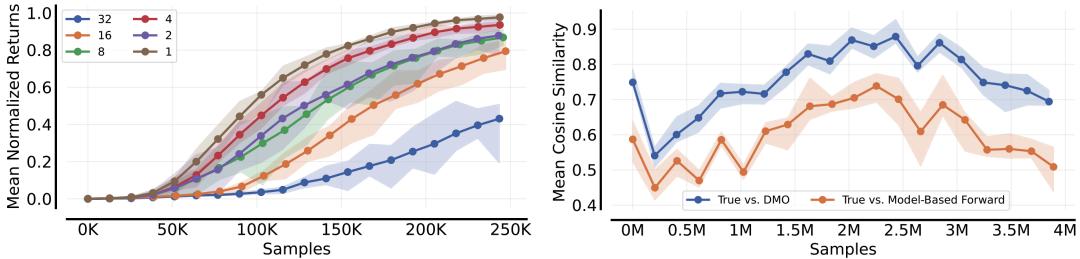
The Right chart shows the “Cosine Similarity,” which measures how closely the DMO gradients point in the same direction as the true gradients.
- The Blue line (True vs. DMO) stays high (above 0.7), indicating the approximation is very accurate.
- The Orange line shows what happens if you use the learned model for the forward pass. The similarity drops significantly, proving that valid state trajectories are essential for accurate gradient estimation.
Real-World Deployment: The Go2 Robot
Simulation results are encouraging, but the real test of a robotics paper is hardware deployment. The authors deployed DMO-trained policies on a Unitree Go2 quadruped.
They tackled two distinct challenges:
- Quadrupedal Walking: A standard locomotion task.
- Bipedal Balancing: A much harder task where the robot must rear up on its hind legs and balance.
Because the real robot (and the Isaac Gym simulator used for it) is not differentiable, methods like SHAC cannot be applied directly. However, DMO works perfectly here because it only requires the simulator to output states, not gradients.
The results were impressive. The robot successfully transferred the agile behaviors from simulation to reality.
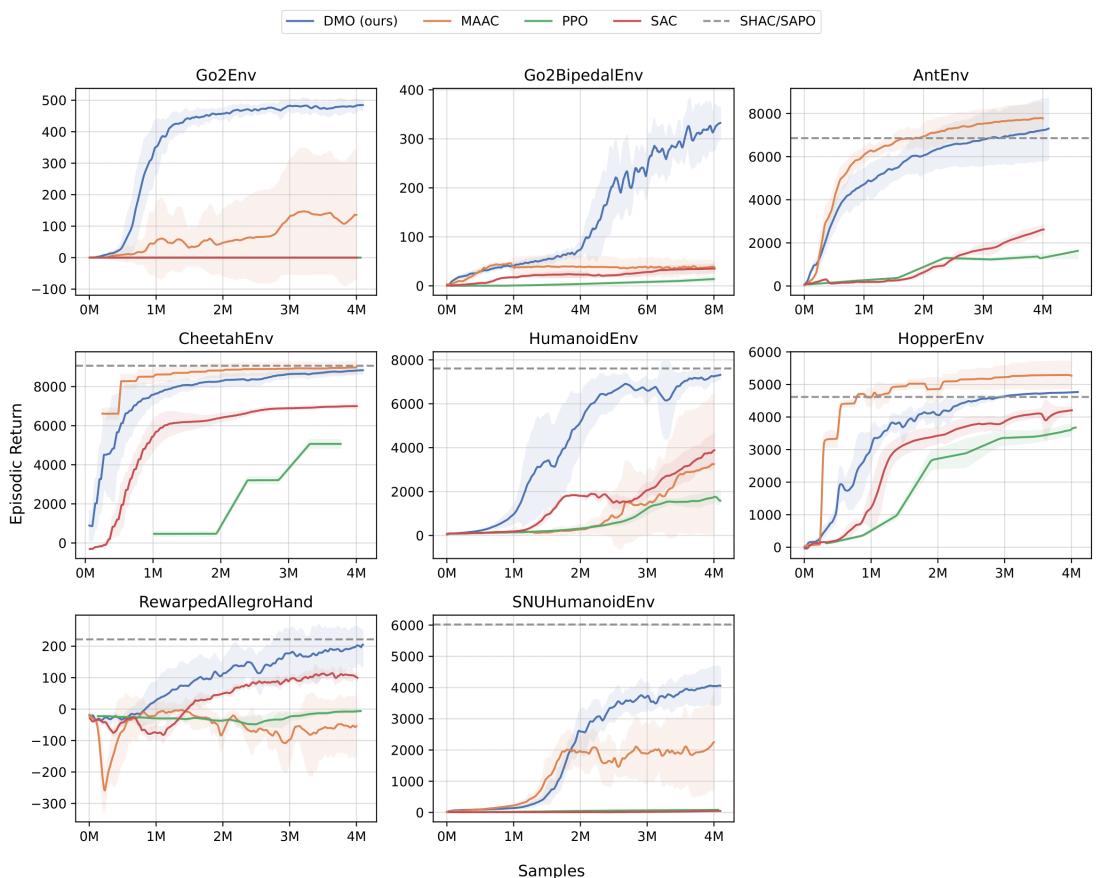
In the figure above, looking at the “Go2Env” and “Go2BipedalEnv” plots, DMO (Blue) demonstrates strong learning curves, solving tasks that PPO struggled with efficiently.
Conclusion and Implications
The DMO paper presents a compelling argument for hybrid architectures in Reinforcement Learning. By combining the best part of simulators (accurate physics integration) with the best part of neural networks (differentiable optimization), we can break the trade-off between sample efficiency and stability.
Here are the key takeaways for students and practitioners:
- Decoupling is Powerful: You don’t need a differentiable simulator to perform first-order optimization. You can learn a local derivative model.
- Compounding Errors Matter: In traditional MBRL, small errors accumulate. Resetting the state to the “true” simulator state at every step during the forward pass eliminates this drift.
- Sim-to-Real Viability: DMO makes it feasible to train policies on complex, non-differentiable simulators (which are often better at modeling real-world friction and contact) while still enjoying the speed of gradient-based learning.
This approach paves the way for robots that can learn highly dynamic skills—like parkour or dexterous manipulation—without requiring the weeks of training time that have traditionally held the field back. As simulators become more realistic (and computationally heavier), efficient methods like DMO will be essential to bridge the gap between simulation and the real world.