](https://deep-paper.org/en/paper/2509.00310/images/cover.png)
Imagine teaching a robot to open a kitchen cabinet. You grab the robot’s arm, guide it to the handle, and pull the door open in a distinct arc. The robot records this motion. Great. But what happens if you ask the robot to open a different cabinet, one that is slightly larger, or perhaps positioned at an angle?
For humans, this is trivial. We understand the underlying mechanics: “I need to rotate the door around its hinge.” For robots, however, this is a notorious stumbling block. Most robotic learning algorithms memorize the specific coordinates of your demonstration. If the environment changes, the robot tries to execute the exact same path in absolute space—often leading to it grasping thin air or colliding with the door.
To solve this, a robot needs to understand the “hidden structure” of the task. It needs to know that the motion is defined relative to a specific part of the object (like a hinge or a handle), not the floor.
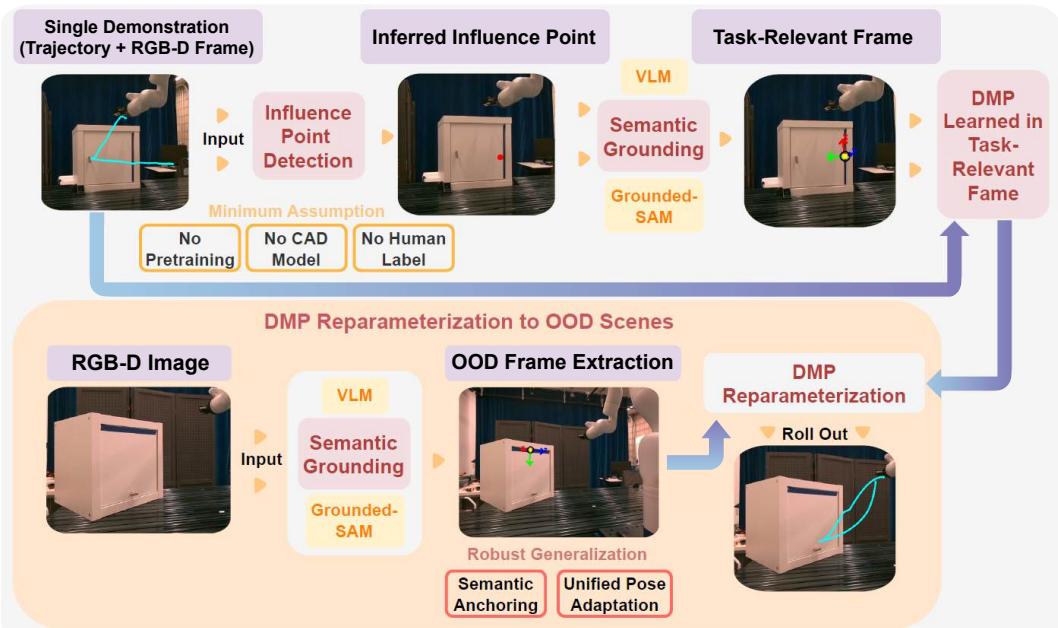
In a recent paper titled “TReF-6: Inferring Task-Relevant Frames from a Single Demonstration for One-Shot Skill Generalization,” researchers from Yale University propose a novel framework that allows robots to extract this hidden structure from just one demonstration. By combining geometric analysis of motion with modern vision-language models, TReF-6 enables robots to generalize skills to new objects and positions instantly.
The Challenge: Generalizing from Limited Data
The core problem here is One-Shot Imitation Learning. We want a robot to learn a task from a single example and apply it to “Out-of-Distribution” (OOD) scenarios—situations the robot hasn’t seen before.
Traditional approaches, such as Dynamic Movement Primitives (DMPs), are excellent at encoding stable trajectories. A DMP essentially acts as a spring-damper system that pulls the robot toward a goal. However, standard DMPs are spatially rigid. If you train a DMP to open a door at position \((x, y)\), it will always try to open a door at \((x, y)\), regardless of where the actual door is.
To fix this, we typically use Task-Relevant Frames. Instead of defining motion relative to the world origin, we define it relative to a local coordinate frame attached to the object (e.g., a frame centered on the door handle). The challenge is: How do we find this frame automatically?
Previous methods required:
- Multiple demonstrations to statistically infer which parts of the scene matter.
- Pre-defined object models (CAD files) to know where handles or hinges are.
- Human labels explicitly telling the robot “this is the hinge.”
TReF-6 (Task-Relevant Frame, 6-DoF) removes these requirements. It infers the frame from the geometry of the trajectory itself.
The Core Intuition: Motion Reveals Structure
The researchers’ key insight is that the shape of a human demonstration reveals the constraints of the task.
Think about opening a door. You don’t pull it in a straight line; you pull it in an arc. Why? Because the door is constrained by a hinge. Even if the hinge isn’t visible, the curvature of your hand’s path points towards it. Similarly, if you are wiping a stain, your hand exerts force against a surface.
TReF-6 operates on the hypothesis that for every task, there is a latent “Influence Point” (\(p\)) in space that governs the motion. If we can find this point mathematically, we can use it as the origin of a new coordinate frame.
Step 1: Influence Point Inference
How do we find this invisible point? The authors define a Directional Consistency Score.
The idea is borrowed from physics. If an object is rotating around a point (like a pendulum), its acceleration vector points toward that center of rotation. Therefore, the algorithm looks for a point \(p\) in 3D space such that the acceleration vectors (\(\ddot{x}_t\)) along the trajectory consistently point toward (or relate to) \(p\).
The score \(\mathcal{S}(p)\) is defined as:
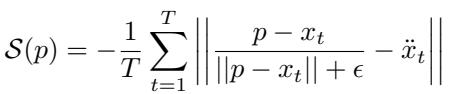
Here is what this equation tells us:
- We iterate through time steps \(t=1\) to \(T\).
- We look at the unit vector pointing from the current trajectory position \(x_t\) to our candidate point \(p\).
- We compare this direction to the actual acceleration \(\ddot{x}_t\).
- We want to minimize the difference (maximize the negative difference).
A higher score means the point \(p\) explains the “pull” of the trajectory well. The researchers found that this specific formulation is robust because it focuses on directional alignment rather than just magnitude, which can vary wildly in human demonstrations.
Solving the Optimization
Finding the optimal point \(p^*\) isn’t straightforward. The “landscape” of this score is non-convex, meaning it has many false peaks (local optima) and flat regions where the algorithm can get stuck.
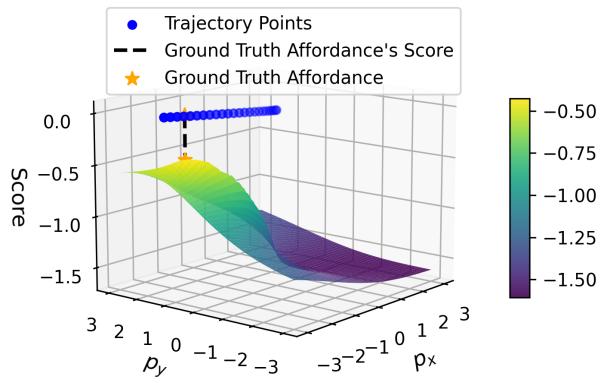
To solve this, the authors use a clever initialization strategy. They don’t start searching randomly. Instead, they look at the moments in the trajectory with the highest acceleration. Why? Because high acceleration usually happens when the constraint is strongest (e.g., the moment you yank the door). They initialize the search near these high-energy points.
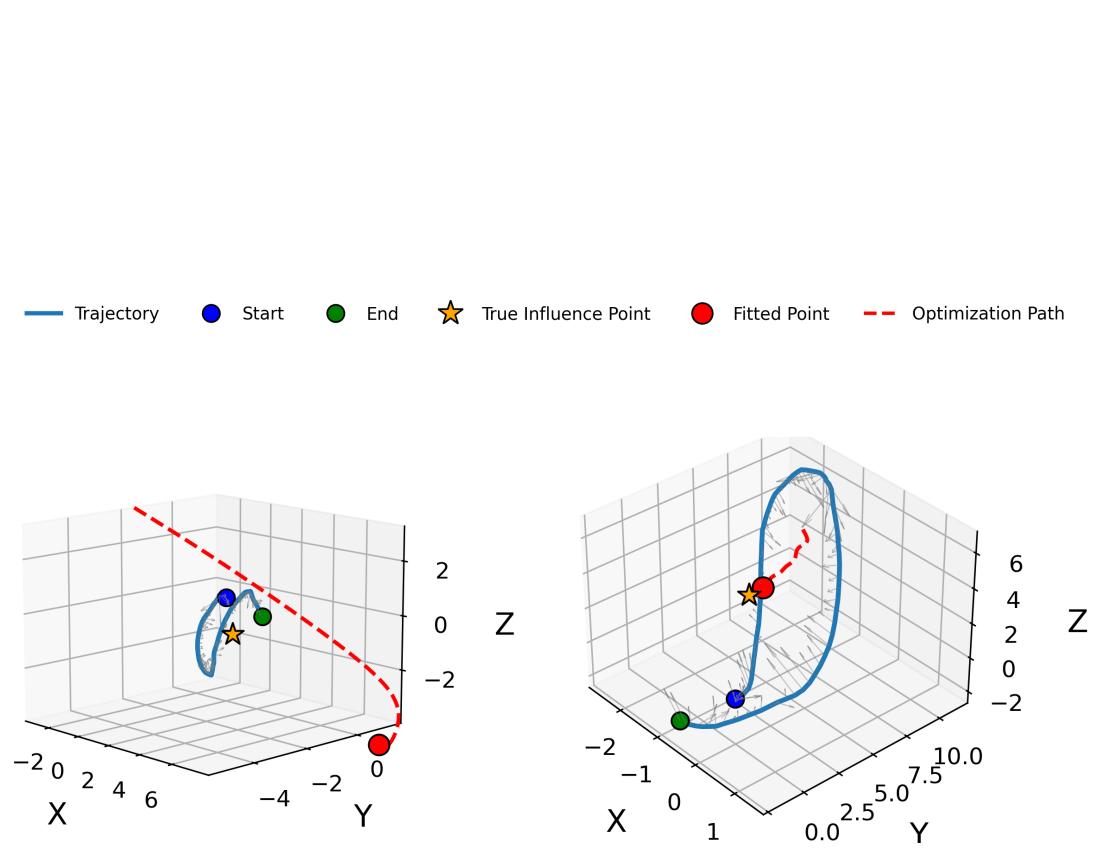
As shown above, structured initialization (Right) allows the optimizer to find the true influence point (yellow star), whereas random initialization (Left) often gets stuck in flat regions.
Step 2: Semantic Grounding
The mathematical optimization gives us a point in 3D space (\(x, y, z\)). However, a raw coordinate isn’t enough. In a new scene, that coordinate might be inside a wall or floating in empty space. We need to anchor this mathematical point to a physical object.
This is where Vision-Language Models (VLMs) come in. TReF-6 uses a two-phase process:
- Task Identification: The system overlays the trajectory on an image of the scene and asks a VLM (like GPT-4o): “What task is happening here?” (e.g., “Opening a cabinet”).
- Feature Localization: It then projects the mathematically inferred Influence Point onto the image and asks: “What specific visual feature is at this location?” (e.g., “The cabinet handle”).
Once the specific feature is identified textually, Grounded-SAM (Segment Anything Model) is used to create a segmentation mask of that object.
Step 3: Extracting the 6-DoF Frame
Now the robot has a specific object part (the handle) identified. To build a full 6-DoF (Degrees of Freedom) frame, we need an origin and orientation (x, y, z axes).
- Origin: The refined influence point on the object surface.
- Z-axis: The surface normal (perpendicular to the object).
- Orientation: Defined by the interaction direction (where the robot grasped the object).
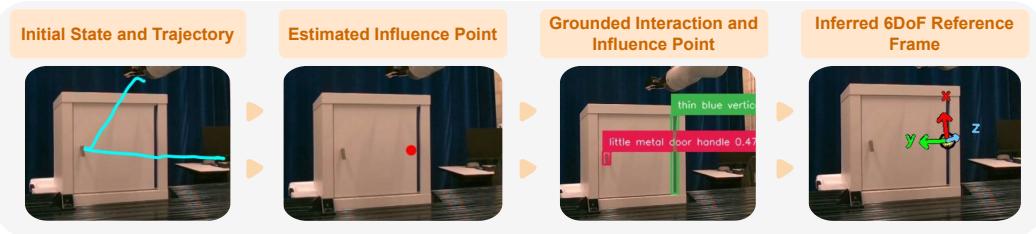
In the figure above, you can see the progression: from raw trajectory, to estimated point, to semantic labeling (“little metal door handle”), and finally the constructed frame axes (\(x, y, z\)).
Step 4: DMP Reparameterization
Finally, the original demonstration is mathematically transformed. Instead of remembering “Move hand to World Coordinates (10, 5, 2),” the robot remembers “Move hand relative to the Influence Frame.”
The trajectory positions (\(x_t\)) and orientations (\(q_t\)) are converted to the local frame:

When the robot encounters a new environment, it repeats the process: it finds the semantic object (using the VLM), establishes the new frame, and executes the learned DMP relative to that new frame.
Experimental Validation
Does this actually work? The researchers tested TReF-6 in both simulation and the real world.
Simulation: Robustness to Noise
Real-world demonstrations are messy. Humans tremble, and sensors have noise. The researchers simulated trajectories with varying levels of noise to see if TReF-6 could still find the correct influence point.
They compared their Directional Consistency Score against other methods, such as Inverse Dynamics Triangulation (a physics-based approach) and Cosine Similarity.
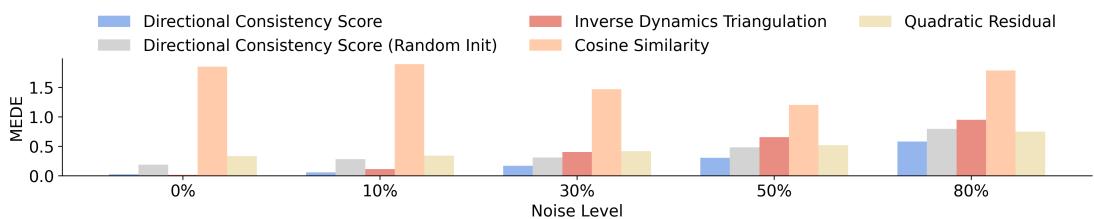
The results (Figure 3) show that TReF-6 (Blue bar) maintains a very low error (MEDE) even as noise increases to 50% or 80%. Other methods, particularly Cosine Similarity (Orange), fail dramatically as soon as the data isn’t perfect. This proves that the TReF-6 optimization objective is uniquely suited for noisy, real-world data.
Real-World Tasks
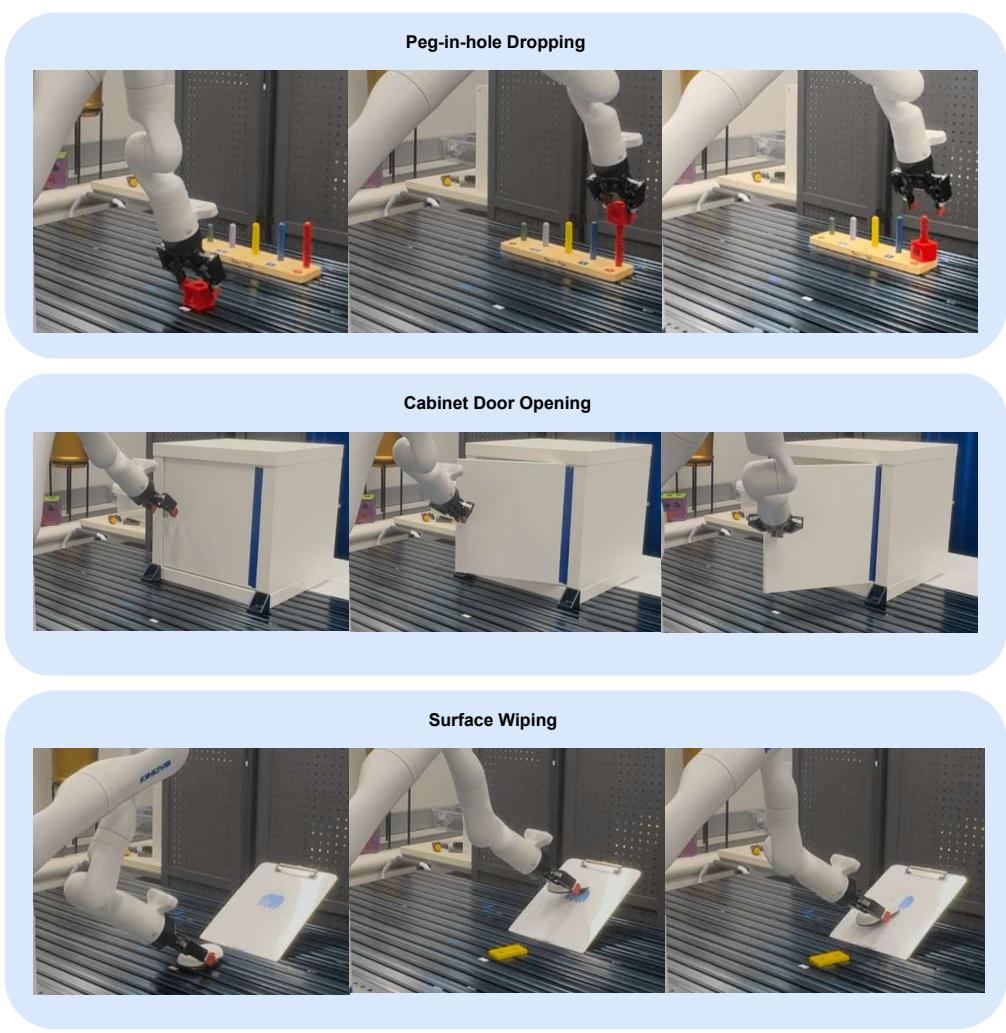
The team deployed the system on a Kinova Gen3 robot for three distinct tasks:
- Peg-in-hole Dropping: Placing a hook onto a rod.
- Cabinet Door Opening: Interacting with a hinged mechanism.
- Surface Wiping: Applying force along a flat surface.
For each task, the robot was given one demonstration. It was then tested on new setups where objects were moved, rotated, or swapped for different colors/shapes.
Results vs. Baseline
The researchers compared TReF-6 against a “Privileged Baseline DMP.” “Privileged” means the baseline was given extra help—it was explicitly told where the objects were (ground truth positions). TReF-6 had to figure it out using only its vision system.
Even with this disadvantage, TReF-6 significantly outperformed the baseline in generalizing the skills.
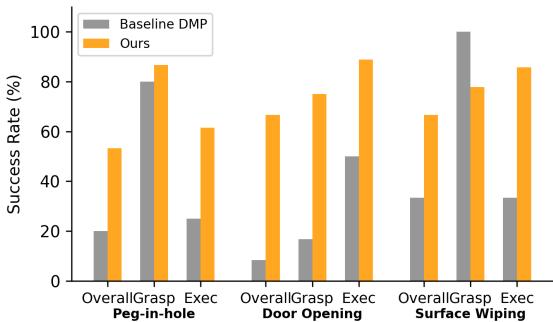
As shown in Figure 4, looking at “Exec” (Execution success), TReF-6 (Orange) dominates the Baseline (Gray).
- Door Opening: The Baseline often failed because it tried to execute a fixed arc. If the door was rotated, the arc didn’t match the hinge, and the gripper slipped or jammed. TReF-6 recognized the door’s orientation and adjusted the arc’s reference frame accordingly.
- Wiping: When the surface was tilted, the Baseline DMP lost contact with the board. TReF-6 detected the new surface normal and tilted the wiping motion to match.
Analyzing Success and Failure
The effectiveness of TReF-6 relies heavily on the “Why.” In the peg-in-hole task, TReF-6 correctly inferred that the motion needed to be relative to the top of the rod.
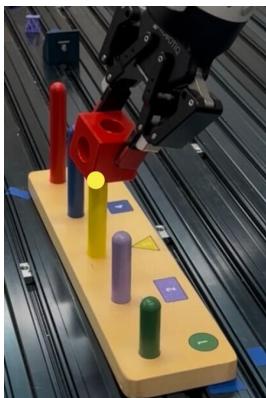
In the image above, the Baseline DMP (b) fails because the new rod is shorter. It moves to the original height, missing the hook. TReF-6 adapts the drop height relative to the detected rod.
However, the system isn’t perfect. It relies on the VLM and depth sensors. If the vision system misinterprets the scene (e.g., due to reflections or extreme angles), the inferred frame will be wrong.
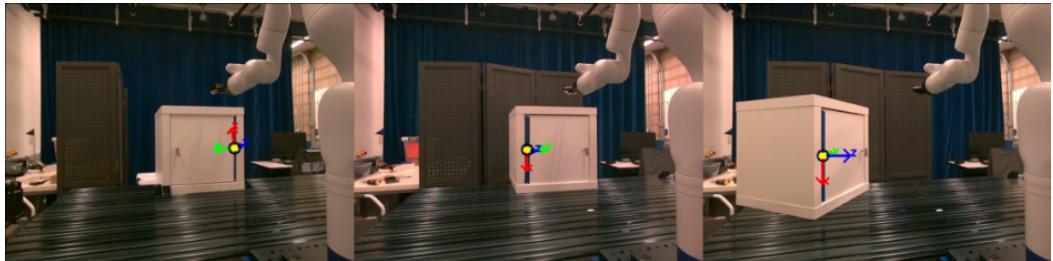
In the failure case above (Right), the depth sensor noise caused the estimated surface normal (Z-axis) to be skewed. Consequently, the robot tried to pull the door open at a weird angle, resulting in failure. This highlights that while the logic of TReF-6 is sound, it is ultimately bound by the quality of the robot’s perception hardware.
Conclusion
TReF-6 represents a significant step forward in One-Shot Imitation Learning. It bridges the gap between low-level motion data and high-level semantic understanding.
By looking at the “physics” of a demonstration (acceleration and curvature), it finds the Geometric Influence Point. By using VLMs, it gives that point Semantic Meaning. This combination allows robots to break free from the rigid coordinates of a single demonstration and understand the intent of the task—whether it’s rotating around a hinge or sliding along a surface.
As vision models continue to improve, frameworks like TReF-6 will become even more reliable, bringing us closer to a future where we can teach a robot a new chore just by showing it once.