](https://deep-paper.org/en/paper/2509.00328/images/cover.png)
Imagine a robot in your kitchen. You ask it to “pick up the apple.” It moves correctly. Now, you ask it to “pick up the apple carefully.” Does the robot actually understand the concept of “carefulness,” or is it just statistically mapping pixels to motor torques?
In the rapidly evolving world of embodied AI, we are seeing the rise of Vision-Language-Action (VLA) models. These are massive neural networks—built on top of Large Language Models (LLMs)—that can see, read, and control robot bodies. Models like OpenVLA and \(\pi_0\) are promising to be generalist agents that can adapt to new tasks “out of the box.”
But there is a catch. These models are opaque black boxes. Unlike classical robotics, where we have explicit mathematical models for kinematics and dynamics, VLAs are giant matrices of floating-point numbers. If a VLA acts unsafely, we often don’t know why, and we don’t know how to fix it without expensive re-training.
In this post, we are diving deep into a fascinating paper titled “Mechanistic Interpretability for Steering Vision-Language-Action Models.” The researchers propose a groundbreaking method to look inside the “brain” of a robot, find the specific neurons responsible for concepts like speed or direction, and manually stimulate them to change the robot’s behavior in real-time.
The Problem: The Ghost in the Machine
The central question this paper addresses is: Do VLA models retain the semantic knowledge they learned during their language pre-training?
VLAs are typically created by taking a pre-trained Vision-Language Model (VLM)—which knows English concepts like “apple,” “fast,” and “up”—and fine-tuning it on robot trajectory data. The model learns to output “action tokens,” which are just specialized tokens that correspond to robot movements.
It would be reasonable to assume that during this fine-tuning process, the model might overwrite its “semantic” neurons to repurpose them for “motor control” neurons. If that were the case, the word “fast” inside the model’s brain would no longer mean speed; it would just be a cluster of numbers useful for moving an actuator.
However, if the semantic meaning is preserved, we could theoretically talk to the robot’s internal layers directly. We wouldn’t need to retrain the model to make it “careful”; we would just need to find the “careful” neuron and turn the volume up.
Background: Mechanistic Interpretability
To understand how the researchers achieved this, we need a quick primer on Mechanistic Interpretability. This field aims to reverse-engineer neural networks to understand the causal mechanisms driving their behavior.
A core concept here is the Linear Representation Hypothesis. This hypothesis suggests that neural networks represent concepts (like “love,” “France,” or “blue”) as directions in their high-dimensional vector space.
The Role of Feed-Forward Networks (FFNs)
Transformer models (the architecture behind GPT, Gemini, and these VLAs) consist of alternating layers of Attention mechanisms and Feed-Forward Networks (FFNs).
While Attention allows the model to route information between tokens, the FFN layers are often viewed as “key-value memories.” They hold the factual and conceptual knowledge of the model.
Mathematically, the FFN layer looks like this:

Here, \(x\) is the input from the previous layer, and \(W_\theta\) is a large parameter matrix. We can rewrite this equation to view the FFN as a weighted sum of specific vectors:
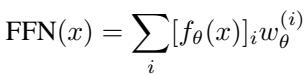
In this view, \(w_\theta^{(i)}\) are fixed value vectors—think of these as “concepts” stored in the model’s memory. The scalar \([f_\theta(x)]_i\) is the activation—how much the current input “triggers” that specific concept.
If we can determine what concept a specific value vector \(w_\theta^{(i)}\) represents, and we control its activation \([f_\theta(x)]_i\), we can effectively steer the model’s “thought process.”
Analysis: Do Robots Dream of Semantic Concepts?
The researchers first had to prove that VLA models actually use these semantic vectors. They analyzed two models: OpenVLA (7 billion parameters) and \(\pi_0\) (3 billion parameters).
They utilized a technique called “logit projection.” Since the FFN value vectors exist in the same mathematical space as the output vocabulary, you can project a vector onto the vocabulary to see which words it “promotes.”
Finding the Concepts
The results were surprising. Even though the VLA models were fine-tuned to output robotic action tokens, the internal FFN layers were still packed with semantic linguistic concepts.
As shown in the table below, specific vectors in the VLM (PaliGemma) clearly encode concepts like “mice and keyboards” or “image-sourcing websites.”
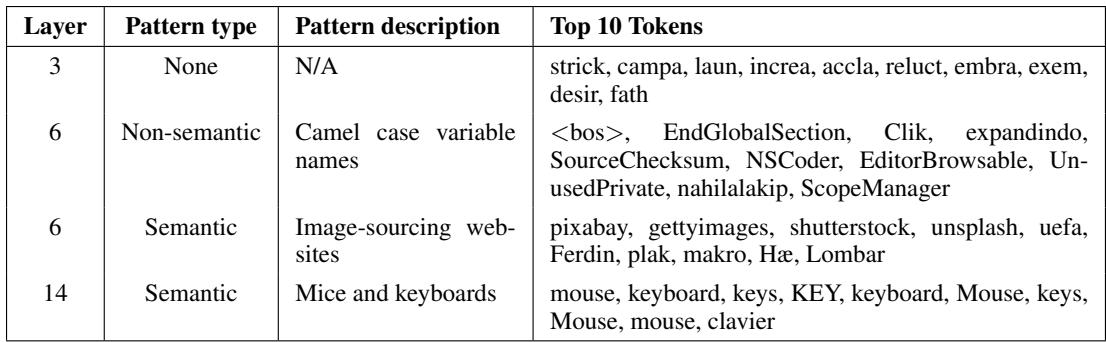
Crucially, this semantic structure survived VLA training. The robot didn’t forget what “fast” or “up” meant. In fact, the researchers found that action tokens (the codes that move the robot) were mixed in with these semantic tokens throughout the model’s layers.
The Impact of Fine-Tuning
The researchers compared a base VLA model (\(\pi_0\)-FAST) against a version fine-tuned on a specific dataset (DROID). They wanted to see how fine-tuning changed the internal brain.
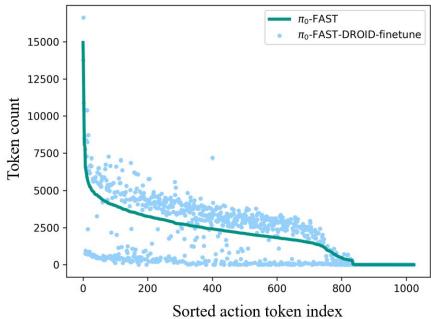
As Figure 3 illustrates, fine-tuning primarily re-wired the action tokens (the control outputs), adjusting their probability distributions to match the specific robot hardware. The semantic backbone remained largely intact. This suggests a powerful conclusion: VLAs reason about control actions by mixing semantic concepts from pre-training with action tokens.
The robot literally “thinks” about the concept of speed when it decides to move quickly.
The Core Method: Activation Steering
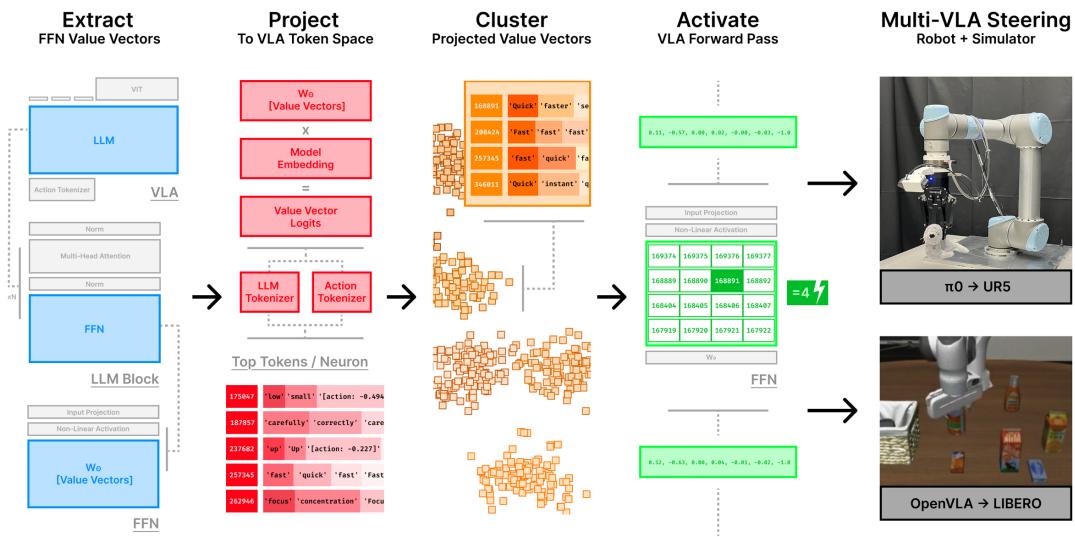
If the concept of “speed” exists inside the model, can we hijack it? The authors introduce a method called Interpretable Activation-Level Steering.
The process works in three steps (refer back to Figure 1 at the top of the post):
- Extract & Project: Take the FFN vectors and project them into the vocabulary space to find out what they mean.
- Cluster: Group vectors that relate to a specific control concept (e.g., cluster all vectors related to “fast,” “quick,” “rapid”).
- Inject: During the robot’s operation, manually override the activation of these specific neurons.
The Mathematics of Steering
Normally, the model calculates its own activations based on what it sees. The researchers intervene by forcing specific activations to a fixed value \(\alpha\).
We define a set of target neurons \(S\) (our “fast” cluster). We then modify the activation function:
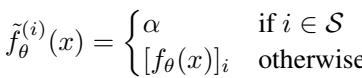
This simple equation says: “If the neuron is in our target cluster \(S\), force its value to \(\alpha\). Otherwise, let the model do its normal thing.”
The new output of the layer becomes:
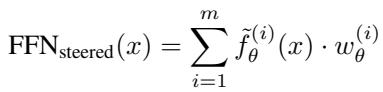
By changing the internal activations, we introduce a “residual shift” that propagates through the rest of the network, biasing the final probability distribution of action tokens toward the behavior we want.
Experiments: Does it Work?
The researchers tested this method in two environments: a simulation benchmark (LIBERO) and a physical robot arm (UR5).
1. Simulation Results (LIBERO)
In the LIBERO simulation, the robot has to perform long-horizon tasks like picking up objects, opening drawers, and placing items.

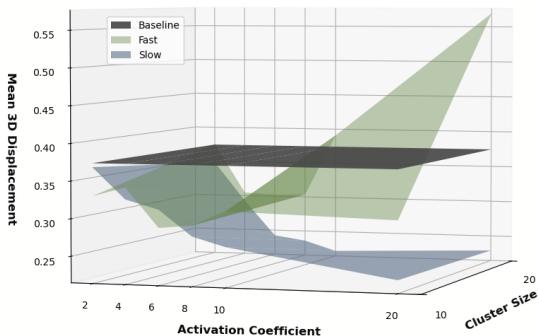
The researchers identified clusters of neurons associated with “Fast” and “Slow.” They then ran the robot through tasks while artificially stimulating these clusters.
The result: Stimulation worked. Activating “Fast” clusters consistently increased the displacement of the robot’s end-effector (hand) per step, while “Slow” clusters reduced it.
They also investigated temporal localization—where in the model (early vs. late layers) should we intervene?
The graph above shows the “Up” concept intervention.
- Early Layers: Intervening here had very little effect (the flat line).
- Late Layers: Intervening here had a significant effect.
- Full Model: Intervening everywhere was strongest.
This suggests that the VLA refines its motion plan into specific semantic directions (like “up”) deeper in the network, closer to the final output.
2. Physical Robot Experiments (UR5)
Simulation is one thing, but hardware is where reality hits. The researchers set up a UR5 robot arm with two cameras (scene and wrist).
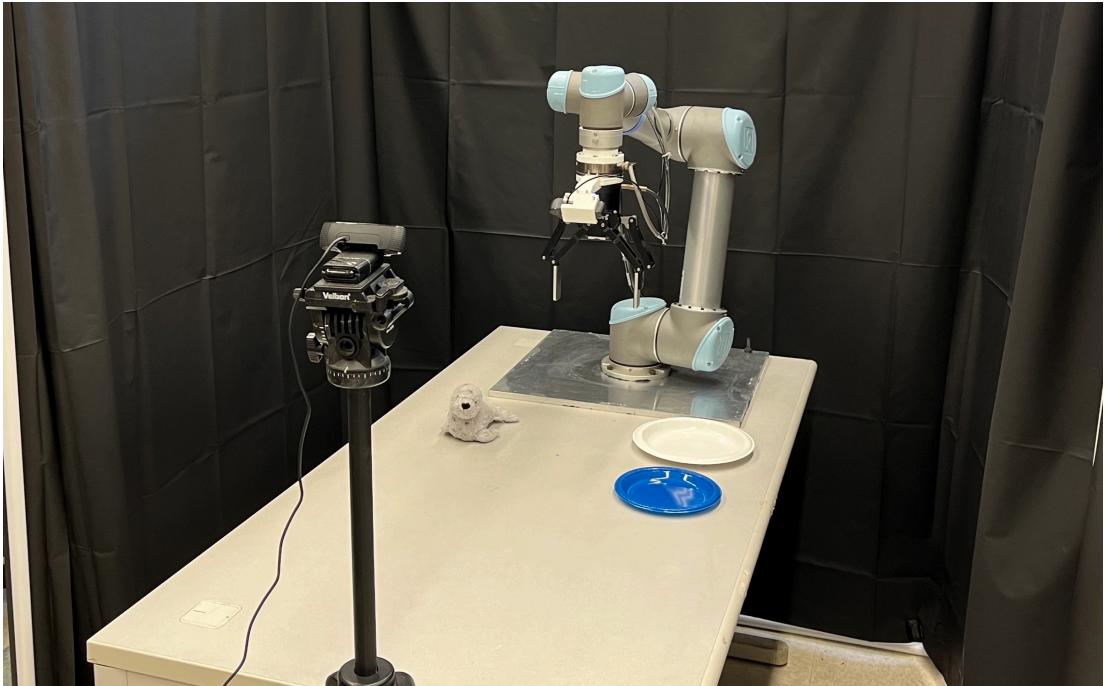
They devised two specific tests to see if they could steer the robot using binary opposites:
- Low vs. High Transport: Can we make the robot lift a penguin toy higher or lower while moving it?
- Slow vs. Fast Transport: Can we make the robot move a seal toy faster or slower?
Crucially, they compared their “Steering” method against a “Prompting” baseline. Usually, if you want a VLA to move fast, you just type “move fast” into the text prompt.
The “Low / High” Experiment
They identified vectors related to “low” and “high” and applied the steering intervention.
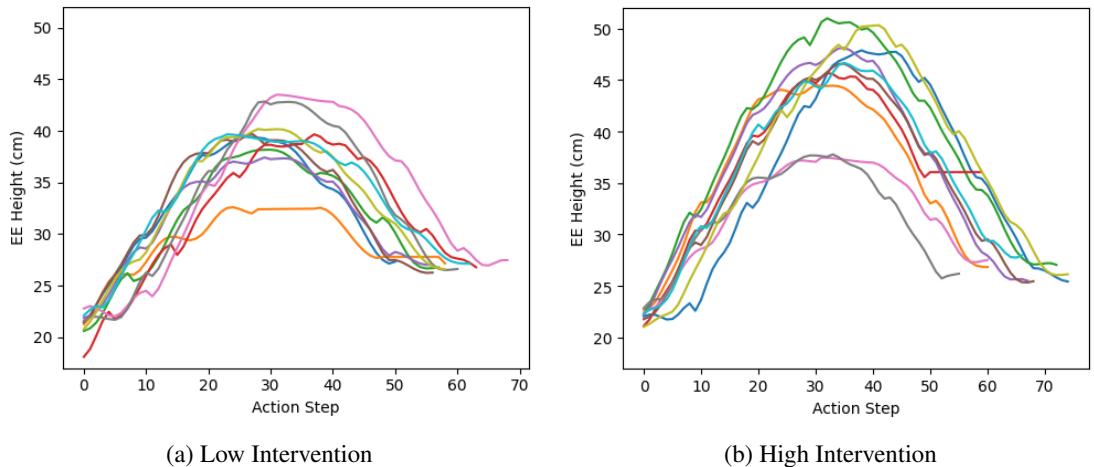
The trajectories in Figure 12 are distinct.
- Graph (a): With the “Low” intervention, the robot’s path (the colored lines) stays lower to the table.
- Graph (b): With the “High” intervention, the robot lifts the object significantly higher (peaking near 50cm) before placing it.
This is a massive result because the robot was not explicitly trained with a “High Mode” or “Low Mode.” The behavior was induced solely by activating the concept of “Highness” inside the neural network.
The “Slow / Fast” Experiment
Next, they tried to modulate speed using “Slow” and “Fast” vectors.
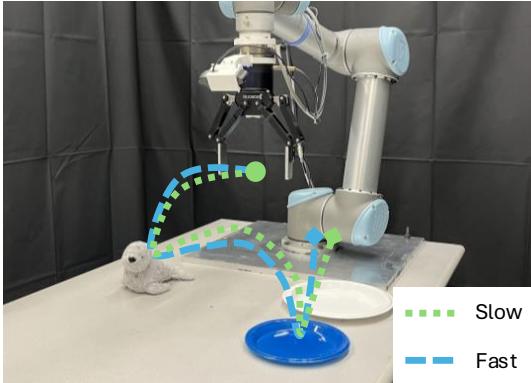
(Note: The image above visualizes the setup, where the green line represents the intended slow path and blue represents fast).
The results were quantified by measuring the displacement of the robot arm at every timestep.
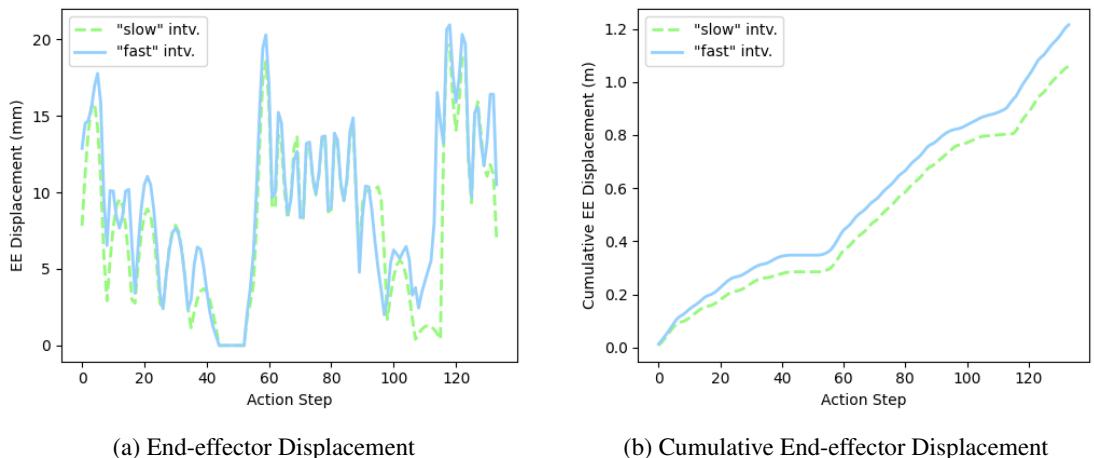
In Graph (b) (Cumulative Displacement), look at the difference between the blue line (Fast intervention) and the green dashed line (Slow intervention). The blue line rises much steeper, meaning the robot is covering distance much faster.
Key Finding: The steering intervention was generally more effective than simply changing the text prompt. Telling the robot “move fast” in the text prompt often had a weaker effect than directly stimulating the “fast” neurons.
Implications and Conclusion
This paper represents a paradigm shift in how we might control and debug generalist robots.
- Zero-Shot Control: We can alter robot behavior (speed, height, carefulness) without needing to collect new data or retrain the model. We just need to find the right buttons to push inside the brain.
- Safety & Transparency: By mapping these semantic circuits, we move away from “black box” dangers. If a robot is acting aggressively, we might be able to detect that the “aggressive” cluster is active and automatically inhibit it.
- The Persistence of Semantics: Scientifically, it proves that even when models are trained to output raw motor actions, they retain the high-level conceptual understanding of the world provided by their language foundation.
The authors acknowledge limitations—identifying the right clusters is tricky, and meanings can shift. However, this work establishes a new toolkit for robotics. Instead of treating the robot’s mind as a mystery, we can start to read it, map it, and steer it.
This blog post explains the research paper “Mechanistic Interpretability for Steering Vision-Language-Action Models” by Bear Häon, Kaylene Stocking, Ian Chuang, and Claire Tomlin from UC Berkeley.