](https://deep-paper.org/en/paper/2509.00361/images/cover.png)
Introduction
When you reach for a coffee mug, you don’t explicitly calculate the inverse kinematics of your elbow and shoulder joints. Instead, you likely visualize the outcome—your hand grasping the handle—and your body intuitively understands how to align your arm to match that mental image. There is a strong sensory coupling between our vision and our body awareness.
In robotics, however, this process is usually far more rigid. Traditional robotic manipulation relies heavily on action-labeled data. This means humans must painstakingly teleoperate robots to demonstrate tasks, recording every joint angle and velocity. While effective, this process is expensive, slow, and hard to scale. If we want generalist robots, we cannot manually teach them every possible movement.
Enter GVF-TAPE (Generative Visual Foresight with Task-Agnostic Pose Estimation). This new framework, proposed by researchers at Southern University of Science and Technology and their collaborators, offers a fascinating alternative. Instead of relying on expensive action labels, GVF-TAPE teaches robots to “imagine” a video of the successful task and then use a separate, general-purpose system to figure out where its arm needs to be to make that video a reality.
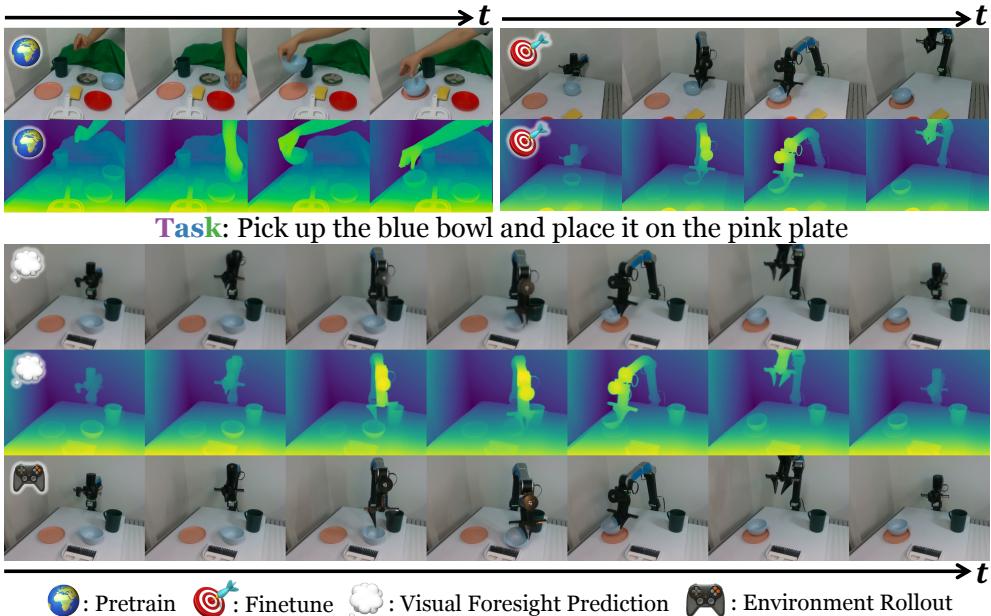
As shown in Figure 1, the system takes a current image and a text instruction (e.g., “Pick up the blue bowl”), generates a video of the future, and extracts the necessary robot poses to execute the task—all without requiring expert demonstration data for the actions.
The Core Problem: The Data Bottleneck
To understand why GVF-TAPE is significant, we need to look at the current state of Imitation Learning (IL). Most state-of-the-art methods, such as Robotic Transformers (RT-1, RT-2), train “Vision-Language-Action” (VLA) models. These models take an image and text as input and directly output motor commands.
The limitation? Data. collecting video data is easy (YouTube is full of it), but collecting robot action data (proprioception aligned with video) is hard. You need physical robots and human operators.
Researchers have tried to bypass this by using Video Prediction models. If a robot can predict what the video should look like, maybe it can figure out the actions. However, previous attempts usually required training an “Inverse Dynamics Model” to map those predicted pixels back to actions. Paradoxically, training that inverse model still typically required action-labeled data.
GVF-TAPE breaks this cycle. It decouples the “what to do” (Visual Foresight) from the “how to move” (Pose Estimation), eliminating the need for task-specific action labels entirely.
The GVF-TAPE Framework
The framework operates in a closed loop, meaning it constantly re-evaluates its surroundings and updates its plan. The process consists of two distinct stages:
- Generative Visual Foresight: A video model predicts the future RGB-D (Color + Depth) frames based on the current view and a text command.
- Task-Agnostic Pose Estimation: A separate model looks at these “imagined” frames and calculates the 6-DoF (Degree of Freedom) pose of the robot’s end-effector.
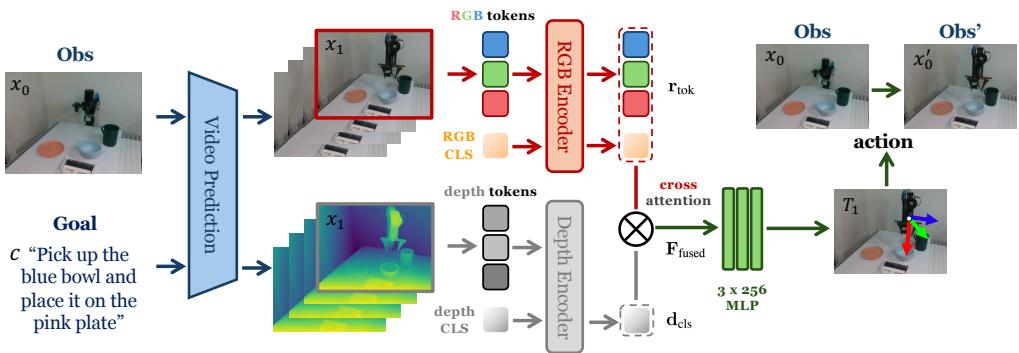
Figure 2 illustrates this pipeline. The robot imagines the future, extracts the coordinates of its own hand in that future, and then uses a standard low-level controller to move there.
Part 1: Text-Conditioned Visual Foresight
The first component is the “planner.” It doesn’t output coordinates; it outputs pixels. Specifically, it predicts a sequence of future frames.
The authors use a Rectified Flow model rather than a standard Diffusion model. While Diffusion models are powerful, they are often slow to sample from, which is bad for real-time robotics. Rectified Flow transforms a noisy sequence toward a clean video prediction by modeling the velocity of the transformation.
The core equation for the flow trajectory is:

Here, \(x^t\) represents the interpolation between pure noise (\(x^1\)) and the clean video (\(x^0\)). The model learns a velocity field \(v_\theta\) to predict the straight path from noise to data. The training objective minimizes the difference between the predicted velocity and the actual direction toward the clean video:

This approach allows the system to generate high-quality video plans in very few inference steps (as few as 3 steps), making it feasible for real-time loops.
Key Innovation: Unlike many video models that only output RGB, GVF-TAPE predicts RGB-D (Color + Depth). It does this implicitly by using a pre-trained depth estimator (like Video Depth Anything) during training. This depth information is crucial for the next step: understanding 3D space.
Part 2: Task-Agnostic Pose Estimation
Once the robot has “dreamed” the video of it picking up a cup, it needs to translate those pixels into coordinates. This is the Task-Agnostic Pose Estimator.
Why “Task-Agnostic”? Because this model doesn’t know about “cups” or “plates.” It only cares about one thing: Where is the robot’s gripper?
Training on Random Exploration
The beauty of this module is its training data. The researchers didn’t use humans. They simply let the robot wave its arm around randomly in the workspace. They recorded the camera feed (RGB), the depth, and the robot’s known proprioception (where the arm actually was).
This creates a dataset of “Image \(\rightarrow\) Pose” pairs. Since the robot generates this data itself, it is practically infinite and free to collect.
Architecture: Fusing RGB and Depth
The model uses a Transformer architecture. It processes the RGB image and the Depth map separately using Vision Transformers (ViT) and then fuses them using a Cross-Attention mechanism.

In this equation, the Query (\(Q\)) comes from the Depth features (\(d_{cls}\)), while the Keys (\(K\)) and Values (\(V\)) come from the RGB features (\(r_{tok}\)). This effectively forces the model to use the depth information to contextualize the visual features, resulting in a fused representation (\(f_{fused}\)) that contains rich 3D spatial awareness.
Finally, the model minimizes the difference between the predicted pose and the actual pose using a Smooth L1 loss:

Experimental Results
The researchers evaluated GVF-TAPE in both the LIBERO simulation benchmark and real-world scenarios.
Simulation Benchmarks (LIBERO)
In the simulation, GVF-TAPE was compared against several state-of-the-art methods. Some of these baselines (like ATM and UniPi) use action-labeled data, while GVF-TAPE uses none.

As Table 1 shows, GVF-TAPE outperforms methods like R3M-finetune and VPT significantly. More impressively, it beats ATM (which uses action data) in the Spatial and Object suites. It struggles slightly in the Goal suite, which the authors attribute to occlusion issues where the gripper blocks the camera view—a known limitation of single-view visual feedback.
The Importance of Pretraining
A major question in robotic learning is data efficiency. How much data do we need? The researchers found that pretraining the visual foresight model on large video datasets (like LIBERO-90) significantly boosted performance.
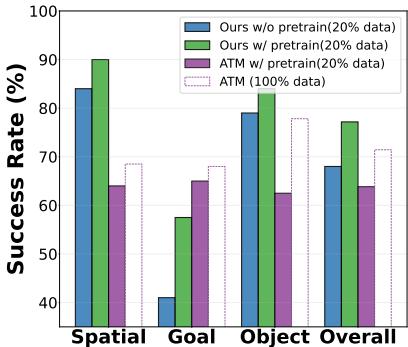
Figure 4 highlights that even with only 20% of the target task data, GVF-TAPE (when pretrained) can outperform fully trained baselines.
Real-World Performance & Robustness
Real-world experiments are the ultimate test. The setup involved an ARX-5 robotic arm and an Intel RealSense camera. The tasks included picking up bowls, putting peppers in baskets, and even folding cloth.
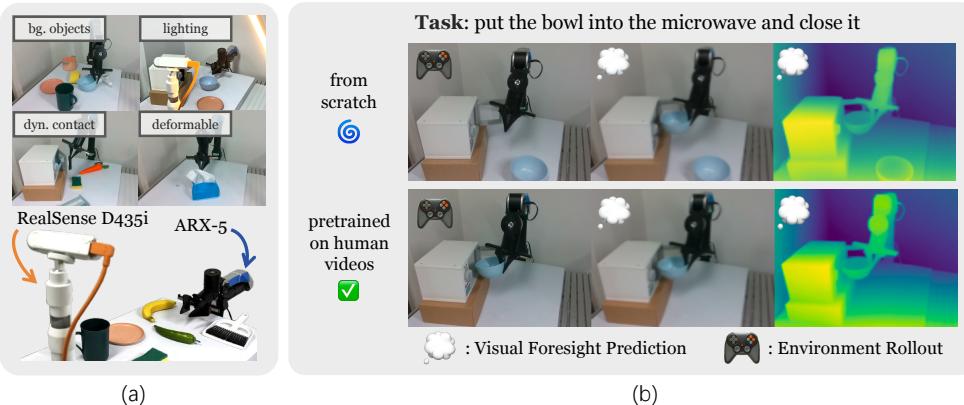
Deformable Objects
One of the most impressive demonstrations involves deformable objects. Robots notoriously struggle with soft items like cloth because their shape changes unpredictably.
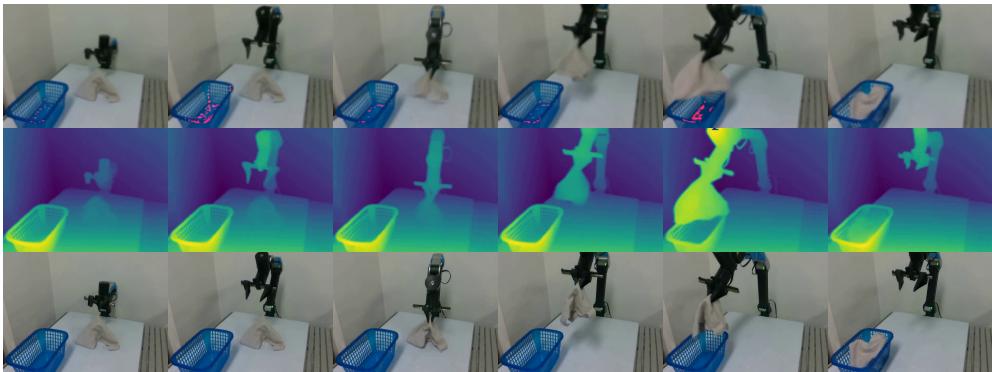
In Figure 22, we see the robot successfully grasping a rag and placing it in a bin. Because the system plans in “video space,” it can visualize the deformation of the rag and guide the gripper accordingly, provided the pose estimator can track the end-effector.
Failure Recovery
A unique advantage of closed-loop visual planning is the ability to correct mistakes. If the robot misses a grasp, the next “imagined” video will likely show the object still sitting on the table, prompting the robot to try again.
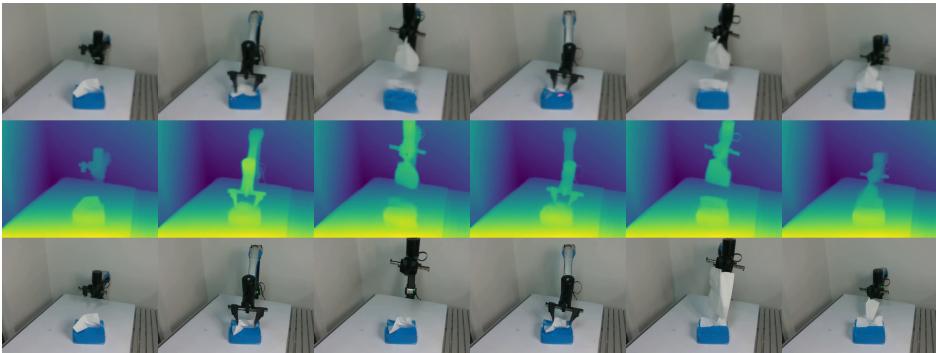
Figure 10 illustrates this perfectly. The robot tries to grab a tissue and fails. The visual foresight model sees the tissue is still in the box and generates a new sequence to grab it again, leading to success on the second attempt.
Why Design Choices Matter: Depth and Diffusion
The paper includes interesting ablation studies justifying their architecture.
1. Why RGB-D (Depth)? Does the robot really need depth perception, or is a 2D image enough? The results are clear.
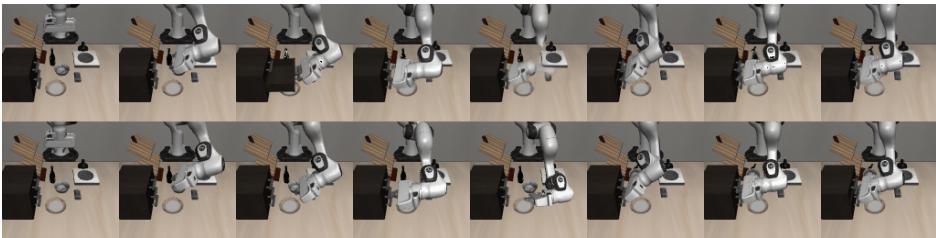
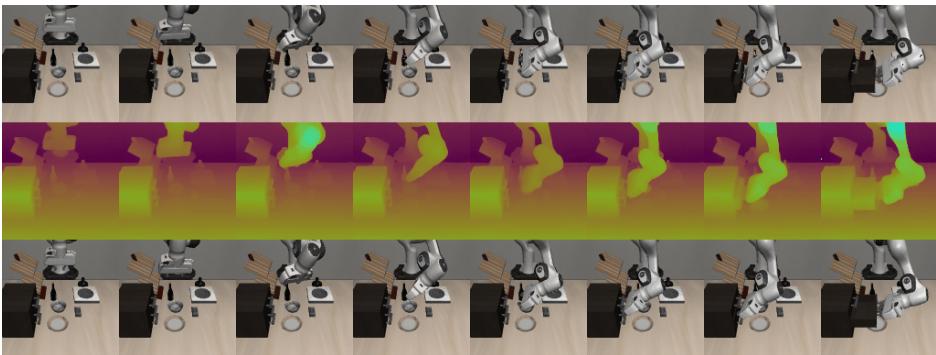
Comparing Figure 12 (No Depth) and Figure 11 (With Depth), we see that without depth information, the robot suffers from “biased spatial pose estimation.” It thinks the handle is closer or further than it actually is, causing it to grasp at thin air. With depth, the cross-attention mechanism aligns the gripper perfectly.
2. Why Rectified Flow? The authors compared Rectified Flow against standard Diffusion (DDIM).
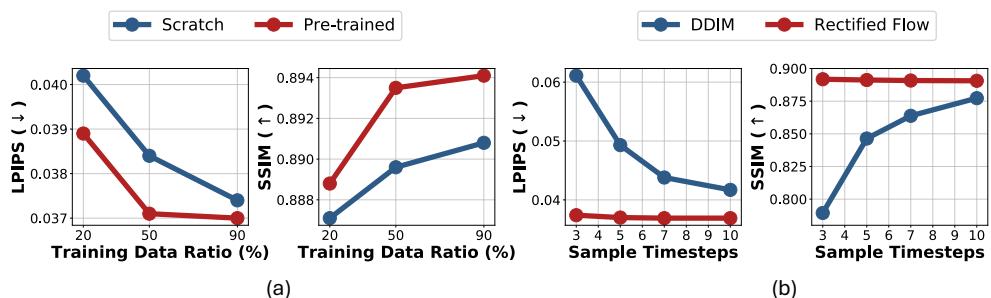
Figure 5(b) shows that Rectified Flow achieves high structural similarity (SSIM) with just 3 sampling steps, whereas DDIM (Diffusion) requires many more steps to reach comparable quality. In a real-time control loop where the robot is waiting for the next command, those milliseconds matter.
Limitations and Challenges
Despite the success, GVF-TAPE isn’t perfect. The reliance on a single camera view creates occlusion problems. If the robot’s arm blocks the camera’s view of the object, the pose estimator loses track of where the gripper is relative to the target.
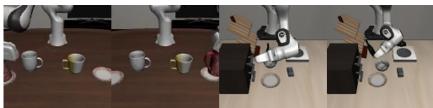
As shown in Figure 3 (note: referenced as Figure 9 in the deck description), scenarios where the end-effector leaves the frame or blocks the object lead to failure. Additionally, the system currently lacks tactile feedback, which limits its ability to perform tasks requiring precise force application.
Conclusion
GVF-TAPE represents a significant step toward scalable robotic learning. By decoupling visual planning from execution and eliminating the need for action labels, it opens the door to training robots on massive datasets of video interactions—potentially even human videos—without the bottleneck of teleoperation.
The combination of Generative Visual Foresight (imagining the future) and Task-Agnostic Pose Estimation (knowing where you are in that future) allows robots to perform complex, dynamic tasks using only their “eyes” and a general understanding of their own body. As video generation models continue to improve in speed and fidelity, frameworks like this may become the standard for how robots interact with the unstructured world.