](https://deep-paper.org/en/paper/2509.01297/images/cover.png)
Introduction
Imagine you are hiking with a heavy backpack. You step onto a patch of ice. Instantly, your brain adapts. It realizes two distinct things: “I am heavier than usual” and “The ground is slippery.” You adjust your stride accordingly.
Now, imagine a robot in the same scenario. Traditional learning methods often struggle to make this distinction. The robot simply realizes “movement is harder,” creating a messy, entangled mental model that mixes the concept of “heavy backpack” with “slippery ground.” If you take that backpack off but keep the robot on the ice, it might fail because its adaptation was tied to the specific combination of both factors.
In the world of machine learning, we call this the problem of entangled representations.
In this article, we are diving deep into a fascinating paper titled “Disentangled Multi-Context Meta-Learning: Unlocking Robust and Generalized Task Learning”. The researchers propose a new framework called DMCM (Disentangled Multi-Context Meta-Learning).
The core idea is elegant: instead of learning one giant adjustment for a new task, the model explicitly learns separate “context vectors” for different factors of variation (like terrain type vs. robot mass). This leads to robots that are remarkably robust and can even handle scenarios they have never seen before by mixing and matching previous experiences—a capability known as zero-shot generalization.
The Background: Why Meta-Learning?
Before we unpack DMCM, we need to understand the foundation it stands on: Meta-Learning, or “learning to learn.”
In standard deep learning, we train a model to solve one specific task. In meta-learning, we train a model to be good at adapting to new tasks quickly. A popular approach is Gradient-Based Meta-Learning (GBML). Algorithms like MAML (Model-Agnostic Meta-Learning) train a neural network’s initial parameters so that, with just a few examples of a new task, the network can adjust its weights to solve it perfectly.
The Evolution: From Weights to Context
Updating all the weights of a massive neural network for every new task is computationally expensive and difficult. A more efficient evolution of this is CAVIA (Fast Context Adaptation via Meta-Learning).
Instead of changing the whole network, CAVIA adds a small “context vector” (a list of numbers) to the input of the network. When the robot encounters a new task, it freezes the main network and only updates this small context vector. Think of it as tuning a few knobs on a radio rather than rebuilding the entire circuit board.
The Problem: The “Black Box” Context
While efficient, standard context adaptation has a flaw. It treats the “context” as a single, unified bucket. If a robot is walking on sand carrying a load, the context vector tries to encode “sand + load” as one unique situation. It doesn’t inherently understand that “sand” is a terrain property and “load” is a robot property.
This leads to two major issues:
- Poor Robustness: If the situation changes slightly (out-of-distribution), the entangled representation fails.
- No Reuse: The robot cannot easily transfer its knowledge of “walking on sand” to a new situation where it isn’t carrying a load.
The Core Method: Disentangled Multi-Context Meta-Learning (DMCM)
This is where DMCM shines. The researchers propose breaking that single context vector into multiple, distinct vectors, each assigned to a specific factor of variation.
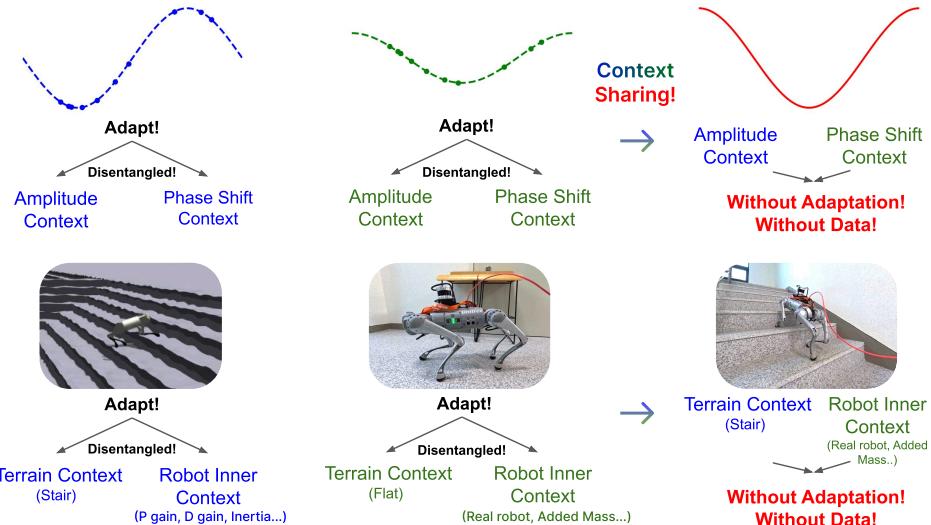
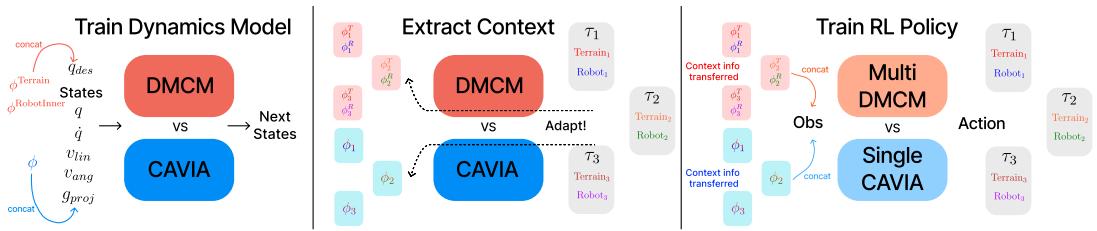
As illustrated in Figure 1, DMCM explicitly separates the “Terrain Context” (is it flat? is it stairs?) from the “Robot Inner Context” (is there a payload? is the motor weak?).
How It Works
The architecture involves a clever training loop designed to force the neural network to keep these factors separate.
1. Structure
Let’s say we have \(K\) factors of variation (e.g., Amplitude and Phase for a sine wave, or Terrain and Mass for a robot). DMCM initializes \(K\) separate context vectors: \(\phi^1, \phi^2, \dots, \phi^K\).
2. The Inner Loop (Selective Adaptation)
In traditional meta-learning, when the model sees a new task, it updates everything. In DMCM, the training data is organized so the model knows which factor is changing.
If the robot moves from grass to concrete (but its mass stays the same), DMCM only updates the context vector associated with terrain. The “mass” context vector remains frozen. This selective update is the key to disentanglement. It forces vector \(\phi^1\) to care only about terrain and \(\phi^2\) to care only about mass.
3. The Outer Loop (Meta-Learning)
Once the specific context vectors are updated, the main network parameters (\(\theta\)) are updated to ensure they work well with these disentangled vectors.
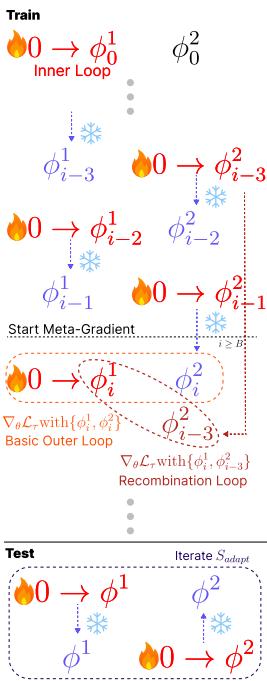
Figure 2 visualizes this flow. Notice the two distinct loops. There is a Basic Outer Loop which trains the model normally, but there is also a Recombination Loop.
The Recombination Loop: The Secret Sauce
This is perhaps the most innovative part of the paper. To ensure the context vectors are truly independent, the researchers introduce a “Recombination Loop.”
During training, the system effectively tells the model: “I am going to take a Terrain Context you learned in Task A, and a Robot Context you learned in Task B. I will combine them and ask you to solve Task C, which has the terrain of A and the robot properties of B.”
Because the model never saw Task C during the inner loop adaptation, it must learn to rely on the composition of the two contexts. This enforces zero-shot generalization—the ability to handle new combinations of known factors without any new training data.
Experiment 1: The Sine Wave Benchmark
To prove the math works, the authors started with the “Hello World” of meta-learning: Sinusoidal Regression. The goal is to predict the shape of a sine wave where the Amplitude and Phase change.
In this setup, DMCM uses two context vectors: one for amplitude and one for phase.
Robustness to Missing Data
The researchers tested “Out-of-Distribution” (OOD) robustness by intentionally deleting specific combinations of amplitude and phase from the training data (e.g., the model never sees high-amplitude waves with a specific phase shift).
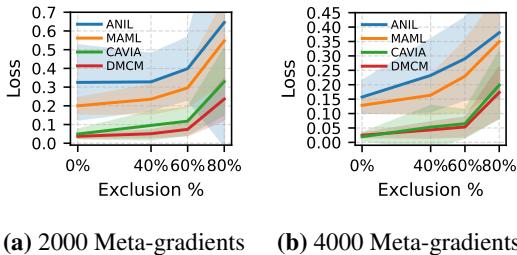
As shown in the charts above, as the data becomes more sparse (exclusion percentage increases), traditional methods (Green/Blue/Orange lines) start failing. DMCM (Red line) maintains a low error rate. Because it learned “Amplitude” and “Phase” separately, it can handle a combination it hasn’t seen before, provided it has seen that specific amplitude and that specific phase separately elsewhere.
Zero-Shot Prediction
The most visually striking result is the zero-shot prediction. The model was given an amplitude context from one task and a phase context from another. Without any gradient updates (adaptation) for the combined task, it was asked to draw the wave.
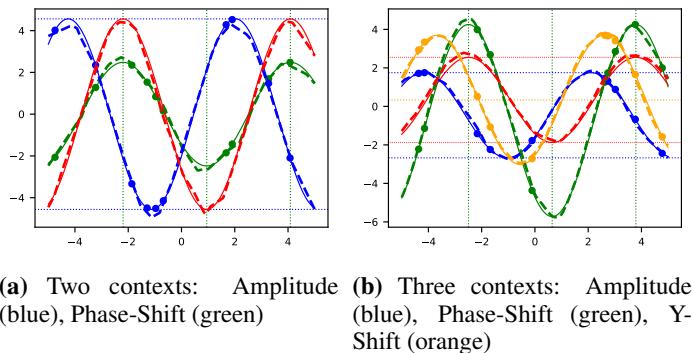
The red dotted line in the image above represents the DMCM prediction. It aligns almost perfectly with the ground truth. This confirms the model isn’t just memorizing tasks; it is understanding the underlying physics of the wave components.
Experiment 2: Quadruped Robot Locomotion
While sine waves are theoretically interesting, the real test is robotics. The researchers applied DMCM to a Unitree Go1 quadruped robot.
The Goal: Train a robot to walk over complex terrains (stairs, slopes, wavy ground) even when its physical properties change (carrying a heavy payload, weaker motors).
The Architecture:
- Dynamics Model: First, they used DMCM to learn a model of the physics. The model predicts the next state of the robot given the current state and action.
- RL Policy: They then used the learned context vectors from the dynamics model as inputs to a Reinforcement Learning (RL) policy that controls the robot.
Disentanglement in Simulation
The researchers analyzed whether the model actually separated the factors. They took terrain contexts and robot contexts from different datasets and checked the prediction error.
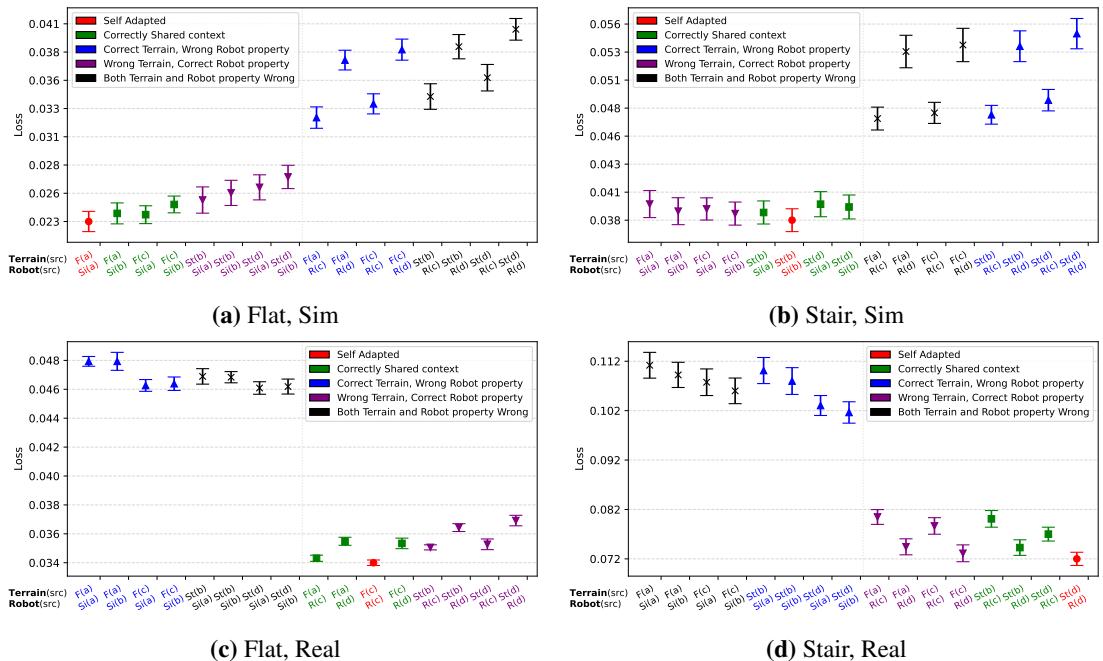
The results (above) are telling. The Green points represent the Recombination strategy (using terrain info from one place and robot info from another). The error is very low, comparable to the Red points (where the model adapted to that exact specific task). This proves the robot can “download” a terrain understanding from a simulation and combine it with a “body understanding” from the real world.
The “Sim-to-Real” Transfer Magic
The most impressive result is the real-world deployment.
The Challenge: The robot needs to climb stairs. The Constraint: We do not have data of this robot carrying this specific payload climbing stairs. The Data We Do Have:
- Simulation data of climbing stairs (but the simulation physics aren’t perfect).
- Real-world data of the robot walking on flat ground with the payload.
Standard methods would fail here. They need data of the robot on the stairs to adapt.
The DMCM Solution:
- Extract the Terrain Context from the simulation (Stairs).
- Extract the Robot Context from the real-world flat ground data (Payload + Real Dynamics).
- Combine them.
Result? The robot climbs the stairs successfully.
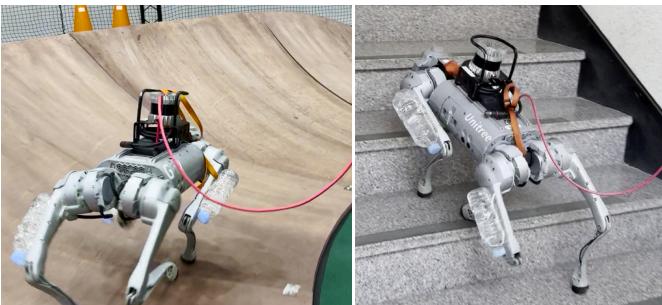
By combining the “Stair” concept from the simulator and the “Heavy Robot” concept from a simple 20-second walk on flat ground, DMCM allowed the robot to tackle a task it had never physically practiced.
Conclusion & Implications
The Disentangled Multi-Context Meta-Learning (DMCM) framework represents a significant step forward in making robots more general and robust. By forcing the AI to separate different factors of variation—like distinguishing between the ground being rough and the backpack being heavy—we gain two massive advantages:
- Robustness: The robot isn’t confused by out-of-distribution combinations of factors.
- Reusability: We can stitch together knowledge from different sources (Simulation + Real World) to solve problems that would otherwise require dangerous or expensive training.
This paper moves us closer to “interpretable” meta-learning, where we don’t just know that the robot adapted, but what it adapted to. As we push for robots that can operate in the messy, unpredictable real world, this ability to divide and conquer complexity will be essential.