](https://deep-paper.org/en/paper/2509.06233/images/cover.png)
Imagine you are teaching a robot to pour tea. To you, this action is intuitive. You pick up the teapot by the handle (not the spout) and tilt it over the opening of the cup (not the bottom). This intuition is based on “affordance”—the properties of an object that define how it can be used.
For years, computer vision research has focused heavily on single-object affordance—identifying that a handle is for holding. But the real world is rarely about isolated objects. Most meaningful tasks involve object-to-object (O2O) interactions: a knife cutting an apple, a hammer hitting a button, or a plug inserting into a socket.
The challenge? Teaching a robot these pairwise interactions usually requires massive datasets of annotated examples, which are incredibly tedious to create.
In this post, we are diving deep into \(O^3\)Afford, a fascinating research paper that proposes a solution to this data bottleneck. The researchers have developed a framework that allows robots to learn complex 3D object-to-object interactions using only one training example (one-shot learning). By combining the geometric power of 3D point clouds with the semantic knowledge of Vision Foundation Models (VFMs) and the reasoning capabilities of Large Language Models (LLMs), \(O^3\)Afford enables robots to generalize across new objects and tricky scenarios like occlusion.
The Core Problem: Beyond Single Objects
In robotic manipulation, “grounding” affordance means mapping a functional property to a specific physical area on an object.
Previous approaches have largely relied on 2D images. While 2D computer vision has advanced rapidly, it suffers from a lack of geometric depth. If a robot only sees a 2D picture of a mug, it might struggle to understand the handle’s orientation if the camera angle changes. Furthermore, most prior work predicts affordances for a single object in isolation.
However, affordance is often relational. The “pourability” of a teapot is only relevant in relation to a “receivability” of a container. \(O^3\)Afford addresses this by focusing on:
- 3D Point Clouds: Using 3D data to understand geometry and spatial relationships robustly.
- Object-to-Object (O2O) Pairs: Analyzing the source object (e.g., knife) and target object (e.g., apple) simultaneously.
- Data Scarcity: Learning these relationships from a single labeled example.
The \(O^3\)Afford Architecture
The \(O^3\)Afford framework is a three-stage pipeline designed to bridge the gap between visual perception and robotic action.
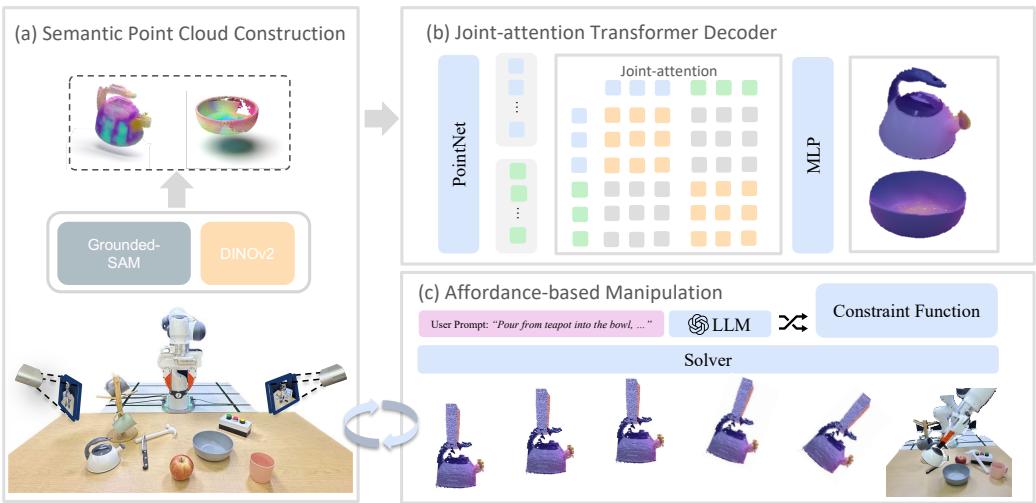
As shown in Figure 1 above, the pipeline proceeds as follows:
- Semantic Point Cloud Construction: Raw 3D scans are enriched with deep semantic features.
- Affordance Grounding: A specialized neural network predicts where the two objects should interact.
- Affordance-Based Manipulation: An LLM generates constraints to guide the robot’s physical movement.
Let’s break down each component in detail.
1. Semantic Point Cloud Construction
The system starts with RGB-D (Red, Green, Blue, Depth) scans of the environment. While raw XYZ coordinates give the robot geometric information (shape), they lack semantic meaning (what the object is).
To solve this, the researchers leverage DINOv2, a state-of-the-art Vision Foundation Model. DINOv2 has been trained on massive amounts of internet data and understands visual concepts deeply. The researchers project semantic features from DINOv2 directly onto the 3D point clouds of the source and target objects.
This results in a “Semantic Point Cloud.” Each point in the cloud now carries a vector of numbers representing both its position in 3D space and its semantic identity (e.g., “this point is part of a handle”). This allows the model to recognize similar parts across completely different objects—like realizing that a spray bottle trigger is semantically similar to a teapot handle in the context of grasping.
2. The Joint-Attention Transformer Decoder
Once the system has semantically enriched point clouds for both the source object (\(\mathbf{P}^{src}\)) and the target object (\(\mathbf{P}^{tgt}\)), it needs to figure out how they interact.
This is handled by the Affordance Grounding Module. The architecture uses a PointNet encoder to extract local geometric features, turning the point clouds into tokenized representations (\(\mathbf{Z}^{src}\) and \(\mathbf{Z}^{tgt}\)).
The innovation lies in how these representations talk to each other. Interaction is a two-way street. To understand where to cut an apple, you need to know the shape of the knife. To understand how to hold the knife for cutting, you need to know the shape of the apple.
The researchers implement a Joint-Attention Transformer Decoder. Instead of processing objects separately, they use a cross-attention mechanism where features from the source object attend to the target, and vice versa.

As described in the equation above, \(\mathbf{A}^{src}\) (the affordance features for the source) are derived by cross-referencing the source tokens \(\mathbf{Z}^{src}\) with the target tokens \(\mathbf{Z}^{tgt}\). The same happens in reverse for \(\mathbf{A}^{tgt}\). This bidirectional flow ensures the model understands the context of the interaction.
The network is trained to output a score between 0 and 1 for every point in the cloud, indicating how likely that point is to be involved in the interaction. This is trained using Binary Cross-Entropy (BCE) loss:

This loss function forces the model to minimize the difference between the predicted affordance map and the ground truth (provided by the one-shot example).
3. LLM-Guided Manipulation
Predicting the affordance map (the “where”) is only half the battle. The robot still needs to know “how” to move. This is where Large Language Models (LLMs) come in.
Hard-coding rules for every possible interaction (pouring, cutting, hanging) is brittle. Instead, \(O^3\)Afford uses an LLM (specifically GPT-4 in their experiments) to act as a logic engine. The system feeds the LLM a prompt describing the task and the objects. The LLM then generates a Python constraint function.
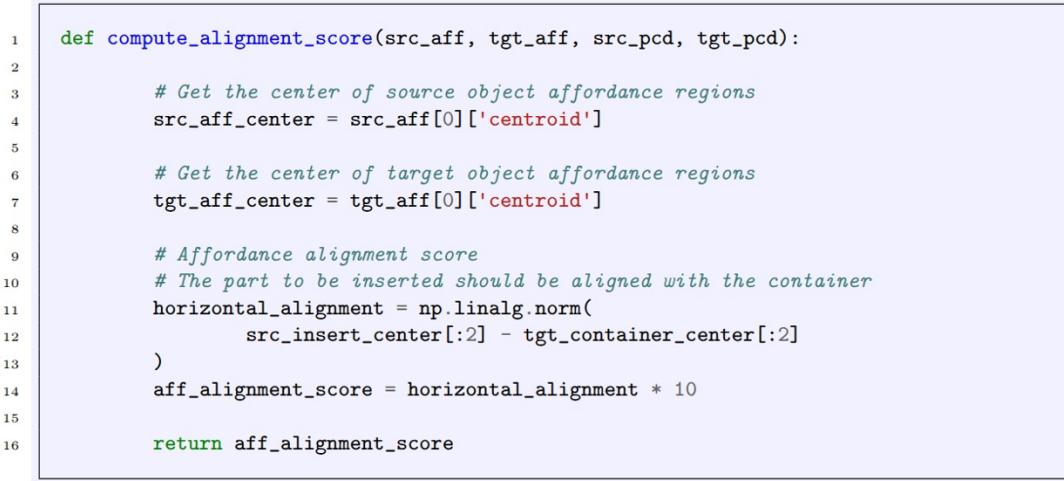
Figure 11 above shows an example of code generated by the LLM. It calculates an alignment score based on the centroids of the predicted affordance regions.
This generated function serves as a cost function for an optimization algorithm. The robot’s motion planner tries to find a 6-DoF (Degrees of Freedom) pose \(\mathbf{T}\) that minimizes this cost:

Here, \(\mathcal{S}_i\) represents the constraint functions generated by the LLM. By minimizing this equation, the robot finds the precise position and orientation needed to execute the task, such as aligning the teapot spout exactly above the bowl’s center.
Does it Work? Experiments and Results
The researchers tested \(O^3\)Afford against several baselines, including O2O-Afford (a prior 3D method), IAGNet (an image-based method), and RoboPoint (a vision-language model approach).
Affordance Grounding Accuracy
The first question is: Can the model correctly identify the interaction parts?
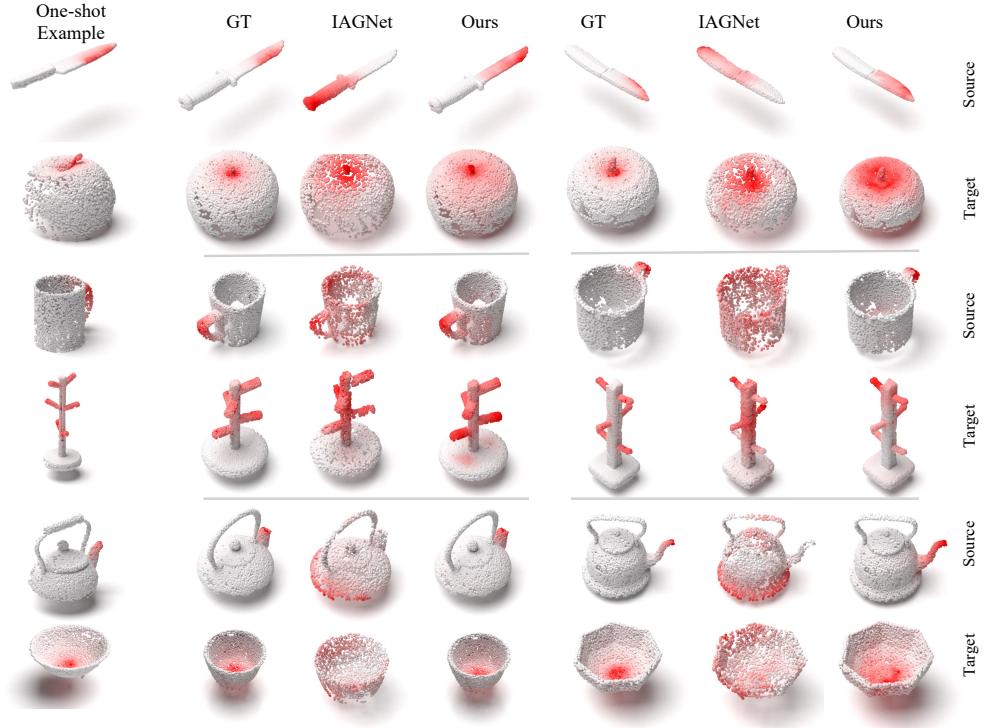
In Figure 2, we see visual comparisons. Look at the “Knife” and “Apple” columns. The Ground Truth (GT) shows the blade and the apple center highlighted in red.
- Ours (\(O^3\)Afford) produces a clean prediction that closely matches the Ground Truth.
- One-shot Example (naive mapping) is noisy.
- IAGNet struggles to localize the precise 3D area.
The quantitative data backs this up:
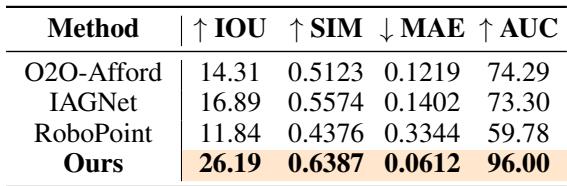
Table 1 shows that \(O^3\)Afford achieves a significantly higher IOU (Intersection Over Union) score of 26.19, compared to 14.31 for O2O-Afford. This indicates a much more precise alignment with the true affordance regions. The AUC (Area Under Curve) of 96.00 further demonstrates the model’s reliability.
Generalization: The Real Test
The true power of this method lies in its ability to generalize. Since it uses DINOv2 features, it isn’t just memorizing shapes; it’s understanding semantic parts.
1. Generalizing to New Categories The model was trained on one pair of objects (e.g., a knife and an apple). Could it handle a pair it had never seen, like a pair of scissors and a piece of paper?
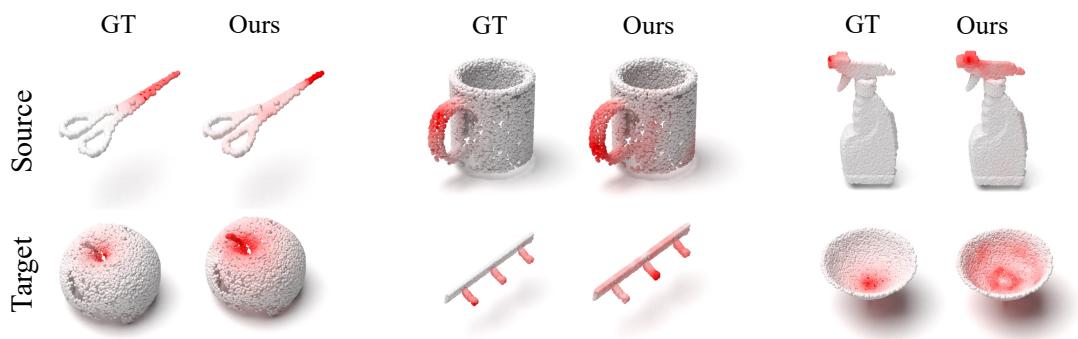
Figure 4 shows the results on unseen categories. The model successfully predicts affordances for objects like scissors (for cutting), a coat rack (for hanging), and a spray bottle (for pouring), even though it wasn’t explicitly trained on them. The semantic similarity allows the knowledge to transfer.
2. Robustness to Occlusion In the real world, objects block each other. A robot arm might obscure the camera’s view of a mug.
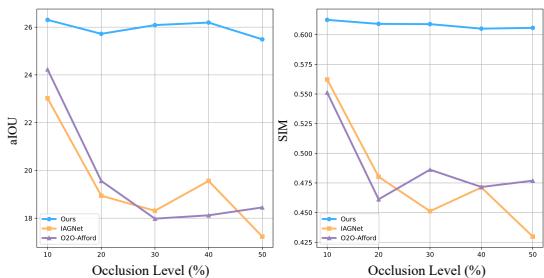
Figure 3 graphs the performance drop as occlusion increases. While baseline methods (Orange and Purple lines) crash as soon as the view gets blocked, \(O^3\)Afford (Blue line) maintains high stability even up to 50% occlusion.
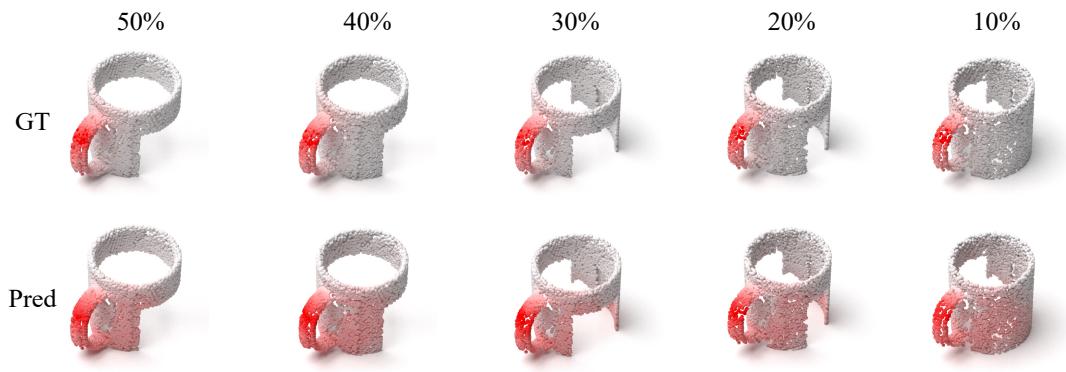
Figure 6 visually demonstrates this robustness. Even when 50% of the mug is missing from the point cloud data, the model can still infer where the handle should be, thanks to the robust patch embeddings learned by the encoder.
Robotic Manipulation in the Real World
Finally, the researchers deployed the system on a real Franka Research 3 robot arm.
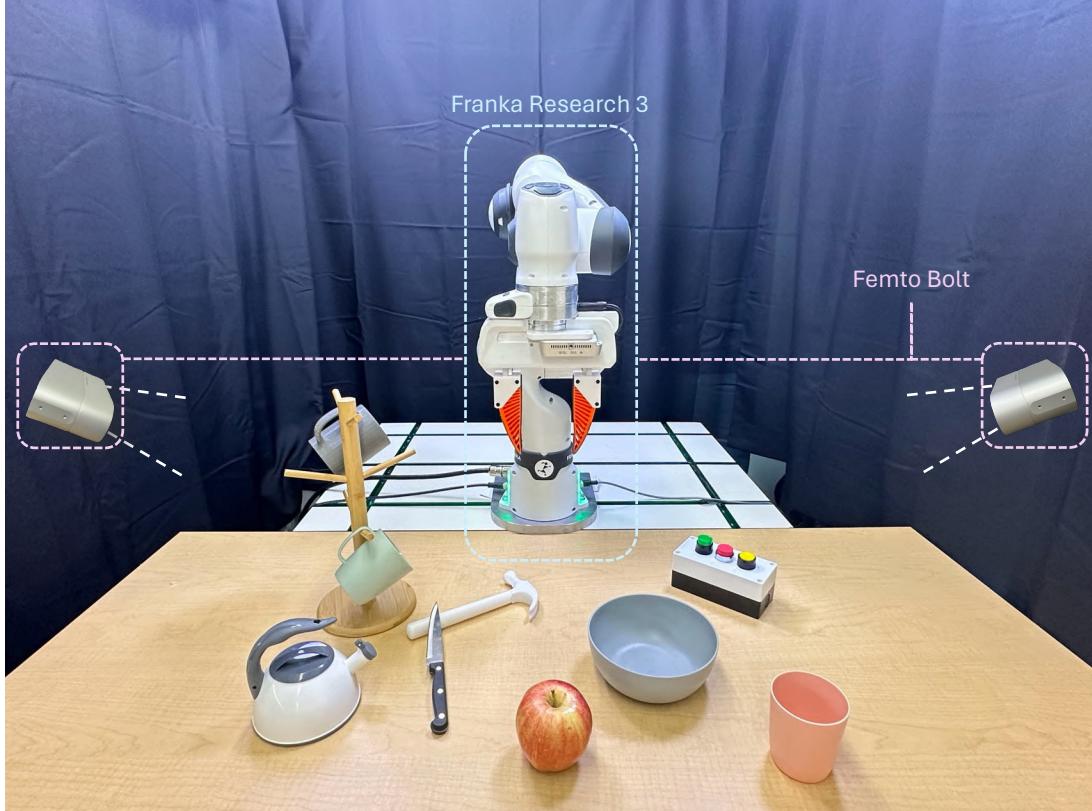
They designed five challenging tasks: pouring, hanging a mug, pressing a button, inserting toast, and cutting.
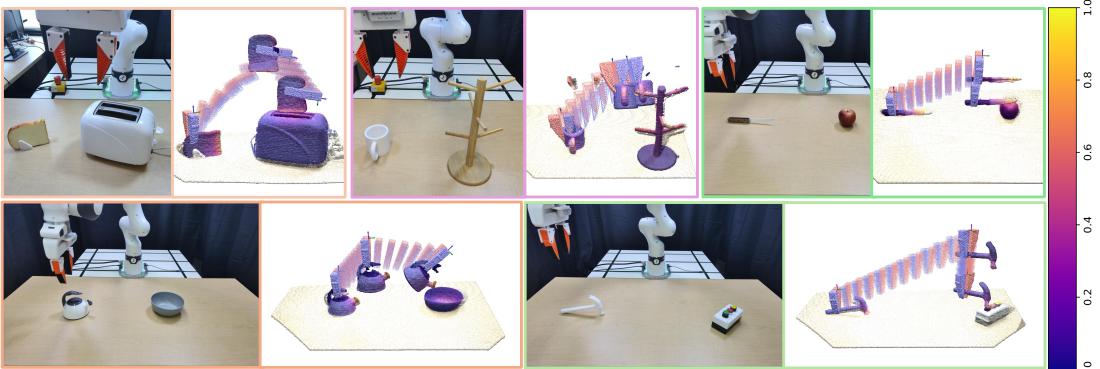
Figure 5 shows the execution sequences. You can see the predicted affordance maps (the colored heatmaps on the objects) guiding the robot. For example, in the top row (middle), the robot identifies the hook on the rack and the handle on the mug to perform the “hanging” action.
The success rates were impressive:
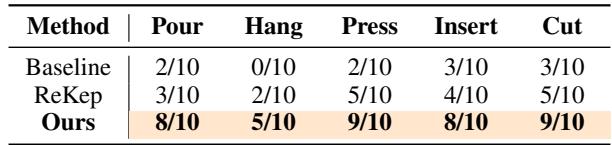
Table 3 highlights that \(O^3\)Afford achieves an 8/10 success rate on tasks like “Pour” and “Insert,” and a 9/10 on “Cut” and “Press.” The baseline (which doesn’t use affordance guidance) fails almost completely on complex tasks like hanging (0/10). The affordance map provides the critical “anchor” the robot needs to plan its approach.
Conclusion and Future Implications
\(O^3\)Afford represents a significant step forward in making robots more autonomous and adaptable. By moving away from massive datasets and focusing on one-shot learning, it opens the door for robots that can learn new tasks instantly from a single demonstration.
Key takeaways from this research include:
- 3D Matters: Point clouds provide the geometric fidelity necessary for precise manipulation that 2D images often miss.
- Foundation Models are Key: Leveraging pre-trained models like DINOv2 allows robotic systems to “inherit” common sense about object parts, enabling generalization to new categories.
- Context is King: The joint-attention mechanism proves that to interact with two objects, you must analyze them together, not in isolation.
- Code as Control: Using LLMs to translate visual affordances into mathematical constraints is a flexible way to bridge perception and control.
While limitations exist—such as dependency on the quality of depth sensors (as seen in Figure 12 below)—this work lays a strong foundation for the next generation of general-purpose robots.
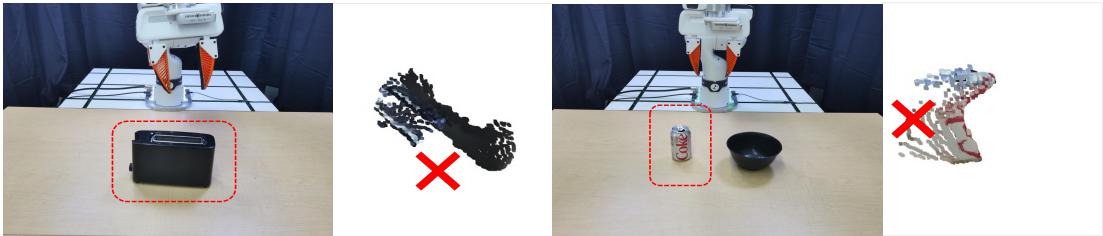 (Figure 12: A failure case where sensor noise leads to a poor point cloud reconstruction, reminding us that hardware quality still constrains software performance.)
As computer vision and language models continue to converge, we can expect robots to become increasingly capable of understanding the subtle “affordances” of our messy, complex world.