](https://deep-paper.org/en/paper/2509.06953/images/cover.png)
Imagine a robot in a kitchen. It’s not a pre-programmed factory arm welding the same car door every 30 seconds; it’s a household helper. You ask it to grab a mug from the drying rack. As it moves, you suddenly reach across its path to grab the salt shaker.
For a traditional robot, this is a nightmare scenario. Most motion planners are too slow to re-calculate a path in the split second before your hand intersects the robot’s arm. The result? A frozen robot, or worse, a collision.
This is the problem addressed in the paper “Deep Reactive Policy: Learning Reactive Manipulator Motion Planning for Dynamic Environments”. The researchers propose a new system called Deep Reactive Policy (DRP). It combines the global awareness of deep learning with the lightning-fast reflexes of reactive control, allowing robots to navigate messy, changing environments using only point cloud data from depth cameras.

In this post, we will break down how DRP works, why it outperforms existing methods, and the three distinct stages of its training and deployment.
The Challenge: Why is this hard?
To operate in homes, robots need to solve the motion generation problem. They need to figure out how to move their joints to get the end-effector (the hand) to a goal without hitting anything.
Traditionally, there are two ways to do this, and both have flaws:
- Global Planners (e.g., A, RRT):* These algorithms search for a path from Start to Goal. They are mathematically guaranteed to find a solution if one exists.
- The Catch: They are slow. By the time the planner calculates a path, the dynamic world has already changed. They also usually require a perfect 3D map of the world, which is hard to maintain in real-time.
- Reactive Controllers (e.g., RMP, Potential Fields): These act like reflexes. They push the robot toward the goal and repel it from obstacles nearby.
- The Catch: They are short-sighted. They often get stuck in “local minima”—like getting trapped in a U-shaped obstacle because the math says “go straight toward the goal” but the wall is in the way.
Neural Motion Policies attempt to bridge this gap. These are neural networks trained to map visual input directly to robot actions. While promising, previous attempts often struggled to generalize to new environments or required slow optimization steps at runtime.
The Solution: Deep Reactive Policy (DRP)
The researchers introduce DRP, a visuo-motor policy that operates directly on point clouds (3D data points from a camera). DRP isn’t just a single network; it is a sophisticated pipeline built on three key pillars:
- IMPACT: A transformer-based policy trained on a massive dataset.
- Student-Teacher Finetuning: A refinement stage to polish static obstacle avoidance.
- DCP-RMP: A mathematical “reflex” layer added at inference time for dynamic safety.
Let’s look at the full architecture below.
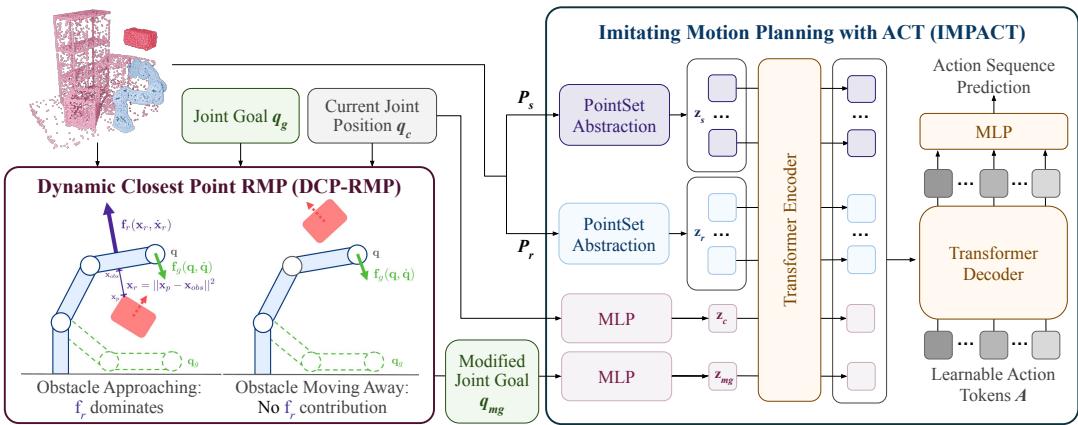
As shown in Figure 2, the system takes in point clouds of the scene. A module called DCP-RMP (left) first adjusts the goal to account for fast-moving threats. Then, the IMPACT network (right) processes the scene and the goal to output the actual robot movements.
Let’s break down each component.
1. IMPACT: The Transformer Brain
The core of DRP is a neural network named IMPACT (Imitating Motion Planning with Action-Chunking Transformer).
The Dataset
Deep learning requires data—lots of it. The authors generated a massive dataset of 10 million trajectories using a state-of-the-art GPU-accelerated planner called cuRobo. They created diverse simulated environments filled with shelves, boxes, and clutter. Crucially, they included “impossible” scenarios where the goal is inside an obstacle. In these cases, the expert data teaches the robot to stop safely as close as possible without crashing, a vital skill for real-world safety.
The Architecture
IMPACT takes raw point clouds as input. Since point clouds are noisy and unstructured, the system uses a PointNet++ encoder to digest the 3D points into a compact latent representation (\(z_s\) and \(z_r\)).
These features are fed into a Transformer. Why a Transformer? Because motion planning is a sequence problem. The model needs to understand the relationship between the robot’s current state, the obstacles, and the goal.
The decoder outputs an Action Chunk. Instead of predicting just the very next movement, it predicts a short sequence of future joint positions (\(S\) steps). This technique, known as action chunking, helps generate smoother motions.
The network is trained using Behavior Cloning (BC) with a standard Mean Squared Error loss function:
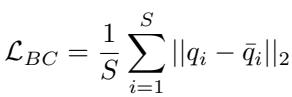
Here, the network minimizes the difference between its predicted joint positions (\(\bar{q}\)) and the expert’s ground truth positions (\(q\)).
2. Student-Teacher Finetuning
Training on expert trajectories gets you 90% of the way there. However, Behavior Cloning has a weakness: compounding errors. If the robot drifts slightly off the perfect path, it might find itself in a state it has never seen before, leading to a collision.
To fix this, the authors use Iterative Student-Teacher Finetuning.
They introduce a “Teacher” policy. This teacher uses a robust controller called Geometric Fabrics, which is excellent at local avoidance but requires “privileged information”—it needs to know the exact geometry and position of every obstacle (something a real robot rarely knows perfectly).
The “Student” is our IMPACT policy, which only gets to see the noisy point cloud data.
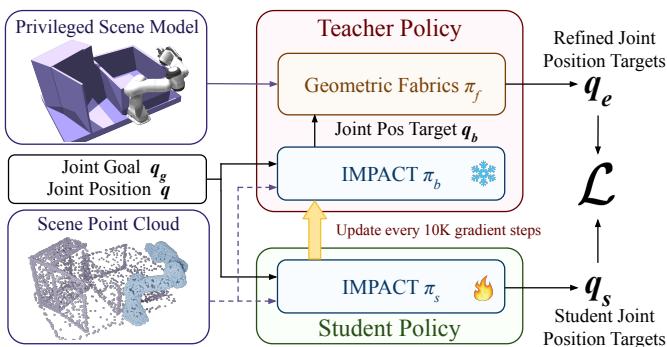
As illustrated in Figure 3, the process works like this:
- The Teacher (Geometric Fabrics) generates refined, safe targets using its perfect knowledge of the world.
- The Student (IMPACT) tries to mimic these targets using only its visual sensors.
- This runs in a loop. As the student gets better, it replaces the base policy in the teacher, allowing the system to learn increasingly complex behaviors.
This stage significantly reduces minor collisions that occurred in the original pretrained model.
3. DCP-RMP: The Reflex Layer
The first two stages result in a policy that is great at global planning and avoiding static obstacles. But what if someone throws a ball at the robot? Or a person walks by quickly? The neural network might be too slow to react, or the scenario might be too different from its training data.
To handle this, the authors introduce a Riemannian Motion Policy (RMP) layer at inference time. RMPs are mathematical functions that generate forces (accelerations) based on the state of the world.
The innovation here is DCP-RMP (Dynamic Closest Point RMP). Traditional RMPs need exact obstacle models. DCP-RMP works directly on raw point clouds.
How it works
- Detect Motion: The system compares the current point cloud to the previous frame to identify points that are moving (dynamic obstacles).
- Find the Closest Threat: It calculates the distance vector (\(\mathbf{x}_r\)) to the closest dynamic point.

- Generate Repulsion: It calculates a repulsive acceleration (\(\mathbf{f}_r\)). The closer and faster the obstacle is, the stronger the push-back.

- Modify the Goal: Instead of sending forces directly to the motors (which might fight the neural network), DCP-RMP modifies the goal fed into the IMPACT network. It creates a “virtual goal” that pushes the robot away from the threat.
The system combines the goal-attraction policy and the obstacle-avoidance policy into a single equation:

This modified goal (\(\mathbf{q}_{mg}\)) essentially tells the neural network: “I know you want to go to the shelf, but for the next second, pretend the goal is slightly to the left because there is a moving hand coming from the right.”
Experiments and Results
To prove DRP works, the authors created DRPBench, a suite of 5 challenging tasks tested in both simulation and the real world.
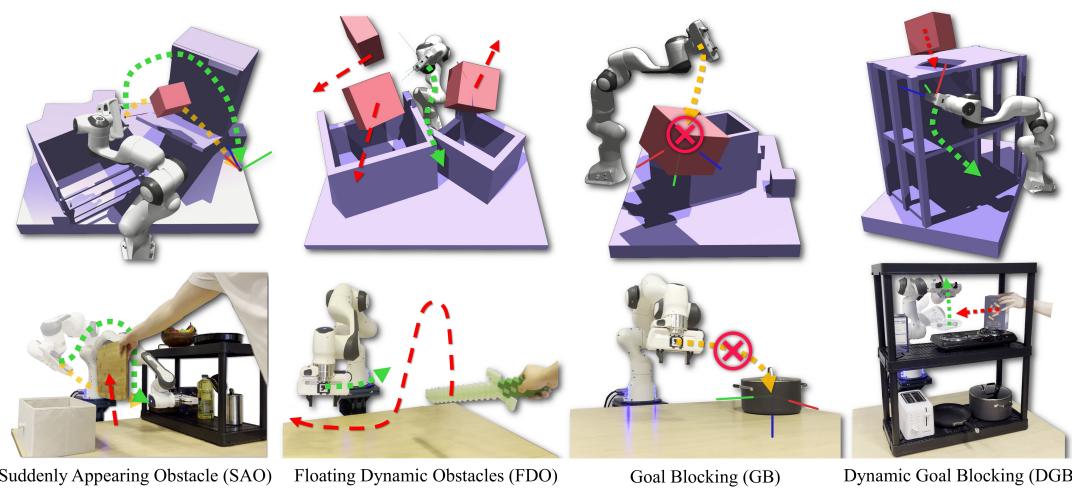
The tasks are:
- Static Environments (SE): Standard clutter.
- Suddenly Appearing Obstacle (SAO): A block appears instantly in the path.
- Floating Dynamic Obstacles (FDO): Random blocks flying around.
- Goal Blocking (GB): The target is covered; the robot must wait/hover safely.
- Dynamic Goal Blocking (DGB): A moving obstacle blocks the goal after the robot arrives.
Simulation Results
The results, shown in Table 1 below, are stark.
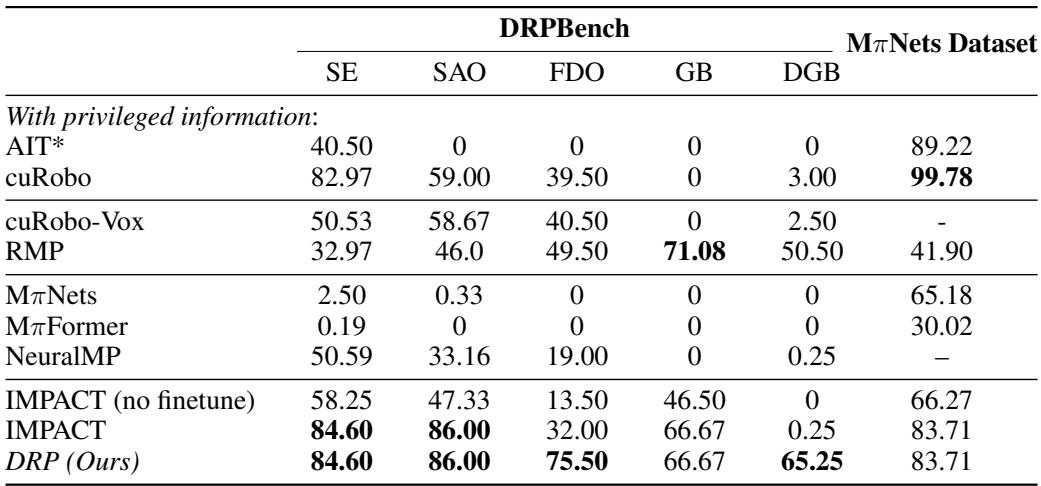
Key Takeaways from the Data:
- Classical Planners Fail at Dynamics: Look at AIT*. It achieves 40.5% in static scenes but 0% in all dynamic categories. It simply cannot replan fast enough.
- Optimization Planners Struggle: cuRobo is excellent at static scenes (82.97%) but drops to 3.00% in Dynamic Goal Blocking. It relies on optimization that gets confused by fast changes.
- DRP Dominates: DRP maintains high success rates across the board. In the hardest category (Dynamic Goal Blocking), it achieves 65.25%, compared to single digits for almost every other method.
The table also highlights the importance of the architectural choices. The “IMPACT” row shows the performance without the final RMP reflex layer. It is strong, but adding the RMP layer (the “DRP” row) doubles the success rate in the Floating Dynamic Obstacles (FDO) task (32.00% -> 75.50%).
Real-World Performance
The authors deployed DRP on a Franka Panda robot. The real world introduces noise, sensor latency, and imperfect depth data. Despite these challenges, DRP successfully navigated around slanted shelves, drawers, and human interference.
A critical finding was that in real-world “Goal Blocking” tasks (where a human blocks the target), DRP achieved a 92.86% success rate. Baselines like cuRobo and NeuralMP failed completely (0%), often crashing into the obstruction or freezing indefinitely.
Conclusion
Deep Reactive Policy (DRP) represents a significant step forward in robotic motion generation. By combining the strengths of large-scale learning (IMPACT) with the mathematical rigor of reactive control (DCP-RMP), the authors created a system that is:
- Globally Aware: It understands the scene structure and can plan around complex static geometry.
- Locally Reactive: It can dodge a flying object or a moving human hand in real-time.
- Sensor-Driven: It works with raw point clouds, requiring no pre-known models of the environment.
For students and researchers, DRP illustrates a powerful trend in robotics: Hybrid Systems. Neither pure learning nor pure classical control is sufficient for the chaos of the real world. But when you use learning for high-level understanding and control theory for low-level safety, you get the best of both worlds.