](https://deep-paper.org/en/paper/2509.07978/images/cover.png)
Introduction
Imagine a robot operating in a household or a flexible factory line. To interact with the world—to pick up a mug, insert a plug, or organize a shelf—the robot needs to know exactly where objects are. It’s not enough to simply draw a 2D box around an object on a screen; the robot needs the object’s 6D pose: its precise 3D position (\(x, y, z\)) and orientation (pitch, yaw, roll).
Traditionally, this problem is solved using pre-scanned 3D CAD models. If the robot knows exactly what the mug looks like geometrically, it can match that geometry to what it sees. But the real world is an “open world” filled with millions of unique items. We rarely have high-quality 3D scans of every random tool, toy, or container a robot might encounter. Often, all we have is a single reference photo.
This is the challenge of One-Shot 6D Pose Estimation: figuring out an object’s precise coordinates in 3D space using only a single reference image (the “anchor”) and no prior 3D model.
In this post, we are diving into a new paper, OnePoseViaGen, which proposes a groundbreaking solution. Instead of trying to estimate pose directly from 2D data alone, the researchers ask: What if we could generate the missing 3D model on the fly?
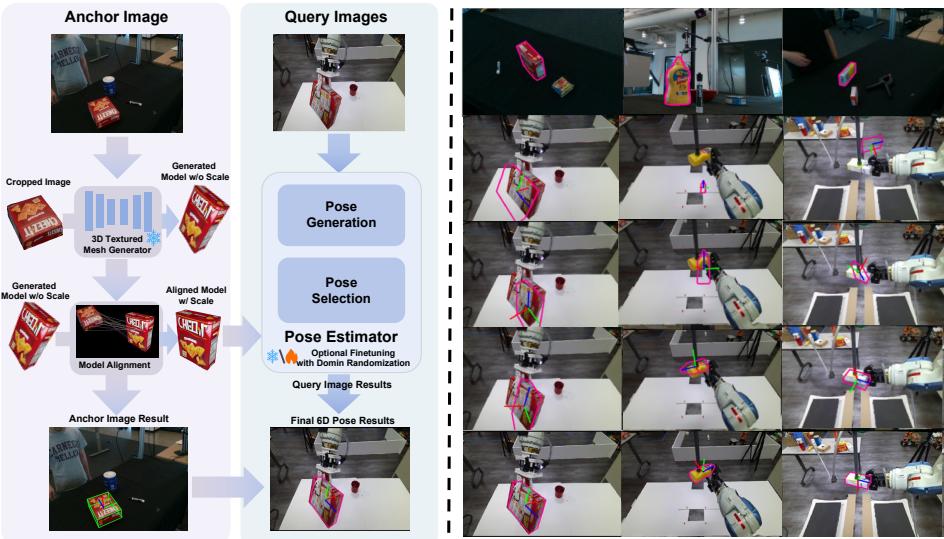
As shown in Figure 1 above, OnePoseViaGen takes a single anchor image, generates a textured 3D mesh, aligns it to the real world, and uses it to estimate poses in new scenes with state-of-the-art accuracy. Let’s explore how this pipeline bridges the gap between 2D generative AI and precise robotic manipulation.
The Core Challenge: The Scale and Domain Gap
Before dissecting the solution, we must understand why this task is so difficult.
- Lack of Geometry: A single photograph is flat. It lacks depth information and 3D structure. Reconstructing a 3D shape from one angle is an “ill-posed” problem—there are infinite 3D shapes that could create the same 2D projection.
- Scale Ambiguity: Even if AI can guess the shape, it cannot guess the size. A toy car and a real car look identical in a photo if the camera distance varies. Without knowing the metric scale (size in meters), a robot cannot grasp the object.
- Domain Gap: If we generate a synthetic 3D model to train our robot, that model often looks “too perfect.” Real-world camera feeds have noise, varying lighting, and occlusions. If the synthetic model doesn’t match the chaotic reality, the pose estimator will fail.
OnePoseViaGen addresses these specific hurdles through a pipeline that combines 3D generation, metric alignment, and generative domain randomization.
The OnePoseViaGen Pipeline
The method operates in a sequence of sophisticated modules. The goal is to take an Anchor Image (\(I_A\)) of an unseen object and find its pose in a target Query Image (\(I_Q\)).
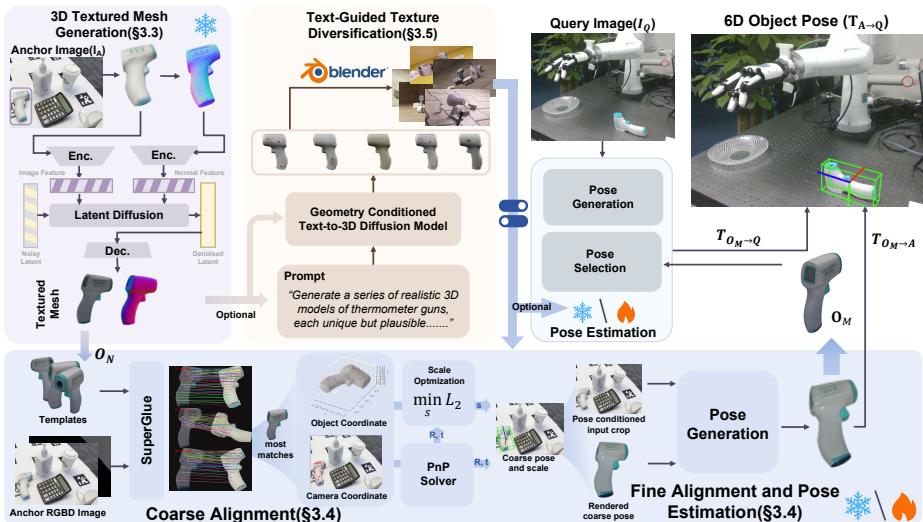
As illustrated in Figure 2, the process moves from 2D input to 3D reconstruction, then to alignment, and finally to pose estimation in new scenes.
1. Normal-Guided 3D Mesh Generation
The first step is to halluncinate the missing 3D data. The researchers utilize a modified version of Hi3DGen, a state-of-the-art 3D generation model.
The process begins by cropping the object from the anchor image (\(I_A\)) to remove background noise. This cropped image is passed through an estimator to create a surface normal map—a representation of the surface texture and orientation. Both the RGB image and the normal map are fed into the generative model.
The output is a standardized textured 3D mesh (\(O_N\)). This mesh looks like the object, but it exists in a normalized coordinate system. It has no concept of real-world size; it is essentially a “unit” size model floating in a void.
2. Coarse-to-Fine Alignment
This is arguably the most critical engineering contribution of the paper. Having a 3D shape is useless if it doesn’t match the scale of the object in the physical world. The researchers introduce a two-stage strategy to align the generated model (\(O_N\)) back to the anchor image (\(I_A\)) to recover the metric scale.
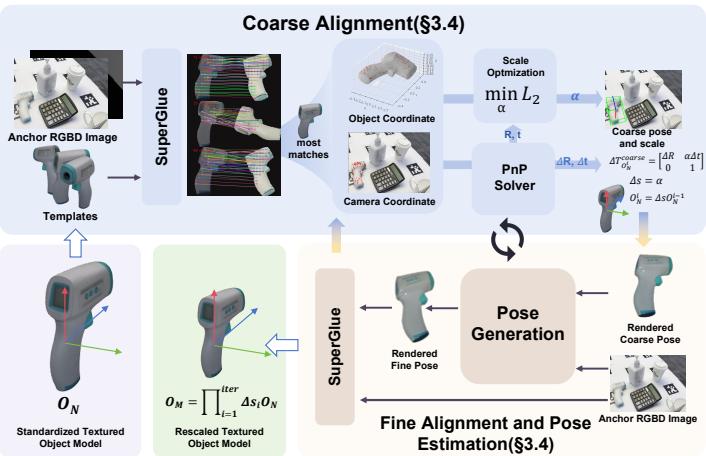
Phase A: Coarse Alignment
First, the system renders the normalized 3D model from various angles to create “templates.” It uses SuperGlue, a feature-matching neural network, to find correspondence points between these rendered templates and the original anchor image.
By matching 2D points in the image to 3D points on the model, they can solve the Perspective-n-Point (PnP) problem. This gives an initial rough pose and a scaling factor, denoted as \(\alpha\).
The transformation at this stage is represented as:
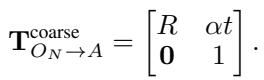
Here, \(R\) is rotation, \(t\) is translation, and \(\alpha\) is the critical scaling factor that converts the normalized model units into real-world meters.
Phase B: Fine Alignment
The coarse alignment is a good starting point, but feature matching can be noisy. To achieve sub-centimeter precision, the system uses a Render-and-Compare refinement.
A specialized network (adapted from FoundationPose) predicts incremental updates to the pose. It looks at the difference between the current rendering of the model and the actual image, then predicts how to nudge the model to fit better.
Crucially, this is an iterative loop. After the pose is nudged, the system re-calculates the scale. This alternating optimization ensures that errors in pose don’t corrupt the scale estimation and vice versa.
The update step can be visualized mathematically as an incremental adjustment:

By the end of this process, we have a Metric-Scale Model (\(O_M\)) that is perfectly aligned with the anchor image. We effectively “know” the object now.
3. Pose Estimation in Query Images
Now that the system has a calibrated 3D model of the object, it can find that object in other images (Query Images, \(I_Q\)).
The robot captures a new view (\(I_Q\)). The system employs the same “render-and-compare” strategy used in the alignment phase. It generates hypotheses of where the object might be, renders the model at those poses, and selects the best match.
Finally, the relative pose \(T_{A \to Q}\) (how the object moved from the anchor image to the query image) is computed by chaining the transformations:

Generative Domain Randomization
There is one remaining problem: Robustness.
If we only use the single texture generated in Step 1 to train the pose estimator, the system becomes brittle. It overfits to that specific lighting and texture. In the real world, shadows shift, and reflections change.
To solve this, the researchers introduce Text-Guided Generative Domain Randomization.
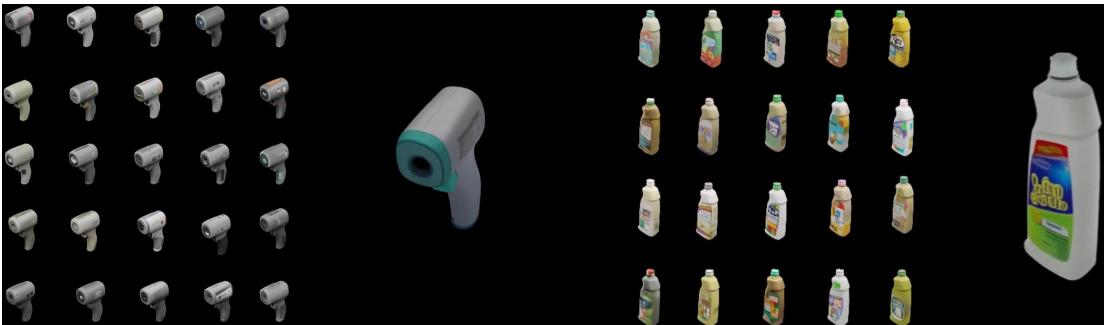
Using a text-to-3D model (Trellis), the system generates variations of the object. It keeps the geometry mostly consistent but wildly varies the texture and style (as seen in Figure 5 above). It might turn a plain thermometer into a “rusty sci-fi” version or a “wooden” version.
These variants are then placed into a synthetic training pipeline. They are rendered into thousands of scenes with random backgrounds, varying lighting conditions, and occlusions.
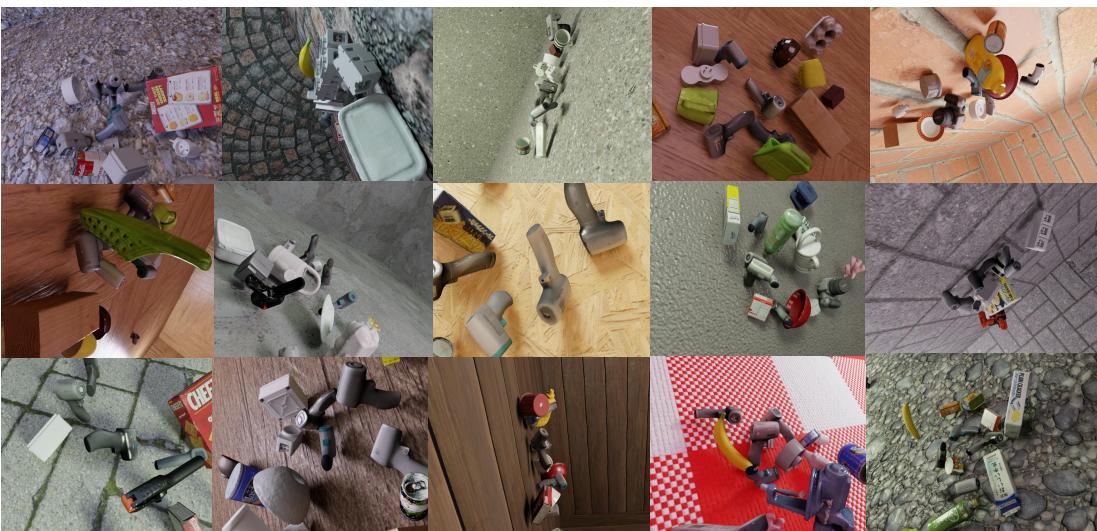
This creates a massive, diverse synthetic dataset (Figure 6) derived from just that one initial photo. By training on this “multiverse” of looks, the pose estimator learns to ignore surface details and focus on the underlying geometry, making it incredibly robust to real-world chaos.
Experimental Results
The researchers tested OnePoseViaGen on three major benchmarks: YCBInEOAT (robotics), Toyota-Light (TOYL) (challenging lighting), and LINEMOD Occlusion (LM-O) (heavy occlusion).
Quantitative Performance
The results show a stark improvement over existing methods like Oryon, LoFTR, and Gedi.
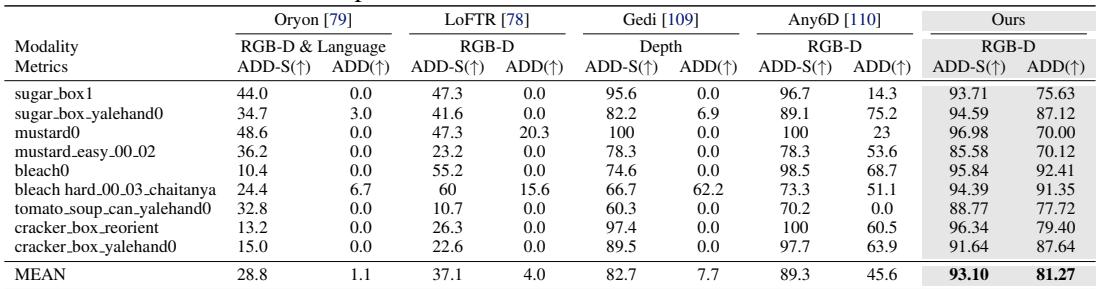
Looking at Table 1 (YCBInEOAT), we see the ADD metric (Average Distance Deviation). While competitors like Any6D struggle with challenging objects (scoring 0.0 or 14.3 on the sugar box), OnePoseViaGen achieves scores in the 90s. The overall mean score jumps from ~45.6 (Any6D) to 81.27 (Ours).
Qualitative Analysis
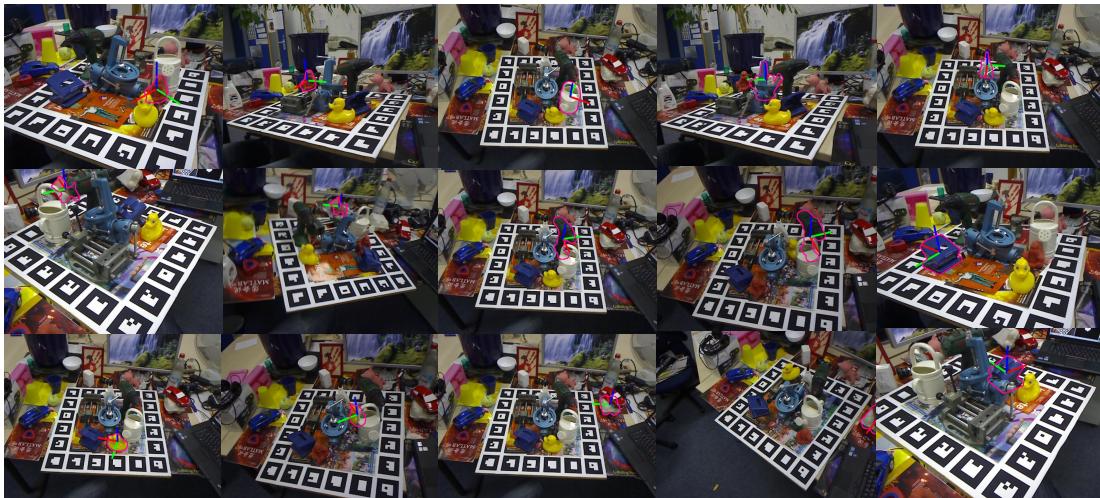
The visual results confirm the data. In the figure below, you can see the estimated pose (pink outline) tightly hugging the object (red/green/blue axes), even when the object is partially hidden or viewed from a steep angle.
Real-World Robotic Manipulation
Simulations are useful, but can it control a robot? The authors integrated their system with a robotic arm for pick-and-place and handover tasks.
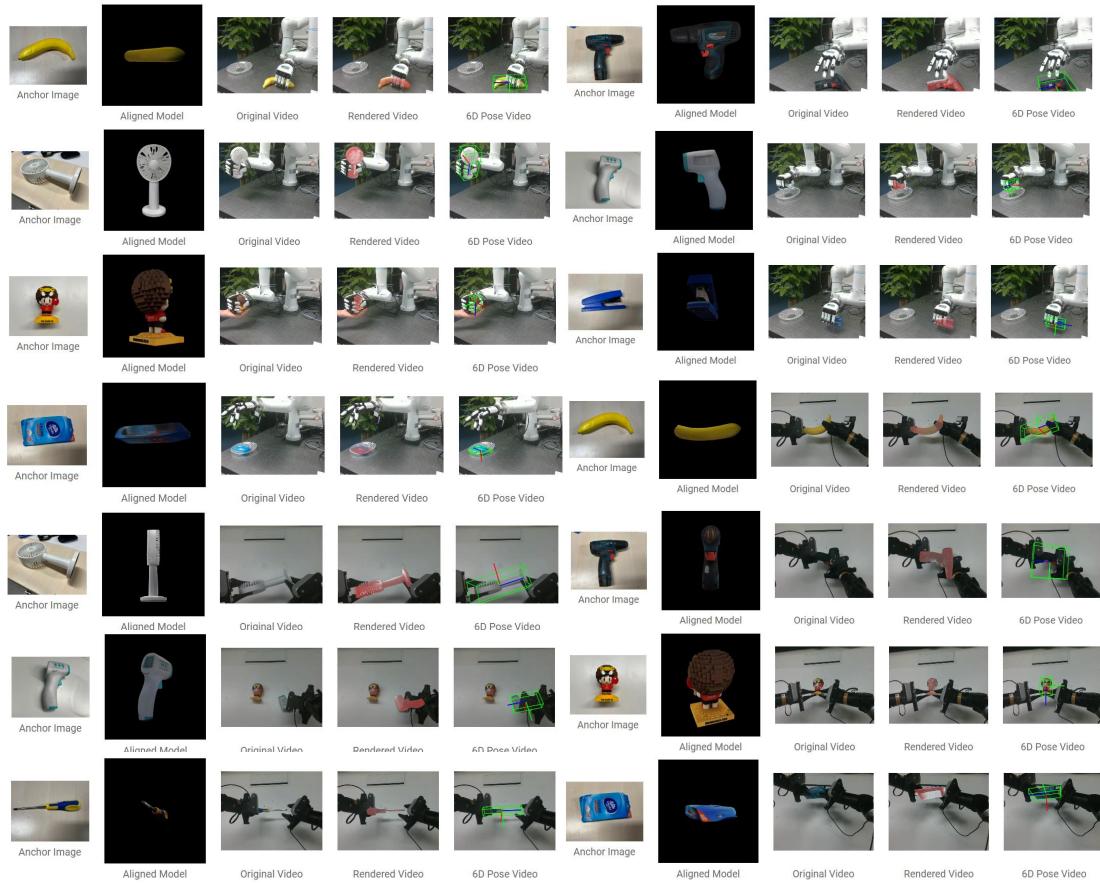
The system achieved a 73.3% success rate in real-world manipulation tasks, significantly outperforming baselines like SRT3D (6.7%) and DeepAC (16.7%). This huge gap highlights that previous methods simply weren’t accurate enough for precision grasping of unseen objects, whereas OnePoseViaGen crosses the threshold of utility.
Ablation Studies: What Matters?
The team also broke down which parts of their pipeline mattered most.

As shown in Table 4, removing the Fine Alignment stage causes a massive drop in accuracy (Success Rate/AR drops from 55.7 to 32.9). Even more telling is the fine-tuning data:
- Without fine-tuning: 12.6 AR
- With naive fine-tuning (just the original model): 11.4 AR (Overfitting actually hurt performance!)
- With Diversified Fine-tuning (Generative Domain Randomization): 52.4 AR
This proves that the “Generative Domain Randomization” isn’t just a gimmick—it is the key factor that allows the model to generalize effectively.
Conclusion
OnePoseViaGen represents a significant leap forward in robotic perception. It successfully combines the creative power of Generative AI (creating 3D assets from thin air) with the geometric rigor of Computer Vision (precise alignment and scaling).
By solving the scale ambiguity problem through coarse-to-fine alignment and solving the robustness problem through generative domain randomization, the authors have created a pipeline that allows robots to handle novel objects with near-zero setup time.
Key Takeaways:
- 3D Generation for Perception: Generative models are not just for creating art; they can serve as critical components in perception pipelines to fill in missing data.
- The Importance of Scale: A 3D model is useless for robotics without accurate metric scale recovery.
- Synthetic Data Works: When real data is scarce (one-shot), synthetic data generated with high variance can bridge the gap to reality.
While the method still faces challenges with deformable objects (like soft toys or cloth), it paves the way for general-purpose robots that can truly operate in the open world, understanding objects they have never seen before.