](https://deep-paper.org/en/paper/2509.08160/images/cover.png)
Imagine a busy factory floor. A single robotic arm picks up a part and places it on a conveyor belt. It’s a solved problem; the robot knows where it is, where the part is, and how to move without hitting itself.
Now, imagine eight robotic arms arranged in a circle, all reaching into the same central bin to sort objects simultaneously. Suddenly, the problem isn’t just about moving; it’s about coordination. If Robot A moves left, Robot B might need to wait, and Robot C might need to take a completely different path to avoid a collision.
This is the challenge of Multi-Arm Motion Planning (MAMP). As we add more robots to a team, the complexity of coordinating them doesn’t just grow linearly—it explodes exponentially.
In this post, we are diving deep into a fascinating paper titled “Diffusion-Guided Multi-Arm Motion Planning” by Viraj Parimi and Brian Williams from MIT. They propose a method called DG-MAP, which combines the generative power of Diffusion Models (the same tech behind AI art generators) with the structured logic of classical pathfinding algorithms. The result is a system that can scale to large teams of robots without needing massive amounts of complex training data.
Let’s break down how they teach robots to dance without stepping on each other’s toes.
The Scalability Problem
To understand why this paper is important, we first need to understand why multi-arm planning is so hard.
Roboticists often talk about the “Configuration Space” (C-space). For a single robot arm with 6 joints (Degrees of Freedom), the C-space is 6-dimensional. Finding a path from Start to Goal is finding a line through this 6D space that doesn’t hit obstacles.
If you have two arms, the system has 12 dimensions. If you have eight arms, you are working in a 48-dimensional space.
The Two Standard Approaches (and why they struggle)
- Sampling-Based Planners (e.g., RRT, PRM): These algorithms randomly sample points in space to build a roadmap. In 48 dimensions, the space is so vast that randomly finding a valid path where no robots collide becomes computationally impossible. It’s like trying to find a needle in a haystack, but the haystack is the size of the universe.
- End-to-End Learning (RL): We can train a neural network to look at the state of all robots and output the next move. This is fast at runtime, but it requires a centralized policy. To train it, you need a dataset of eight robots moving together. If you want to add a ninth robot, you have to retrain the whole system from scratch. It doesn’t “scale” well to unseen team sizes.
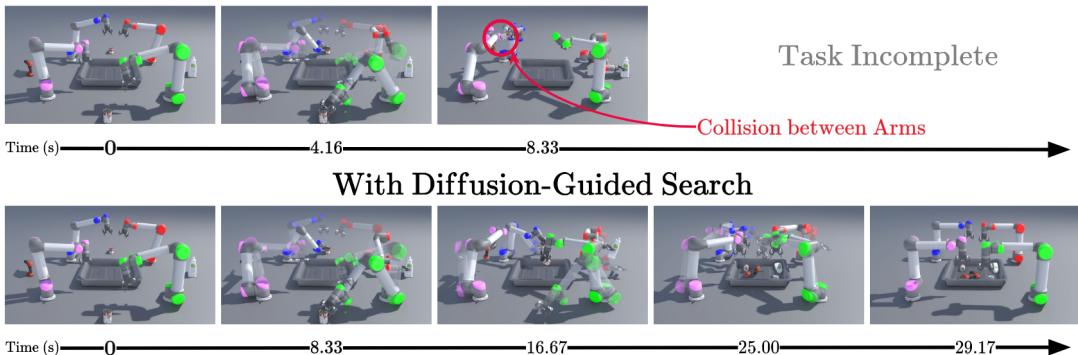
As shown in Figure 1, purely learning-based methods (top row) often fail in dense environments because they haven’t seen that specific complex interaction during training. The DG-MAP approach (bottom row) manages to solve the task smoothly.
The Core Insight: Decomposition
The researchers at MIT realized that while the global problem is high-dimensional, the conflicts are usually local. Even with 10 robots, collisions usually happen between just two robots at a time.
This observation led to the architecture of DG-MAP. Instead of trying to solve the 48-dimensional problem all at once, they decompose it:
- Plan for each arm individually (ignoring the others).
- Check for collisions.
- Fix the specific pairwise collisions that occur.
To achieve this, they need a way to generate flexible, high-quality trajectories, and a way to “repair” trajectories when two robots are about to crash. This is where Diffusion Models come in.
Background: Diffusion for Motion
You might know Diffusion Models from tools like Midjourney or DALL-E. They work by taking an image, adding noise to it until it’s static, and then learning to reverse the process—turning static back into a clear image.
In robotics, we treat a trajectory (a sequence of joint positions over time) just like an image.
- Take a good robot movement.
- Add Gaussian noise to the coordinates until it’s random gibberish.
- Train a neural network to predict the noise and remove it.
Mathematically, the reverse process (denoising) looks like this:

Here, \(\epsilon_{\theta}\) is the neural network. By repeatedly applying this denoising step \(K\) times, starting from random noise \(z_K\), we arrive at a smooth, valid trajectory \(z_0\). The model is trained using a standard Mean Squared Error loss between the predicted noise and the actual noise:

The benefit of using diffusion over other methods is that it handles multimodality very well. If there are two ways to go around an obstacle (left or right), a diffusion model can generate either, whereas other models might try to average them and crash straight into the obstacle.
The DG-MAP Method
DG-MAP utilizes two specialized diffusion models and a search algorithm to orchestrate them.
1. The Single-Arm Model (\(\epsilon_{\theta_1}\))
This model is the “selfish” planner. It is trained on data of a single robot moving from a start pose to a goal pose. It knows nothing about other robots.
- Input: Current history of observations (joint angles, goal position).
- Output: A sequence of future joint movements (\(\Delta q\)).

2. The Dual-Arm Model (\(\epsilon_{\theta_2}\))
This is the “negotiator.” It is trained on data of two robots interacting.
- Input: The history of the “ego” robot (the one we are planning for) PLUS the history of the “conflicting” robot, transformed into the ego robot’s coordinate frame.
- Output: A trajectory for the ego robot that explicitly avoids the other robot.

Crucially: These models are only trained on single and dual-arm data. They never see 3, 4, or 8 robots during training. This is what makes the system scalable.
3. The Search Framework (Putting it Together)
The system runs a Closed-Loop Receding Horizon Controller. This means it constantly re-plans a short trajectory into the future, executes a tiny bit of it, and then plans again.
Here is the flow, visualized in Figure 2:
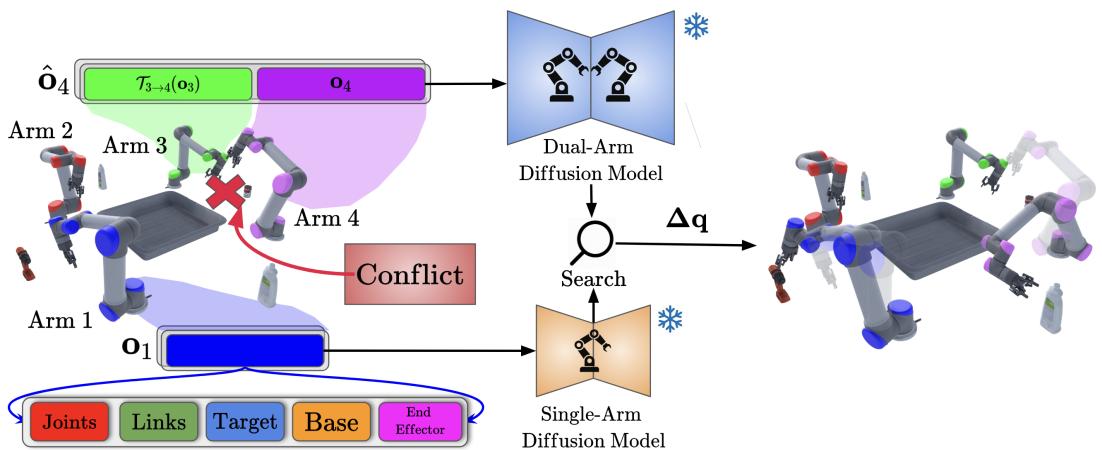
- Generate Initial Plans: Each robot uses the Single-Arm Model to suggest a path to its goal.
- Detect Conflicts: The system checks if any of these paths collide.
- Search Tree (MAPF): If a collision is found between Robot A and Robot B, the system creates a “search node.” It needs to resolve this conflict. It has two strategies to generate “successor” nodes (new potential plans):
Strategy A: Rebranch
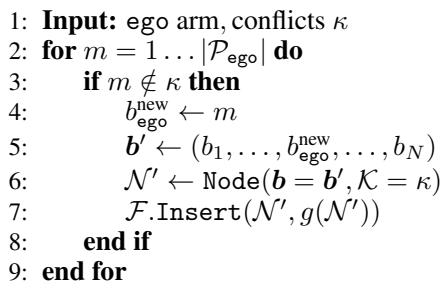
Sometimes, the diffusion model just got unlucky with its random seed. The Rebranch strategy (Algorithm 2) simply asks the Single-Arm model to sample a different random trajectory. Since diffusion is stochastic (random), the new path might accidentally avoid the collision.
Strategy B: Repair
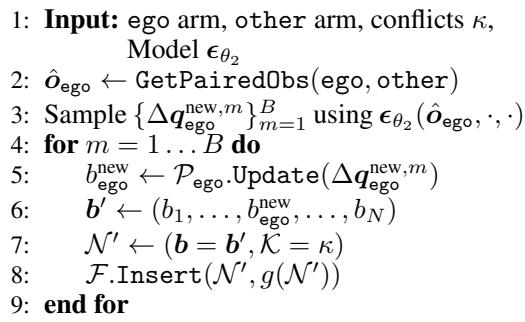
If random resampling doesn’t work, the planner calls in the specialist. The Repair strategy (Algorithm 3) uses the Dual-Arm Model. It explicitly tells the model: “Here is where Robot B is moving. Generate a path for Robot A that respects its goal but dodges Robot B.”
The planner uses a cost function to evaluate these new nodes, prioritizing paths that are smooth, collision-free, and get closer to the goal:

The term \(P_{coll}\) adds a heavy penalty for any remaining collisions, guiding the search toward safe solutions.
Experiments and Results
The authors tested DG-MAP in the PyBullet simulator with teams ranging from 3 to 8 robots. They categorized tasks by difficulty—essentially, how much the robots’ workspaces overlapped.

Question 1: Does it scale?
The most impressive result is how DG-MAP performs compared to a baseline trained on the same limited data (Baseline-LD). Remember, both methods only saw 1 or 2 robots during training.
Table 1 (implied from text):
- Baseline-LD (3 Arms): ~41% success rate.
- Baseline-LD (8 Arms): ~2% success rate (Complete failure).
- DG-MAP (8 Arms): 92.4% average success rate.
Because DG-MAP decomposes the problem into pairwise interactions, it doesn’t care that it has never seen 8 robots before. It just sees “many pairs of conflicts” and solves them one by one.
Question 2: Is it as good as “Big Data” models?
The authors also compared it to Baseline-ED (Extended Data), a model trained on massive datasets including 3 and 4-robot interactions.
Remarkably, DG-MAP was competitive with this heavy-duty baseline, and actually outperformed it in the hardest scenarios (8 arms, hard difficulty). This proves that structured planning (fixing specific conflicts) is often more robust than trying to learn everything end-to-end.
Real-World Application: Pick-and-Place
Moving to a specific coordinate is one thing; performing a task is another. The team set up a “Pick-and-Place” simulation where four arms have to grab objects and dump them in a central bin.
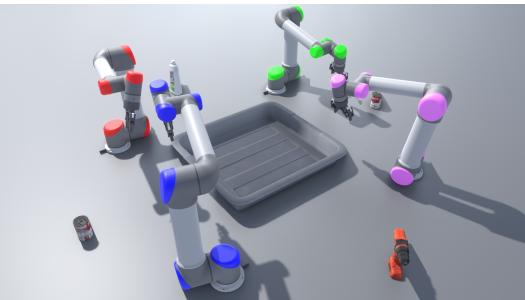
- Baseline-LD Success: 37.5%
- DG-MAP Success: 89.0%
This confirms that the method isn’t just a theoretical curiosity; it works in dense, task-oriented environments.
The Trade-off: Computation Time
There is no free lunch. Because DG-MAP runs a search algorithm (checking collisions, branching, repairing) at every step, it is computationally heavier than a simple neural network inference.
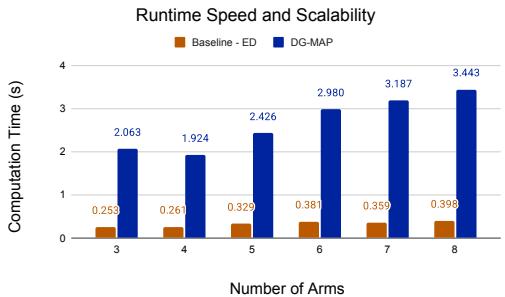
As Figure 5 shows, DG-MAP takes between 2 to 3.5 seconds to compute a plan step, whereas the end-to-end baselines take fractions of a second. However, in many industrial applications, a 2-second planning time is acceptable if it guarantees the robots won’t crash (which causes much longer delays).
Conclusion and Key Takeaways
The DG-MAP paper presents a compelling argument for Hybrid AI Systems.
- Don’t throw away classical algorithms: The logic of Multi-Agent Path Finding (decomposing problems, searching for solutions) is incredibly powerful.
- Use AI for what it’s good at: Diffusion models are excellent at generating natural, feasible motion in complex spaces.
- Local interactions drive global behavior: You can coordinate a massive swarm of robots simply by understanding how to keep any two of them from crashing.
By combining conditional diffusion models with a MAPF-inspired search, Parimi and Williams have created a planner that is both data-efficient (training only on pairs) and highly scalable. As robotic swarms become more common in logistics and manufacturing, techniques like DG-MAP will likely become the standard for keeping the choreography smooth and safe.