](https://deep-paper.org/en/paper/2509.08820/images/cover.png)
Imagine a chemistry laboratory. It is a place of precise measurements, volatile reactions, and fragile equipment. Now, imagine a robot trying to navigate this space. Unlike organizing blocks on a table—a classic robotics benchmark—chemistry involves transparent glassware that depth sensors can’t see, liquids that slosh and spill, and safety protocols where a few millimeters of error can lead to a hazardous situation.
For years, the dream of an autonomous “Robotic Chemist” has been stifled by these physical realities. Robots are good at repetitive motions, but they struggle with the dynamic, safety-critical reasoning required for experimental science.
Enter RoboChemist.
In a new paper from researchers at BAAI and Tsinghua University, a novel framework has been proposed that marries high-level reasoning with low-level dexterity. By integrating Vision-Language Models (VLMs) with Vision-Language-Action (VLA) models, RoboChemist achieves a level of autonomy and safety previously unseen in robotic experimentation.
In this deep dive, we will explore how this system works, why “visual prompting” is the secret ingredient, and how it manages to perform complex experiments like acid-base neutralization without human intervention.
The Problem: Why Robots Struggle with Chemistry
To understand why RoboChemist is a breakthrough, we first need to appreciate the difficulty of the domain. Robotic manipulation has advanced significantly with the rise of Vision-Language-Action (VLA) models like \(\pi_0\) and RDT. These models can look at an image and output robot actions (joint movements).
However, in a chemistry lab, standard VLAs face two critical failures:
- Semantic Blindness: A standard VLA might know how to “pick up a cup,” but it doesn’t understand the context of a chemical experiment. It doesn’t know that a specific test tube must be heated at the top to avoid exploding the contents, or that a solution must be stirred until it turns a specific color.
- Perception Gaps: Many existing systems rely on depth cameras (RGB-D). In a lab full of clear beakers, test tubes, and pipettes, depth sensors often fail. Transparent objects are notoriously difficult for robots to perceive in 3D space.
Previous attempts like VoxPoser or ReKep have tried to bridge this gap but often fall short when dealing with transparent objects or strict safety constraints. They struggle to translate a text instruction like “heat safely” into precise geometric coordinates.
The Solution: The RoboChemist Architecture
The core innovation of RoboChemist is a dual-loop framework. It doesn’t rely on a single model to do everything. Instead, it assigns the “brain” work to a Vision-Language Model (VLM) and the “hand” work to a VLA model, connecting them through a rigorous feedback loop.
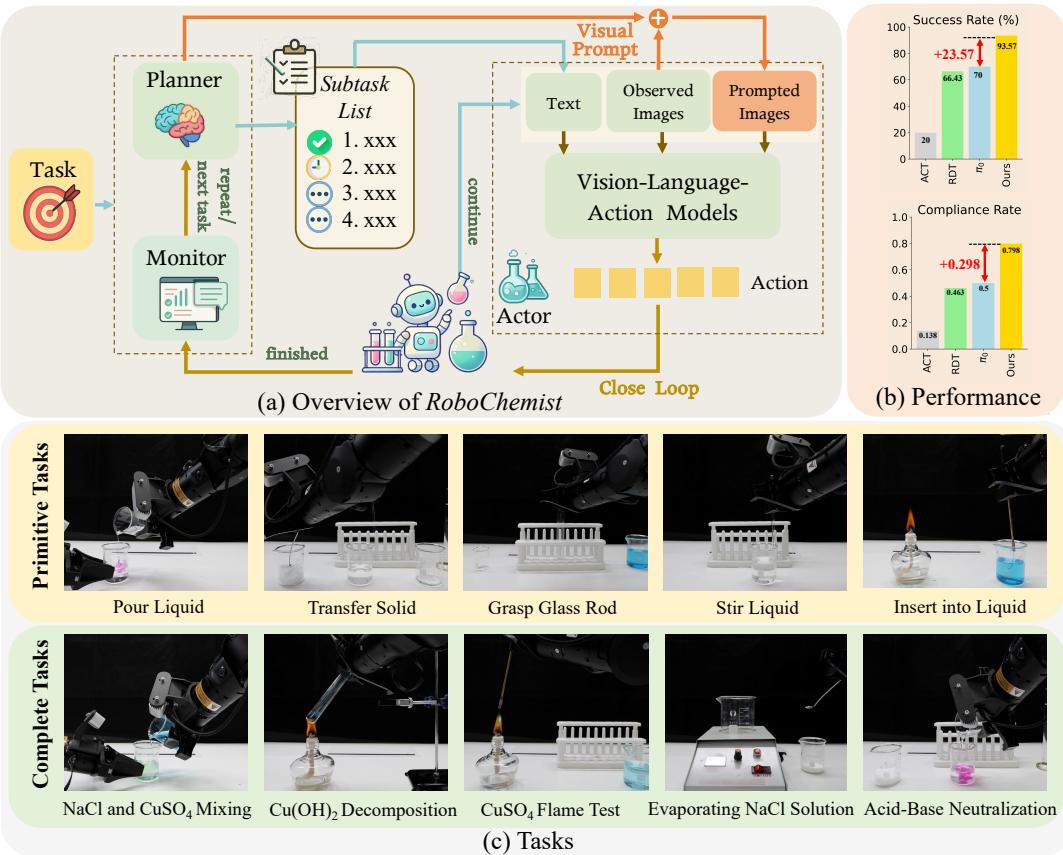
As shown in Figure 1, the system operates in three distinct stages, managed by the VLM (specifically Qwen2.5-VL):
- The Planner (The Brain): It takes a high-level goal (e.g., “Perform acid-base neutralization”) and decomposes it into a sequence of primitive actions (e.g., “Grasp rod,” “Stir,” “Pour acid”).
- The Visual Prompt Generator (The Guide): This is the key innovation. Instead of just telling the robot “grasp the beaker,” the VLM looks at the scene and draws bounding boxes or keypoints on the image. It effectively says, “Grasp here (coordinates) to be safe.”
- The Monitor (The Supervisor): After an action is taken, the VLM looks at the result. Did the liquid turn clear? If no, it triggers a retry. This creates a closed-loop system capable of error correction.
The Core Method: Visual Prompting and Closed-Loops
Let’s break down the mechanics of how RoboChemist achieves precision using Visual Prompting.
Why Text Isn’t Enough
In many robotic systems, instructions are text-based. “Pick up the flask.” But in chemistry, how you pick up the flask matters. If you are heating a test tube, you cannot grasp it at the bottom where the flame is; you must grasp it at the top third. A standard VLA model trained on general data might not know this specific safety protocol.
RoboChemist solves this by having the VLM generate Visual Prompts. The system inputs the current image of the lab bench into the VLM and asks it to identify safe grasp points and target zones based on safety guidelines. The VLM outputs precise 2D coordinates (bounding boxes or points).
These visual cues are overlaid on the image and fed into the VLA. This gives the robot an explicit target, drastically reducing the complexity of the control problem.
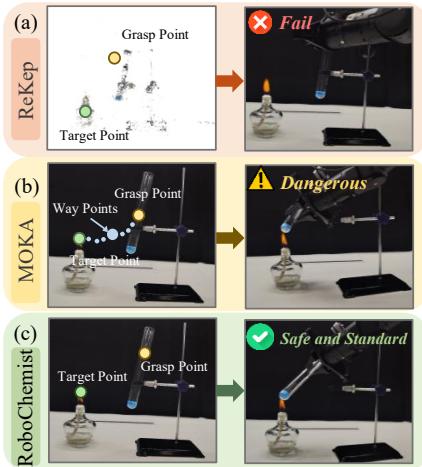
Figure 3 above illustrates this perfectly.
- ReKep (a) fails because it relies on depth perception, which struggles with the transparent test tube, leading to a failed grasp.
- MOKA (b) identifies a grasp point but places it in the center of the tube. When heating, this brings the robot gripper dangerously close to the flame—a major safety violation.
- RoboChemist (c) generates a “safety-compliant” prompt. It explicitly identifies the upper part of the tube as the grasp point and sets the target height safely above the flame.
The Acid-Base Neutralization Example
To see the full pipeline in action, let’s look at a complex, long-horizon task: Acid-Base Neutralization. This experiment requires preparing a base solution, adding an indicator (phenolphthalein), and then carefully adding acid until the color changes—a classic “titration” problem that requires visual feedback.
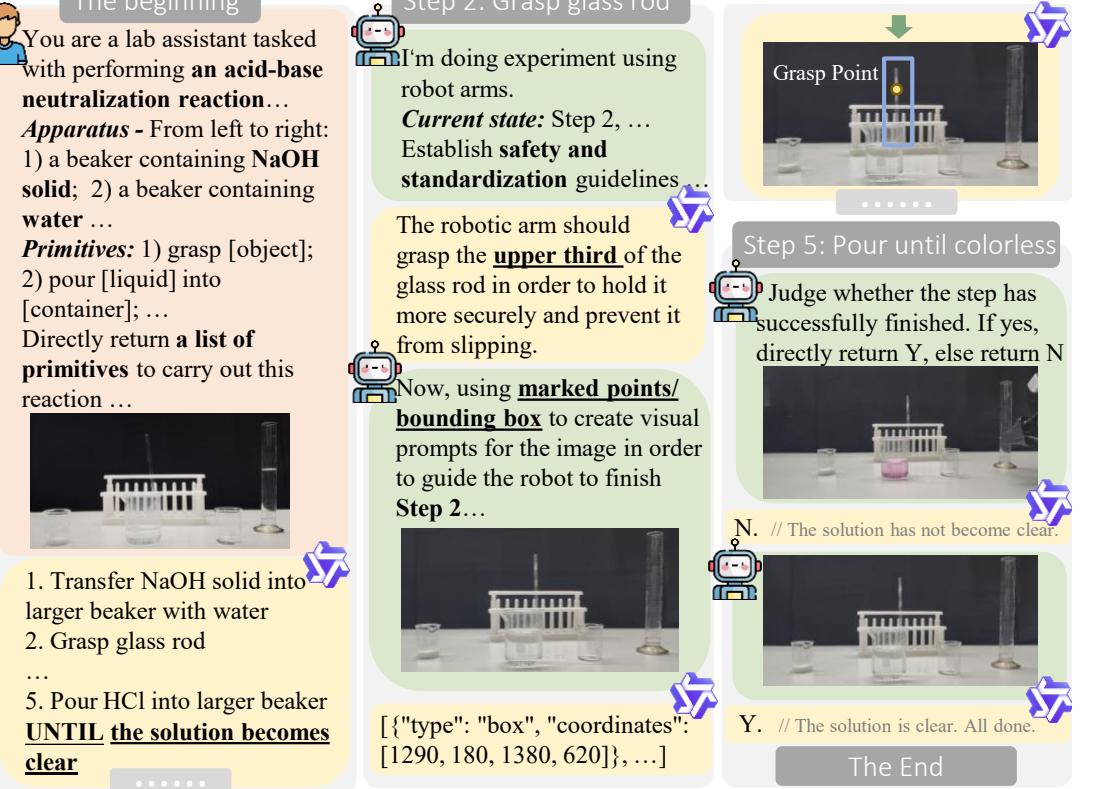
Referencing Figure 2:
- The Beginning: The researcher gives the goal. The VLM decomposes this into specific primitives: Grasp, Pour, Stir.
- Visual Prompting (Step 2): To grasp the glass rod, the VLM draws a green bounding box around the rod and a red point indicating exactly where to grab it. This handles the transparency issue—the VLM “sees” the glass in the RGB image even if depth sensors fail.
- Closed-Loop Monitoring (Step 5): The robot pours acid. The VLM acts as a monitor. It asks, “Is the solution colorless?”
- Observation 1: The liquid is still pink. The Monitor returns “N” (No).
- Action: The Planner triggers the “Pour” primitive again.
- Observation 2: The liquid turns clear. The Monitor returns “Y” (Yes).
- Completion: The task ends only when the chemical reality matches the goal.
This “Outer Loop” (the VLM checking the work) is what allows RoboChemist to handle variability. If the concentration of the acid is slightly different, the robot simply pours more times until the reaction is done.
Experimental Results
The researchers evaluated RoboChemist on two fronts: Primitive Tasks (individual actions) and Complete Experiments (long workflows). They compared it against state-of-the-art baselines like ACT, RDT-1B, and \(\pi_0\).
Primitive Tasks
The primitives included actions like grasping glass rods, heating wires, pouring liquids, and stirring. The metrics used were Success Rate (SR) and Compliance Rate (CR)—the latter measuring whether the robot followed safety norms (e.g., did it spill? did it grasp the hot part of the tube?).

As shown in Table 2, RoboChemist (especially the version with the Closed-Loop “w/ CL”) dominates the baselines.
- Grasping Glass Rod: RoboChemist achieved 95% success, while the powerful RDT model only managed 20%. The baselines struggled heavily with the transparent, thin glass objects.
- Compliance: In terms of safety (CR), RoboChemist scored 0.875 on grasping, compared to 0.100 for RDT. This confirms that the visual prompts effectively enforce safety rules that end-to-end models miss.
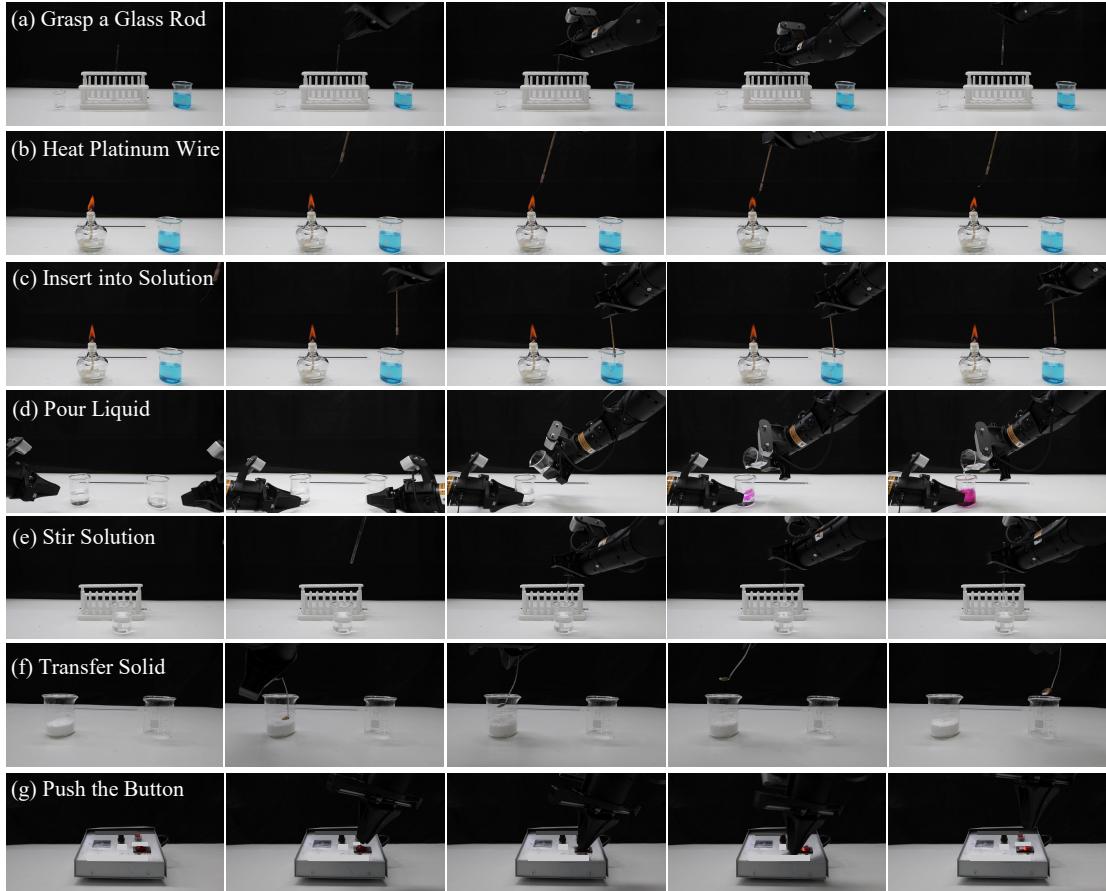
Figure 6 visualizes these primitives. Notice the diversity of actions—from the delicate insertion of a platinum wire into a solution (c) to the precise pouring of liquids (d).
Complete Chemical Experiments
The true test of the system was chaining these primitives into full experiments. The team tested five scenarios, including:
- Mixing NaCl and CuSO\(_4\) (Complexation).
- Flame Tests (Identifying metals by flame color).
- Acid-Base Neutralization.
- Thermal Decomposition.
- Evaporation.
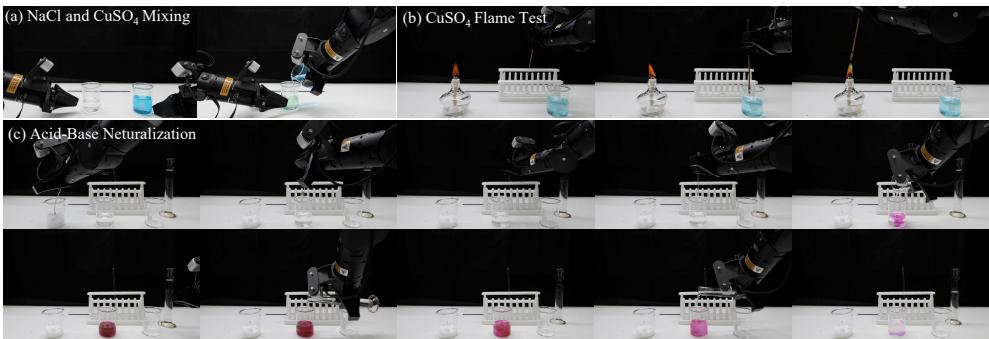
In Figure 4, we see the robot executing these multi-step protocols. The Flame Test (b) is particularly impressive. The robot must dip a wire into a solution and then hold it precisely in the flame to observe a color change.
The results for these complete tasks were stark. In the Acid-Base Neutralization task:
- ACT: 0% Success Rate (failed at the stirring/pouring stages).
- RDT: 0% Success Rate.
- \(\pi_0\): 5% Success Rate.
- RoboChemist: 40% Success Rate.
While 40% implies there is still room for improvement in long-horizon reliability, it is a massive leap over existing models which essentially fail completely on such complex, multi-stage chemical tasks. For shorter tasks like Mixing NaCl and CuSO\(_4\), RoboChemist achieved 95% success.
Generalization: The Mark of True Intelligence
A major claim of the paper is that RoboChemist can generalize. It doesn’t just memorize specific cups or lighting conditions.
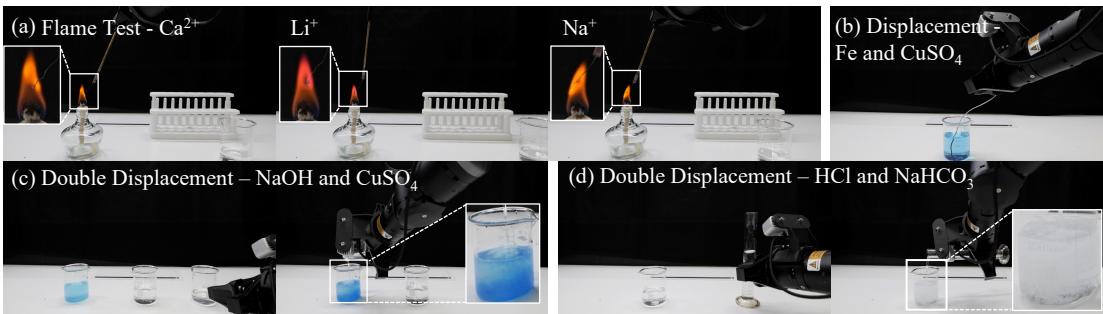
Figure 5 showcases this generalization. The system successfully performed Flame Tests (a) for different elements (\(Ca^{2+}\), \(Li^+\), \(Na^+\)), correctly interpreting the different flame colors (brick-red, purplish-red, yellow). It also handled Displacement Reactions (b) and Double Displacement (c), identifying precipitates and gas bubbles (\(CO_2\)).
This confirms that the VLM’s semantic understanding allows the robot to adapt. If the instruction changes from “Test for Sodium” to “Test for Lithium,” the VLM updates its expectations for the visual monitor (looking for red instead of yellow) without requiring the robot to be retrained from scratch.
Conclusion
RoboChemist represents a significant step forward in laboratory automation. By acknowledging that robots need both “eyes” (perception) and “brains” (reasoning) to handle the subtle dangers of chemistry, the researchers have created a system that is remarkably robust.
The key takeaways from this work are:
- Visual Prompting bridges the gap: Using a VLM to draw bounding boxes on an image provides the precise geometric grounding that VLA models lack, especially for transparent objects.
- Safety is computable: By generating prompts based on safety guidelines, the robot can adhere to strict lab protocols (e.g., “don’t touch the hot glass”).
- Closed-Loop is essential: In chemistry, you cannot simply execute a plan blindly. You must monitor the reaction. RoboChemist’s “Planner-Monitor” outer loop enables it to react to the physics of the real world.
While limitations remain—handling extremely precise quantitative tasks or assembling complex apparatus from scratch is still out of reach—RoboChemist proves that the future of science will likely involve AI agents that can not only think about experiments but physically execute them with the care and precision of a human chemist.