](https://deep-paper.org/en/paper/2509.09671/images/cover.png)
The human hand is an engineering marvel. With over 20 degrees of freedom, dense tactile sensors, and complex muscle synergies, it allows us to perform tasks ranging from threading a needle to crushing a soda can with effortless grace. Replicating this level of dexterity in robots has been a “holy grail” challenge in robotics for decades.
While we have made massive strides in computer vision and navigation, robotic manipulation—specifically using multi-fingered hands—remains surprisingly difficult. One of the most promising avenues to solve this is learning from human demonstrations. We have vast repositories of motion capture (MoCap) data showing humans interacting with objects. Theoretically, we should be able to feed this data to a robot and have it mimic the behavior.
However, a fundamental problem stands in the way: the embodiment gap. A robot hand is not a human hand. The dimensions are different, the joint limits are different, and the actuation mechanisms are fundamentally distinct. Trying to force a robot to strictly copy a human trajectory often results in awkward, impossible, or failed grasps.
In this post, we dive into DEXPLORE, a new research paper that proposes a paradigm shift. Instead of forcing robots to strictly copy human motion, DEXPLORE treats human demonstrations as “soft references,” allowing the robot to explore and adapt the motion to its own physical body.
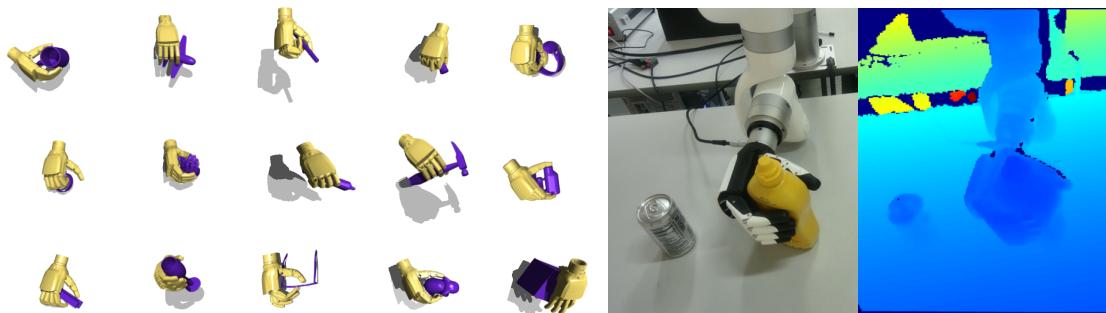
The Problem with Strict Imitation
To understand why DEXPLORE is necessary, we first need to look at how researchers currently teach robots from human data. The standard workflow is a multi-stage pipeline:
- Retargeting: Mathematical algorithms attempt to map human joint angles to robot joint angles.
- Tracking: A controller tries to execute these retargeted angles.
- Correction: Residual learning is added to fix the inevitable errors.
This approach has a major flaw: it assumes the retargeted trajectory is “correct.” But because the robot’s hand is different, a grasp that works perfectly for a human might be physically impossible for a robot. If the retargeting step introduces an error (e.g., the thumb is 1cm too far left), the downstream tracking controller is doomed to fail, no matter how good it is. The errors compound at every stage.
As shown in the comparison below, standard retargeting methods often force the robot into unnatural poses that fail to accomplish the task, especially when the robot has fewer degrees of freedom than a human.
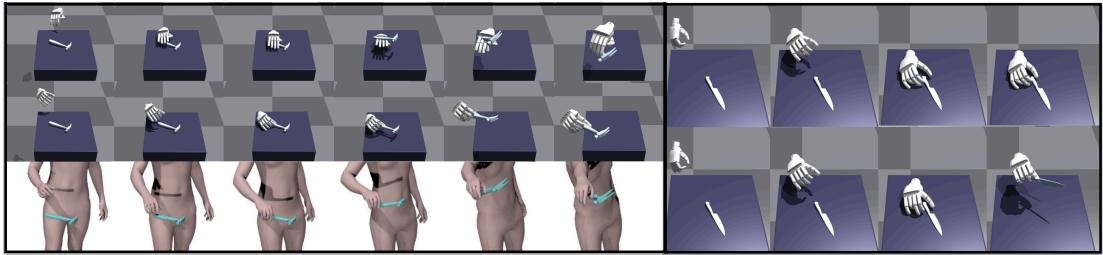
The DEXPLORE Solution: Reference-Scoped Exploration
The researchers behind DEXPLORE propose a unified, single-loop approach. Instead of a rigid pipeline, they use Reinforcement Learning (RL) where the human demonstration serves as a guide, not a rulebook.
The core philosophy is simple: Preserve the intent, not the exact coordinates.
The method is split into two distinct phases:
- State-Based Imitation Control: Learning how to manipulate using “privileged” information (exact positions of everything).
- Vision-Based Generative Control: Distilling that knowledge into a policy that runs on a real robot using only camera inputs.
Let’s break down the architecture.
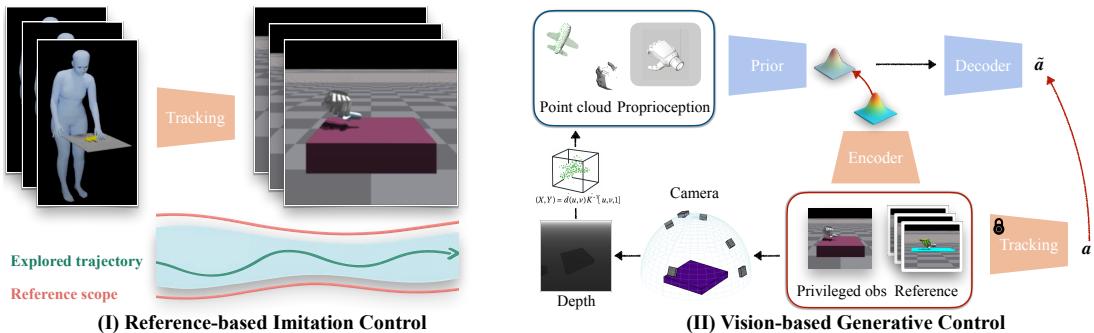
Phase 1: Learning from Soft References (The Teacher)
In the first phase (Figure 2, Section I), the robot trains in a physics simulation. It has access to the “ground truth” state of the object and its own hand.
The innovation here is Reference-Scoped Exploration (RSE).
In standard RL, the robot gets a reward for matching the human pose exactly. In DEXPLORE, the system creates a “scope” or an “envelope” around the reference trajectory.
- Early Training: The scope is wide. The robot is allowed to deviate significantly from the human motion as long as it is moving roughly in the right direction and attempting the task. This encourages exploration. The robot figures out, “Hey, my thumb is shorter than a human’s, so I need to grasp this bottle a bit lower.”
- Late Training: The system analyzes success rates. If the robot is succeeding, the scope tightens to encourage precision. If it fails, the scope remains loose to allow for alternative strategies.
The reward function is dynamic. It balances Kinematic Matching (looking like the human) with Energy Efficiency (moving smoothly). Crucially, the weight of the matching reward drops as the hand gets closer to the object. This effectively tells the robot: “Look like a human while approaching, but once you make contact, do whatever is necessary to hold the object securely.”
This single-loop optimization removes the need for a separate retargeting step. The robot learns its own retargeting strategy implicitly.
Phase 2: Going Visual (The Student)
A policy that requires exact GPS coordinates of every object vertex is useless in the real world. Real robots rely on cameras, which suffer from occlusion (the hand blocks the object) and noise.
To solve this, the researchers distill the Phase 1 policy into a Vision-Based Generative Policy (Figure 2, Section II). This is a “Teacher-Student” setup.
- The Inputs: The student policy receives a depth image (point cloud) from a single camera and the robot’s own joint angles (proprioception).
- The Architecture: They use a Conditional Variational Autoencoder (CVAE).
- The model encodes the complex manipulation behaviors into a Latent Skill Space.
- Instead of outputting a single rigid action, the policy samples from this latent space.
This latent space is powerful. It represents a library of “manipulation concepts.” Because the model is generative, it can handle uncertainty. If the camera view is blocked, the model can infer the most likely successful motion based on the learned latent skills.
As illustrated below, this generative approach allows the robot to handle novel objects and grasp geometries it hasn’t seen before by hallucinating the missing data based on its learned skills.
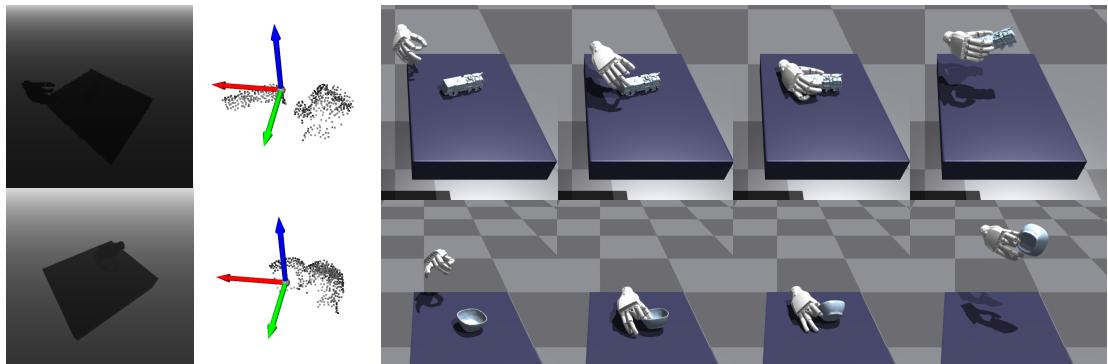
Diverse and Robust Manipulation
One of the most interesting side effects of learning a latent skill space is diversity. Because the policy isn’t memorizing a single path, it can generate multiple valid ways to grasp the same object.
In the visualization below, we can see the “imagination” of the robot. The latent space allows it to sample different valid poses for initial contact, resulting in diverse manipulation styles that all achieve the same goal.

Experimental Results
The DEXPLORE team validated their method extensively, both in simulation and on real hardware.
Simulation Performance
They tested the method on the GRAB dataset, which contains whole-body human grasping data. They compared DEXPLORE against state-of-the-art baselines like DexTrack and AnyTeleop.
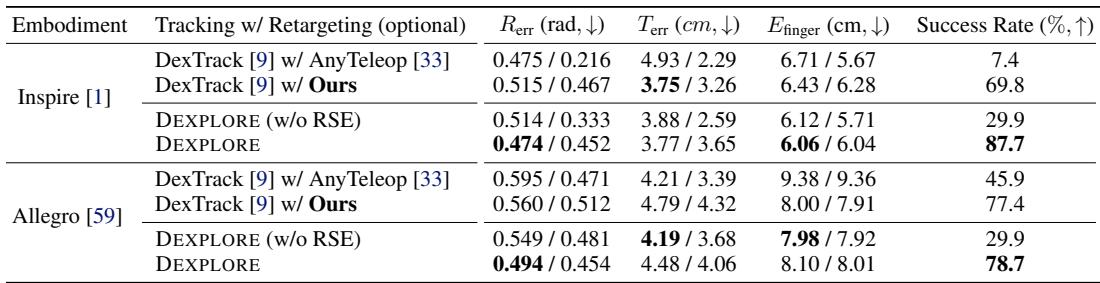
The results, summarized in Table 1 below, are striking.
- Success Rate: DEXPLORE achieved an 87.7% success rate with the Inspire hand, compared to just 7.4% for DexTrack combined with AnyTeleop.
- Tracking Error: Even though DEXPLORE is allowed to deviate from the reference (higher kinematic error), it achieves significantly better task success. This validates the hypothesis that strict tracking often leads to task failure.
Hardware Agnosticism
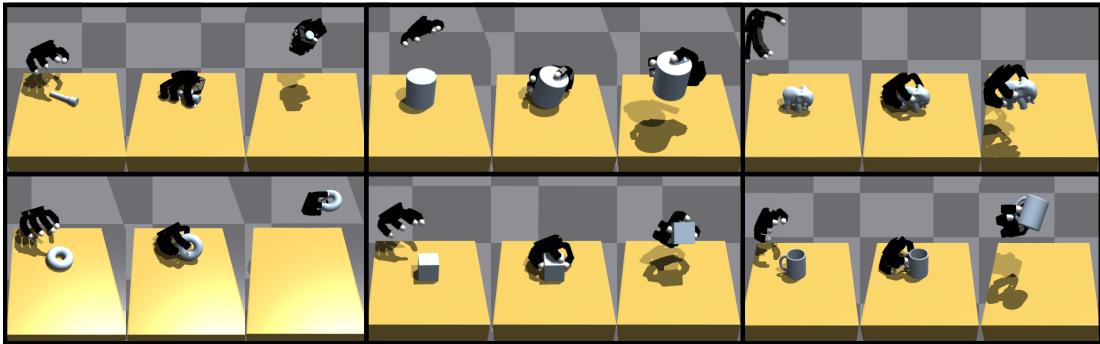
A robust algorithm shouldn’t depend on a specific robot hand. The authors demonstrated that DEXPLORE works on completely different morphologies. They tested it on the Allegro Hand, which has 4 fingers and 16 DoFs (degrees of freedom), and the Inspire Hand, which has 5 fingers but only 6 active actuators (under-actuated).
The method adapted successfully to both, proving that the “Reference-Scoped Exploration” can find embodiment-specific solutions regardless of the hardware constraints.
Real-World Deployment
Finally, the ultimate test is the real world. The team deployed the vision-based policy on an XArm-7 robot equipped with an Inspire hand and a Femto Bolt depth camera.
The setup (shown below) used no motion capture markers during inference. The robot relied entirely on its depth camera and the learned policy.
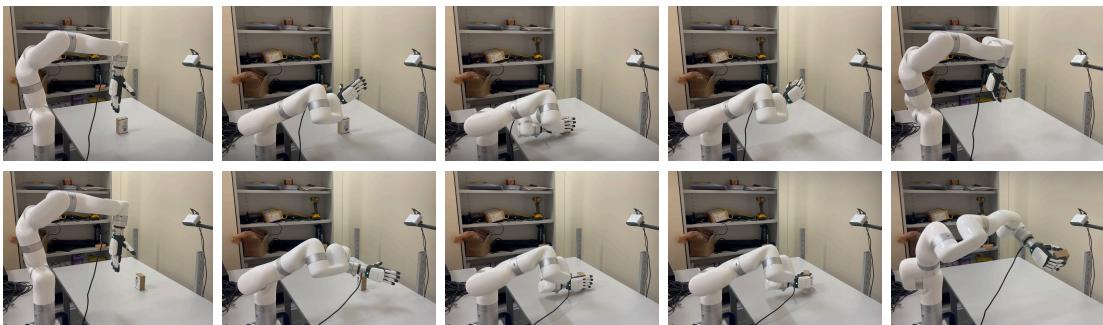
The real-world experiments highlighted robustness in several areas:
- Deformable Objects: The robot successfully grasped a cloth, a non-rigid object that is notoriously difficult to simulate perfectly.
- Heavy/Large Objects: The policy generalized to objects larger and heavier than those in the training set.


Conclusion
DEXPLORE represents a maturing of robotic control strategies. We are moving away from the rigid “playbook” approach—where a robot blindly follows a pre-recorded path—toward a more organic, intent-driven methodology.
By treating human demonstrations as soft guidance rather than hard constraints, DEXPLORE allows robots to bridge the embodiment gap. It gives robots the agency to figure out how to use their specific bodies to achieve a human-like goal. Furthermore, by distilling this capability into a vision-based generative model, the research provides a scalable path toward robots that can operate in unstructured, real-world environments.
As we look toward a future of general-purpose domestic robots, techniques like Reference-Scoped Exploration will be essential for helping machines navigate a world designed for human hands.