](https://deep-paper.org/en/paper/2509.10454/images/cover.png)
Unlocking Zero-Shot Robot Navigation: How Graph Constraints Turn Language into Motion
Imagine telling a robot, “Go through the living room, pass the sofa, and stop at the white table near the window.” To a human, this is a trivial task. We visualize the path, identify landmarks (sofa, table), and understand spatial relationships (pass, near). To a robot, however, this is a massive computational headache involving language processing, visual recognition, and path planning.
This field is known as Vision-and-Language Navigation (VLN). Traditionally, solving VLN has relied heavily on training massive neural networks in simulated environments. While these models can learn to navigate specific video game-like houses, they often fail when deployed in the real world—a problem known as the sim-to-real gap.
But what if a robot didn’t need to be trained to navigate? What if it could just reason its way through?
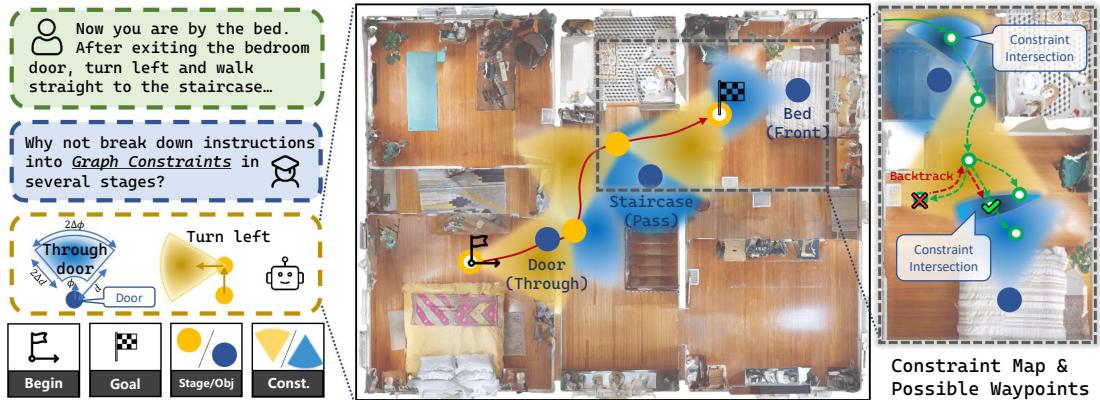
In this post, we will dive into GC-VLN, a novel framework presented by researchers from Tsinghua University. They propose a training-free approach that treats navigation instructions not as data to be memorized, but as a set of mathematical graph constraints to be solved. By combining Large Language Models (LLMs) with geometric optimization, GC-VLN achieves state-of-the-art results without needing a single epoch of navigation training.
The Problem: The Gap Between Simulation and Reality
To understand why GC-VLN is significant, we first need to look at the limitations of current approaches.
Discrete vs. Continuous Environments
Early VLN research often used discrete environments. Imagine the world as a graph of pre-defined nodes. The robot jumps from Node A to Node B. This makes the math easier, but real robots don’t teleport between nodes; they move continuously through space. VLN-CE (Continuous Environment) attempts to fix this by allowing robots to move freely. However, most methods for VLN-CE rely on unsupervised training within simulators. When you take a robot trained in a perfect, glitch-free simulator and put it in a messy, real-world office, it often fails.
The “Training-Free” Ambition
The “holy grail” of robotic navigation is a system that is:
- Zero-Shot: Can navigate environments it has never seen before.
- Training-Free: Doesn’t require computationally expensive training cycles on navigation datasets.
- Sim-to-Real Robust: Works on a physical robot just as well as it does in a simulator.
GC-VLN achieves this by shifting the paradigm from “learning a policy” to “solving a constraint problem.”
The GC-VLN Framework
The core insight of GC-VLN is that every navigation instruction can be broken down into a series of geometric rules. “Walk past the chair” isn’t just a sentence; it’s a mathematical constraint dictating that the robot’s trajectory must intersect a specific region relative to the chair’s coordinates.
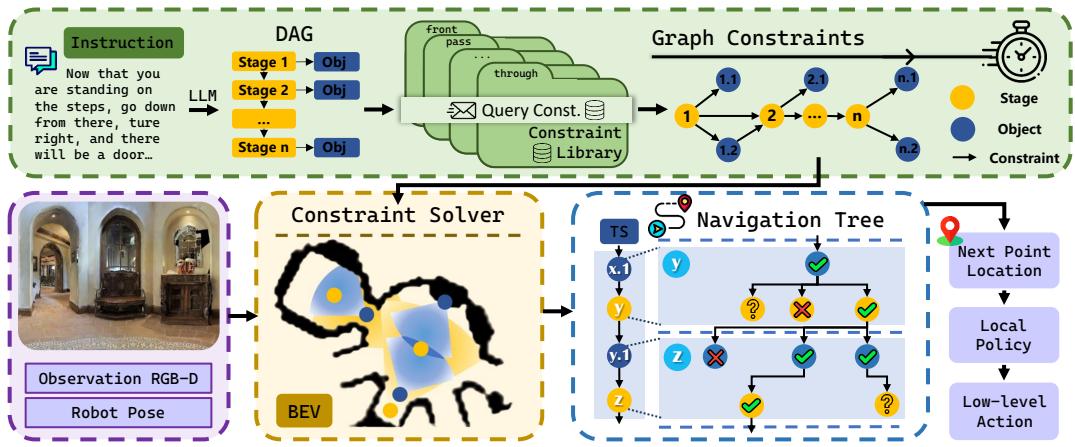
The framework operates in a pipeline:
- Decompose the natural language into a structured graph.
- Map the graph to a library of spatial constraints.
- Solve for the next waypoint using optimization.
- Backtrack using a navigation tree if the robot gets stuck.
Step 1: Instruction Decomposition
The process begins with a human instruction. The system utilizes a Large Language Model (LLM) to parse this text. The goal isn’t just to “understand” the text, but to convert it into a Directed Acyclic Graph (DAG).
In this graph:
- Nodes represent waypoints (where the robot should be) or objects (landmarks like “table” or “door”).
- Edges represent the relationships between them.
For example, if the instruction is “Walk past the fridge to the sink,” the graph establishes a dependency: the robot must satisfy the spatial constraint regarding the “fridge” before it can satisfy the constraint regarding the “sink.”
Step 2: The Constraint Library
This is where the method shines. The researchers created a Constraint Library that categorizes every possible spatial relationship found in navigation instructions into six mathematical types.
Instead of vague concepts, the robot deals with precise geometry. As shown in the diagram below, a constraint defines a “possible region” (green) relative to a reference point (blue).
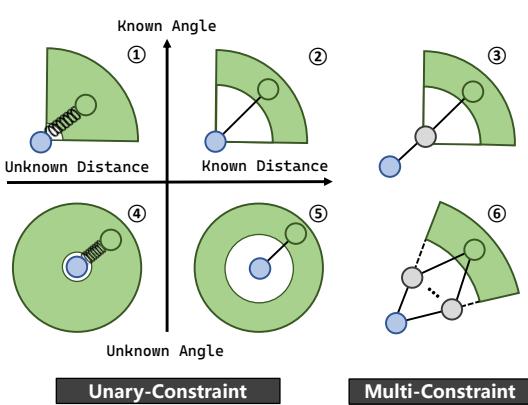
- Unary Constraints: Relationships involving distance and angle from a single point (e.g., “move forward 3 meters”).
- Multi-Constraints: Relationships involving multiple objects (e.g., “go between the two chairs”).
Mathematically, a constraint \(c(v|u)\) (where \(v\) is the target position and \(u\) is the current position or object) is defined by checking if the proposed position satisfies specific angle (\(\phi\)) and distance (\(d\)) requirements.
The paper formulates these constraints using the following equations:

Here, \(c^a\) represents the angle constraint (is the target in the correct direction?) and \(c^d\) represents the distance constraint (is the target at the correct distance?). The function ensures the robot moves within a tolerance cone defined by \(\cos(\Delta \phi)\) and distance tolerance \(\Delta d\).
Step 3: The Constraint Solver
Once the instruction is turned into a graph of these constraints, navigation becomes an optimization problem. The robot doesn’t “guess” where to go; it calculates the coordinates \((x, y)\) that maximize the satisfaction of the constraints.
The system uses a Topological Sort (TS) on the graph. This ensures the robot solves the path in the correct order (e.g., handle the “start point” constraints before the “mid-point” constraints).
The solver treats the waypoints \(v_i^w\) as variables to be solved. It uses a pre-trained vision model (like Grounded-SAM-2) to identify object nodes \(v_{ij}^o\) in the real world (e.g., the camera sees the “chair” and determines its coordinates).
The optimization problem is formulated as maximizing the sum of constraint satisfactions:
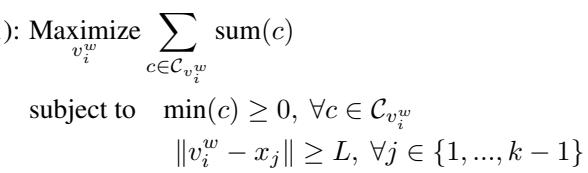
Essentially, the math asks: “Find me a point \((x,y)\) that is ‘front’ of the current spot, ’near’ the observed table, and ’left’ of the observed door.”
Step 4: The Navigation Tree and Backtracking
Real-world navigation is messy. Sometimes the vision system misidentifies a chair, or the solver finds multiple valid paths.
To handle uncertainty, GC-VLN builds a Navigation Tree.
- The root is the starting point.
- Branches represent possible solutions for the next waypoint.
- The depth of the tree corresponds to the stages of the instruction.
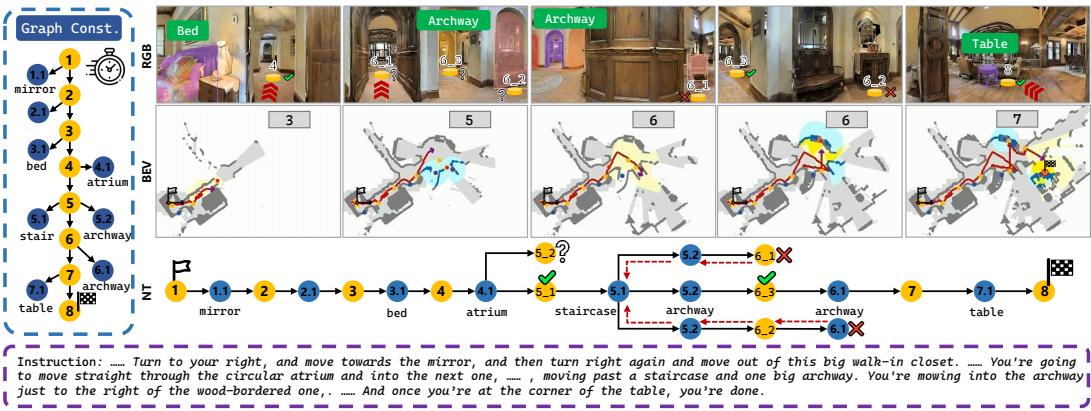
If the robot moves to a point and realizes it can no longer satisfy the next constraints (e.g., it turned left, but now sees a wall where the “kitchen” should be), it triggers a backtracking mechanism. It moves back up the tree to the previous decision point and tries a different branch. This exploration capability significantly increases the success rate compared to methods that commit blindly to a single predicted path.
Experiments and Results
The researchers tested GC-VLN in both high-fidelity simulators and the real world.
Simulator Performance
The method was evaluated on R2R-CE and RxR-CE, two standard benchmarks for continuous environment navigation. The key metrics are Success Rate (SR) and SPL (Success weighted by Path Length—essentially, did you get there, and did you take a direct route?).
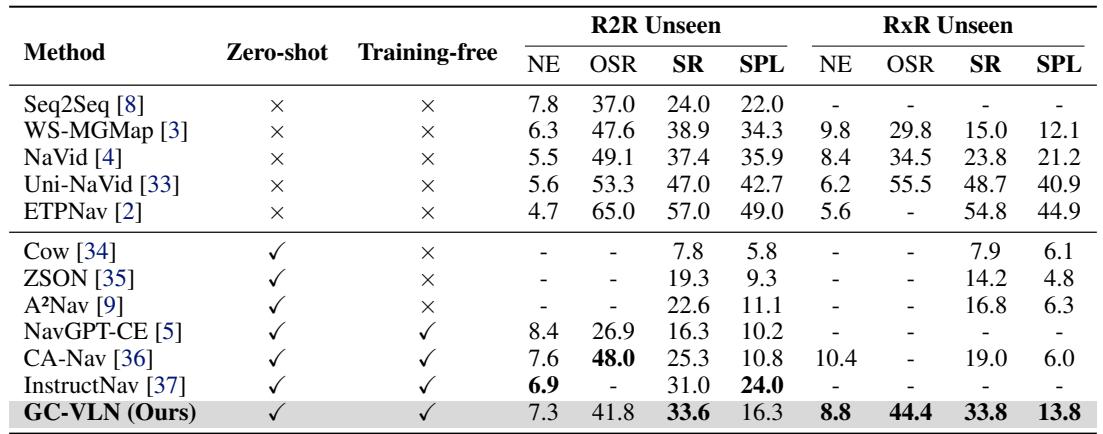
As seen in Table 1, GC-VLN (bottom row) outperforms existing Zero-Shot and Training-Free methods.
- On R2R-CE, it achieves a 33.6% Success Rate, beating the previous best training-free method (InstructNav at 31.0%) and significantly outperforming zero-shot methods like ETPNav in generalization efficiency.
- On RxR-CE, which features longer and more complex instructions, the gap is even wider.
Real-World Deployment
Perhaps the most impressive aspect of GC-VLN is its ability to run on a physical robot without modification. Because the system relies on geometric constraints rather than learned visual features of a specific simulator, it doesn’t suffer from the “texture” differences between a video game and reality.
The researchers deployed the system on a “Hexmove” robot equipped with RGB-D cameras.
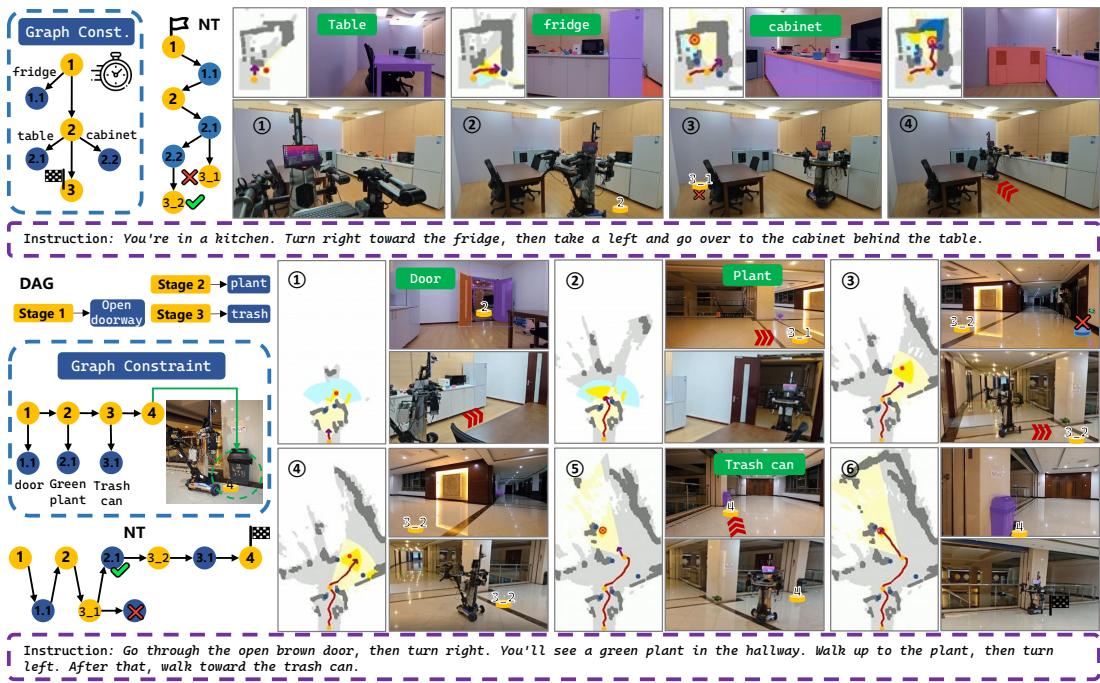
In the example above, the robot successfully navigates a real office environment by identifying the “mirror,” navigating the “atrium,” and finding the “cabinet,” strictly following the graph constraints generated from the prompt.
Failure Analysis
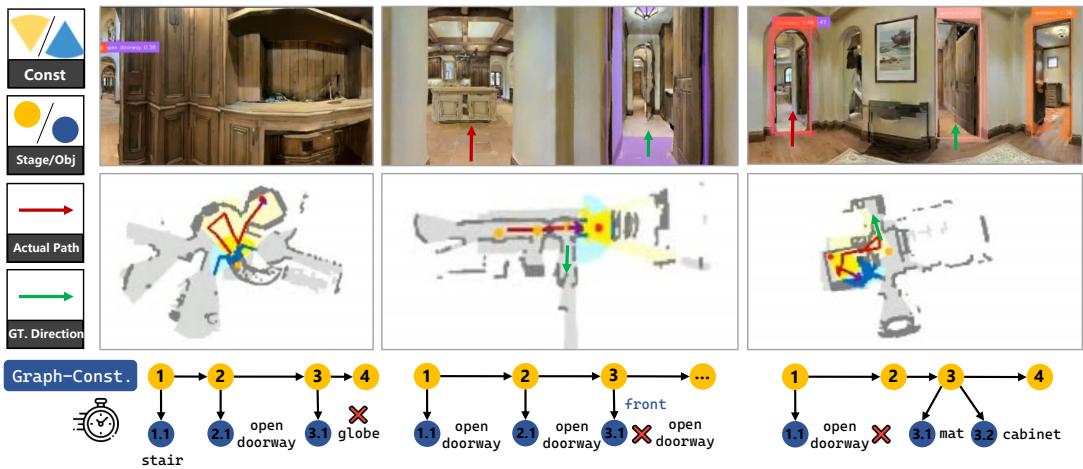
No system is perfect. The authors provide an honest look at where GC-VLN struggles. Failures primarily stem from:
- Perception Errors: If the vision model fails to detect an object (e.g., missing a “globe”), the constraint solver has no reference point.
- Ambiguity: Sometimes an instruction like “right” is interpreted relative to the wrong reference frame.
- Coincidental Success (False Positives): The robot might take a wrong turn but coincidentally see an object that matches the description of the next target, confusing the solver.
Conclusion & Implications
GC-VLN represents a shift in how we approach embodied AI. Instead of throwing massive amounts of data at a black-box neural network and hoping it learns the concept of “spatial reasoning,” this framework explicitly models that reasoning.
By combining the linguistic power of LLMs with the rigorous logic of graph constraints, GC-VLN achieves:
- True Generalization: It works in new environments immediately.
- Interpretability: Unlike end-to-end networks, we can look at the graph and see exactly why the robot decided to turn left.
- Sim-to-Real Transfer: It effectively ignores the visual gap between simulation and reality.
This work paves the way for more robust autonomous agents that can act as helpful assistants in our homes and offices, understanding our instructions not just as words, but as actionable geometric plans.