](https://deep-paper.org/en/paper/2509.10952/images/cover.png)
Introduction
One of the most persistent bottlenecks in robotics is the cost of data. To teach a robot a new skill—like cracking an egg or using a hammer—we typically need hundreds, if not thousands, of teleoperated demonstrations. This process is slow, expensive, and scales poorly.
On the other hand, we have the internet. Platforms like YouTube are overflowing with millions of videos of humans performing exactly these kinds of manipulation tasks. In theory, this is a goldmine of training data. But in practice, a massive barrier stands in the way: the domain gap.
A human hand looks nothing like a two-finger robotic gripper. Our skin tone, the lighting in our kitchens, and the specific way our joints move are drastically different from a robot’s metallic structure and sterile lab environment. Because of these visual and physical discrepancies, a robot cannot simply “watch and learn” directly from a human video.
In this post, we dive deep into a paper titled “ImMimic: Cross-Domain Imitation from Human Videos via Mapping and Interpolation.” The researchers propose a novel framework that doesn’t just treat human videos as a reference, but actively blends them with robot data to create a smooth learning path.
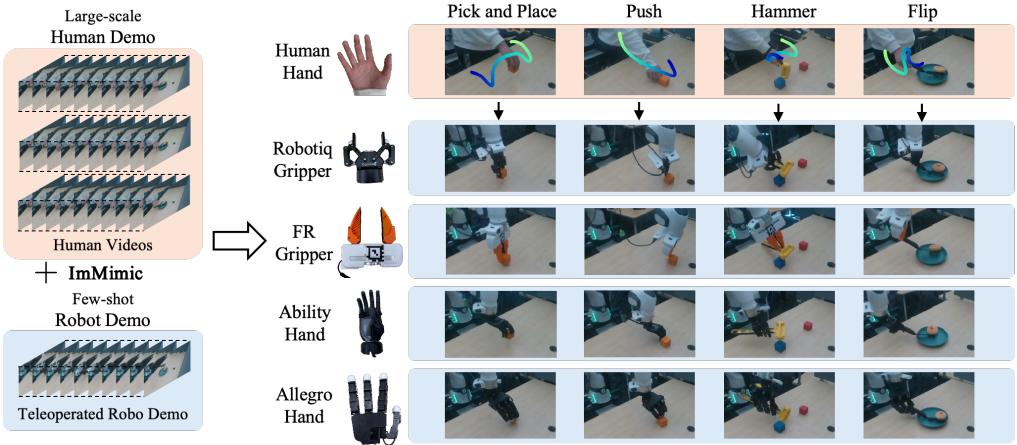
As shown in Figure 1, the ImMimic framework leverages large-scale human videos alongside a small set of robot demonstrations. By using a clever combination of mapping and mathematical interpolation, it allows diverse robots—from simple grippers to complex five-fingered hands—to learn robust manipulation skills.
Background: The Challenge of Cross-Domain Imitation
To understand why ImMimic is necessary, we have to look at how robots usually learn from humans.
The Two Domains
In this context, we have two distinct domains:
- Source Domain (Human): Abundant video data, but the “agent” (the human) has a different morphology (hand shape) and appearance than the robot.
- Target Domain (Robot): The actual hardware we want to control. Data here is scarce because collecting it requires a human to manually control the robot (teleoperation).
Previous Approaches vs. ImMimic
Traditional methods often try to force these two domains together by “masking out” the robot or human hand in the images, hoping the network only pays attention to the object being moved. Others try to align the visual features using unsupervised learning.
However, these methods often ignore the most important part: the action. The trajectory of a human hand contains rich information about how to solve a task. ImMimic operates on the insight that we should leverage both the visual context and the physical action trajectory.
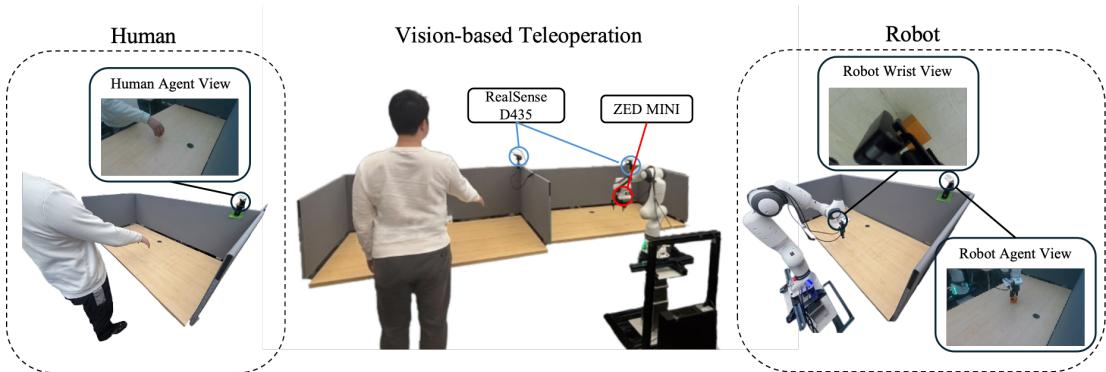
The system setup, illustrated below, highlights the duality of data collection. We have unconstrained human demos on one side and precise, teleoperated robot demos on the other.
The ImMimic Framework
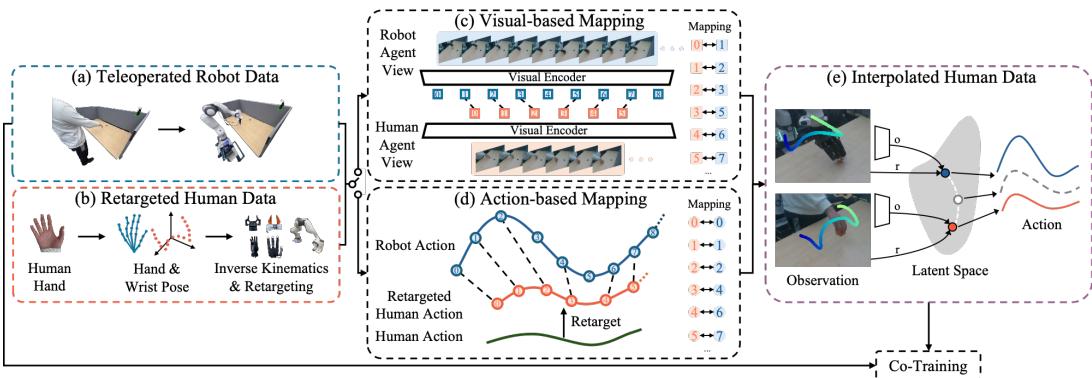
The core philosophy of ImMimic is Co-Training. Instead of pre-training on human data and fine-tuning on robot data (a two-stage process), the model learns from both simultaneously. But you can’t just throw mismatched data into a pile and hope for the best. You need a bridge.
ImMimic builds this bridge in three steps:
- Retargeting: translating human poses into robot actions.
- Mapping: aligning human and robot timelines.
- Interpolation (MixUp): blending the data to fill the gap.
Let’s break down the full pipeline.
1. Hand Pose Retargeting
Before the robot can understand a human video, the human’s motion must be translated into the robot’s language.
The system first extracts the 3D position of the human hand and fingers using tools like MediaPipe and FrankMocap. Once the human hand pose is estimated, it must be “retargeted” to the robot’s joint space. This is done by solving an optimization problem. The goal is to find robot joint angles (\(\mathbf{q}_t\)) that make the robot’s fingertips end up in similar positions to the human’s fingertips, while ensuring the motion is smooth over time.
The researchers use the following objective function for retargeting:

Here:
- \(\mathbf{p}_t^i\) is the position of the human finger keypoint.
- \(f_i(\mathbf{q}_t)\) is the robot’s forward kinematics (where the robot’s finger ends up given joint angles \(\mathbf{q}_t\)).
- The second term (\(\beta \| \dots \|\)) ensures temporal smoothness so the robot doesn’t jitter.
2. The Policy Architecture
The underlying “brain” of the robot is a Diffusion Policy. Diffusion models, popular in image generation (like Stable Diffusion), have recently shown incredible success in robotics for generating smooth, multimodal action sequences.
As seen in the architecture diagram below, the system processes two streams of data:
- Robot Stream: Takes agent-view images, wrist-view images, and proprioception (joint states).
- Human Stream: Takes agent-view images and the retargeted actions we calculated in the previous step.
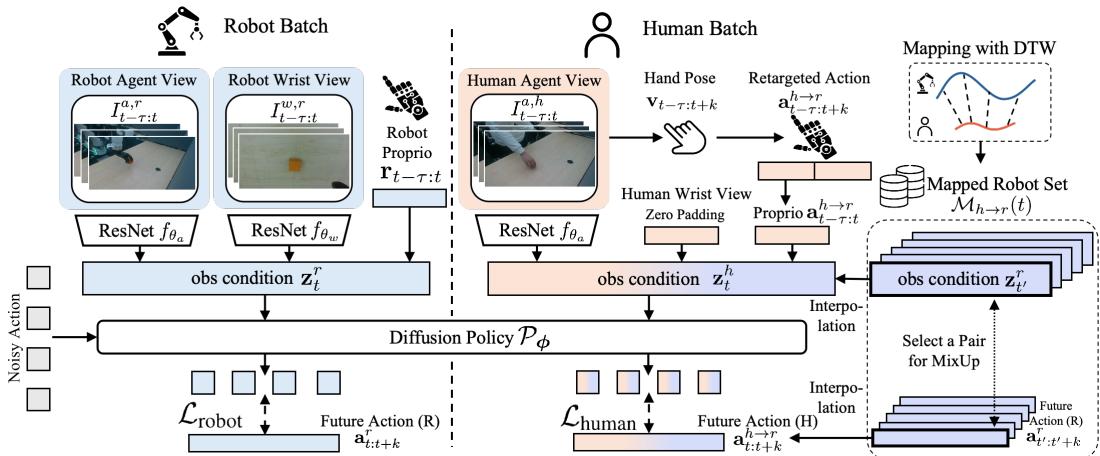
The model is trained to minimize the difference between the predicted action and the ground truth action (for robots) or the retargeted action (for humans).
3. Mapping via Dynamic Time Warping (DTW)
Here lies a critical challenge: humans and robots move at different speeds. A human might grab a cup in 1 second; a careful robot might take 3 seconds. To learn effectively, we need to match a specific moment in the human video to the corresponding moment in the robot demonstration.
The authors use Dynamic Time Warping (DTW) to solve this. DTW is an algorithm that aligns two sequences that may vary in speed.
The paper investigates two ways to align these sequences:
- Visual-based Mapping: aligning frames that look similar.
- Action-based Mapping: aligning frames where the movement (trajectory) is similar.
Key Insight: The researchers found that Action-based Mapping is significantly better. Visual features can be noisy—lighting changes or background clutter can confuse the alignment. However, the geometry of the movement (e.g., “moving forward and closing grippers”) is a robust signal that remains consistent across domains.
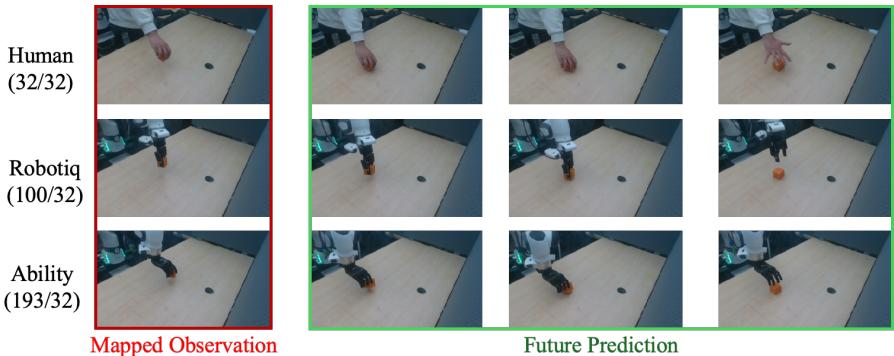
We can visualize this alignment process below. The system pairs human observations (top) with robot observations (bottom) that correspond to the same phase of the task, even if they happened at different absolute times.
4. Mapping-guided MixUp Interpolation
This is the most innovative part of ImMimic. Once we have aligned the human data to the robot data using DTW, we don’t just train on them separately. We mix them.
Inspired by a technique called MixUp, the researchers create “intermediate domains.” Imagine a sliding scale where 0% is pure robot and 100% is pure human. ImMimic generates training samples that lie somewhere in between.
For a paired human input (\(\mathbf{z}^h\)) and robot input (\(\mathbf{z}^r\)), and their corresponding actions, the new “mixed” sample is calculated as:

Here, \(\alpha\) is a mixing coefficient. By training on these interpolated samples, the network learns a smooth transition manifold in the latent space. It forces the model to understand that the human data and robot data are just two variations of the same underlying skill.
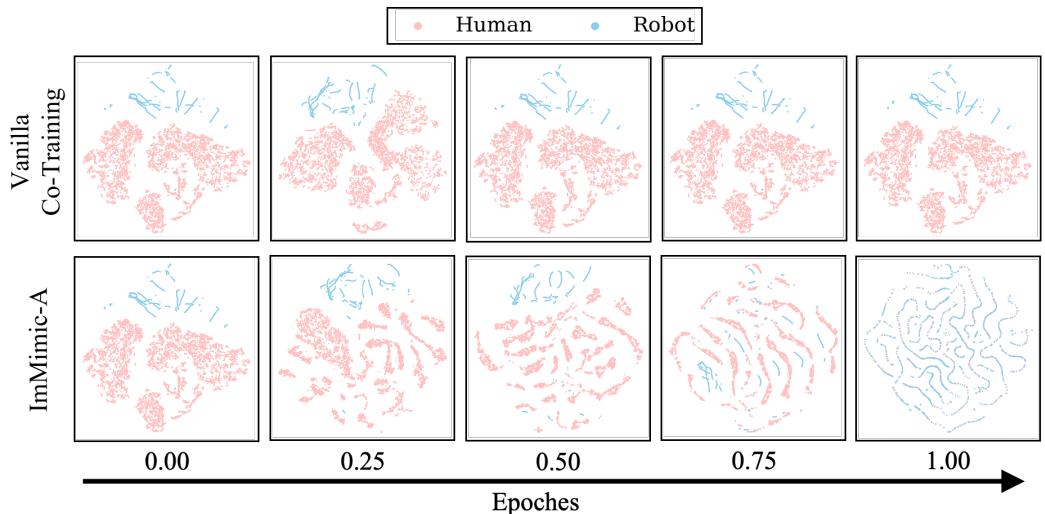
Visualizing the latent space using t-SNE (a dimensionality reduction technique) reveals the effect of this interpolation. In standard co-training (top row), human and robot data remain in separate clusters. In ImMimic (bottom row), the domains merge into a continuous flow, allowing the robot to generalize better from the human data.
Experiments and Results
The team evaluated ImMimic on four tasks: Pick and Place, Push, Hammer, and Flip. They tested these tasks on four significantly different end-effectors:
- Robotiq Gripper: A standard 2-finger parallel gripper.
- Fin Ray Gripper: A compliant, deformable gripper.
- Allegro Hand: A large 4-fingered robotic hand.
- Ability Hand: A dexterous 5-fingered hand.
Does ImMimic Work?
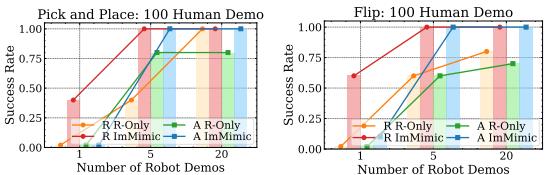
The results show a clear advantage. ImMimic-A (ImMimic using Action-based mapping) consistently outperforms models trained only on robot data (“Robot Only”) and standard co-training methods.
In the graph below (Figure 4), we see the performance on “Pick and Place” using 100 human demonstrations. Even with very few robot demos, ImMimic (dotted/dashed lines) achieves high success rates much faster than the baselines.
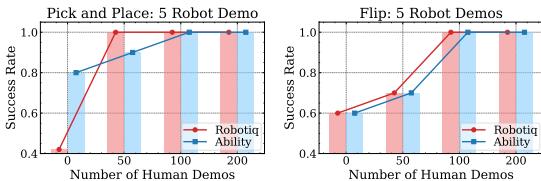
Similarly, Figure 5 demonstrates that adding human data drastically improves sample efficiency. With just 5 robot demonstrations, ImMimic can reach near 100% success rate by leveraging the human video data, whereas the robot-only baseline struggles.
Action vs. Visual Mapping
To further prove that mapping based on actions is better than visuals, the authors conducted a retrieval experiment. They tried to find the correct matching robot segment for a human video segment under different disturbances (like changing the background or altering the object).
As shown in Figure 6, visual-based mapping suffers heavily when visual disturbances are introduced (the blue bars drop significantly). Action-based mapping (green bars) remains robust because the motion trajectory itself hasn’t changed, even if the visual scene has.
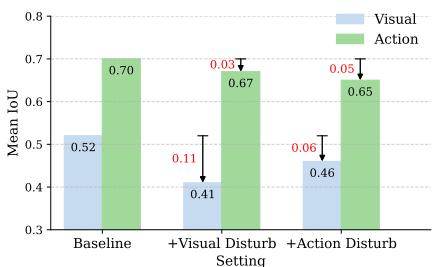
This confirms a major hypothesis of the paper: retargeted human hand trajectories provide more informative labels than visual context alone.
The “Human-Like” Paradox
An interesting finding from the paper is that more human-like hands do not necessarily yield better performance.
Intuitively, one might think the Allegro or Ability hands (which look more like human hands) would learn easier from human video than a simple 2-finger gripper. However, the experiments showed that the action distance (the mathematical difference in trajectory) was actually higher for the complex hands.
Why? Complex hands are harder to control. Factors like the mounting angle, the length of the thumb, or the friction of the fingertips play a huge role.
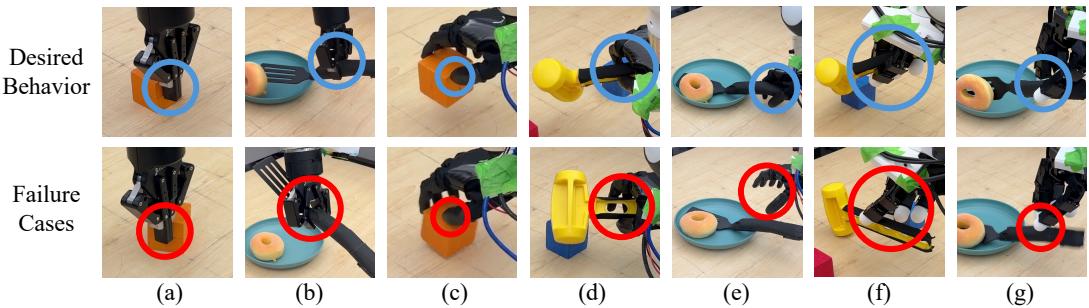
The figure below highlights failure cases. For example, in (g), the large size of the Allegro hand makes it clumsy when trying to flip a bagel. In (a), the thin tips of the Robotiq gripper cause the object to slip during a push. This highlights that while ImMimic bridges the algorithmic gap, the hardware gap remains a physical constraint.
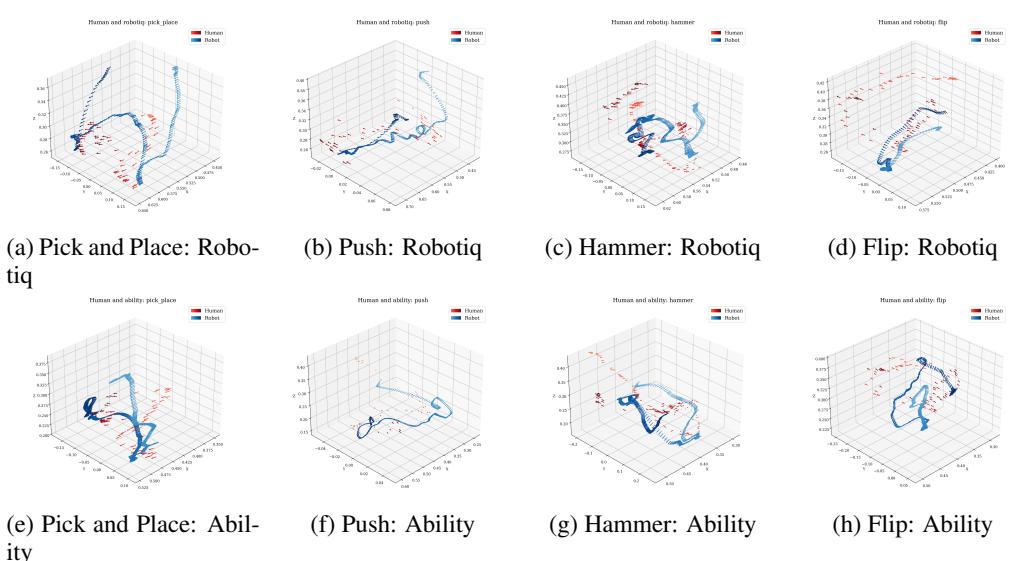
We can also visualize the trajectories directly. Figure E.1 shows the human retargeted trajectory (red) versus the robot trajectory (blue). While they follow the same general trend, the morphological differences result in distinct paths, which ImMimic successfully aligns.
Conclusion
ImMimic represents a significant step forward in our ability to utilize the vast ocean of human video data for robotics. By acknowledging the domain gap and actively bridging it through retargeting, DTW mapping, and MixUp interpolation, the framework allows robots to “mimic” humans more effectively than ever before.
Key takeaways for students and researchers:
- Don’t ignore the action: Visual adaptation is good, but aligning the physical trajectories (actions) provides a much stronger supervision signal.
- Smooth the space: Co-training works best when you create a continuous path between domains (interpolation) rather than treating them as binary opposites.
- Morphology matters: A robot hand that looks human might not mathematically move like a human due to kinematics. Algorithms need to account for this reality.
ImMimic moves us closer to a future where robots can learn to cook, clean, or use tools simply by watching us do it first—even if they only have two metal fingers to work with.