](https://deep-paper.org/en/paper/2509.12741/images/cover.png)
Imagine trying to put a jacket on a toddler. Now, imagine that toddler is actively moving—reaching for a toy, scratching their head, or waving. It is a task that requires patience, visual coordination, and, crucially, a sense of touch. If the sleeve gets stuck, you feel the resistance and adjust your angle. You don’t just keep pushing.
For assistive robots, dressing a human is one of the “holy grail” challenges. It promises to restore independence to millions of individuals with mobility impairments. However, it is also a nightmare of physics and safety. Clothes are deformable objects with infinite ways to fold and snag. Humans are dynamic; they move, tremble, and shift posture.
In this post, we will deep dive into a fascinating research paper, “Force-Modulated Visual Policy for Robot-Assisted Dressing with Arm Motions,” which proposes a robust solution to this problem. The researchers introduce a system that doesn’t just “see” the garment but also “feels” the interaction through force feedback, allowing it to adapt to a moving human arm in real-time.
The Core Problem: Why is Robot Dressing So Hard?
To understand the contribution of this paper, we first need to appreciate the difficulty of the task.
- Deformable Object Manipulation: Unlike picking up a rigid mug, a shirt changes shape constantly. There is no single “state” to track.
- Occlusion: As the robot pulls a jacket onto an arm, the jacket itself blocks the camera’s view of the arm. The robot effectively becomes blind to the exact position of the limb it is trying to dress.
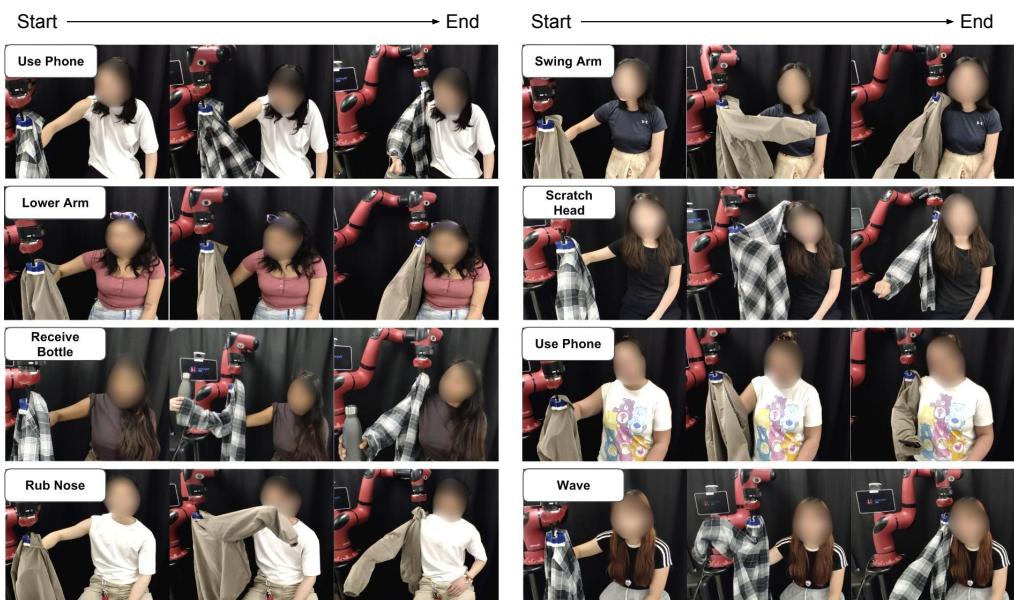
- Human Motion: Most prior research assumes the human stays perfectly still (like a mannequin). In reality, people with mobility impairments may have tremors, or they might simply move naturally (e.g., checking a phone). If a robot assumes a static arm, and the arm moves, the robot might force the garment into a collision, causing injury.
The researchers argue that vision alone is not enough. When your view is blocked by a jacket, you need another sense to tell you what is happening underneath the fabric. That sense is force.
The Solution: Force-Modulated Visual Policy (FMVP)
The researchers propose a method called Force-Modulated Visual Policy (FMVP). The high-level idea is to train a robot using a combination of large-scale simulation and a small amount of real-world data that fuses two sensory inputs:
- Vision: A point cloud from a depth camera to understand the geometry of the cloth and person.
- Force: Readings from the robot’s arm to detect resistance and contact.
The method is broken down into a three-stage pipeline.
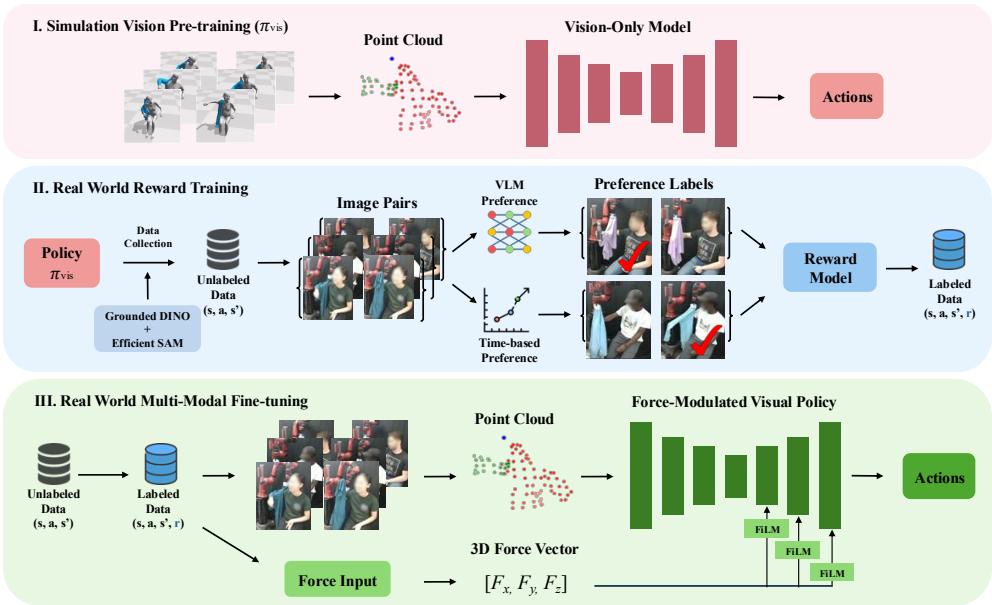
Let’s walk through these three stages in detail.
Stage 1: Vision-Based Pre-training in Simulation
Training a robot in the real world from scratch is dangerous and slow. If the robot flails around trying to learn physics, it might hurt someone. Therefore, the team starts in a simulator (NVIDIA FleX).
In simulation, they train a Vision-Based Policy (\(\pi_{vis}\)) using Reinforcement Learning (RL).
- Observation: The robot sees a “point cloud”—a 3D set of dots representing the garment and the visible part of the human arm. Crucially, the simulation mimics real-world “partial observability,” meaning the policy doesn’t get to see the whole arm if it’s covered by cloth.
- Limitation: Simulation isn’t perfect. It assumes the arm is static (because simulating cloth dynamics on moving arms is computationally unstable). Furthermore, simulators are notoriously bad at modeling accurate friction and force data for soft cloth.
So, at the end of Stage 1, we have a robot that is decent at the general motions of dressing a static person but has no concept of force and gets confused if the person moves.
Stage 2: Real-World Data Collection and Reward Labeling
To cross the “Sim-to-Real” gap, the robot needs real-world experience. The researchers take the policy from Stage 1 and run it on real people.
Because the Sim-policy isn’t perfect, the data collected here is “sub-optimal.” The robot might get stuck or take inefficient paths. However, this noisy data is valuable if we can learn from it. But to learn, we need a “Reward Function”—a way to mathematically score how good a specific action was.
In simulation, calculating reward is easy (we know exactly where the cloth particles are). In the real world, we only have camera images. How do we grade the robot?
The authors use a clever mix of Vision-Language Models (VLMs) and time-based heuristics to label this data.
The Preference-Based Reward Model
Instead of manually defining a reward function, they train a neural network to predict rewards based on preferences. They show pairs of images (Segment A vs. Segment B) to a VLM (like GPT-4V) and ask: “In which image is the jacket more successfully dressed?”
\[ P _ { \theta } [ \tau _ { i } \succ \tau _ { j } ] = \frac { \exp \left( r _ { \theta } ( \tau _ { i } ) \right) } { \exp \left( r _ { \theta } ( \tau _ { i } ) \right) + \exp \left( r _ { \theta } ( \tau _ { j } ) \right) } \]This equation represents the Bradley-Terry model used to train the reward network. Essentially, the network \(r_{\theta}\) learns to assign a higher scalar value to the image trajectory (\(\tau\)) that the VLM preferred.
They also add a safety constraint. A dressing attempt is bad if it exerts too much force. They penalize high forces using the following formula:
\[ r _ { \mathrm { f o r c e } } = - \operatorname* { m i n } \left( 1 , { \frac { \| \mathbf { f } \| } { 8 } } \right) ^ { 2 } \]This creates a “soft” penalty that grows quadratically as force increases, discouraging the robot from simply powering through resistance.
Stage 3: Multi-Modal Fine-Tuning with FiLM
This is the most critical technical contribution. The team takes the simulation-trained policy and fine-tunes it using the real-world data collected in Stage 2.
They use an Offline RL algorithm called IQL (Implicit Q-Learning). But they don’t just retrain the vision network; they inject the Force data into it.
How Vision and Force are Fused
The researchers don’t just concatenate the force vector to the image vector. They use a technique called FiLM (Feature-wise Linear Modulation).
Imagine the vision network is analyzing the 3D geometry of the scene. FiLM layers allow the Force input to “modulate” or adjust how the network interprets that visual data.
- If the force is low (0 Newtons), the visual features might be processed normally.
- If the force is high (indicating a snag), the FiLM layer shifts the neural network’s activations, effectively telling the policy: “The visual data says go forward, but the force data implies we are stuck, so change the plan.”
This allows the policy to be force-modulated. It doesn’t just react to force; the force changes how it sees the world.
Simulation Experiments: Proving the Concept
Before touching humans, the method was rigorously tested in a secondary simulation environment (PyBullet/Assistive Gym) to verify that the fine-tuning actually works. This setup served as a “Sim-to-Sim” transfer test.
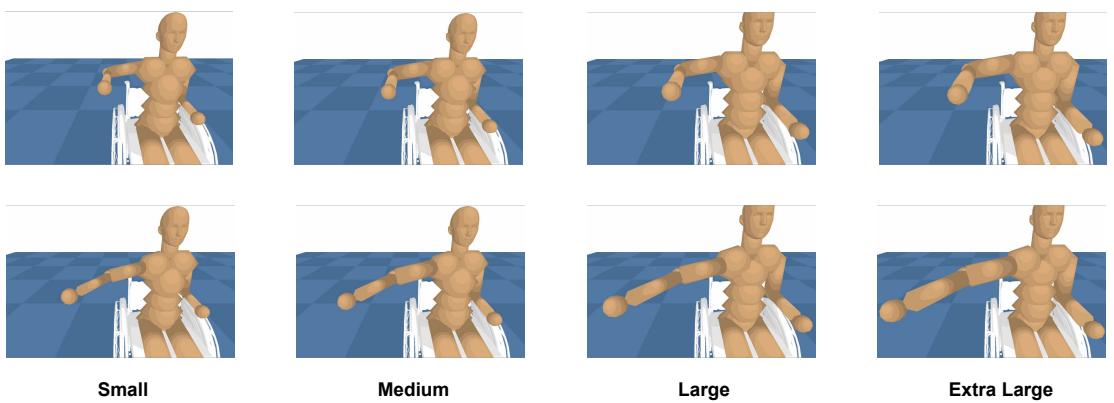
They tested the robot on four different body sizes (Small to Extra Large) and diverse arm motions.
The results were striking. The FMVP (Ours) method significantly outperformed the baseline Vision-only policy and other force-integration methods.
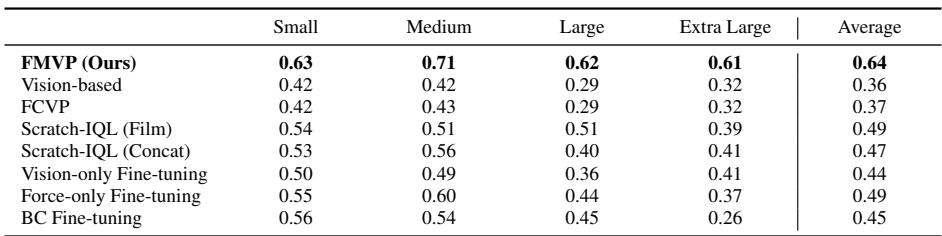
As shown in Table 1, the “Vision-based” policy struggles, especially as body sizes change (dropping to 0.29 success ratio on Large bodies). The FMVP method remains robust, maintaining scores above 0.60 across all sizes. This proves that incorporating force feedback helps the robot generalize to body shapes it hasn’t seen before.
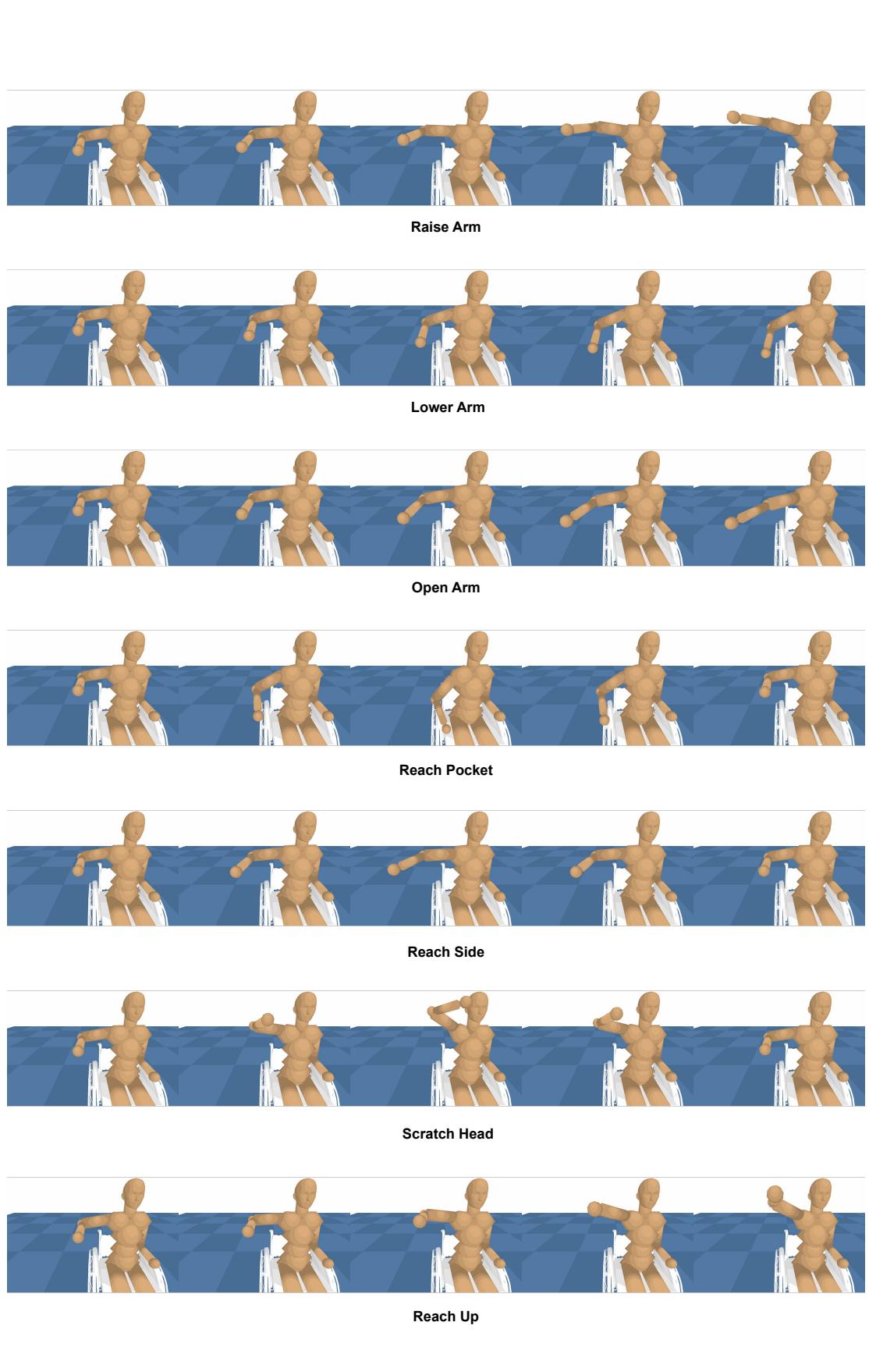
The team also tested the robot against distinct arm motions, ranging from simply lowering the arm to scratching the head.
Real-World Human Study
The ultimate test for any robotics paper is the real world. The researchers recruited 12 participants for a study involving 264 dressing trials.
The Setup:
- Robot: Sawyer robotic arm.
- Garments: Two long-sleeve everyday garments (a plaid shirt and a brown jacket).
- Task: Dress the sleeve fully onto the participant’s arm.
- Condition: Participants were asked to perform specific motions (like checking a phone, waving, or improvised movement) during the dressing process.

Quantitative Results
The primary metric was the “Upper Arm Dressed Ratio”—how much of the sleeve successfully made it up the arm.
The results validated the simulation findings. FMVP achieved an average Upper Arm Dressed Ratio of 0.79, compared to 0.63 for the Vision-based policy and 0.50 for a baseline called FCVP (Force-Constrained Visual Policy).
Note: FCVP is a method that uses force only to stop unsafe actions, rather than learning a unified policy. The failure of FCVP highlights that simply “avoiding high force” isn’t enough; the robot needs to actively use force data to find a better path.
Qualitative Results: How did it feel?
In assistive robotics, user comfort is just as important as task success. The participants were asked to rate their experience on a Likert scale.
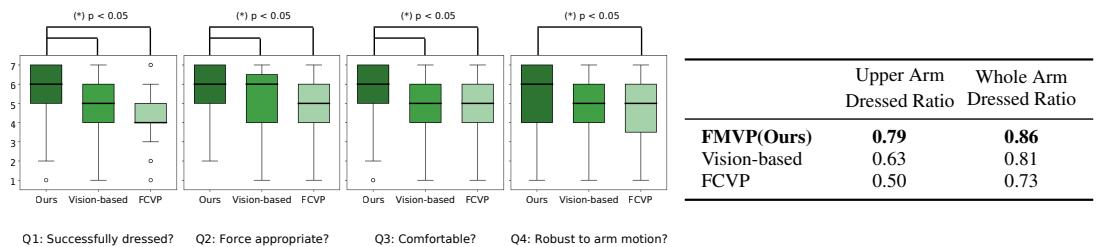
Look at the box plots in Figure 4 (Left):
- Q3 (Comfortable?): The FMVP method (blue) has a much higher median score than the baselines.
- Q4 (Robust to motion?): Participants agreed that FMVP handled their movements much better.
The difference is palpable. With a vision-only robot, if you move your arm and the jacket obscures the view, the robot might blindly push the sleeve into your elbow. With FMVP, the robot feels the snag and adjusts.
Failure Cases
No robot is perfect. The researchers transparently shared failure cases.
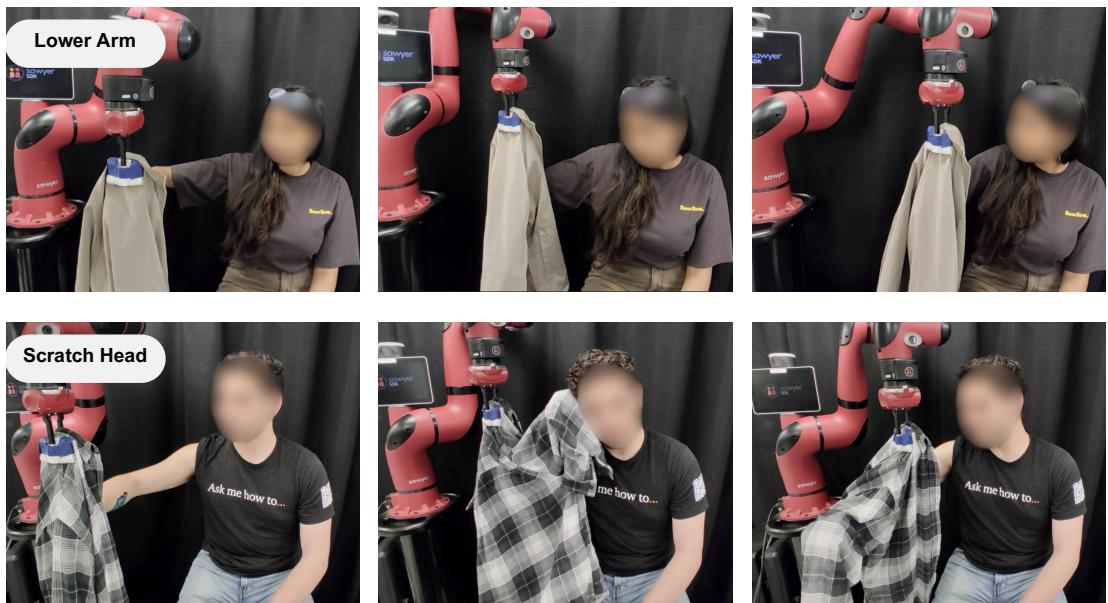
In the top example, the participant lowers their arm significantly. This creates two problems: heavy visual occlusion (the camera can’t see the arm) and out-of-distribution physics (pulling the robot down). The policy failed to adapt here.
Conclusion and Implications
This paper represents a significant step forward in Physical Human-Robot Interaction (pHRI). By moving away from the assumption that humans are static statues, the researchers have created a system that is safer and more capable of handling the messy reality of daily life.
Key Takeaways:
- Sim-to-Real with a Twist: Training in sim is great, but fine-tuning with real-world data is essential for contact-rich tasks.
- Sensory Fusion: Vision guides the robot to the goal; Force guides the robot around obstacles. Using FiLM layers to modulate vision with force is a powerful architecture for this.
- Safety through Learning: Instead of hard-coded safety stops (which often freeze the robot and fail the task), learning a policy that understands force leads to smoother, more continuous operation.
As robots move from factories into our homes and nursing facilities, the ability to “feel” what they are doing will be just as important as their ability to see. This work on Force-Modulated Visual Policy brings us one step closer to robots that can gently and reliably help us get dressed for the day.