](https://deep-paper.org/en/paper/2509.16412/images/cover.png)
Introduction
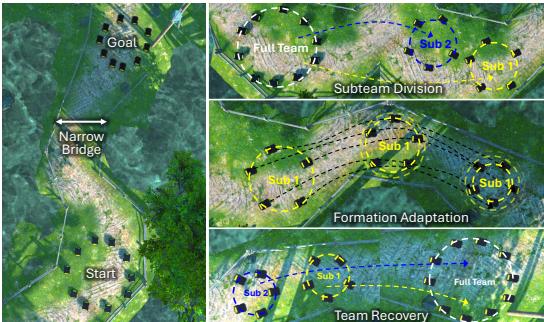
Imagine a team of robots deployed for a search and rescue mission in a collapsed building. To ensure safety and maximum sensor coverage, they need to move in a specific formation—perhaps a circular perimeter protecting a human responder in the center. Everything works perfectly in the open atrium. But then, the team encounters a narrow hallway or a partially blocked bridge.
This presents a fundamental conflict in multi-robot systems: the need for coordinated formation versus the need for environmental adaptability. If the robots rigidly stick to their circle, they cannot fit through the door. If they break formation completely, they lose their protective coordination.
The ideal solution lies somewhere in the middle: the ability to dynamically split into smaller squads (subteaming), squeeze through the bottleneck (adaptive formation), and regroup on the other side.
In this post, we are deep-diving into a research paper titled “Subteaming and Adaptive Formation Control for Coordinated Multi-Robot Navigation.” The authors propose a novel framework called STAF (SubTeaming and Adaptive Formation). This method moves beyond standard collision avoidance, introducing a hierarchical learning system that gives robot swarms the intelligence to know when to split up, how to adjust their shape like a rubber band, and when to merge back together.
The Core Problem: Rigidity vs. Chaos
To understand why this research is significant, we have to look at the limitations of previous approaches.
- Rigid Formations: Traditional “Leader-Follower” methods assign one robot as the leader. The others maintain fixed distances and angles. This is computationally efficient but brittle. If the leader goes through a narrow gap, the followers on the “wings” might crash into the walls.
- Pure Decentralization: Methods like Decentralized Graph Neural Networks (DGNN) treat every robot as an individual agent avoiding collisions. While they can navigate complex spaces, they often fail to maintain the tactical shape of the team. The “team” becomes a chaotic cloud of dots.
- Task Allocation: Existing subteaming algorithms focus on assigning tasks (e.g., “You three go to Room A, you two go to Room B”). They rarely address the motion control required to actually navigate those subteams through physical bottlenecks.
STAF bridges these gaps by treating the robot team as a fluid entity. It uses a graph-based representation where robots are nodes and their spatial relationships are edges. By learning on this graph, the system can preserve the structure of the team while allowing the necessary flexibility to survive the environment.
The Solution: A Hierarchical Learning Framework
The researchers built STAF as a three-tier hierarchy. This separation of duties is crucial because it allows the system to solve different types of problems—strategic, tactical, and operational—at different levels.
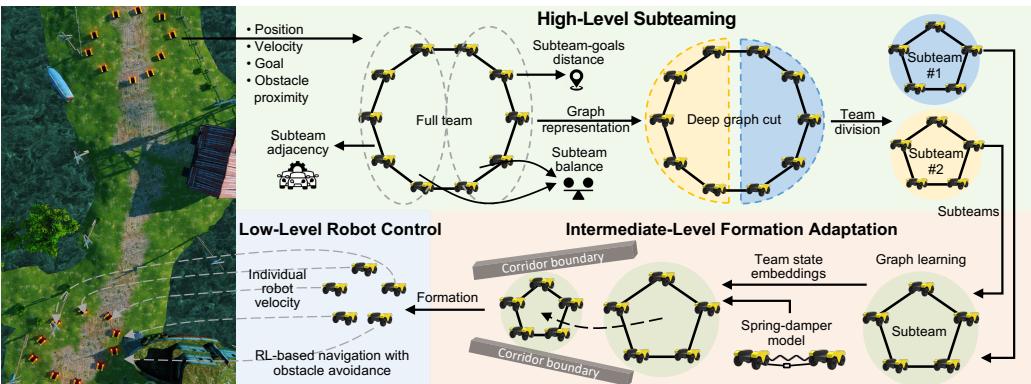
As shown in the architecture overview above, the system flows from high-level decision-making down to individual motor control. Let’s break down each level.
Level 1: High-Level Deep Graph Cut (The Strategist)
The top level is responsible for Subteaming. When the full team cannot proceed, this layer decides how to split the group. It doesn’t worry about wheel velocities; it worries about graph topology.
The researchers model the robot team as a graph \(G\). They use a Graph Attention Network (GAT) to analyze the state of the team. The GAT looks at every robot’s position, goal, and proximity to obstacles. It then computes an “embedding”—a compressed numerical summary of the robot’s context.
Using these embeddings, the system performs a Deep Graph Cut. This is effectively a classification task where the network assigns a probability that robot \(i\) belongs to subteam \(j\).
The “brain” of this level is trained using a composite loss function designed to balance three competing objectives:
- Adjacency: Robots that are physically close to each other should probably be in the same subteam.
- Balance: We don’t want one subteam of 9 robots and another of 1 robot. The split should be roughly equal.
- Goal Distance: Subteams should be formed in a way that helps them move efficiently toward their specific sub-goals.
The mathematical formulation for this logic is elegantly captured in the following equation:

Note: In the image above, the second term corresponds to Subteam Balance and the third to Subteam-Goals Distance, despite the repetitive labels in the annotation.
The researchers validated these three components through an ablation study. They removed each term one by one to see what would happen.

Looking at the ablation results in Figure 7:
- Without Balance (d): The team might split into a 1-vs-All arrangement.
- Without Adjacency (e): The subteams are scattered and interlaced, making physical splitting impossible without collision.
- Without Goal Distance (f): The subteams form valid clusters, but they aren’t oriented correctly toward where they need to go.
Level 2: Intermediate-Level Formation Adaptation (The Coordinator)
Once the subteams are defined, they need to move. This level handles Formation Adaptation.
In a perfect world, a formation is a rigid shape. In STAF, the formation is modeled using a Spring-Damper system.
- Spring: Tries to keep robots at a desired distance (the ideal formation shape). If they get too close, the spring pushes them apart; if they get too far, it pulls them together.
- Damper: Smoothes out the movement so robots don’t oscillate or jitter wildly.
Crucially, this physics-based model is integrated into a Graph Neural Network (GNN). The GNN aggregates information from all teammates in the subteam. It produces an embedding that encodes “Where am I relative to my team, and how much is our formation currently being ‘squished’ by the walls?”
This allows the formation to be elastic. When entering a narrow corridor, the virtual “springs” compress, allowing the formation to narrow. Once back in open space, the springs expand the team back to its original shape.
Level 3: Low-Level Individual Control (The Pilot)
The bottom level is where the rubber meets the road. This is a Reinforcement Learning (RL) policy.
It takes the high-level context (subteam assignment) and the intermediate-level context (formation stresses and relative positions) and outputs direct velocity commands (\(v_x, v_y\)).
The RL agent is rewarded for:
- Reaching the goal.
- Avoiding obstacles.
- Maintaining the formation (minimizing the stress on the virtual springs).
This hierarchy allows the system to be robust. The High-Level planner doesn’t need to know about obstacle avoidance, and the Low-Level controller doesn’t need to worry about global team strategy.
Experiments and Results
To test STAF, the researchers set up challenging scenarios in both Gazebo (a standard robotics simulator) and Unity (for high-fidelity environments), as well as on physical hardware.
Simulation Performance
They compared STAF against two main baselines:
- L&F (Leader & Follower): A standard rigid formation method.
- DGNN (Decentralized GNN): A modern learning-based method without explicit formation control.
The results were stark. In narrow corridor scenarios, L&F failed almost completely because the rigid formation couldn’t fit. DGNN could navigate but failed to maintain any coherent formation.
STAF achieved a 100% Success Rate in these scenarios. It successfully split the team, navigated the bottleneck, and regrouped.
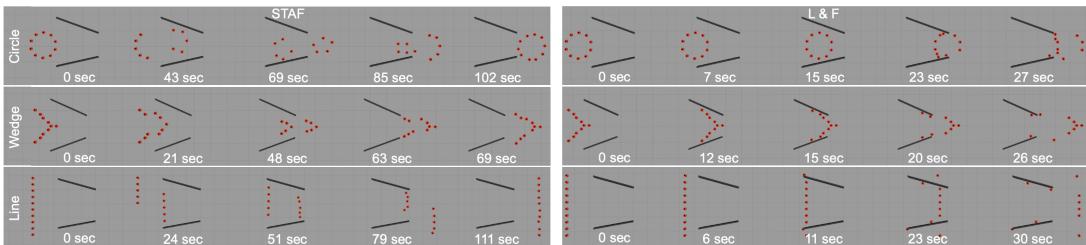
In Figure 3, you can see the progression. The red robots (Subteam 1) detach from the blue robots (Subteam 2). They pass through the corridor sequentially and then merge back into the full circle, wedge, or line.
Visualizing the trajectories clarifies exactly how fluid this movement is:
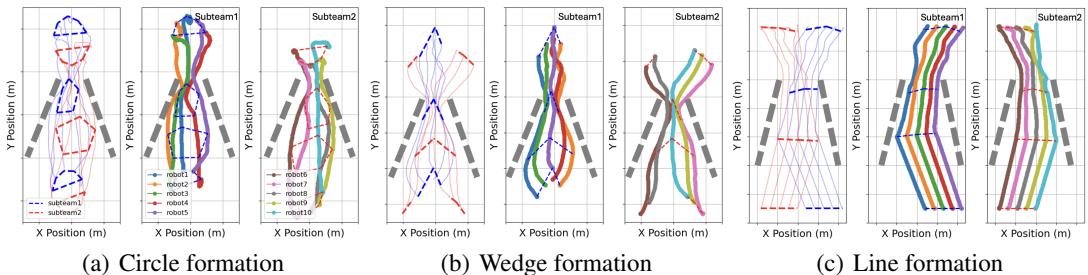
In Figure 4(a), observe the “necking” effect. The circular formation elongates into an oval to squeeze through the gap—that is the spring-damper model in action.
Quantitative Success
The table below breaks down the performance of the subteams. The metric CFI (Contextual Formation Integrity) measures how well the robots kept their shape. A higher percentage means better adherence to the formation.
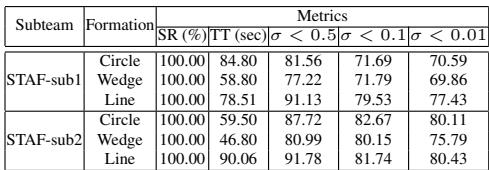
Even with strict thresholds (\(\sigma < 0.01\)), the subteams maintained high formation integrity (mostly >70-80%) while moving at speed. This proves that the elasticity of the formation didn’t result in the formation breaking; it was a controlled deformation.
Robustness and Generalizability
A key question in learning-based robotics is: “Does this only work for the specific setup you trained on?”
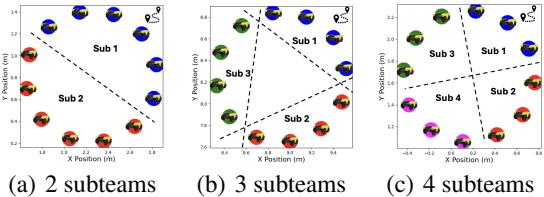
The authors tested STAF with different team sizes (4 to 8 robots) and different splitting configurations (2, 3, or 4 subteams).
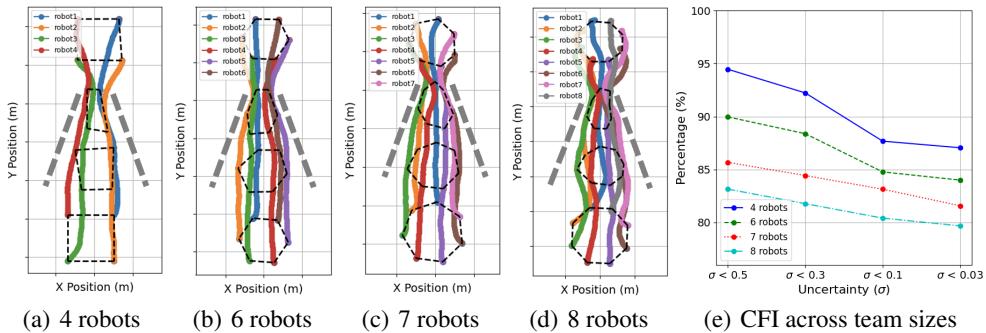
As shown in Figure 8, the trajectories remain smooth regardless of team size. Figure 9 (below) further demonstrates that the graph cut algorithm is flexible enough to handle multi-way splits, not just binary ones.
Real-World Deployment
Finally, the team took the code out of the simulator and onto physical “Limo” robots. These robots communicated via Wi-Fi and used onboard computers.

The real-world tests (Figure 6) covered indoor hallways and outdoor uneven terrain (snow/grass). The transition to the real world is notoriously difficult due to sensor noise and wheel slippage (especially on snow), but STAF maintained formation and successful subteaming.
Conclusion and Future Implications
The STAF framework represents a significant step forward in swarm robotics. By combining the discrete logic of graph cuts (for decision making) with the continuous control of reinforcement learning (for movement), it solves the specific problem of navigating bottlenecks that has plagued rigid formation control for years.
The implications extend beyond just moving robots through doors. This “divide and conquer” capability is essential for:
- Search and Rescue: Teams splitting up to search different rooms and regrouping.
- Military/Defense: Drones adapting formations to avoid anti-air measures.
- Logistics: Warehouse robots coordinating in tight aisles.
The authors note that the current high-level decision-making is centralized (one brain decides the split). Future work aims to decentralize this, allowing the robots to negotiate the split among themselves using consensus algorithms. But for now, STAF provides a robust, elegant answer to the challenge of coordinated mobility in complex environments.