](https://deep-paper.org/en/paper/2509.18447/images/cover.png)
Imagine a future where a robot helps a bedridden patient with a sponge bath. To do this effectively, the robot cannot just use its “hand” (end-effector); it must use its entire arm to reach around the patient, perhaps leaning its forearm gently against the patient’s shoulder to wipe their back.
Now, imagine that patient has a bruised shoulder. The robot’s task is to wipe the back, but the patient’s priority is “don’t hurt my shoulder.” If the robot prioritizes the wiping motion over the contact force, the patient gets hurt. If it prioritizes the shoulder too much, it might not reach the back at all.
This scenario highlights one of the most difficult challenges in assistive robotics: Physical Human-Robot Interaction (pHRI). It’s not just about moving from point A to point B; it is about negotiating physical contact across the entire arm (Whole-Arm Manipulation, or WAM) while respecting the unique, often invisible, pain thresholds and preferences of a human user.
In this post, we will dive deep into PrioriTouch, a new framework developed by researchers at Cornell University and the Toyota Research Institute. This system allows robots to learn a user’s contact preferences in real-time and adjust their control strategies to maximize comfort and safety without sacrificing the task at hand.
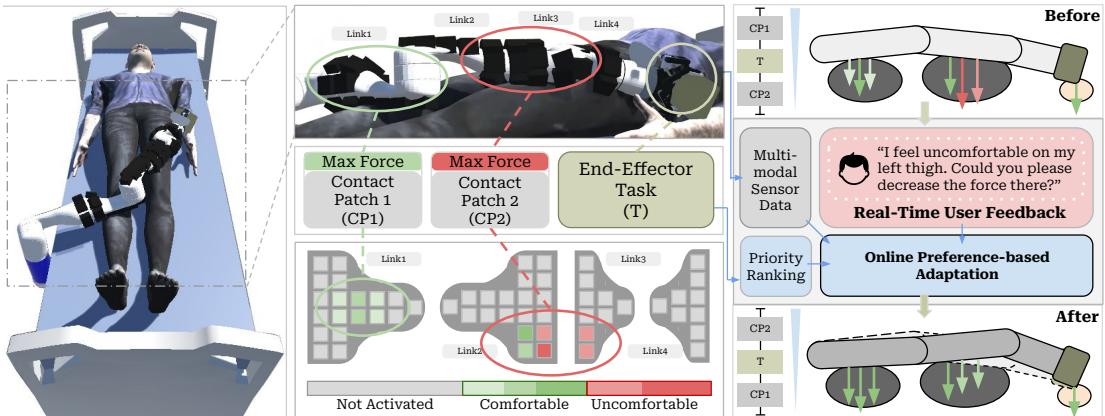
The Challenge: When Touch Becomes Personal
In robotic caregiving—such as dressing, bathing, or transferring a patient—contact is unavoidable. Unlike industrial robots that operate in cages, caregiving robots must be up close and personal.
The problem is that “comfort” is not a universal constant. It varies:
- Between People: One person might find a firm grip reassuring, while another finds it painful.
- Across the Body: You might tolerate significant pressure on your back, but your shins or abdomen are much more sensitive.
- Over Time: An injury, a change in clothing, or simple fatigue can change preferences from one minute to the next.
Traditional control methods often rely on a “one-size-fits-all” approach or conservative safety margins that make the robot uselessly slow or timid. On the other hand, trying to learn these preferences by trial-and-error on a real human is dangerous. A robot cannot be allowed to “explore” how much force is too much by actually hurting someone.
The Solution: PrioriTouch
The researchers propose PrioriTouch, a framework that treats comfort not just as a constraint, but as a ranking problem.
The core insight is that robotic control often involves multiple competing objectives. For example:
- Move the hand to the washcloth location.
- Keep force on the shoulder below 5 Newtons.
- Keep force on the torso below 2 Newtons.
When these conflict (e.g., to reach the washcloth, the robot must press against the shoulder), the robot needs a hierarchy. It needs to know which rule to break and which to follow strictly. PrioriTouch learns this hierarchy dynamically based on user feedback.
The system has three main pillars:
- Hierarchical Operational Space Control (H-OSC): The low-level mathematical engine that executes tasks based on strict priorities.
- LinUCB-Rank: A machine learning algorithm (Contextual Bandit) that figures out the best priority order.
- Simulation-in-the-Loop: A “digital twin” safety net that allows the robot to practice new priorities virtually before touching the human again.
Let’s break these down.
Core Method: How It Works
1. Hierarchical Operational Space Control (H-OSC)
To understand how the robot moves, we need to look at the control theory. The robot is an articulated chain of joints. The dynamics of this robot are governed by the following equation of motion:

Here:
- \(\mathbf{M}(\mathbf{q}_t)\) is the mass/inertia matrix (how heavy the arm is).
- \(\mathbf{C}\) and \(\mathbf{g}\) represent Coriolis, centrifugal, and gravity forces.
- \(\boldsymbol{\tau}_t\) is the torque (rotational force) applied at the joints.
In a standard controller, you calculate the torques needed to move the hand. But in Whole-Arm Manipulation, we have multiple objectives active at once. We want to control the pose of the hand and the forces at various contact points on the arm.
H-OSC manages this by using Null Space Projection. Imagine you have a budget of \(100. Your top priority is Rent (\)60). You pay that first. You have \(40 left (your “Null Space”). Your next priority is Food (\)30). You pay that from the remaining budget. You have \(10 left. If your third priority is Video Games (\)50), you can only spend $10 on it. You can’t spend the Rent money on Games.
In robotics, the “budget” is the degrees of freedom (movement capacity) of the robot. The controller calculates torques as a sum of prioritized tasks:
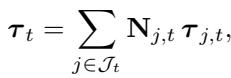
Here, \(\mathbf{N}_{j,t}\) is the Null Space Projector. It ensures that the torque for task \(j\) (\(\boldsymbol{\tau}_{j,t}\)) does not disturb the tasks that came before it (\(1\) to \(j-1\)).
The projectors are calculated recursively. The first task gets the full robot. The second task gets whatever movement is “invisible” to the first task, and so on:

And the dynamically consistent generalized inverse (a fancy way of inverting the Jacobian matrix while respecting the robot’s mass) is calculated as:

Finally, for each specific task (like “don’t push on the torso”), we calculate the necessary forces in “Operational Space” (the world coordinates, not joint angles):

This mathematical structure guarantees that if “Safety on Shoulder” is Rank 1 and “Move Hand” is Rank 2, the robot will stop moving the hand if that’s the only way to save the shoulder.
2. Learning the Hierarchy with LinUCB-Rank
H-OSC is great, but it requires us to know the ranking. Which is more important right now? The shoulder or the torso? The task or the contact?
This is where LinUCB-Rank comes in. It is a variation of a Contextual Bandit algorithm.
- Contextual: It looks at the current situation (robot pose, current forces).
- Bandit: It chooses an action (a ranking of objectives) to maximize a reward.
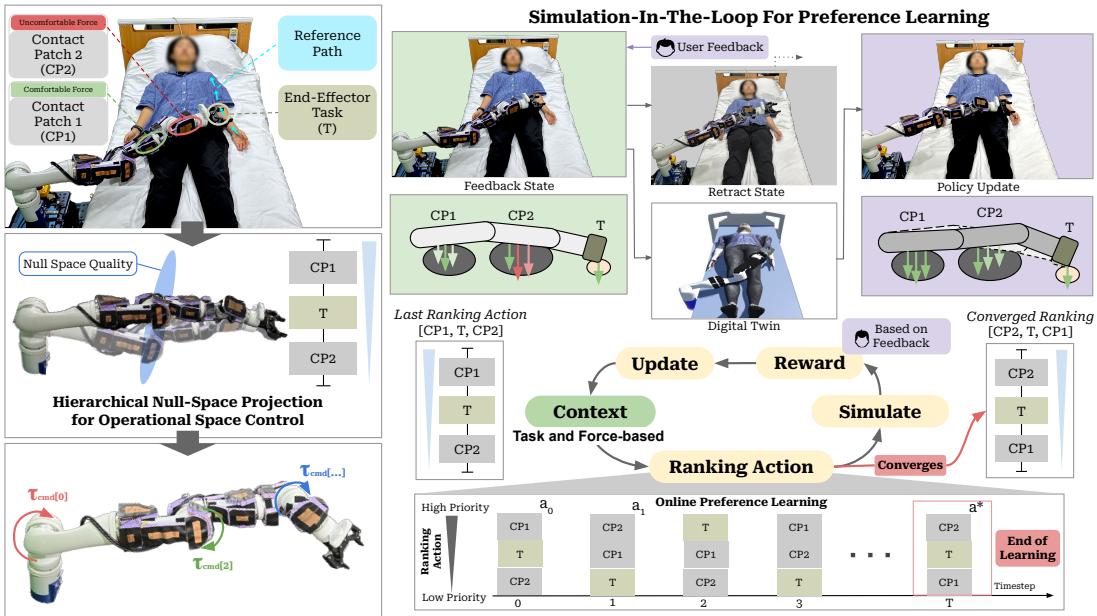
Standard bandit algorithms pick one best “arm” to pull. But here, the robot needs to build a sequence. The researchers modified the algorithm to fill the priority slots one by one.
- Slot 1: Look at all active contacts and the task. Which one has the highest confidence score to be the “Boss”? Pick it.
- Slot 2: Look at the remaining objectives. Pick the next best.
- Repeat until all objectives are ranked.
The “Reward” comes from the user. If the user says “Ouch, my arm!”, the algorithm gets a negative reward for any ranking that prioritized the task over the arm. Over time, it learns that when the arm is in contact, “Protect Arm” should be Rank 1.
3. Simulation-in-the-Loop: The Safety Layer
Learning usually requires making mistakes. If a robot makes a mistake in prioritizing, it might press too hard on a painful spot. To prevent this from happening repeatedly, PrioriTouch uses a Digital Twin.
When a user provides feedback (e.g., “Too much force on the arm”), the robot:
- Retracts to a safe pose.
- Spawns a Digital Twin: A simulation of the robot and the human in the exact current state.
- Learns Virtually: It runs the LinUCB-Rank algorithm inside the simulation. It tries different rankings, simulating the interaction. Since it knows the user just complained about the arm, it updates the virtual user’s comfort threshold.
- Converges: Once the algorithm finds a ranking that works in the simulation (satisfies the new threshold), it transfers that policy back to the real robot.
- Resumes: The robot continues the task with the new, smarter priorities.
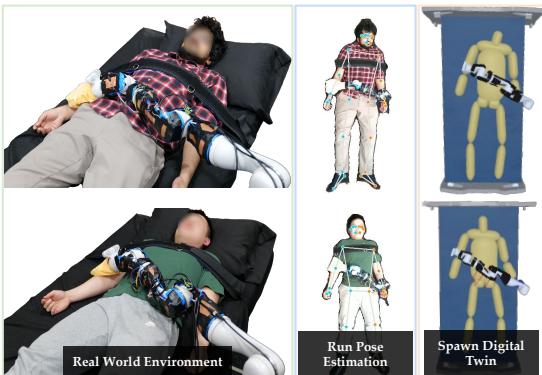
This means the robot does its “trial and error” in the Matrix, not on the human.
Experiments and Results
The team validated PrioriTouch through a series of escalating complexities: simulation, hardware benchmarks, and human user studies.
1. Simulation Experiments
First, they tested the math in a controlled virtual environment.
- Sphere Environment: Multiple spheres moved toward the robot arm. Each sphere represented a body part with a specific force limit.
- Bed Bathing Sim: A simulated robot wiping a virtual patient.
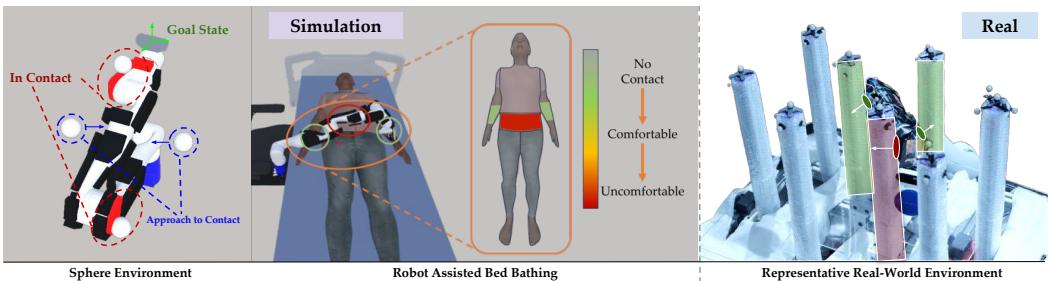
The results were compelling. Compared to baselines (like Fixed Priority or Heuristic methods), PrioriTouch (LinUCB-Rank) significantly reduced Force Threshold Violations.
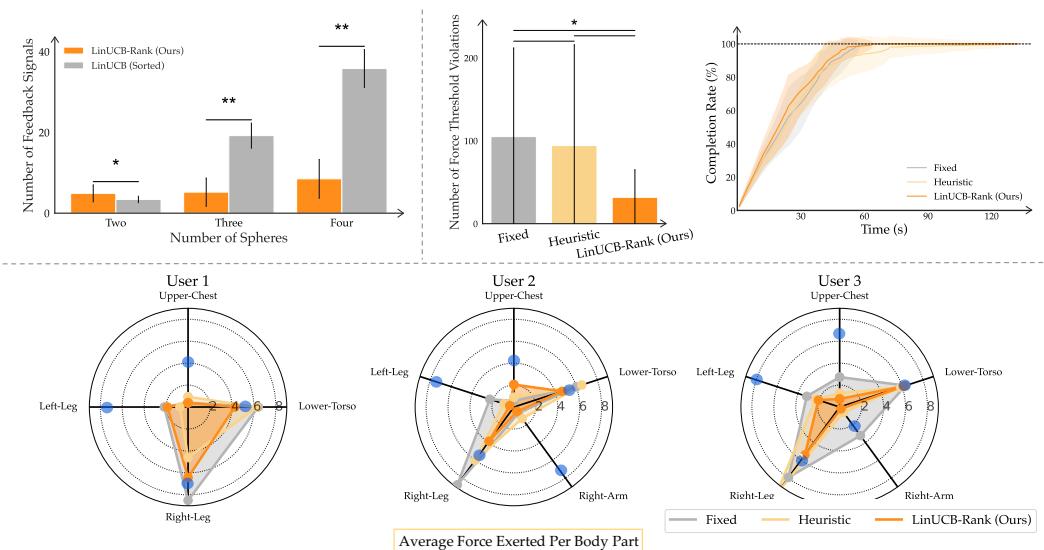
As seen in the graphs above (Top-Right), the number of times the robot pushed too hard dropped drastically with LinUCB-Rank. It also required fewer feedback signals from the user to “get it right” (Top-Left), proving it learns efficiently.
2. The Real-World Maze
To prove this works on physical hardware (a Kinova Gen3 arm), they built a “3D Goal-Reaching Maze.” The robot had to navigate through vertical cylinders. Each cylinder represented a body part with a specific sensitivity (red cylinders were sensitive).
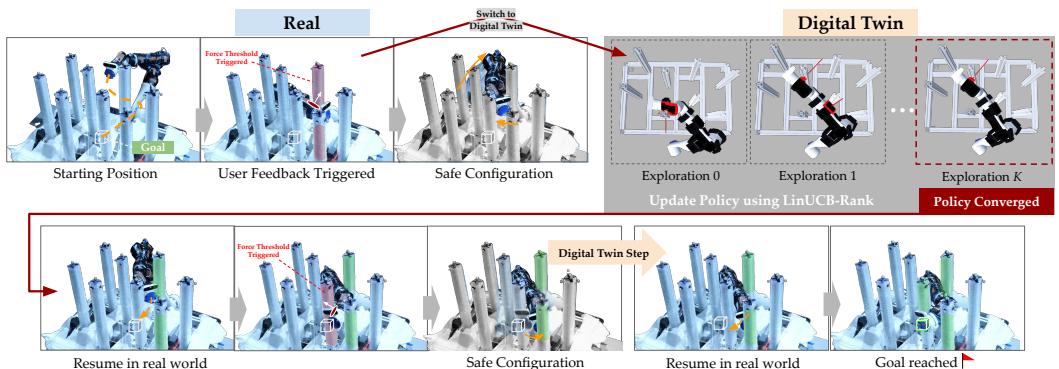
When the robot brushed against a “sensitive” cylinder, it triggered a feedback loop. The system paused, spun up the simulation (Digital Twin), learned that this specific cylinder was high-priority, adjusted the ranking, and then successfully navigated past it without triggering the force sensor again.
3. Human User Studies
Finally, the most important test: real humans.
Establishing Preferences: Before testing the robot, the researchers conducted a broad survey (n=98) to understand where people are okay with being touched. They created a “contact heatmap.”
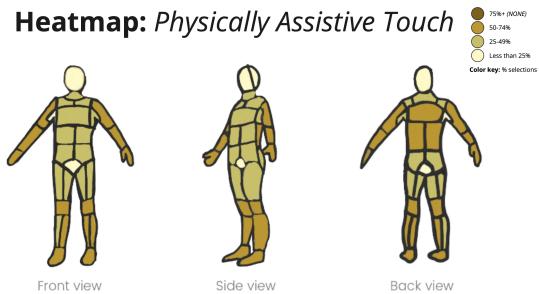
Darker areas (like the upper back and shoulders) are generally more acceptable for assistive touch. Lighter areas (chest, abdomen) are more sensitive. This data was used to seed the robot’s initial beliefs.
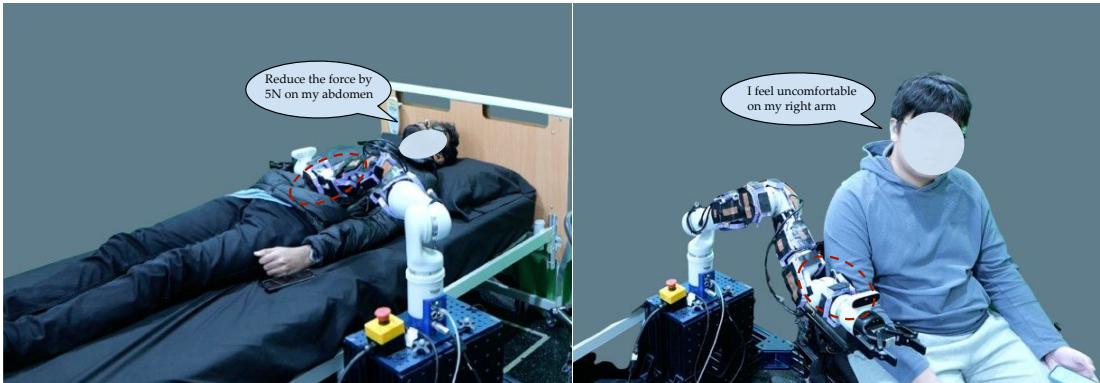
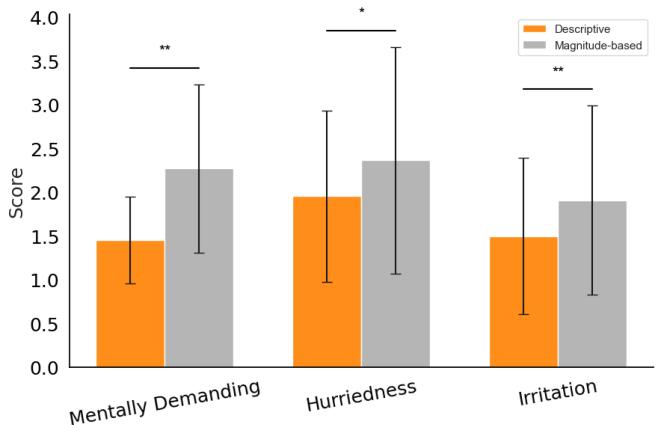
The Feedback Mechanism: How does a user tell the robot “stop”? They tested two methods:
- Magnitude-based: “Decrease force by 5 Newtons.” (Hard for humans to estimate).
- Descriptive: “My abdomen hurts a bit.” (Natural).
Unsurprisingly, users found the Descriptive feedback much easier to use, with significantly lower cognitive workload.
Putting it all together: In the final study, 8 participants experienced the robot performing a wiping motion on their limbs. They compared PrioriTouch against a heuristic baseline.
The results were overwhelmingly in favor of PrioriTouch.

Participants rated PrioriTouch higher on Task Performance, Safety, and Comfort. 7 out of 8 participants explicitly preferred it over the baseline. One participant noted, “It performed the task very well, the contacts felt seamless and natural.”
Conclusion
PrioriTouch represents a significant step forward in making robots safe for intimate caregiving settings. By acknowledging that “safety” is not a static rule but a dynamic preference, the system allows robots to adapt to the individual human.
The combination of H-OSC (to handle the physics of prioritization), LinUCB-Rank (to learn the priorities), and Simulation-in-the-Loop (to learn safely) creates a robust framework. It solves the “Goldilocks” problem of physical interaction: applying not too much force, not too little, but just the right amount, in just the right order.
As we move toward a world where robots assist the elderly and those with mobility impairments, systems like PrioriTouch will be essential. They ensure that the robot isn’t just a machine blindly following code, but a helper that respects the person it touches.