](https://deep-paper.org/en/paper/2509.18830/images/cover.png)
Introduction
Imagine trying to blindly fish a specific key out of your pocket or wrap a rubber band around a small box while wearing thick, rigid winter gloves. Even if your muscles know the movements, the lack of tactile feedback makes these tasks nearly impossible. You rely on the subtle pressure on the tips, sides, and backs of your fingers to know where the object is and how it is behaving.
For robots, this “thick glove” problem is the status quo. While robotic manipulation has advanced rapidly thanks to computer vision, the sense of touch (tactile sensing) lags behind. Most robotic grippers are rigid, and existing tactile sensors are often flat, expensive pads that only cover a small “fingertip” area. They lack the conformability to wrap around curved robot fingers and the coverage to detect contacts that happen on the sides or back of the hand.
In a recent paper, researchers from Stanford University and the University of Alabama at Birmingham introduced DexSkin, a solution that aims to bridge this gap. DexSkin is a soft, stretchable, and conformable tactile skin that provides high-coverage sensing for robotic fingers. It is low-cost, durable, and—crucially for modern AI—provides data that is consistent enough to be used in reinforcement learning and imitation learning frameworks.
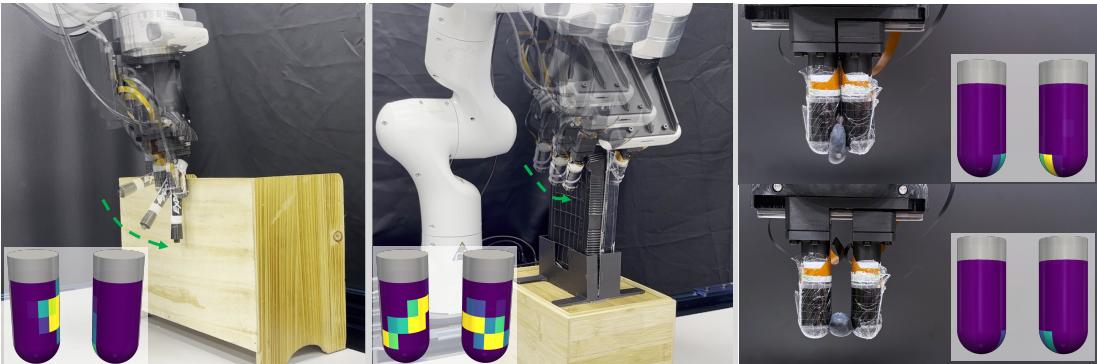
In this deep dive, we will explore how DexSkin is built, how it solves the unique challenges of “sensing everywhere,” and how it empowers robots to handle delicate blueberries and perform complex tasks like pen twirling and box packaging.
The Challenge of Robotic Touch
To understand why DexSkin is significant, we first need to look at the limitations of current tactile sensors. Broadly speaking, robotic touch falls into a few categories:
- Vision-based sensors (e.g., GelSight): These use a camera looking at a piece of rubber from the inside. They provide incredible resolution but are bulky and generally limited to flat or slightly curved surfaces. You can’t easily wrap a camera-based sensor around a thin finger.
- Magnetic sensors: These detect magnetic field changes caused by surface deformation. While they are getting better, they often struggle to resolve multiple simultaneous contact points.
- Resistive/Capacitive sensors: These measure changes in electrical resistance or capacitance when pressed. While common, creating a version that is soft, stretchable, and wraps seamlessly around a 3D geometry (like a fingertip dome) without blind spots has been a massive manufacturing hurdle.
The lack of coverage is a critical failure point. If a robot is trying to reorient a pen in its hand, the pen might roll off the sensor pad and touch the plastic casing of the finger. At that moment, the robot becomes “blind” to the object, often leading to a drop. Furthermore, for learning-based robotics (where robots learn from data), sensors need to be robust and replaceable. If a sensor wears out and you replace it, the new one must behave exactly like the old one, or the robot’s “brain” needs to be retrained from scratch.
The DexSkin Framework
DexSkin addresses these challenges through a novel fabrication process and a clever design that allows a 2D sensor pattern to wrap perfectly around a 3D finger.
1. The Anatomy of Soft Skin
DexSkin utilizes a capacitive sensing mechanism. Capacitive sensors work like a sandwich: two conductive plates (electrodes) are separated by a soft, insulating material (dielectric). When you press on the skin, the dielectric compresses, the plates get closer together, and the capacitance changes.
The innovation here lies in the materials and geometry:
- Materials: The sensor is made of SEBS (styrene-ethylene-butylene-styrene), a highly stretchable and durable thermoplastic elastomer. This allows the skin to deform and recover thousands of times without breaking.
- The Flower Petal Design: To cover a hemispherical fingertip (a compound curve) using a flat sheet of material, the researchers used a “flower petal” design for the electrodes.
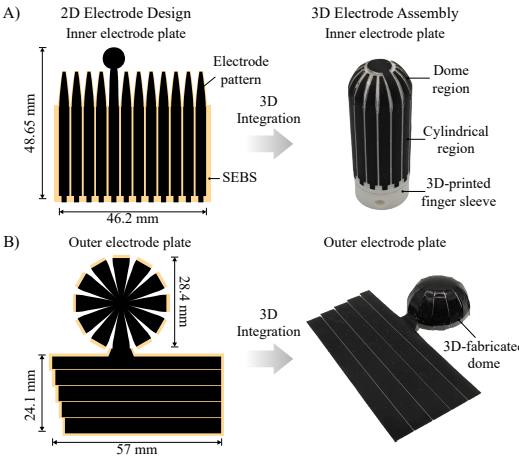
As seen in the image above, the electrode pattern looks like a flower. When folded onto the 3D printed finger core, these “petals” come together to form a seamless dome. This eliminates the wrinkles and gaps that usually occur when trying to wrap a flat sensor around a round object.
2. Integration and Electronics
The DexSkin system isn’t just the rubber skin; it’s a fully integrated hardware stack. The sensorized finger consists of a rigid core for stability, a soft sleeve for compliance (squishiness), and the electrode layers on top.
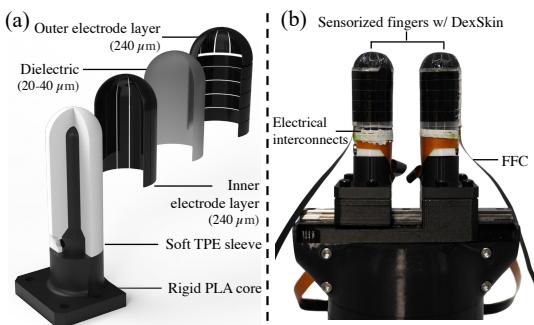
The result is a robotic finger with 120 individually addressable taxels (tactile pixels).
- The Dome: The fingertip has 12 taxels, allowing it to sense fine manipulation at the very tip.
- The Cylinder: The body of the finger has 48 taxels, wrapping 294° around the circumference. This means the robot can feel objects touching the sides and back of its fingers—critical for tasks like using tools or threading elastic bands.
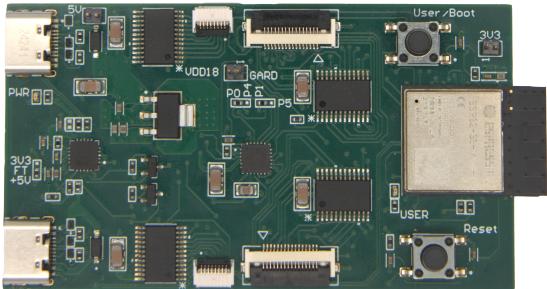
The signals are read by a custom printed circuit board (PCB) that fits on the robot’s wrist. This board converts the tiny capacitance changes into digital signals that the robot’s computer can process at 30 Hz.
3. Sensor Characterization
For a sensor to be useful in robotics, it must be consistent. The researchers subjected DexSkin to rigorous testing to ensure it behaves predictably.
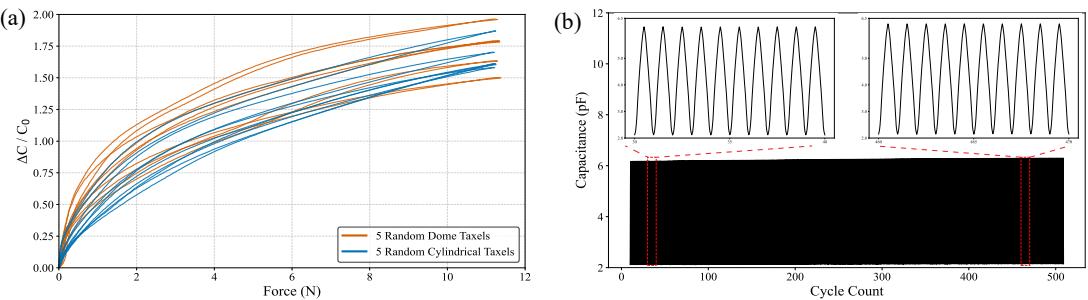
- Linearity and Range: The sensor can detect pressures as light as a gentle touch (1.7 kPa) and as heavy as a firm grip (over 700 kPa).
- Hysteresis: Soft sensors often suffer from hysteresis, where the reading lags behind the physical release of pressure. DexSkin shows very low hysteresis (~6.5%), meaning it reacts quickly and accurately to letting go of an object.
- Stability: Even after 500 cycles of pressing and releasing, the sensor’s baseline didn’t drift significantly.
One of the most impressive features is the isolation of the taxels. In many soft sensors, pressing one spot causes “ghost” readings in nearby spots (crosstalk). DexSkin minimizes this, allowing the robot to distinguish between one broad contact and two distinct sharp contacts.
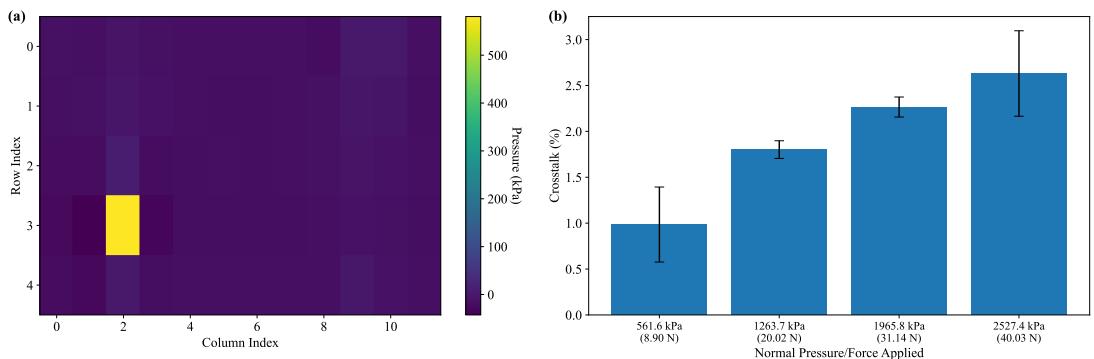
The crosstalk formula used (shown below) confirms that interference remains below 3%, ensuring precise localization of contact.
\[ \mathrm { C r o s s t a l k \ } ( \% ) = \left( \frac { \operatorname* { m a x } { P _ { j } } } { \mathcal { P } _ { i } } \right) \times 1 0 0 \% \]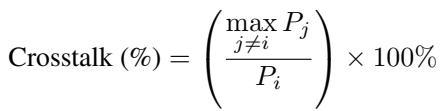
Learning Contact-Rich Manipulation
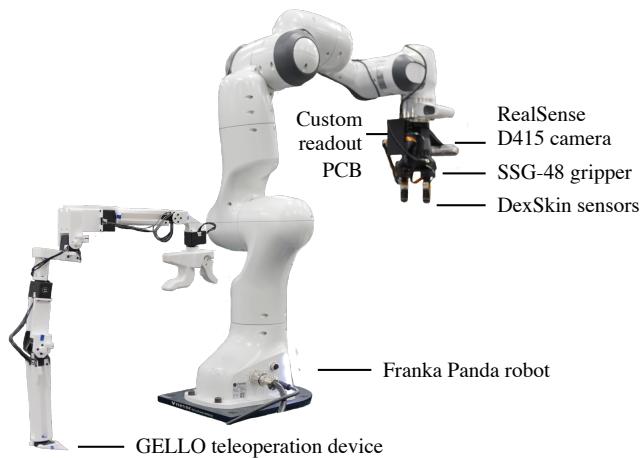
The true test of a sensor is not how it performs on a test bench, but what it allows a robot to do. The researchers integrated DexSkin onto a Franka Panda robot and used Imitation Learning (teaching the robot by showing it examples) to solve difficult manipulation tasks.
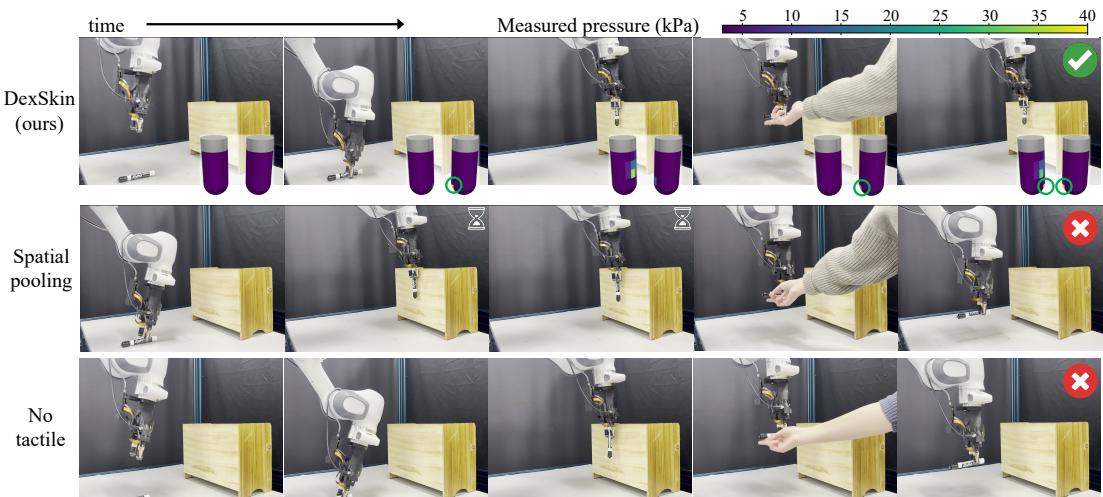
Task 1: In-Hand Pen Reorientation
The Goal: Pick up a pen lying on the table and rotate it in the hand until it is vertical, ready to write. The Challenge: This requires controlled slipping and re-grasping. If the robot loses track of the pen’s orientation, it will fail. The Twist: A human interrupts the robot by poking the pen, forcing the robot to recover.
Results: The robot equipped with DexSkin achieved a 95% success rate, even with perturbations.
- No Tactile Baseline: Failed completely when perturbed. It simply executed a blind trajectory.
- Spatial Pooling Baseline: If the researchers averaged the tactile data (simulating a lower-resolution sensor), the robot failed to react effectively because it couldn’t tell where the pen was contacting the finger.
- DexSkin: The high coverage allowed the robot to “feel” the pen rolling across the fingertip and down the side of the finger, allowing it to adjust its grip dynamically.
Task 2: Box Packaging with Elastic Bands
The Goal: Pick up a rubber band and wrap it around a small box. The Challenge: This is a nightmare for standard grippers. To stretch a rubber band, it must wrap around the back (dorsal side) of the fingers. Standard sensors only have pads on the inside. Furthermore, the robot was given “perforated” bands that would snap if stretched; it had to feel the difference in tension and discard the bad ones.
Results:
- DexSkin: The robot successfully identified weak bands (by sensing the lack of tension) and discarded them. For good bands, it utilized the sensors on the side and back of the fingers to maintain the stretch without slipping.
- Limited Coverage Baseline: A policy using only the inner-finger sensors failed significantly because it lost track of the band once it wrapped around the outside of the gripper.
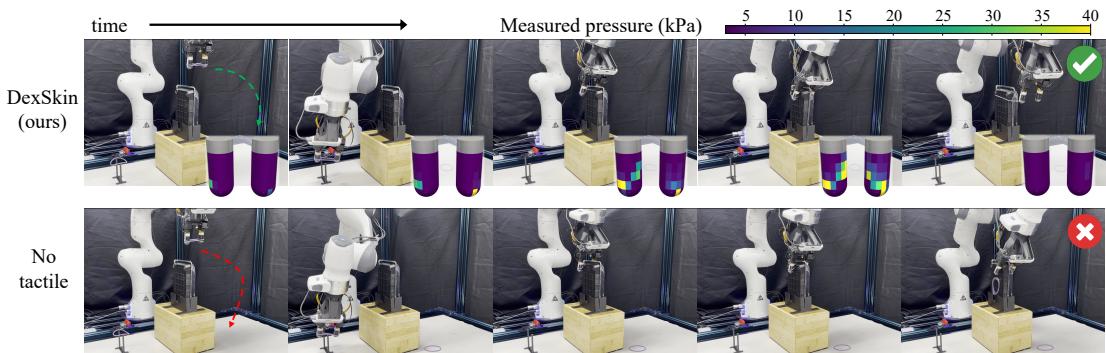
As shown in the table below, DexSkin was the only configuration that could consistently select the right band and complete the wrapping process.

Task 3: Delicate Berry Picking (Reinforcement Learning)
The Goal: Pick up a fresh blueberry and move it without crushing it. The Challenge: Blueberries are soft and variable. A hard-coded grip force will squash them. The robot needs to learn “gentleness” via trial and error (Reinforcement Learning).
Method: The team used a technique called Residual Reinforcement Learning (RL). They started with a basic policy (trained via imitation) that could pick up objects but was clumsy (often crushing the berry). Then, they trained a “residual” policy—a small neural network that tweaks the actions of the main policy based on tactile feedback.
The reward function penalized high forces detected by the DexSkin:
\[ r _ { f o r c e } = \| \operatorname* { m a x } ( 0 , t - t _ { t h r e s h } ) \| _ { 2 } ^ { 2 } \]
Results: The system learned to grasp the berry with just enough force to hold it, significantly reducing damage compared to the baseline policies.
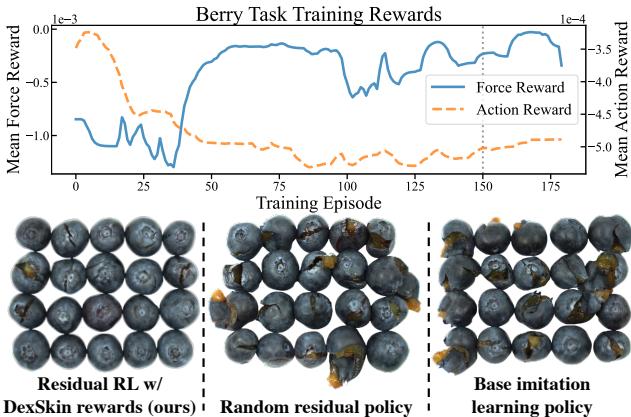
The Calibration Breakthrough: Solved via Transfer
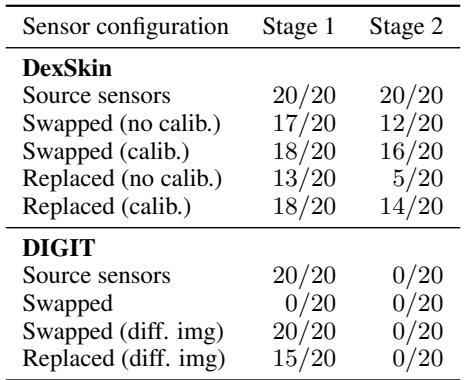
One of the biggest hurdles in robotic skin is manufacturing variability. If you build two sensors by hand, they will be slightly different. If you train a neural network on Sensor A, it usually fails when you plug in Sensor B.
DexSkin solves this with a rapid calibration process. The researchers designed a pneumatic chamber that inflates to apply uniform pressure across the entire finger.
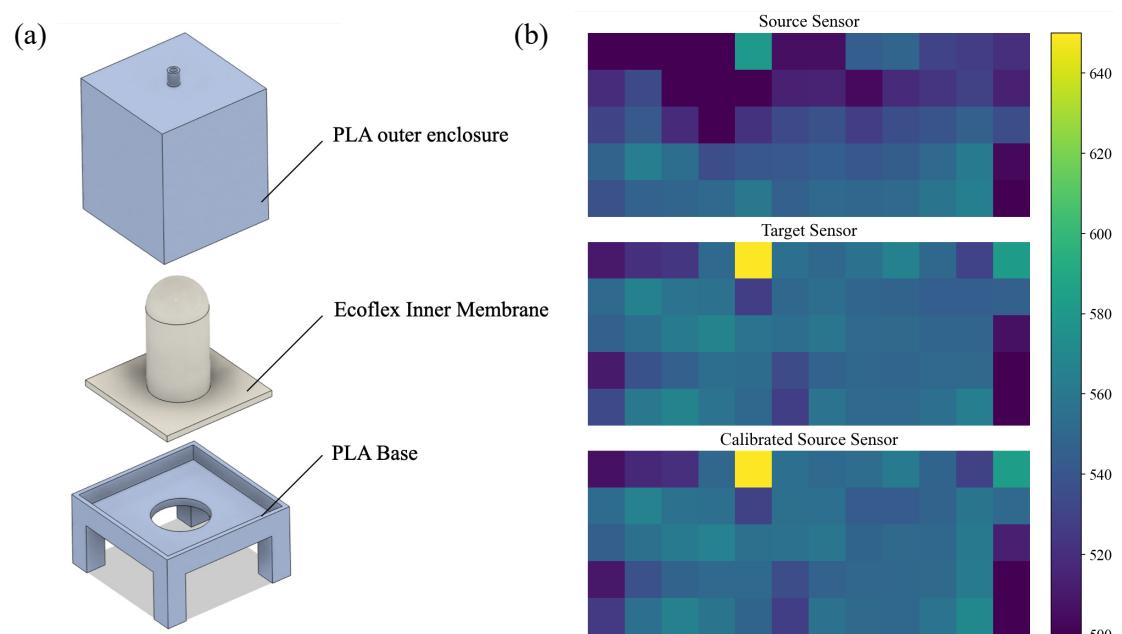
By recording the response of the new sensor in this chamber, they can mathematically map its readings to match the “source” sensor that the AI was trained on.
\[ C _ { 2 } = \frac { C _ { 0 , 2 } } { b _ { 2 } } \ln \left( \frac { a _ { 1 } \exp \left( b _ { 1 } \frac { C _ { 1 } - C _ { 0 , 1 } } { C _ { 0 , 1 } } \right) + d _ { 1 } - d _ { 2 } } { a _ { 2 } } \right) + C _ { 0 , 2 } \]
This calibration takes only a few minutes but saves the hours or days required to retrain the robot. The experiments showed that a calibrated replacement sensor performed almost as well as the original, enabling model transferability—a “holy grail” feature for deploying robots in the real world.
Conclusion and Future Outlook
DexSkin represents a significant step forward in robotic manipulation. By creating a sensor that is cheap, conformable, high-resolution, and easy to calibrate, the researchers have removed many of the hardware barriers that keep robots “clumsy.”
Key takeaways from the work:
- Conformability is King: Being able to wrap sensors around complex 3D shapes opens up new manipulation strategies that rely on the sides and backs of fingers.
- Data Quality Matters: High-quality, isolated taxel data allows for both precise control and effective Sim-to-Real or Sensor-to-Sensor transfer.
- Softness enables Robustness: Unlike rigid sensors that can shatter, soft skin can absorb impacts and survive the rough-and-tumble world of reinforcement learning.
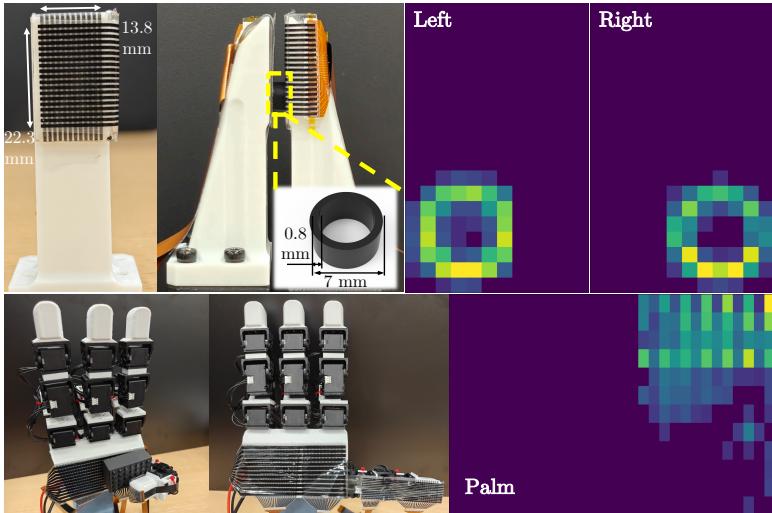
The authors note that while they focused on a two-finger gripper, the technology is scalable. We can imagine future robots with DexSkin covering entire multi-fingered humanoid hands, finally giving them the sense of touch required to navigate our unstructured world.
This research moves us away from robots that blindly execute coordinates and toward robots that can feel, react, and adapt—just like we do.