](https://deep-paper.org/en/paper/2509.19597/images/cover.png)
Imagine a drone delivering a package in a dense urban environment. It takes off from a calm rooftop, but as it descends into the “urban canyon” between two skyscrapers, it encounters a sudden, fierce wind tunnel. The wind dynamics here are completely different from the rooftop.
For autonomous systems, this is a nightmare scenario. To guarantee safety, the drone needs to know the limits of the environment—specifically, the maximum disturbance (wind) it might encounter. If the drone assumes the worst-case storm at all times, it will be too conservative to fly efficiently (or at all). If it assumes calm weather, it might crash when it hits the wind tunnel.
This dilemma is the core focus of the paper “From Space to Time: Enabling Adaptive Safety with Learned Value Functions via Disturbance Recasting.” The researchers introduce a framework called SPACE2TIME, which allows robots to navigate environments with unknown, spatially varying disturbances by fundamentally rethinking how we model risk.
In this post, we will break down how SPACE2TIME converts complex spatial problems into manageable temporal ones, enabling drones to fly safely in unpredictable winds without being paralyzed by caution.
The Safety Dilemma: Performance vs. Guarantee
In safety-critical robotics, we often use a modular architecture. We have a “nominal controller” designed for performance—getting from point A to point B quickly. Then, we wrap that controller in a Safety Filter. This filter monitors the system and intervenes only when the robot is about to violate a safety constraint (like hitting a wall or losing control due to wind).
Two popular methods for building these filters are Control Barrier Functions (CBFs) and Hamilton-Jacobi Reachability (HJR) analysis.
- CBFs are efficient optimization constraints but are hard to design for complex, nonlinear systems.
- HJR provides formal safety guarantees by calculating the set of all states from which a crash is inevitable (the “Backward Reachable Tube”). However, HJR suffers from the “curse of dimensionality,” making it computationally impossible for high-dimensional systems (like a 6-DoF drone) to solve in real-time.
Recent advances, such as DeepReach, use neural networks to approximate HJR solutions offline, allowing them to scale to higher dimensions. However, a major limitation remains: The Static World Assumption.
Most offline learning methods assume the operational domain (e.g., maximum wind speed) is known and constant. In the real world, wind varies across space. A drone moving 10 meters might enter a completely different airflow regime. If we don’t know the map of the wind beforehand (which we rarely do), how can we pre-train a safety filter?
The Core Insight: From Space to Time
The researchers propose a brilliant simplification. Mapping every possible variation of wind across every possible spatial environment is impossible. However, as a robot moves through space, it experiences these spatial changes as temporal changes.
If a drone flies into a wind tunnel, the wind speed acting on it increases over time. Therefore, instead of modeling complex spatial maps, we can model the rate of change of the disturbance over time.
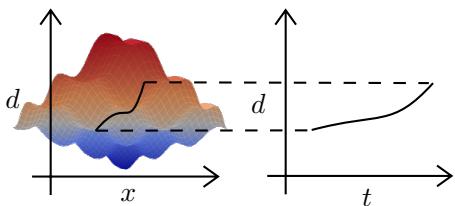
As illustrated in Figure 2, the spatial gradient of the disturbance (left) can be reparameterized as a temporal evolution (right). By learning a value function that accounts for a disturbance that grows over time, the system becomes robust to spatial variations encountered along the trajectory.
This is the heart of SPACE2TIME. It ensures the system is:
- Realistic about the present: It uses the disturbance currently measured.
- Pessimistic about the future: It assumes the disturbance will worsen at the worst-case rate.
The SPACE2TIME Framework
The framework operates in two distinct phases: an offline learning phase and an online deployment phase.
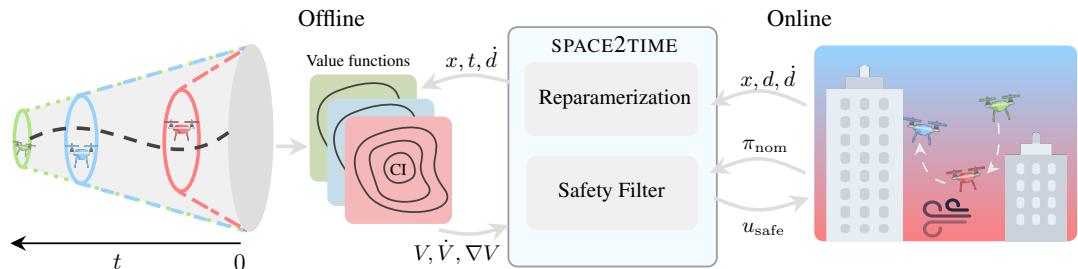
1. Offline: Learning Time-Varying Value Functions
To make this work, the researchers augment the system dynamics. Standard dynamics depend on state \(x\), control \(u\), and disturbance \(d\):

In the offline phase, they extend the state space to include the disturbance rate. They define a new joint state \(z\) that includes the robot’s physical state and the disturbance evolution. The disturbance is allowed to grow linearly over time based on a rate \(\dot{d}\).

Here, \(\eta\) represents the disturbance, which is bounded by a set that changes over time. The “Time-Varying Disturbance Set” \(\mathcal{D}_{tv}\) shrinks the safety margin as time progresses (effectively modeling the wind getting stronger):

Using this formulation, the team uses DeepReach (a self-supervised learning framework using Physics-Informed Neural Networks) to learn a Reach-Avoid Value Function.
The goal of this value function \(V(z, t)\) is to identify a “Reach-Avoid Tube”—the set of states from which the drone can reach a target set while avoiding failure states (obstacles), assuming the disturbance grows at the specified rate.

The training process involves minimizing a loss function that enforces the Hamilton-Jacobi-Isaacs Partial Differential Equation (PDE). The specific loss function used ensures the target set is control-invariant (meaning once the drone is safe, it can stay safe):

2. Online: Adaptive Safety Filtering
Once the drone is flying, it needs to use this pre-learned value function. But the drone observes spatial changes, not the theoretical temporal growth we trained on.
The online module estimates two things:
- Current Disturbance (\(\bar{d}\)): How strong is the wind right now?
- Directional Derivative (\(D_{\tilde{f}}d\)): How fast is the wind changing as we move in our current direction?
Using these estimates, the system calculates a “Time to Return” (\(t_{return}\)). This metric answers the question: Given how fast the wind is increasing, how much “time” do I have before the disturbance exceeds the maximum limit my controller can handle?
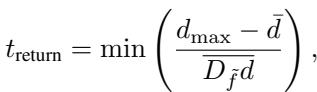
This \(t_{return}\) is then used to query the pre-trained value function. If the drone is in a safe state according to \(V(z, t_{return})\), the nominal controller takes charge. If safety is threatened, the Safety Filter kicks in.
The safety filter is formulated as a Quadratic Program (QP). It finds the control input \(u^*\) closest to the nominal control \(u_{nom}\) that satisfies the safety constraint defined by the value function:

Experimental Validation
The researchers validated SPACE2TIME in both simulation and hardware, comparing it against “Naive” approaches (switching between fixed disturbance models) and “Worst-Case” approaches (assuming maximum wind everywhere).
Simulation: The Urban Canyon
The test environment mimicked a city skyline. As the drone flies lower between buildings, the wind intensity increases exponentially—a classic spatial disturbance trap.
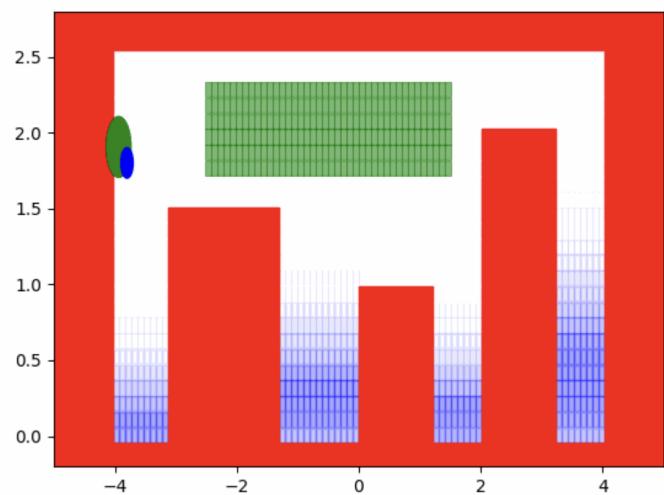
The results were striking. The Naive baselines frequently crashed because they failed to anticipate the increasing wind as they descended. The Worst-Case baseline survived but was often paralyzed, unable to reach the goal because it assumed the wind was always at hurricane force.
SPACE2TIME (Ours) struck the balance. It successfully navigated the canyons by adapting its safety margins based on the rate of wind increase.
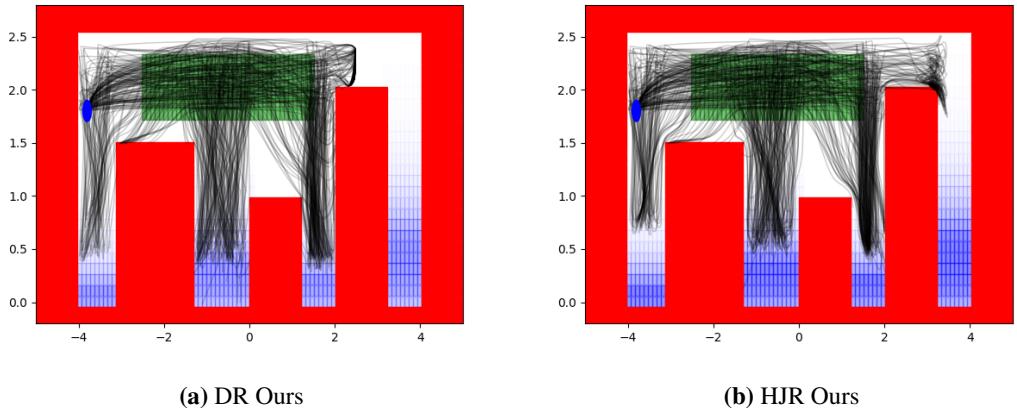
Contrast the clean trajectories above with the baselines below. The Naive method (left/center) results in crashes (short, terminated lines), while the Worst-Case method (right) barely moves from the start.
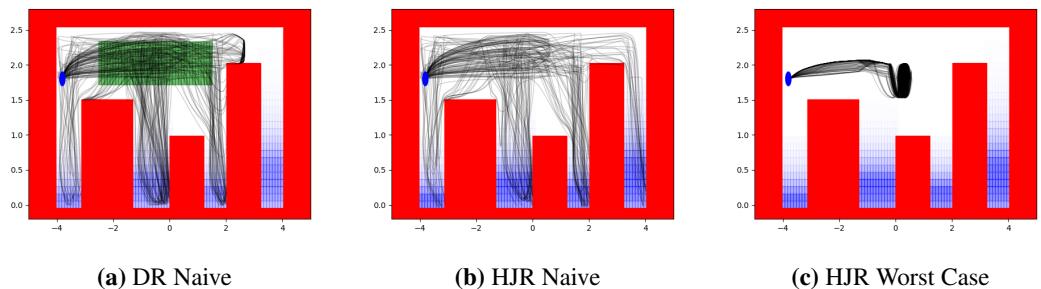
The statistical comparison reinforces the visual evidence. SPACE2TIME reduced safety violations from 96% (Naive) to just 2%, while maintaining a much shorter distance to the goal than the Worst-Case baseline.

Hardware Experiments: Crazyflie Drones
To prove this wasn’t just a simulation artifact, the team deployed the algorithm on Crazyflie 2.1 drones in a motion capture arena with obstacles. They “spoofed” the wind disturbance in the controller to perfectly match the simulation physics (ensuring repeatability).
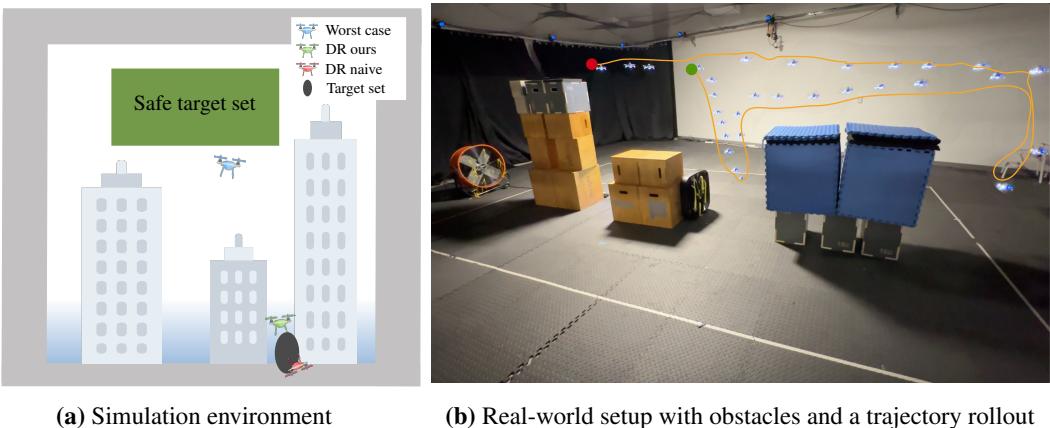
The hardware results mirrored the simulation. The Naive controller crashed in 4 out of 5 attempts. SPACE2TIME succeeded in 100% of the trials.
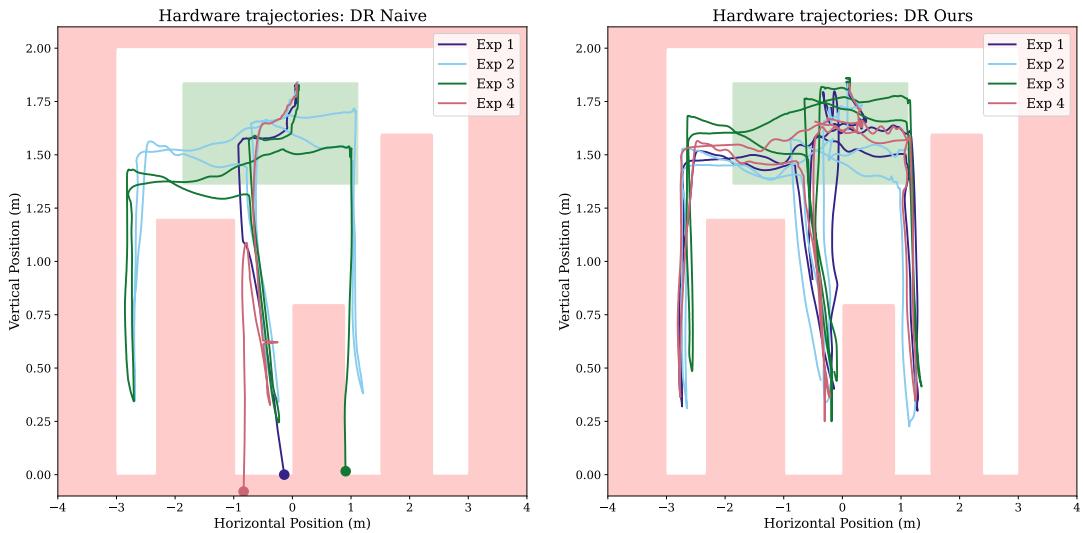
As shown in Figure 4, the SPACE2TIME trajectories (right) are tightly controlled and keep the drone within the safe zone. The Naive trajectories (left) are erratic, drifting wide into obstacles as the simulated wind overpowers the drone’s unaware safety filter.
Why It Works: Visualizing the Value Function
To understand what the neural network actually learned, we can visualize the “zero-level set” of the value function. This boundary represents the edge between safety and danger.
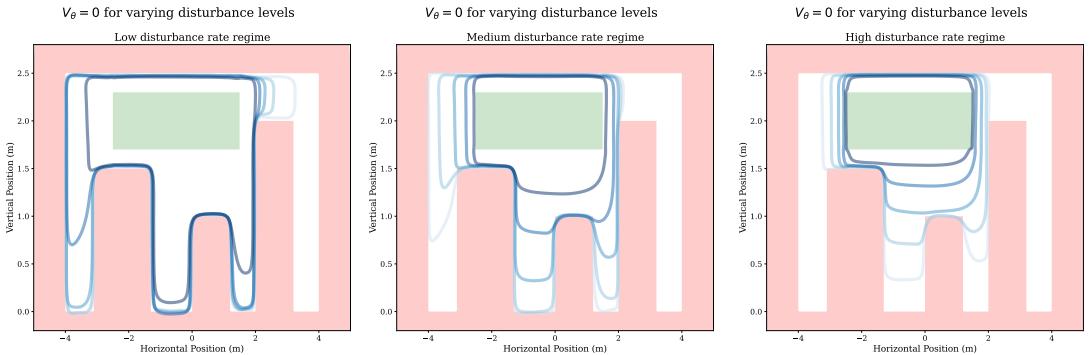
In Figure 5, we see how the safe region shrinks as the rate of disturbance increases.
- Left (Low Rate): The drone can safely operate in a large area because the wind isn’t changing fast.
- Right (High Rate): The safe area (the green/blue contours) shrinks dramatically. The system knows that if the wind is picking up speed rapidly, it has very little room for error and must stay close to the target invariant set.
This adaptability allows SPACE2TIME to be permissive when conditions are stable and strict when conditions are volatile.
Conclusion
The SPACE2TIME framework represents a significant step forward for autonomous systems in the wild. By recasting spatial uncertainty as temporal evolution, the authors provide a way to leverage the power of offline deep learning for real-time, adaptive safety.
This approach eliminates the need for perfect prior maps or overly conservative worst-case assumptions. Whether it’s a delivery drone in a windy city or an inspection robot in a turbulent industrial site, SPACE2TIME ensures that the machine respects the changing limits of its environment—keeping itself, and us, safe.