](https://deep-paper.org/en/paper/2509.19712/images/cover.png)
Introduction
Imagine teaching a robot to prepare a meal. Asking it to pick up an apple is a solved problem in many labs. Asking it to slice that apple into perfectly even wedges, however, is a nightmare of physics and control.
Why? Because cutting fundamentally changes the topology of an object. One object becomes two; a solid mesh splits into independent clusters. The physics are complex—materials deform, squish, and fracture. Furthermore, evaluating success is incredibly difficult. If a robot slices a potato and the piece rolls off the table, did it fail? Geometrically, the slice might be perfect, but a standard sensor looking for the slice in a specific xyz-coordinate would register a zero score.
In this deep dive, we are exploring TopoCut, a research paper presented at CoRL 2025 by researchers from Georgia Tech and Nvidia. They propose a unified framework that solves these problems through three clever innovations: a high-fidelity simulator that tracks damage at the particle level, a “spectral reward” system that evaluates shapes regardless of where they are in the room, and a diffusion-based policy that learns where to cut.
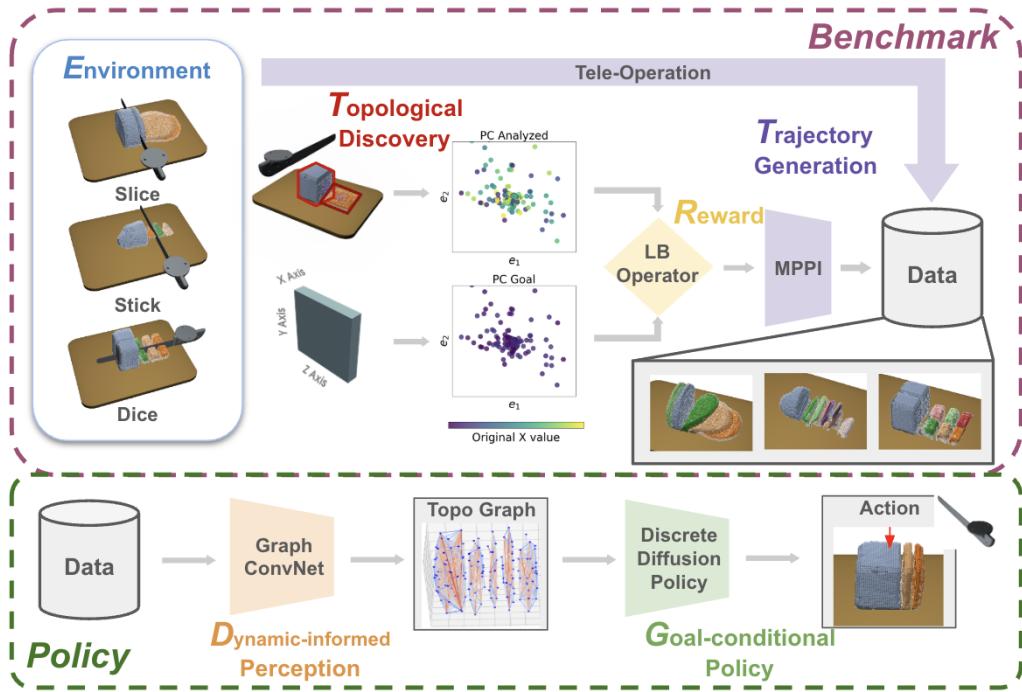
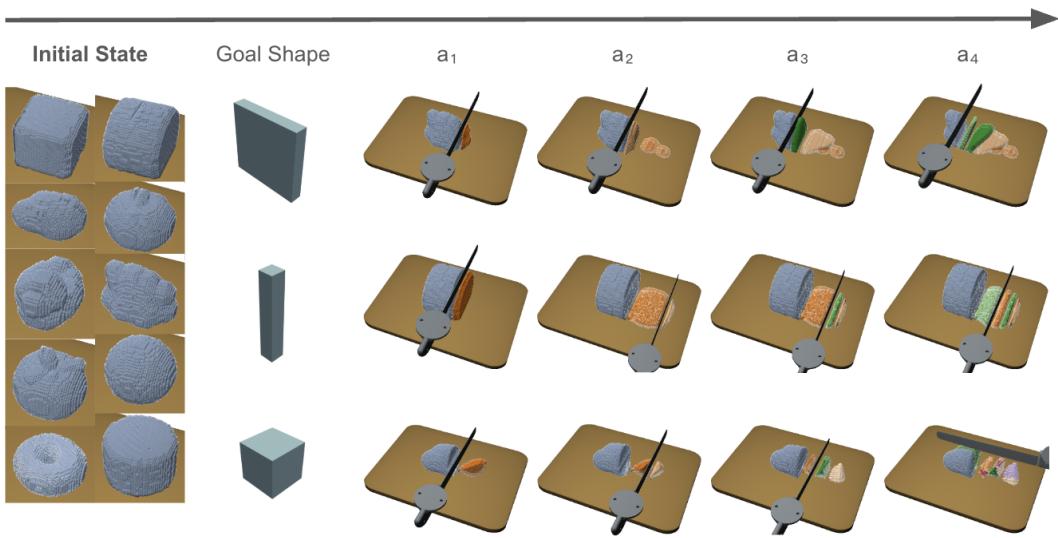
As shown in Figure 1, TopoCut is designed to handle multi-step tasks like slicing, sticking (cutting strips), and dicing, bridging the gap between simulation and intelligent robotic control.
The Challenge of Deformable Objects
Robotic manipulation usually assumes rigid bodies. When you move a block, it stays a block. Deformable object manipulation (DOM) is harder because the state space is infinite—a piece of dough can take any shape.
Cutting adds another layer of complexity: Topology Change. Existing methods often rely on fixed trajectories (e.g., “move knife down 10cm”). But if the object is slightly rotated, or if the material is tougher than expected, a fixed trajectory fails. To succeed, a robot needs to be goal-conditioned. It needs to understand what the final pieces should look like and plan a sequence of cuts to get there.
To achieve this, the authors built a system resting on three pillars:
- Simulation: Accurate physics with topology discovery.
- Evaluation: A mathematical way to score “shape” independently of “pose.”
- Policy: A learning algorithm that can generate complex cut plans.
Pillar 1: High-Fidelity Simulation and Topology Discovery
You cannot train a robot to cut if your simulator cannot handle things breaking apart. The authors built their environment on MLS-MPM (Moving Least Squares Material Point Method).
MPM is a hybrid approach. It uses particles to carry material data (mass, velocity, deformation) and a grid to calculate forces. This is perfect for cutting because particles can easily separate from each other, unlike connected meshes which require complex remeshing algorithms when they tear.
Tracking Damage
To simulate a cut, the system needs to know when the material yields. The authors introduced a damage-driven topology discovery mechanism.
Every particle \(p\) has a deformation gradient \(\mathbf{F}_p\). The system monitors the volumetric Jacobian \(J_p = \det(\mathbf{F}_p)\), which represents how much a particle has expanded or compressed. A particle is flagged as “damaged” if it exceeds critical thresholds:
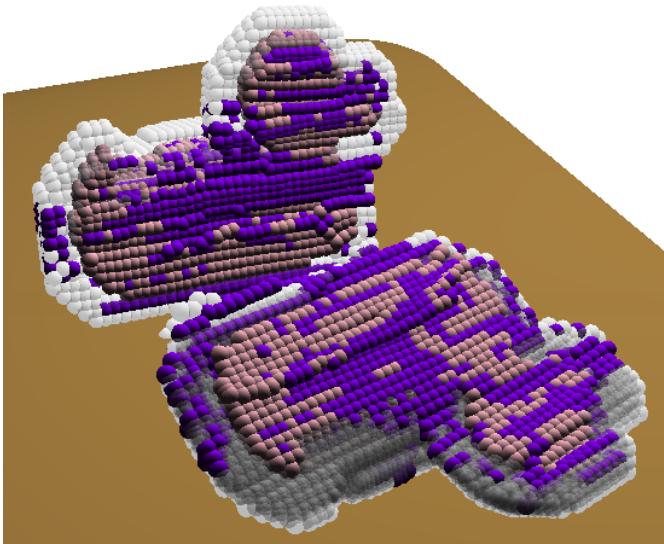
When a knife presses into the object, particles compress. If they compress too much (or stretch too much), the equation below triggers, classifying the particle as damaged:

Once damaged, these particles effectively become the “surface” of a new cut. The simulator then constructs a Signed Distance Field (SDF) around the healthy particles and uses the Marching Cubes algorithm to reconstruct the 3D mesh of the new pieces in real-time. This allows the system to distinguish that one object has successfully become two distinct pieces.
Pillar 2: The Spectral Reward (Evaluation)
This is perhaps the most mathematically fascinating contribution of the paper.
The Alignment Problem
In standard reinforcement learning, you might reward a robot based on the Chamfer distance—how closely the point cloud of the cut object matches the point cloud of the goal.
But imagine the robot cuts a perfect cube, but the cube gets pushed 5cm to the left. The Chamfer distance would be high (bad error) because the points don’t align in 3D space. The robot would be penalized for a perfect cut just because the piece moved. This is the pose alignment problem.
The Spectral Solution
The authors propose a Pose-Invariant Spectral Reward. Instead of comparing the position of the points, they compare the intrinsic geometry of the shape.
They do this using the Laplace-Beltrami Operator. By treating the object’s point cloud as a graph, they can compute the eigenvalues (frequencies) and eigenvectors (modes) of that graph. Think of it like the “sound” of the shape. A drum shaped like a square sounds different than a drum shaped like a triangle. Crucially, if you rotate the square drum or move it across the room, it still sounds the same.
The spectral distance between a cut fragment \(X\) and a goal shape \(Y\) is calculated as:

Here, \(\Lambda\) represents the eigenvalues and \(\Phi\) represents the eigenvectors. This distance measures how different the shapes are, completely ignoring where they are located.
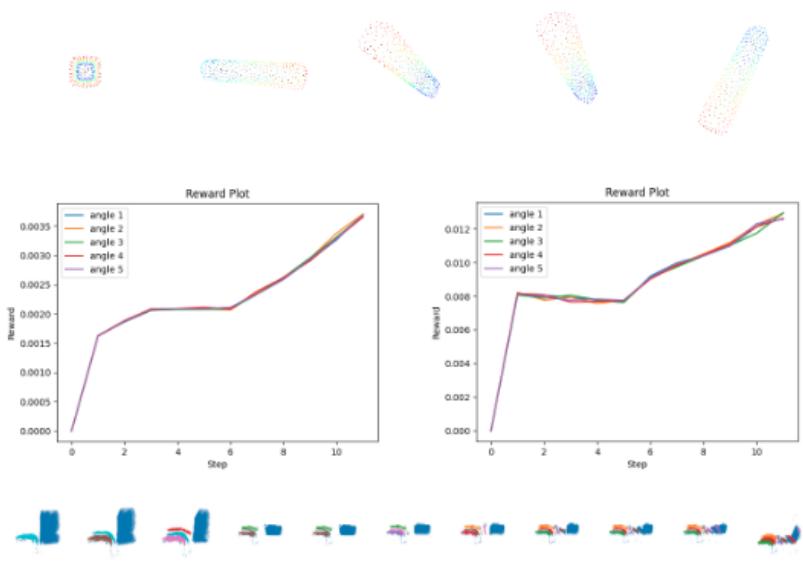
To verify this, the researchers rotated a “stick” fragment into various angles and computed the reward. As seen in the figure below, the reward curves (the colored lines) overlap almost perfectly. The metric knows that a rotated stick is still a stick.
The final reward function converts this spectral distance into a score, penalizing deviations from the target shape:

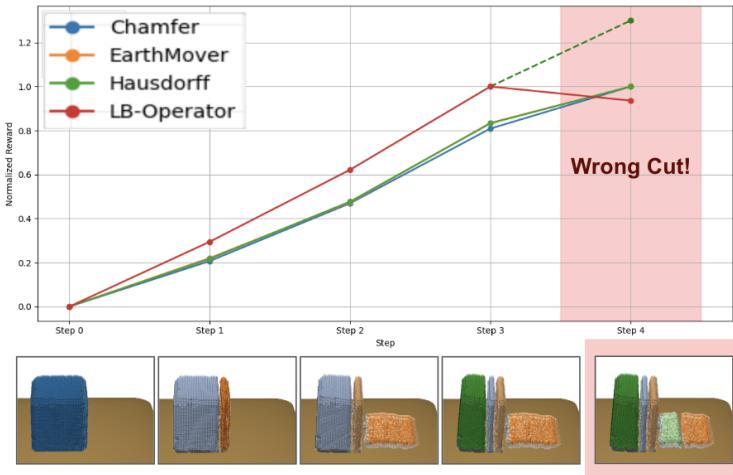
This reward signal is robust. In a test where a robot performs three correct cuts and one wrong cut, standard metrics (Chamfer, Earth Mover’s) failed to identify the error clearly because they were confused by shifting pieces. The Spectral Reward, however, dropped immediately when the shape became incorrect.
Pillar 3: Dynamics-Informed Policy Learning
With a good simulator and a reliable reward, we can now train the robot. The authors use a method called PDDP (Particle-based Score-Entropy Discrete Diffusion Policy).
Dynamics-Informed Perception
First, the robot needs to see. But a raw point cloud is noisy. The authors use a perception module that is “dynamics-informed.” This means the model is pre-trained to predict how the topology will change given an action.
It takes the current graph of particles (\(G_{topo}\)) and the action graph (\(G_{a}\)) and embeds them into latent vectors:

This pre-training ensures that the embeddings fed into the policy heavily emphasize topological structures—critical for deciding where to cut.
Discrete Diffusion Policy
Generative diffusion models (like those used for creating images) are powerful at capturing complex distributions. The authors apply this concept to action selection.
Instead of outputting a single coordinate for the knife, the policy treats the cutting action as a classification problem for every particle: “Should this particle be cut? Yes or No.”
The process works as a Discrete Diffusion model:
- Forward Process: Take the “perfect” cut mask and gradually add noise (randomly flipping bits) until it’s random.
- Reverse Process (Inference): Start with random noise and use a neural network to iteratively “denoise” the mask, conditioned on the current state and the goal.
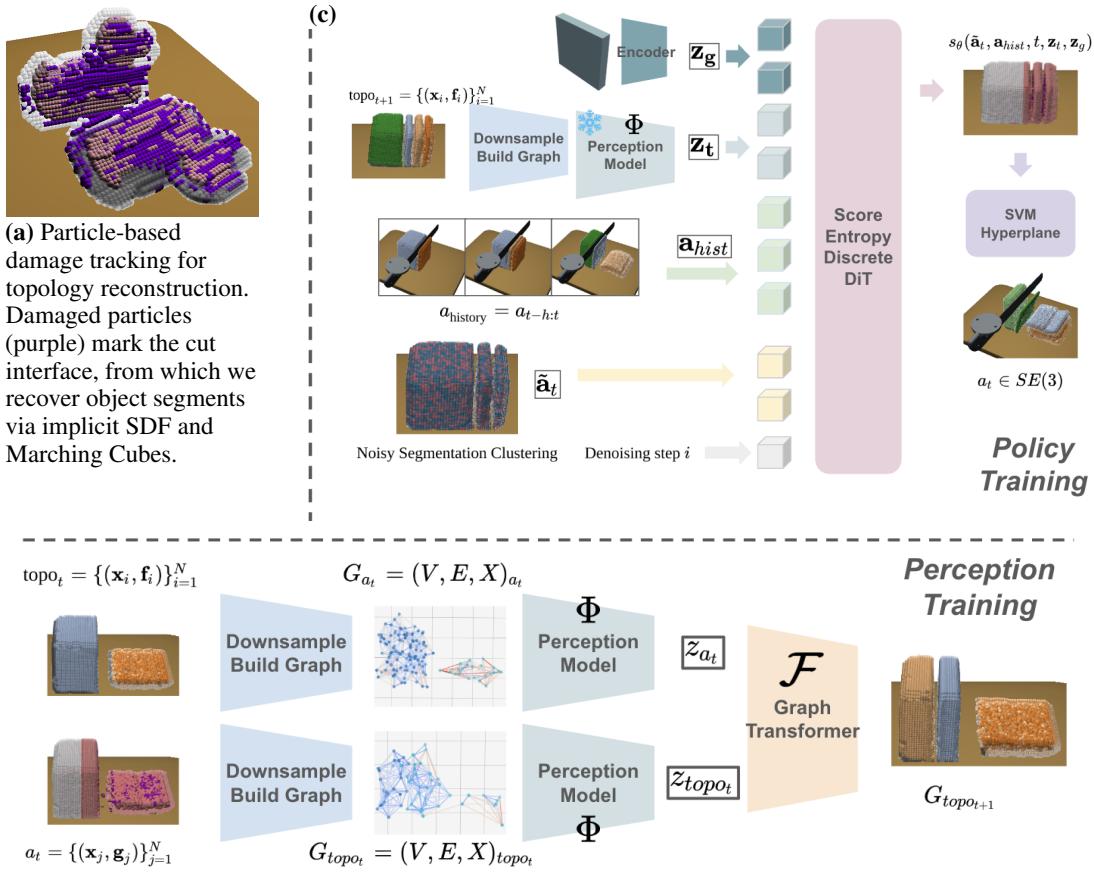
The policy network \(s_\theta\) learns to predict the “score” (gradient of the log-probability), guiding the noisy data back to a valid cut mask:

The training objective is to minimize the difference between the predicted score and the actual noise added:

Once the diffusion process generates a binary mask of “cut” particles, the system fits a cutting plane through those points to determine the exact 6-DoF pose for the knife.
Experiments and Results
The team validated TopoCut on three canonical kitchen tasks: Slice (thin sheets), Stick (french fry shapes), and Dice (cubes).
Performance
They compared PDDP against several baselines, including standard 3D diffusion models (Diffuser Actor, DP3) and heuristics.
The results (Table 1) show that TopoCut’s PDDP significantly outperforms baselines, particularly in Normalized Spectral Reward (\(\hat{R}\)) and the number of successful cuts (\(N_C\)).
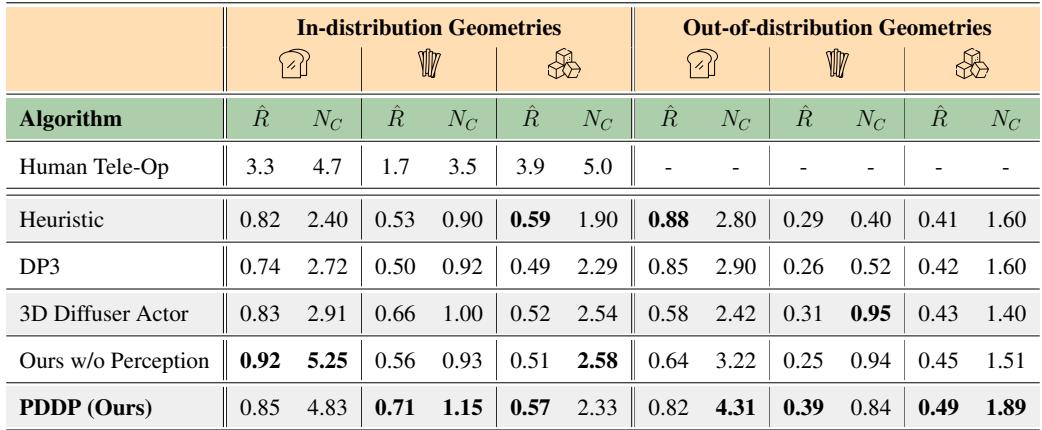
- Human Tele-Op: Set the baseline (normalized to ~3.3-5.0).
- Baselines: Often struggled to generalize or produce consistent shapes.
- PDDP (Ours): Achieved the highest rewards and cut counts, especially on “Out-of-distribution” geometries—shapes the robot had never seen before.
Generalization: The Pyramid Task
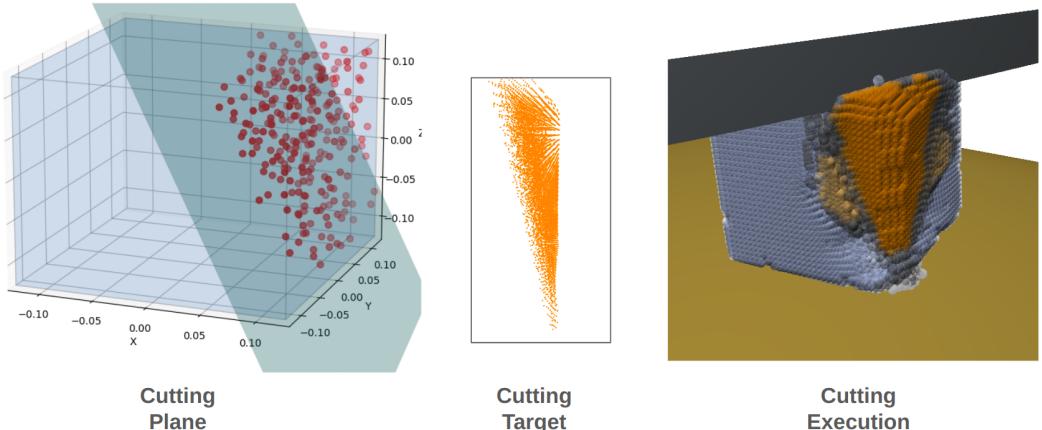
To prove the system isn’t just memorizing straight lines, they tasked the robot with carving a Pyramid out of a cube. This requires angled cuts that are difficult to hard-code.
Driven by the spectral reward (which simply wanted the final shape to “look like” a pyramid), the planner successfully discovered the correct angled cutting plane.
Conclusion
TopoCut represents a significant step forward in deformable object manipulation. By moving away from fixed trajectories and towards goal-conditioned topology changes, it allows robots to perform tasks that require genuine understanding of shape and structure.
The combination of particle-based simulation for handling fractures, spectral geometry for robust evaluation, and discrete diffusion for precise action generation creates a pipeline that is both scientifically rigorous and practically effective.
While currently limited by the speed of simulation (mesh reconstruction is heavy), this framework lays the groundwork for future robots that can work alongside humans in kitchens, hospitals, and workshops, handling soft, changing materials with the same dexterity as rigid tools.