](https://deep-paper.org/en/paper/2509.19958/images/cover.png)
Introduction
Imagine trying to learn how to cook a complex dish. You have two ways to learn. One is to have a master chef stand behind you, physically guiding your hands, correcting every chop of the onion, and adjusting the heat for you. The other way is to simply watch a few YouTube videos of someone else cooking the dish, and then try to replicate the motion yourself.
In the world of robotics, the first method—explicit supervision with “action labels”—is the standard. We collect data by teleoperating robots (puppeteering them), recording exactly which motors moved and by how much. This produces high-quality data, but it is incredibly slow and expensive to collect.
The second method—learning from watching videos—is the “Holy Grail.” The internet is flooded with videos of humans interacting with objects. If a robot could watch a human pour coffee and understand the motion required to do it, we could scale robotic learning exponentially. But there is a massive language barrier: humans don’t have motors, and videos don’t come with joint-angle data.
This is the problem tackled by MotoVLA.
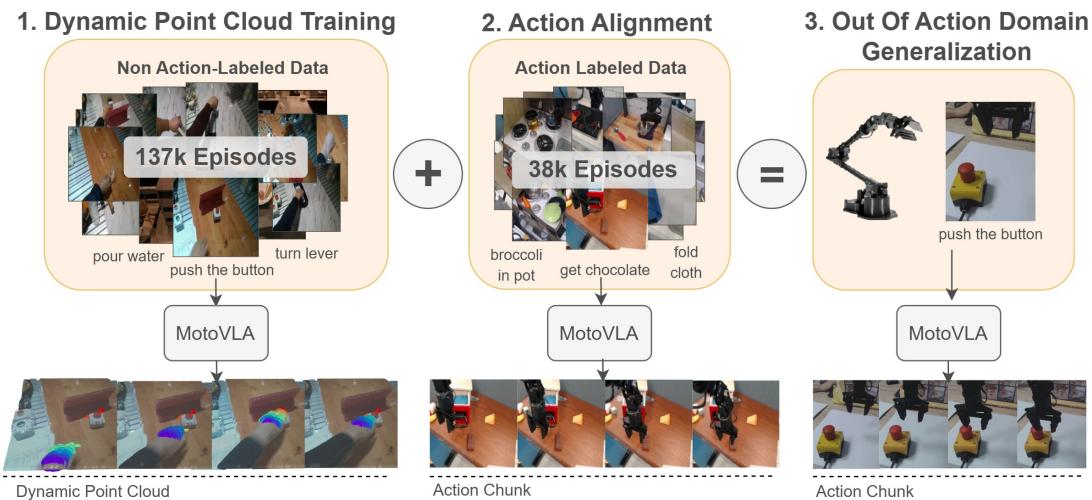
In the paper “Generalist Robot Manipulation beyond Action Labeled Data,” researchers from INSAIT and ETH Zurich propose a novel architecture that allows robots to learn from unlabeled videos—both of other robots and of humans. By bridging the gap between “watching” and “doing,” MotoVLA achieves what they call Out-of-Action Domain Generalization: the ability to perform tasks the robot has never explicitly practiced, simply by having “seen” them in videos.
In this post, we will tear down the MotoVLA architecture, explain the clever use of “Dynamic Point Clouds” as a universal language for motion, and look at how this approach outperforms state-of-the-art models like OpenVLA.
The Background: The Data Bottleneck
To understand why MotoVLA is significant, we need to understand the current bottleneck in Generalist Robot Manipulation.
Modern AI for robotics often relies on VLA (Vision-Language-Action) models. These are massive neural networks, similar to the Large Language Models (LLMs) behind ChatGPT, but with a twist. They take an image (Vision) and a command (Language) as input, and output robot commands (Action).
The recipe for a successful VLA usually involves:
- A Pre-trained VLM: A model that already understands what objects look like (e.g., distinguishing a cup from a spoon).
- Robot Demonstrations: Thousands of hours of teleoperated robot data to teach the VLM how to move.
The problem is the second ingredient. While we have billions of images to train Vision models, “robot demonstration data” is scarce. Worse, existing VLAs struggle to generalize. If you train a robot to pick up a red apple, and then ask it to pick up a green pear (a task it hasn’t practiced), it often fails.
The researchers hypothesize that we don’t need more expensive robot data. We need to unlock the value of unlabeled video.
The Embodiment Gap
Why can’t we just show a robot a video of a human hand and say “do that”? This is known as the Embodiment Gap.
- Visual Difference: A fleshy human hand looks nothing like a metal gripper.
- Kinematic Difference: A human arm has different joints and degrees of freedom than a robotic arm.
- Data Difference: A video is just a grid of pixels. A robot needs 7-dimensional joint vectors (actions).
MotoVLA solves this by introducing an intermediate representation that ignores who is doing the action and focuses on how the action happens: Dynamic Point Clouds.
Core Method: The MotoVLA Architecture
The core philosophy of MotoVLA is that while a human hand and a robot gripper look different, the geometry of their movement when performing a task is similar. If a human pushes a button, their hand moves in a specific trajectory towards the target. If a robot pushes the button, the trajectory is geometrically comparable.
The authors propose a two-stage training process:
- Dynamic Point Cloud Training: Learn “how things move” using massive amounts of unlabeled video (human and robot).
- Action Alignment: Learn “how to move the robot” using a smaller set of labeled robot data.
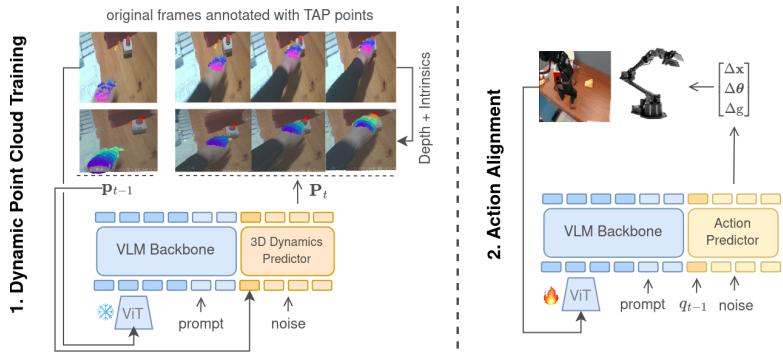
Let’s break these stages down.
Stage 1: Dynamic Point Cloud Training (The Generalist Phase)
In this stage, the goal is to teach the model physics and motion dynamics without worrying about robot motors yet. The researchers use a mix of data:
- Robot Videos (Unlabeled): Videos of robots performing tasks, but stripping away the action labels.
- Human Videos: The RH20T dataset, containing humans performing manipulation tasks.
Generating the Signal
Since these videos don’t have labels, the researchers generate their own supervision. They use a pipeline of computer vision tools to extract Dynamic Point Clouds:
- Detection: Use an object detector (Grounding DINO) to find the hand or gripper.
- Segmentation: Create a mask of the hand/gripper (SAM v2).
- Tracking: Sample points on the hand and track them through time (Boots-TAPIR).
- 3D Lifting: Convert these 2D tracks into 3D space using depth estimation (MoGE).
The result is a sequence of 3D points representing the hand or gripper moving through space. This representation is embodiment-agnostic. A cluster of 3D points moving forward looks roughly the same whether it came from a hand or a gripper.
The Learning Objective
The model is trained to predict the future positions of these points. Mathematically, the model learns a function \(\mathbf{f}_{\theta}^{points}\) that takes the current image \(\mathbf{I}\), the language instruction \(l\), and recent point history \(\mathbf{p}\), and predicts the future point cloud trajectory \(\mathbf{p}_{t:t+c}\):

The Architecture
The backbone of MotoVLA is Paligemma, a 3-billion parameter Vision-Language Model.
- VLM Backbone: Processes the image and text to understand the scene (e.g., “Where is the cup?”).
- 3D Dynamics Predictor: A smaller transformer that takes the VLM’s understanding and the current point cloud, and predicts the future motion using Flow Matching (a generative technique similar to diffusion models).
The loss function basically asks: “Did the model correctly guess where the hand/gripper points would be in the next few frames?”

By the end of Stage 1, the model understands the concept of manipulation. It knows that “pouring water” implies a specific arc of motion, regardless of what limb performs it.
Stage 2: Action Alignment (The Specialist Phase)
Now the model understands motion, but it doesn’t know how to drive the specific motors of the WidowX robot used in the experiments.
In this stage, the researchers introduce a smaller dataset that does have action labels (robot joint commands). They swap out the “3D Dynamics Predictor” head for an “Action Predictor” head.
Because the main VLM backbone has already learned to interpret scenes and predict motion dynamics from the massive video dataset, this second stage is essentially just “calibrating” that knowledge to the robot’s hardware.
The training objective shifts to predicting the robot’s proprioception (joint states) \(\mathbf{q}\):

The architecture is mirrored—it still uses Flow Matching, but now the target is the robot action chunk rather than the point cloud.

This two-stage approach allows MotoVLA to be incredibly data-efficient. It learns the “hard part” (reasoning and motion planning) from abundant video, and the “specific part” (motor control) from scarce robot data.
Experiments & Results
To prove this works, the authors ran extensive experiments both in simulation (SIMPLER) and on a real-world WidowX robot. They compared MotoVLA against strong baselines, including:
- \(\pi_0\) (B): A state-of-the-art flow-matching VLA trained from scratch on robot data.
- OpenVLA: A popular open-source generalist model.
- MotoVLA (R): Their own model, but trained only on robot videos (no human data), to test if human videos actually help.
The experiments were designed to answer a crucial question: Can the robot do things it has never physically practiced?
The “Out-of-Action Domain” Test
This is the most exciting part of the paper. The researchers tested the robot on tasks that were present in the unlabeled human videos (Stage 1) but missing from the labeled robot actions (Stage 2).
For example, the task “Push Button” was seen in human videos, but the robot never practiced it during the action alignment phase.
Quantitative Results
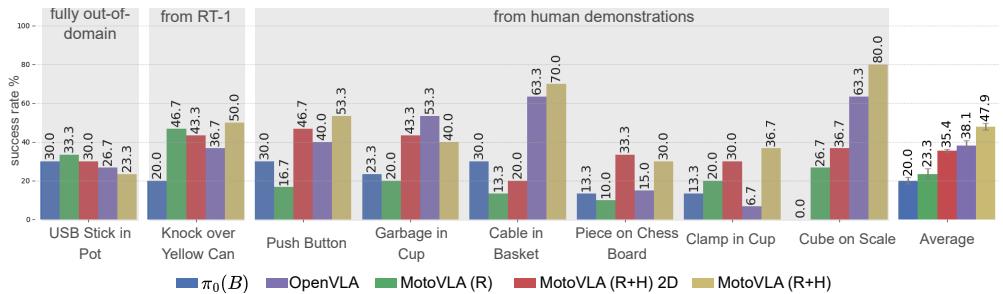
The results were striking. MotoVLA (R+H)—trained with Robot + Human data—consistently outperformed the baselines.
Take a look at Figure 3 below. The yellow bars represent MotoVLA (R+H).
- Look at the “From Human Demonstration” section (middle). In tasks like “Push Button” or “Cable in Basket,” MotoVLA dominates the \(\pi_0\) baseline (blue bar).
- The baseline \(\pi_0\) often fails (0% or low success) because it has never seen these tasks in its training data. MotoVLA succeeds because it “remembers” the motion from the unlabeled human videos.
Qualitative Results: Seeing is Believing
Numbers are great, but in robotics, you want to see the motion. The authors provide “film strips” comparing their model against the baseline.
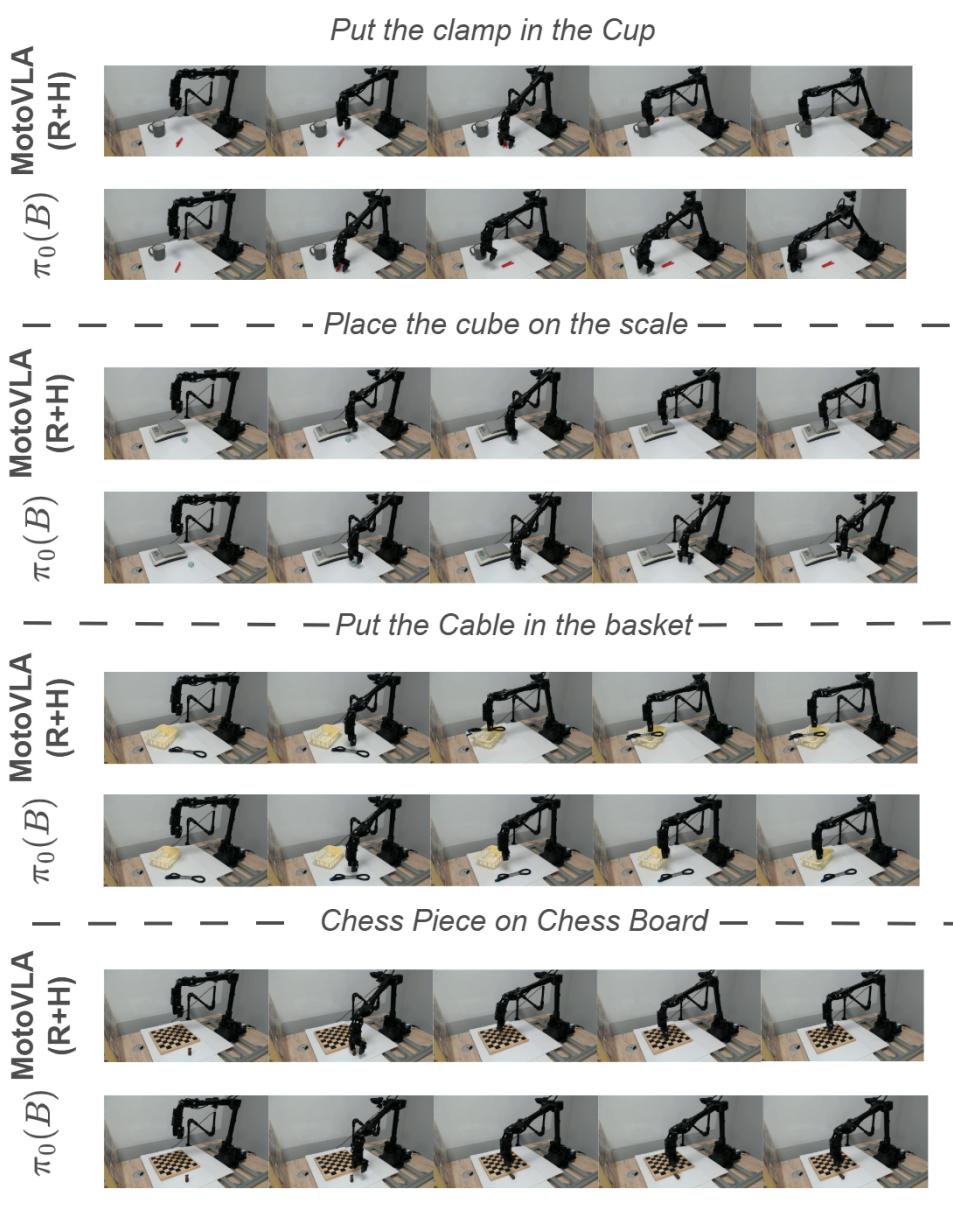
In Figure 8 (below), look at the difference in behavior:
- MotoVLA (Top Rows): The motion is decisive. In “Push the Button,” it moves directly down. In “Put Garbage in Cup,” it accurately grasps the paper.
- Baseline (Bottom Rows): The baseline struggles. In “Push the Button,” it hovers or drifts. It lacks the “prior” knowledge of what pushing a button looks like.
Why 3D Points Matter (Ablation Study)
You might wonder: Why go through the trouble of creating 3D point clouds? Why not just track 2D pixels on the screen?
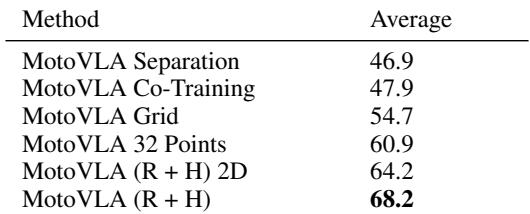
The authors asked this too. They ran an ablation study comparing their 3D method against a version that just predicted 2D tracks (MotoVLA 2D).
The results (shown in Table 2 below) confirm that 3D is superior. The MotoVLA (R+H) model achieved a 68.2% success rate in simulation, compared to 64.2% for the 2D version. On the real robot, the gap was even wider (12.5% drop for 2D).
The reasoning is that 3D point clouds are closer to the “truth” of the physical world. A 2D pixel track changes drastically if the camera angle shifts slightly. A 3D trajectory is more robust and easier for the robot to map to its 3D motor commands.
Conclusion & Implications
The MotoVLA paper presents a compelling step forward for generalist robots. By treating dynamic point clouds as a universal language, the researchers successfully bridged the gap between passive video watching and active robotic control.
Here are the key takeaways for students and practitioners:
- Unlabeled Data is Usable: We are no longer limited by the amount of teleoperated data we can collect. Human videos on the internet contain valuable motion priors that can be extracted.
- Representation Matters: The choice of intermediate representation is critical. Mapping pixels directly to actions is hard. Mapping pixels \(\to\) 3D Points \(\to\) Actions creates a smoother learning curve.
- Generalization is Possible: Robots can learn to perform tasks they haven’t been explicitly programmed for, provided they have seen the concept elsewhere (even if performed by a human).
This work suggests a future where we might “teach” a home robot to fold laundry simply by showing it a YouTube tutorial, rather than spending hours moving its arms around manually. While we aren’t quite there yet, MotoVLA proves that the visual intuition from human videos can directly translate to robotic skill.