](https://deep-paper.org/en/paper/2509.21189/images/cover.png)
Introduction: The “Lost in the Office” Problem
Imagine you are visiting a massive corporate headquarters for the first time. You need to deliver a document to “Jane Doe” in Room 4205. You walk into the lobby. What do you do?
You probably don’t start walking down every single corridor, opening every door, and checking every room sequentially until you find Jane. That would take hours. Instead, you look for a directory. You check overhead signs pointing toward “Rooms 4100-4300.” If you get confused, you stop a passing employee and ask, “Excuse me, do you know where room 4205 is?”
This efficient, context-aware behavior is second nature to humans. Our world is literally built with these “knowledge resources”—signs, logical room numbering, and helpful people—to assist navigation.
However, for traditional robots, this scenario is a nightmare. Most robotic navigation systems operate on geometric maps. They are excellent at avoiding obstacles and building a floor plan (SLAM), but they are often “semantically blind.” They don’t know that a sign with an arrow is a hint. To a standard robot, a sign is just another obstacle to avoid. Consequently, robots often resort to brute-force exploration, wasting massive amounts of time searching dead ends.
In this post, we will deep dive into ReasonNav, a research paper that proposes a solution to this inefficiency. By integrating Vision-Language Models (VLMs) into the navigation stack, the researchers have created a robot that can read signs, reason about room numbering patterns, and even ask humans for directions—drastically reducing the time it takes to find a specific goal in an unseen environment.
Background: Why VLMs Change the Game
Before we dissect the ReasonNav architecture, it is helpful to understand why previous approaches struggled. Traditional robotic navigation relies on “geometric” maps—grids of occupied vs. free space. While recent work has introduced “semantic” maps (labeling objects like “chair” or “table”), these systems rarely possess higher-order reasoning.
Higher-order reasoning in navigation involves connecting disparate pieces of information. For example:
- Perception: Seeing a sign that says “Conference Rooms ->”.
- Context: Knowing my goal is “Room B,” which is a conference room.
- Deduction: Therefore, I should follow the arrow, even if I haven’t seen the room yet.
This type of logic is where Large Language Models (LLMs) and Vision-Language Models (VLMs) shine. VLMs can accept images and text as input and output logical reasoning. The authors of ReasonNav leverage this capability to build a “high-level planner” that sits on top of standard robotic controls.
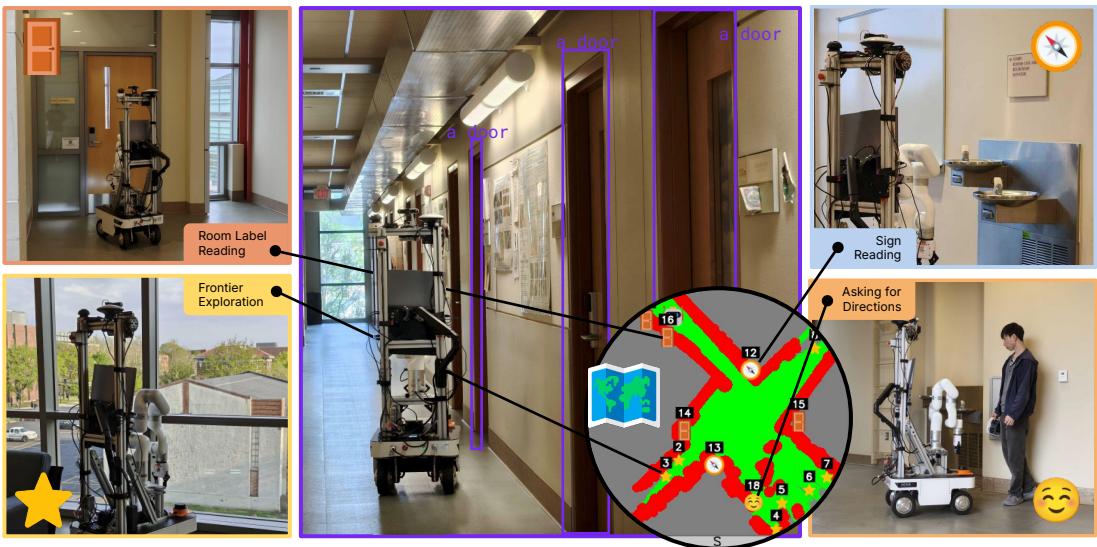
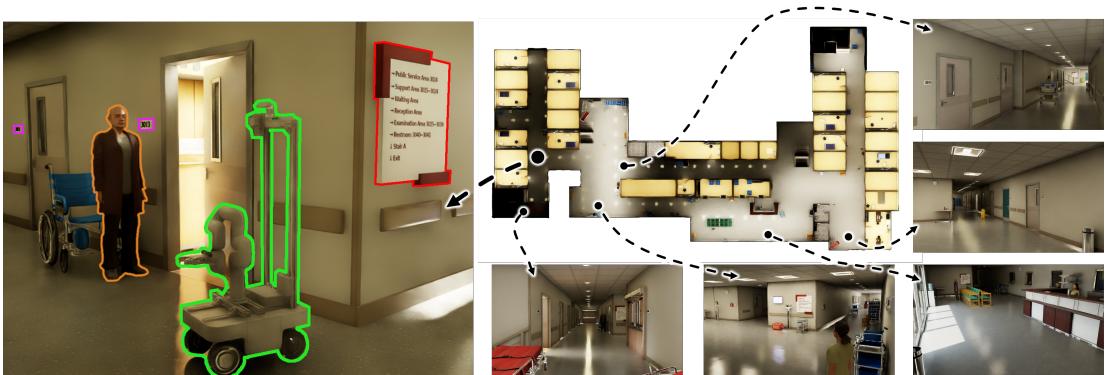
As shown in Figure 1, the goal is to equip robots with the same toolkit humans use: reading room labels, exploring frontiers, interpreting directional signs, and social interaction.
The Core Method: Inside ReasonNav
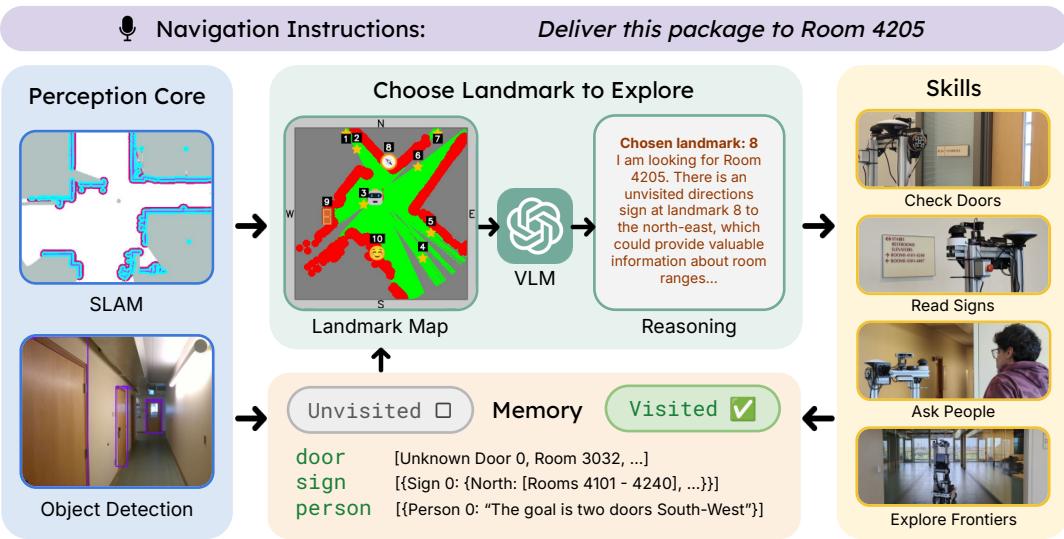
ReasonNav is designed as a modular system split into two distinct streams: a Low-Level Stream for basic robot operations and a High-Level Stream for cognitive reasoning.
1. The Low-Level Stream (The Body)
The low-level stream handles the “mechanics” of moving and seeing. It performs two main jobs:
- SLAM (Simultaneous Localization and Mapping): It builds a 2D occupancy map of the environment so the robot knows where walls and obstacles are.
- Object Detection: Using an open-vocabulary detector (specifically NanoOWL), the robot constantly scans for three specific types of objects: Doors, Signs, and People.
When these objects are detected, they are stored in a Global Memory Bank. This is a database of “Landmarks.” For example, if the robot sees a door, it logs it as a landmark. If it reads a sign, it attaches the text of that sign to the landmark entry.
2. The High-Level Stream (The Brain)
This is where ReasonNav innovates. Instead of feeding raw video footage to the VLM (which is computationally expensive and often confusing for the model), the system creates an abstraction.
The VLM receives two specific inputs:
- A Visual Map: A top-down image of the explored area, with icons representing the landmarks (doors, people, signs).
- A JSON Dictionary: A text list of the landmarks and their attributes (e.g., “Landmark 3: Unvisited Person,” or “Landmark 5: Sign reading ‘Exit’”).
By abstracting the world into landmarks and a simplified map, the VLM can focus purely on logic rather than pixel-peeping. The VLM is prompted to act as a planner: it looks at the map and the list of known items and decides which landmark to visit next.
The Reasoning Engine
How does the VLM decide? It uses the context provided in the prompts. If the robot is looking for “Room 305” and the memory bank says “Landmark 4 is a sign that points North for Rooms 300-310,” the VLM infers that it should select a landmark to the North.
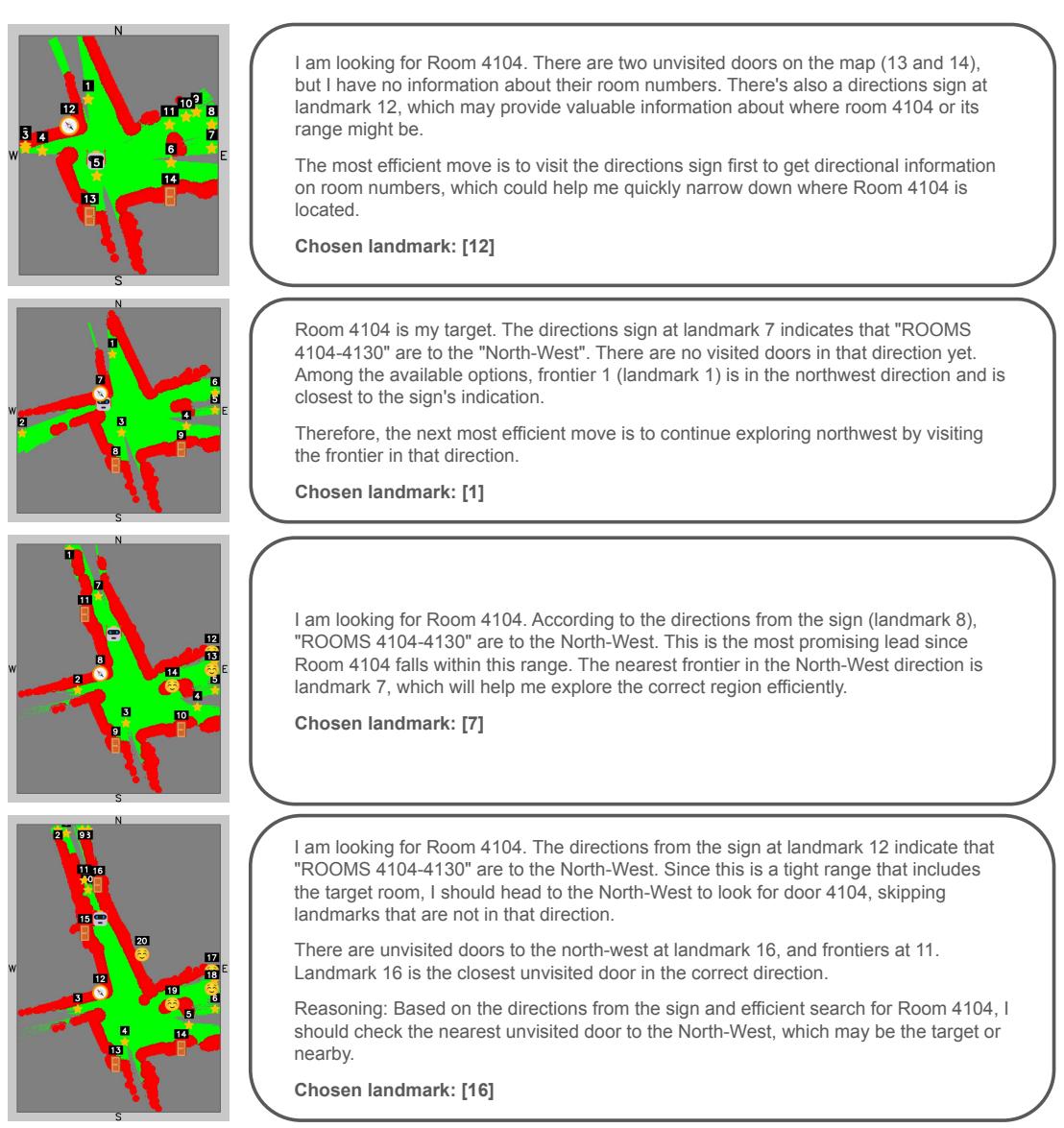
Figure 10 (above) provides a fascinating look into the “internal monologue” of the robot. You can see the VLM analyzing the map and the sign text (“Rooms 4104-4130”) to rule out incorrect paths and select the frontier that aligns with the sign’s guidance.
3. Behavior Primitives (The Skills)
Once the VLM selects a landmark, the robot executes a “Behavior Primitive.” These are pre-coded skills that the robot performs autonomously.
Skill A: Frontier Exploration
If the VLM selects an unexplored area (a “frontier”), the robot simply navigates there to uncover more of the map.
Skill B: Room Label Reading
If the VLM selects a door, the robot approaches it. It pans its camera to find the room number plate. If the number matches the goal, the mission is successful. If not, the number is added to the memory bank (helping the VLM understand number patterns, like ascending/descending order).
Skill C: Sign Reading
When a sign is visited, the robot extracts the text and associates it with cardinal directions (North, South, East, West). This is crucial for global planning.
Skill D: Asking for Directions (Human Interaction)
This is perhaps the most “human-like” feature. If the VLM selects a person, the robot approaches them.
- Text-to-Speech: The robot asks, “Do you know where Room X is?”
- Speech-to-Text: The human responds (e.g., “It’s down the hall to your left”).
- VLM Parsing: The system processes this natural language response and converts it into a “Note to Self” using cardinal directions (e.g., “Goal is to the West”).
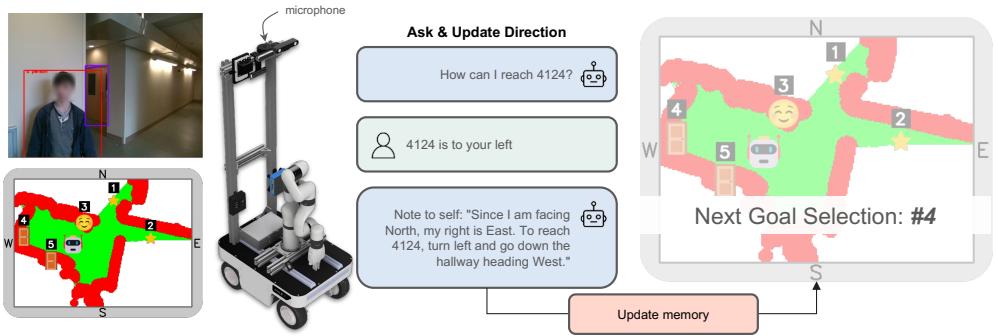
As visualized in Figure 3, this interaction allows the robot to skip exploring unrelated areas (like Frontiers 1 and 2) and head directly toward the area indicated by the human (toward Landmark 4).
Experiments and Results
Evaluating navigation in “human-centric” environments is difficult because standard datasets (like Gibson or Matterport) are static scans—they don’t have interactive humans, and the signs are often unreadable.
To address this, the authors created two testing grounds:
- Real World: Two large university buildings (Complex A and B).
- Simulation: A custom, high-fidelity hospital environment built in Isaac Sim, populated with NPCs (Non-Player Characters) acting as doctors and patients who can answer questions.
Qualitative Success
In real-world tests, ReasonNav demonstrated an impressive ability to chain behaviors.
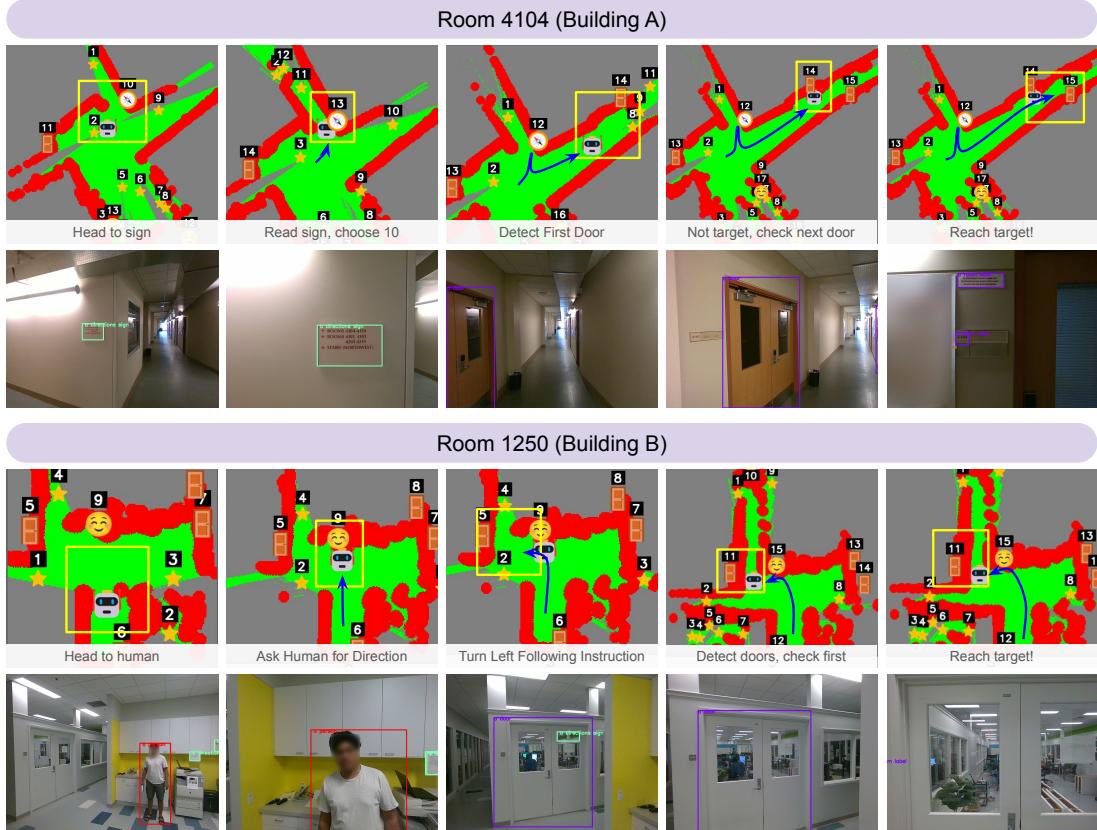
Figure 5 shows two runs. In the top example (“Room 4104”), the robot reads a sign, realizes the room is in a specific wing, and heads there. In the bottom example (“Room 1250”), the robot sees a person, asks for directions, receives a “turn left” instruction, and immediately executes a path to the left to find the room.
Quantitative Comparison: Does it actually work better?
The researchers compared ReasonNav against “ablated” versions of itself to prove that the VLM reasoning was actually doing the heavy lifting.
- Baseline 1: No Signs/People: The robot detects doors and frontiers but ignores signs and humans.
- Baseline 2: No Map Image: The VLM gets the list of landmarks (JSON) but not the visual map image.
The results were striking.
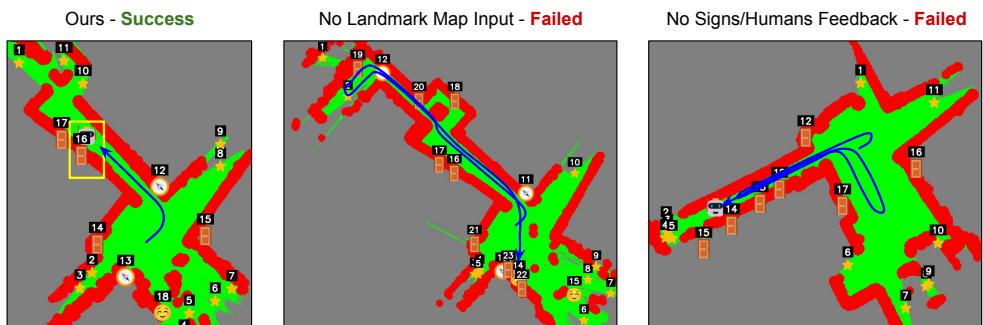
As seen in Figure 6, the “No Signs/People” baseline results in aimless wandering (the red path loops repeatedly). Without the ability to ask for help or read signs, the robot has to guess.
Table 1 below quantifies this difference in the real world:

In “Build B,” ReasonNav achieved a 100% success rate, whereas the baselines failed completely (0%). The “No Signs/People” baseline timed out because the search space was too large to explore blindly. This confirms that higher-order skills are not just “nice to have”—they are critical for navigating large, complex environments efficiently.
Similarly, in the simulation environment (Table 2 below), ReasonNav maintained a significantly higher success rate and lower travel distance compared to the baselines.

Why does it fail?
The system isn’t perfect. The authors conducted a failure analysis (Table 3) and found that Perception is the biggest bottleneck.
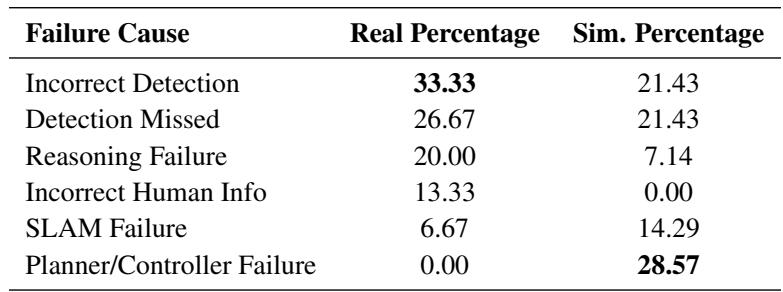
The primary failure modes were “Incorrect Detection” (e.g., mistaking a poster for a sign) or “Detection Missed.” Interestingly, “Reasoning Failure” (the VLM making a bad plan) was relatively low. This suggests that the VLM logic is sound; the robot just needs better eyes.
Conclusion and Implications
ReasonNav represents a significant step toward robots that can operate in the real world alongside humans. By abstracting the environment into semantic landmarks and leveraging the common-sense reasoning of VLMs, the system transforms navigation from a geometry problem into a reasoning problem.
The key takeaways are:
- Context Matters: Reading signs and room numbers allows robots to infer locations rather than exhaustively searching.
- Interaction is Efficient: Asking a human for help is often the optimal path-planning algorithm.
- Abstraction is Key: VLMs perform better when given a simplified “Landmark + Map” view rather than raw data streams.
While current limitations in object detection still pose a challenge, the framework proves that “social” skills like reading and talking are essentially navigation skills. As vision models improve, we can expect future robots to be less like confused tourists and more like seasoned locals.