](https://deep-paper.org/en/paper/2509.23655/images/cover.png)
Introduction: The High Cost of Robotic Vision
In the rapidly evolving landscape of Artificial Intelligence, we have witnessed a massive shift from text-based Large Language Models (LLMs) to multimodal systems. We no longer just want AI to write poetry; we want it to see the world and, more importantly, act upon it. This ambition has given rise to Vision-Language-Action (VLA) models—systems that ingest visual data and language instructions to output robotic control actions.
Ideally, a robot should be able to look at a messy table, hear the command “put the banana in the green bowl,” and execute the task smoothly. Models like OpenVLA have made significant strides in this direction by repurposing massive pre-trained Vision-Language Models (VLMs) for robotic control.
However, there is a catch. These models are computationally expensive.
The standard approach to robotic vision involves treating every part of an image as equally important. A picture of a table is chopped into hundreds of small squares (patches), and the model processes every single square with the same intensity—whether that square contains the target object, the robot’s gripper, or just a blank patch of white wall. This “visual tax” creates a massive bottleneck, requiring immense GPU resources and training time that pushes state-of-the-art research out of reach for many smaller labs and universities.
But what if the robot didn’t have to look at everything? What if, like a human, it could focus only on the objects that matter and its own hand, ignoring the irrelevant background?
This is the core premise of Oat-VLA, a new research paper that introduces Object-Agent-centric Tokenization. By teaching the model to “focus on what matters,” the researchers achieved a drastic reduction in computational cost while actually improving performance. In this post, we will tear down the Oat-VLA architecture, explore how it reduces visual inputs by over 93%, and analyze why this focused approach leads to faster convergence and more robust real-world manipulation.
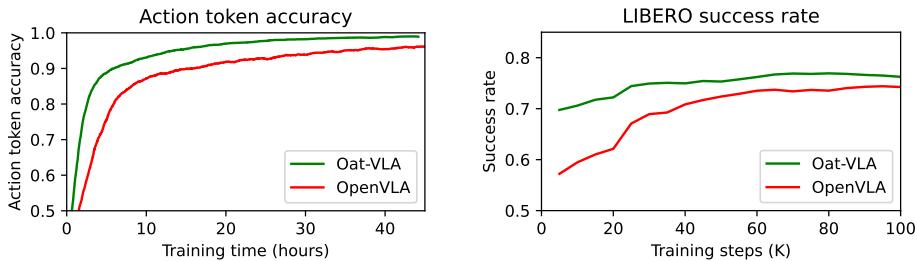
As shown in Figure 1 above, the results are striking: Oat-VLA converges more than twice as fast as the state-of-the-art OpenVLA, proving that in robotic learning, doing less work can sometimes yield better results.
Background: From Pixels to Actions
To understand why Oat-VLA is a significant innovation, we first need to understand the standard architecture of a VLA and where the inefficiencies lie.
The Standard VLA Pipeline
A Vision-Language-Action model generally works by combining two streams of information:
- Vision: An image from the robot’s camera.
- Language: An instruction (e.g., “pick up the cube”).
The goal is to predict an Action (e.g., how the robot arm should move).
In models like OpenVLA, the visual processing is handled by a Visual Encoder (often a Vision Transformer or ViT). The standard method for encoding an image is patching. A \(224 \times 224\) pixel image is divided into a grid of patches, usually \(14 \times 14\) pixels each. This results in \(16 \times 16 = 256\) patches.
Each of these 256 patches is converted into a vector of numbers called a visual token. These 256 tokens are then fed into the massive brain of the Large Language Model (LLM) alongside the text tokens from the user’s instruction.
The Problem with Patches
The issue is that an LLM treats every token as a piece of information to be analyzed. If you feed it 256 visual tokens, it has to process the relationships between all of them.
In a typical robotics scene, perhaps 20 patches cover the object you want to pick up, and another 20 cover the robot’s gripper. The remaining 216 patches might just be the table surface or the background wall. Yet, the model spends computational power processing those background patches just as heavily as the target object. This is inefficient from an information perspective and expensive from a hardware perspective.
Oat-VLA identifies this visual tokenization scheme as the primary bottleneck. The researchers ask a simple question: Can we discard the background and only feed the LLM the “useful” pixels?
The Core Method: Oat-VLA
The solution proposed in this paper is Oat-VLA (Object-Agent-centric Tokenization for VLAs). The philosophy is to move away from a fixed grid of patches and towards a semantic understanding of the scene.
The method replaces the 256 generic patch tokens with two specific types of tokens:
- Object-Centric Tokens: Summarized information about the objects in the scene.
- Agent-Centric Tokens: High-resolution details about the robot’s end-effector (gripper).
By using this approach, Oat-VLA reduces the number of visual tokens from 256 down to just 16. Let’s break down how each component works.
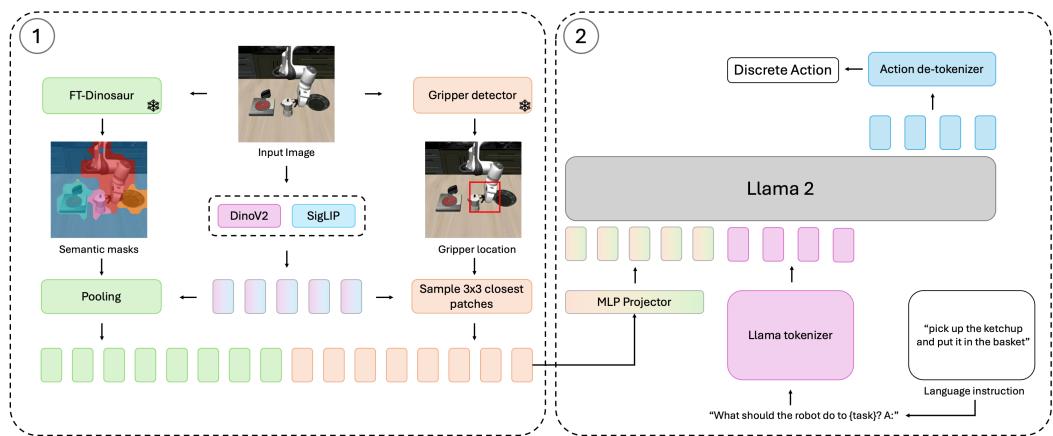
Figure 2 illustrates the complete pipeline. Notice how the image is split into two processing streams before being recombined and sent to the LLM (Llama 2).
1. Object-Centric Tokens: Compressing the “What”
To interact with the world, the robot needs to know what objects are present and where they are. However, it doesn’t need a pixel-perfect reconstruction of the entire table; it needs semantic summaries.
The Masking Process
Oat-VLA employs an external object-centric model (specifically, FT-Dinosaur) to analyze the image. This model performs semantic segmentation—it groups pixels that belong to the same object.
For a given image, the system extracts \(N\) masks (in this paper, they use 7 masks). Each mask corresponds to a distinct object or meaningful region in the scene.
Pooling Visual Tokens
Once the masks are generated, the system looks at the original visual embeddings (from the DinoV2/SigLIP encoders). Instead of keeping all the patch tokens associated with an object (which could be dozens), Oat-VLA compresses them into a single token per object.
They achieve this through a mathematical operation called Pooling.

As defined in the equation above:
- \(\mathbf{v}_k\) represents the visual token for a specific patch.
- \(\mathbf{m}_n^k\) is the mask value indicating if that patch belongs to object \(n\).
- The system averages (pools) all patch tokens belonging to a specific mask to create a single object token \(\mathbf{t}_j\).
The result is a set of just 7 tokens that represent the semantic content of the scene (the “objects”).
2. Agent-Centric Tokens: Preserving the “How”
If the system only used object tokens, it might fail at fine-grained manipulation. Why? Because pooling compresses information. While “average pooling” is great for summarizing a banana, it blurs the high-frequency details necessary to know exactly where the robot’s fingertips are relative to that banana.
Robotic manipulation requires precise spatial awareness of the End Effector (the gripper). To solve this, Oat-VLA introduces Agent-Centric tokens.
Gripper Detection
The system runs a lightweight detector (a ResNet-based Faster R-CNN) to find the precise 2D pixel coordinates of the robot’s gripper in the image. This is a crucial step because relying on robot calibration data is often unreliable or unavailable in diverse datasets.
The Local Grid
Once the gripper’s location is identified, the system extracts a \(3 \times 3\) grid of raw visual patches centered on that point. Unlike the object tokens, these 9 patches are not pooled. They are kept as distinct, high-resolution tokens.
This ensures that the LLM receives uncompressed, high-fidelity visual information exactly where the action is happening—at the fingertips of the robot.
3. The Combined Input
The final visual input to the VLA consists of:
- 7 Object-Centric Tokens (What is in the scene?)
- 9 Agent-Centric Tokens (Where is my hand?)
Total: 16 Visual Tokens.
Compared to the 256 tokens used by OpenVLA, this is a 93.75% reduction. These tokens are concatenated, passed through a projector (a small neural network that translates visual data into the LLM’s language space), and fed into the Llama 2 backbone to predict the robot’s next move.
Experimental Results
The theory is sound: focus on the important parts to save compute. But does throwing away 93% of the visual tokens hurt performance? The researchers put Oat-VLA to the test against OpenVLA using widely recognized benchmarks.
1. Training Efficiency and Speed
One of the most immediate benefits of reducing token count is that you can fit more data into the GPU memory. This allows for a larger batch size during training.
- OpenVLA: Batch size of 32.
- Oat-VLA: Batch size of 64 (on the same hardware).
This efficiency translates directly to training speed. Referring back to Figure 1, we see that Oat-VLA reaches high accuracy significantly faster than OpenVLA. It’s not just about processing speed; the learning itself is more efficient. The researchers argue that by removing the “noise” of background patches, the model can learn the task-relevant features much easier.
2. The LIBERO Benchmark
LIBERO is a standard suite of tasks for evaluating lifelong robot learning. It includes varying challenges, from spatial reasoning (LIBERO-Spatial) to long-horizon tasks (LIBERO-10).
The researchers compared Oat-VLA against OpenVLA using full fine-tuning.

In Figure 3, looking at the green line (Oat-VLA) versus the red line (OpenVLA):
- Faster Convergence: Oat-VLA shoots up to high success rates much earlier in the training process (look at the first 20k steps).
- Higher Ceiling: In difficult tasks like LIBERO-Goal and LIBERO-10, Oat-VLA maintains a consistent lead.
The paper also compares results using LoRA (Low-Rank Adaptation), a popular parameter-efficient fine-tuning method.
![Table 1: LoRA fine-tuning success rate comparison on LIBERO. The numbers for OpenVLA, Octo and Diffusion Policy are taken from OpenVLA [10].](/en/paper/2509.23655/images/005.jpg#center)
As shown in Table 1, Oat-VLA outperforms OpenVLA across every single category, with an average success rate of 78.6% compared to OpenVLA’s 76.5%. This confirms that the token reduction strategy doesn’t lose critical information; it actually helps the model generalize better.
3. Real-World Robustness
Simulation results are great, but robots live in the real world. The team tested the models on a physical xArm 6 robot performing pick-and-place tasks. They tested both In-Distribution tasks (tasks the robot had seen before) and Out-Of-Distribution tasks (new objects or arrangements).
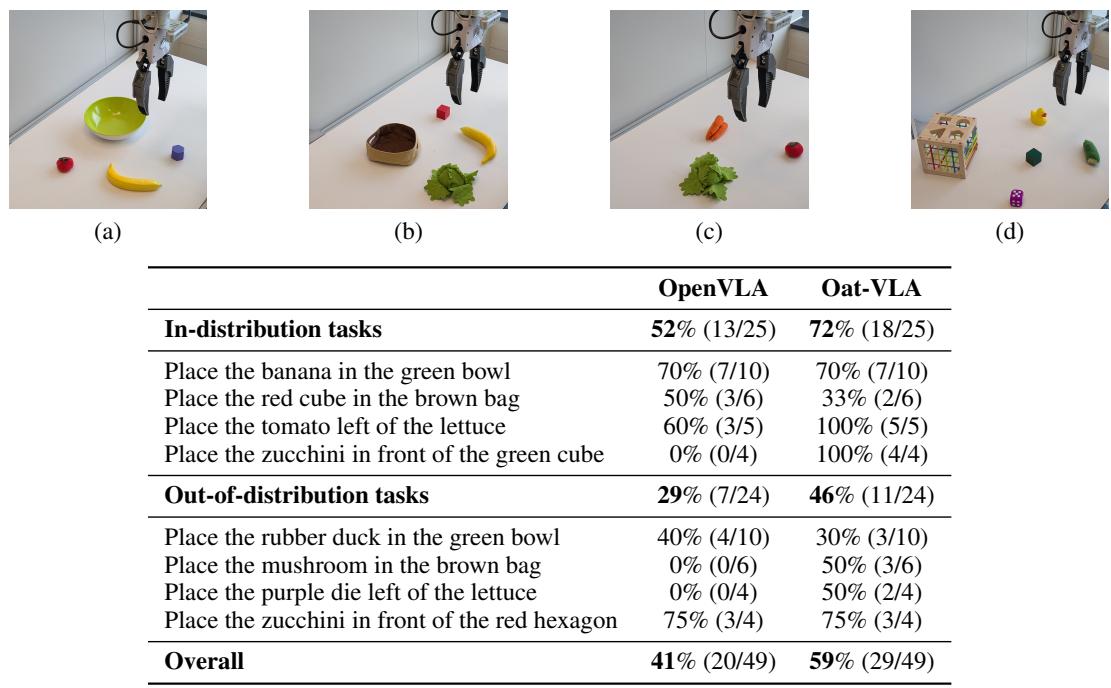
The results in Figure 4 highlight a crucial qualitative difference. Oat-VLA achieved a 59% overall success rate compared to OpenVLA’s 41%.
The researchers noted that OpenVLA often failed in “silly” ways—grasping the air above the object or placing an item slightly to the side of the target. Oat-VLA, likely due to the precise Agent-Centric tokens, was much more accurate in the final approach and grasp. This validates the hypothesis that keeping high-resolution patches around the gripper is essential for fine motor control.
4. Hardware Efficiency
Finally, for students and researchers with limited budgets, the hardware implications are massive. Because Oat-VLA uses so few visual tokens, the memory footprint per sample is much lower.
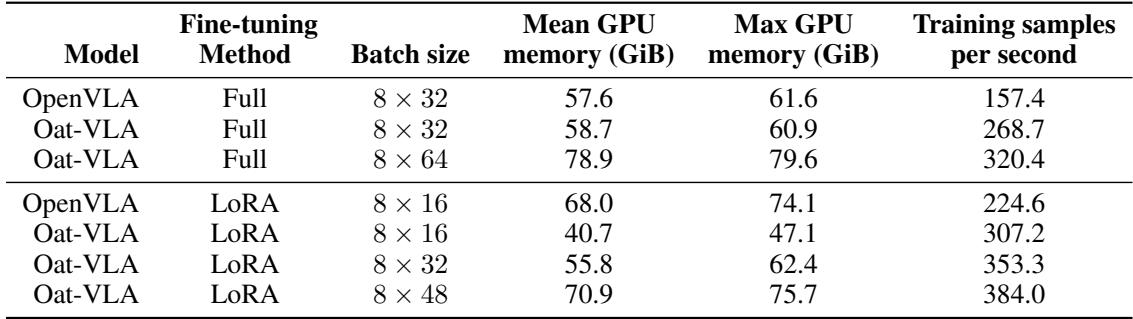
Table 5 shows the throughput comparison. With full fine-tuning, Oat-VLA can process 320 samples per second compared to OpenVLA’s 157. That is effectively a 2x speedup in raw training throughput. This means experiments that used to take a week could now be done in 3 days.
Why Does It Work? (Ablation Studies)
In research, it is vital to ask “Why?” Is it the object tokens? The agent tokens? Or both? The researchers performed ablation studies to isolate these factors.
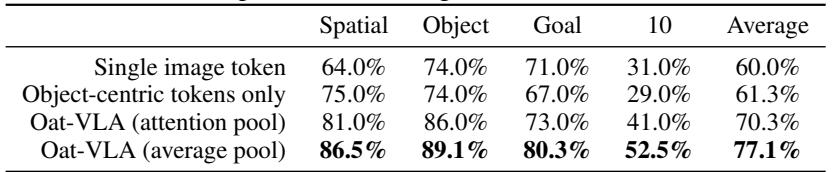
Table 2 provides the answer:
- Single Image Token: If you compress the entire image into one token, performance collapses (60% average). The model loses too much spatial detail.
- Object-Centric Only: If you use object masks but ignore the gripper (no agent tokens), performance is still poor (61.3%). This proves that knowing what is in the scene isn’t enough; you need to see the interaction.
- Oat-VLA (Full): Combining Object summaries with Agent details yields the best result (77.1%).
This confirms the “Object-Agent” duality is necessary. You need the global context of objects (compressed) and the local context of the agent (detailed).
Conclusion and Implications
Oat-VLA presents a compelling argument for the future of robotic learning: Efficiency is not just about speed; it’s about focus.
By applying an inductive bias—telling the model that objects and grippers are important, and the background is not—the researchers managed to:
- Reduce visual tokens by ~94%.
- Double the training speed.
- Improve success rates in both simulation and the real world.
For students and practitioners, this paper highlights an important lesson in architecture design. We often assume that “more data is better” or “end-to-end learning will figure it out.” However, Oat-VLA shows that injecting domain knowledge—specifically, the understanding that manipulation is about objects and agents—can significantly outperform brute-force approaches.
As VLAs continue to scale, techniques like Oat-VLA will be essential to keeping training costs manageable and making advanced robotic policies accessible to a broader scientific community. The visual tax has been lowered, and the robots are learning faster than ever.