](https://deep-paper.org/en/paper/2772_graph_diffusion_for_robus-1672/images/cover.png)
Introduction
In the world of artificial intelligence, getting a single agent to perform a task is difficult. Getting multiple agents to work together—like a swarm of drones fighting a fire or a fleet of autonomous vehicles navigating a busy intersection—is exponentially harder. This is the domain of Multi-Agent Reinforcement Learning (MARL).
While MARL has seen significant success, a major hurdle remains: Offline Learning. In many real-world scenarios, we cannot allow robots to learn by trial and error (which involves crashing and failing). Instead, we must train them on pre-collected datasets. The problem is that offline data is static, but the real world is dynamic. If an agent’s motor degrades, or if a team member suddenly goes offline, policies trained on static data often crumble because they haven’t “seen” these specific coordination failures before.
Recent approaches have tried using Diffusion Models—the same technology behind image generators like DALL-E—to generate agent behaviors. However, most of these methods treat agents as isolated entities, diffusing their trajectories independently. They miss the forest for the trees, ignoring the critical, evolving relationships between agents.
In this post, we dive into a new framework called MCGD (Multi-agent Coordination based on Graph Diffusion). This approach fundamentally changes how we model multi-agent interactions by treating the team as a graph. By learning how to diffuse and denoise the connections between agents (edges) alongside their actions (nodes), MCGD creates policies that are not only effective but incredibly robust to unexpected changes.
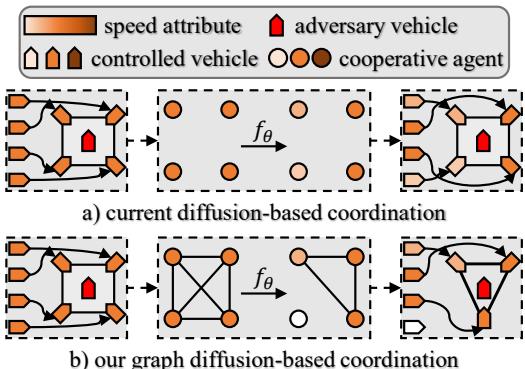
As illustrated in Figure 1, traditional diffusion methods (a) fail when an agent becomes unavailable because they rely on fixed spatial patterns. MCGD (b), by contrast, adapts the coordination graph dynamically, allowing the remaining agents to regroup and succeed.
Background: The Limits of Independence
Before dissecting the new method, we need to understand the building blocks: Offline MARL and Diffusion Models.
Offline MARL and the Coordination Gap
In offline MARL, we aim to learn a policy from a fixed dataset \(\mathcal{D}\) without further interaction with the environment. The main challenge is the distribution shift. When the trained agents encounter a state that isn’t well-represented in the dataset (Out-Of-Distribution or OOD), their performance often collapses. This is particularly acute in multi-agent settings where the joint state space is massive.
Diffusion Models in RL
Denoising Diffusion Probabilistic Models (DDPMs) generate data by reversing a noise process. They start with pure noise and iteratively “denoise” it to recover a structured output. In Reinforcement Learning, this output is usually a sequence of actions or states.
Standard diffusion follows a forward process \(q\) that adds Gaussian noise:

And a reverse process \(p_\theta\) that learns to remove it:

While effective for single agents, applying this independently to multiple agents is flawed. It assumes that Agent A’s best action is independent of Agent B’s, provided the state is known. But in cooperative tasks, the structure of coordination matters just as much as the individual actions.
The Core Method: Graph Diffusion for Coordination
The researchers propose MCGD, a framework that models the multi-agent system as a Coordination Graph. In this graph:
- Nodes represent agents and their continuous attributes (actions).
- Edges represent the discrete relationships or coordination channels between them.
The innovation lies in applying two different types of diffusion simultaneously: Categorical Diffusion for the discrete edges and Anisotropic Diffusion for the continuous nodes.
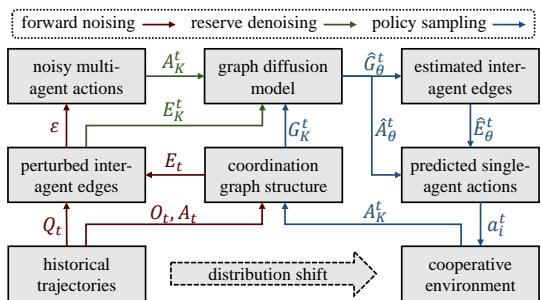
Figure 2 outlines the architecture. It is a cycle involving a forward process that perturbs the data and a reverse process that learns to reconstruct the optimal coordination graph and actions from noise.
1. Constructing the Coordination Graph
Not all agents need to coordinate with everyone else all the time. A fully connected graph is computationally expensive and often unnecessary. The authors construct a sparse k-nearest-neighbor (k-nn) graph based on observation similarity. If two agents see similar things or are in relevant proximity, an edge is formed. This graph \(G_t = (A_t, E_t)\) consists of node attributes \(A_t\) (actions) and edge attributes \(E_t\) (connections).
2. The Forward Noising Process
The forward process perturbs the clean graph \(G_t\) into a noisy graph \(G_K^t\). This is done differently for edges and nodes.
Categorical Noising on Edges
Edges are discrete—they either exist or they don’t (or they exist in a specific category). You cannot simply add Gaussian noise to a binary connection. Instead, the authors use Categorical Diffusion. They define a transition matrix \(Q_t\) that dictates the probability of an edge flipping its category (e.g., from “connected” to “disconnected”).
Crucially, this transition isn’t random. It is guided by a similarity matrix \(C\), derived from how similar the agents’ observations are. The transition matrix is computed as:
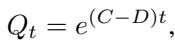
This matrix ensures that the diffusion process respects the underlying structure of the multi-agent interactions. The categorical forward process is defined as:

Anisotropic Noising on Nodes
For the agents’ actions (the nodes), the authors introduce Anisotropic Diffusion. In standard diffusion, noise is added spherically (uniformly in all directions). However, in a team, an agent’s uncertainty is often shaped by its neighbors.
If Agent A is tightly coordinated with Agent B, its action variance should be constrained relative to Agent B. The authors define a noise distribution that is neighbor-dependent. The forward process for a node \(a_i\) depends on its current value and a covariance matrix \(\Sigma_i\) derived from the coordination graph:

By combining these two processes, the framework diffuses the entire graph structure simultaneously:

3. The Reverse Denoising Process
The goal of the training phase is to reverse this noise. The authors employ a Graph Transformer Network. This network takes the noisy graph \(G_K^t\) and attempts to predict the clean edge attributes \(E_t\) and node actions \(A_t\).
The detailed architecture is shown below. Notice how the “Perturbed Edges” and “Neighboring Actions” feed into the learning process, allowing the model to understand the context of the swarm.
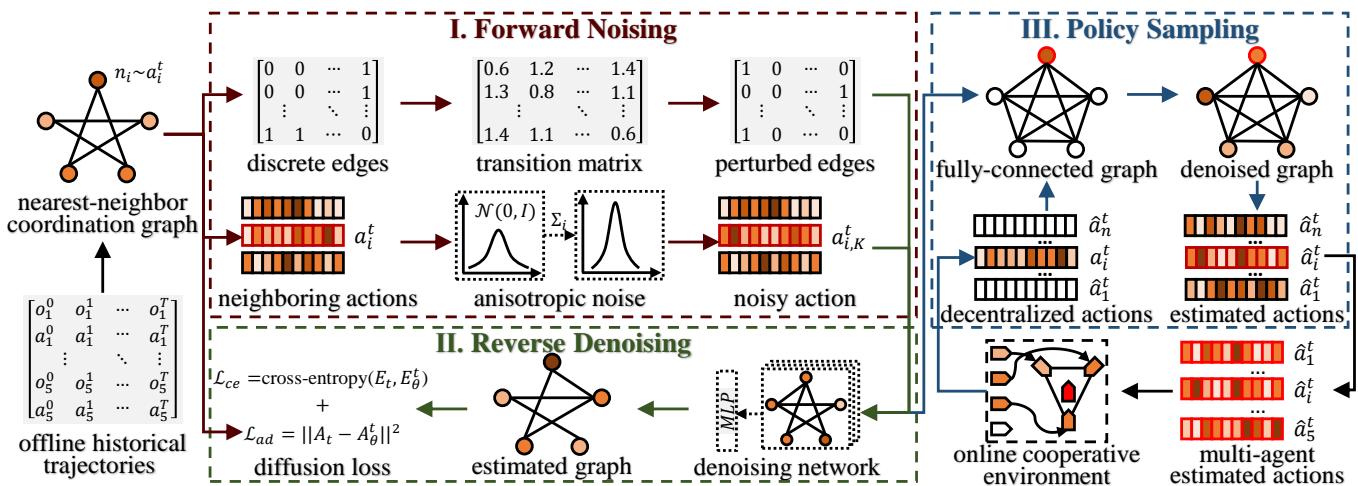
The network is trained using a composite loss function. First, a Cross-Entropy Loss ensures the model correctly predicts the discrete edge structure:

Second, an Anisotropic Diffusion Loss ensures the continuous actions are recovered accurately. This loss also incorporates a Q-value function (from a Critic network) to ensure the generated actions are not just realistic, but optimal for the task:

4. Policy Sampling
Once trained, how does the team act? In the inference (sampling) phase, the process starts with pure noise. The model iteratively refines this noise.
- It predicts the clean graph structure (who should coordinate with whom?).
- It samples the edges for the next step of the reverse chain.
- It uses the refined structure to denoise the agents’ actions.
This results in a decentralized execution strategy where agents dynamically form coordination structures to solve the task.
Experiments & Results
To validate MCGD, the researchers tested it on three standard, challenging benchmarks:
- MPE (Multi-Agent Particle Environments): Tasks like Spread, Tag, and World.
- MAMuJoCo (Multi-Agent MuJoCo): Robotic control where different agents control different joints of a robot (e.g., a 2-agent Ant).
- SMAC (StarCraft Multi-Agent Challenge): Micro-management of units in StarCraft II.
Effectiveness
The method was compared against state-of-the-art baselines, including other diffusion-based methods like MADIFF and DOM2. The results on “Expert” and “Good” datasets were impressive.

As shown in Table 1, MCGD consistently achieves the highest scores (bolded). In high-dimensional control tasks like MAMuJoCo, the performance gap is substantial, indicating that explicitly modeling the graph structure helps agents coordinate complex joint movements much better than independent diffusion.
Robustness: The Real Test
The true power of MCGD appears when the environment breaks. The researchers created “Shifted Environments” where:
- Dynamic Attributes: Agent speeds or motor power were randomly altered.
- Dynamic Coordination: An agent was forced to “disconnect” (speed/power set to zero).
Standard offline policies usually fail here because they overfit to the static training data.

Table 2 reveals that MCGD maintains superior performance even under these harsh conditions. In the “Coordination Structure” shift (where an agent disconnects), MCGD outperforms baselines significantly (up to 14.2% improvement). This proves that the model isn’t just memorizing trajectories; it’s learning how to adapt the team structure on the fly.
Visualizing the Coordination
To understand how the agents adapt, we can look at their trajectories. Figure 4 shows the MPE Spread task (covering landmarks).
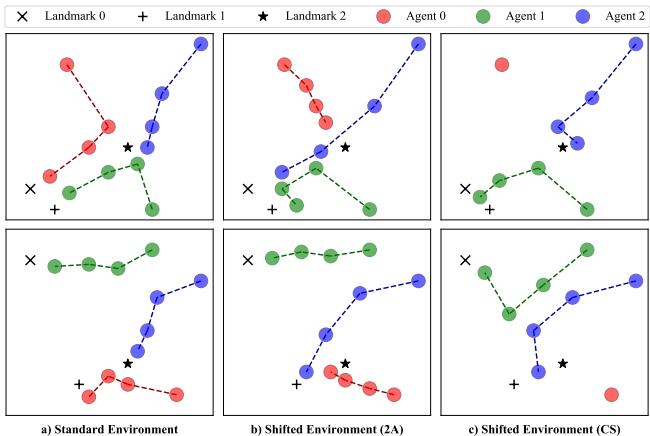
In the standard environment (a), agents move directly to targets. In the shifted environment (c), where the coordination structure changes (likely due to an agent failure), the remaining agents alter their paths significantly to cover the necessary ground, compensating for the loss.
Furthermore, we can visualize the learned graph itself. Figure 5 shows the edges the model decides to create over time.
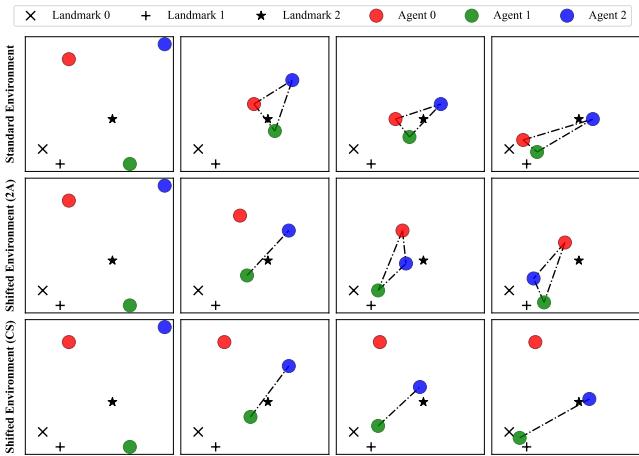
In the top row (Standard), the graph stabilizes quickly. In the bottom row (Shifted), where the coordination structure is dynamic, the model actively modifies the edges (the connections between agents) throughout the episode to maintain optimal coverage. This dynamic re-wiring is unique to the graph diffusion approach.
Ablation Studies
Is all this complexity necessary? The authors performed ablation studies to verify the contributions of Categorical Diffusion (for edges) and Anisotropic Diffusion (for nodes).
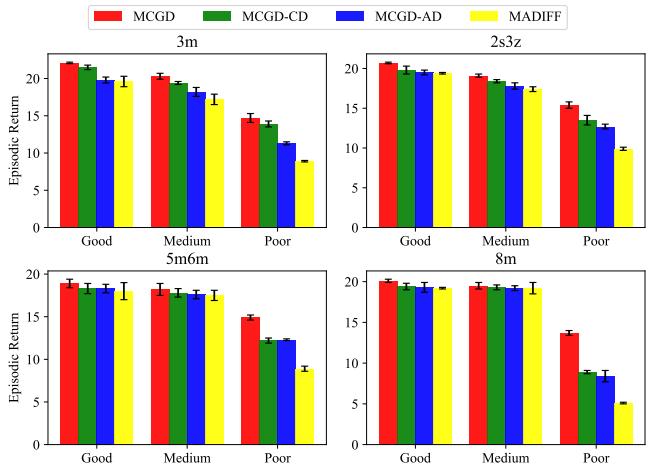
Figure 6 shows the results. The red bars (full MCGD) are consistently higher than the green (removing anisotropic diffusion) or blue (removing categorical diffusion) bars. This confirms that both the structural learning (edges) and the neighbor-aware action generation (nodes) are essential for peak performance.
Conclusion & Implications
The MCGD framework represents a significant step forward in Offline Multi-Agent Reinforcement Learning. By moving away from treating agents as independent entities and instead modeling the system as a graph, the researchers have created policies that are not only more effective but also remarkably robust.
The key takeaways are:
- Structure Matters: explicitly modeling the edges (interactions) between agents allows for better generalization than modeling agents in isolation.
- Hybrid Diffusion: Combining categorical diffusion (for structure) and anisotropic diffusion (for actions) effectively captures the dual nature of multi-agent systems.
- Adaptability: The ability to dynamically “re-wire” the coordination graph allows teams of agents to survive and succeed even when individual components fail or the environment shifts.
This work paves the way for deploying multi-agent systems in the real world, where conditions are rarely as static as they are in a training dataset. Whether it’s search-and-rescue drones adapting to wind and battery failure, or autonomous warehouse robots handling unexpected obstacles, graph diffusion offers a robust path forward.